I was reading a magazine this morning and found a somewhat disappointing article about journalism in films, mourning the lack of romanticism in filmic depictions of the trade. The author mentioned movies that were about magazines rather than news journalism.

Now, I get that there is a great deal of disenchantment over the state of modern day journalism. Believe me, I share much of it. But to say that all journalists are in the thrall of big business, accountants and politicians is like saying that all police officers are corrupt. It’s just not true.

There is still some decent journalism out there, you just have to find it.

HINT: You won’t find it on much of social media. There are ‘journalists’ on there who are not journalists at all but politically motivated shit-stirrers. The lies and propaganda in any casual scroll of platforms outweigh any accurate reporting by a considerable degree.

However, I’m not here to talk about that. I want to look at the rich seam of movies over the years with journalists at their core, none of which were mentioned in the article I read.

You want the romance of journalism? That’s where you’ll find it, not in movies about fashion magazines and rock music.

Let’s talk about the big one first.

ALL THE PRESIDENT’S MEN.
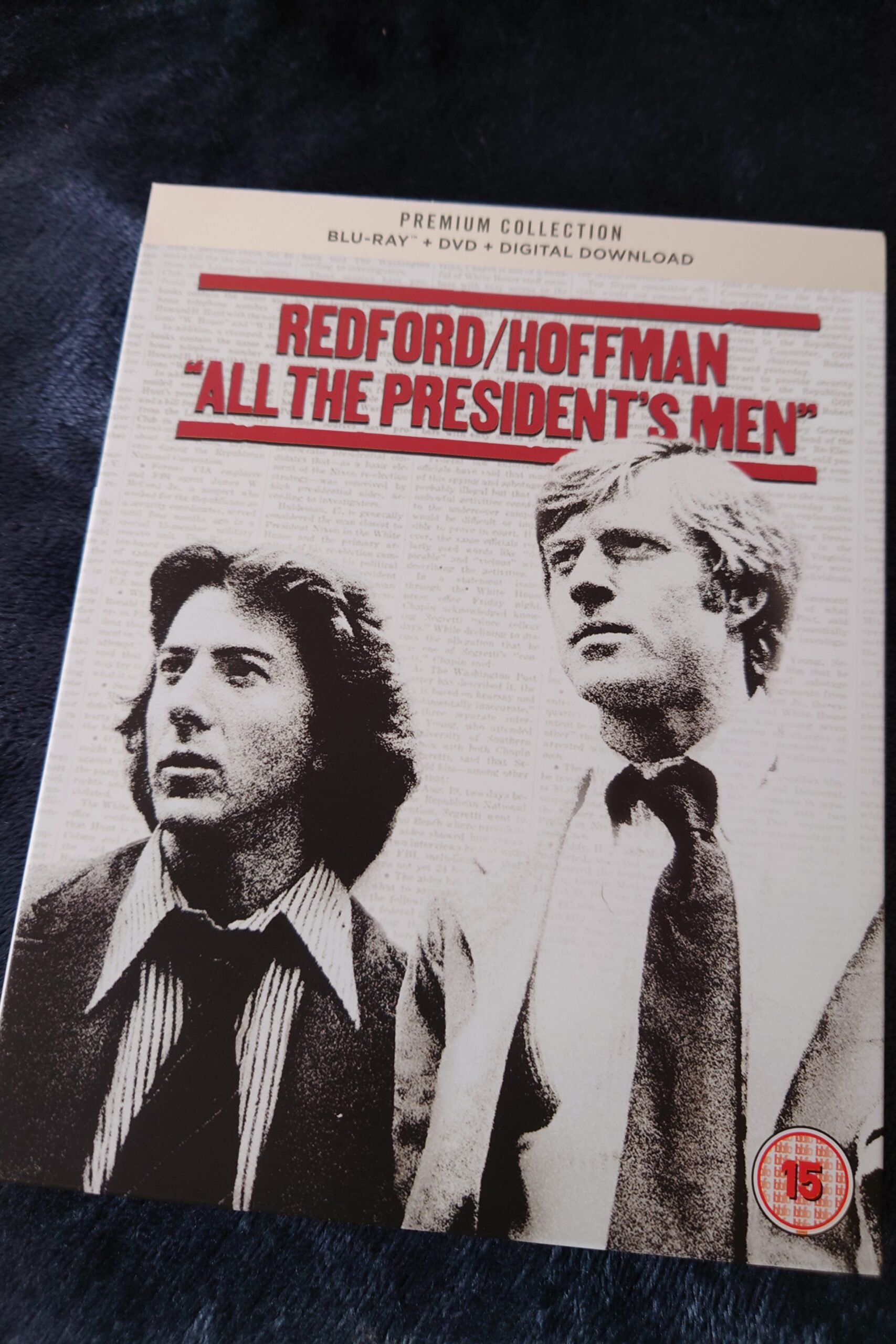
Really, that’s all I need to say. It doesn’t matter whether this 1976 classic was completely accurate or not, or whether the real Bob Woodward and Carl Bernstein were presented on the screen, this is the film that kept me going when I was working on the biggest story I’d ever done. When I was about to give up, certain that I was not up to the task, watching this spurred me on.

Screenwriter William Goldman did a masterful job in distilling the somewhat confusing book (all those names!) into a tight two hours. Sure, it didn’t tell the full story, it couldn’t.

Alan J. Pakula turned it into a thrilling drama that verged on film noir, albeit mostly brightly lit. Redford and Hoffman were superb in the lead roles, Jack Warden, Martin Balsam and the marvellous Jason Robards Jnr providing strong support, as did a host of bit players.

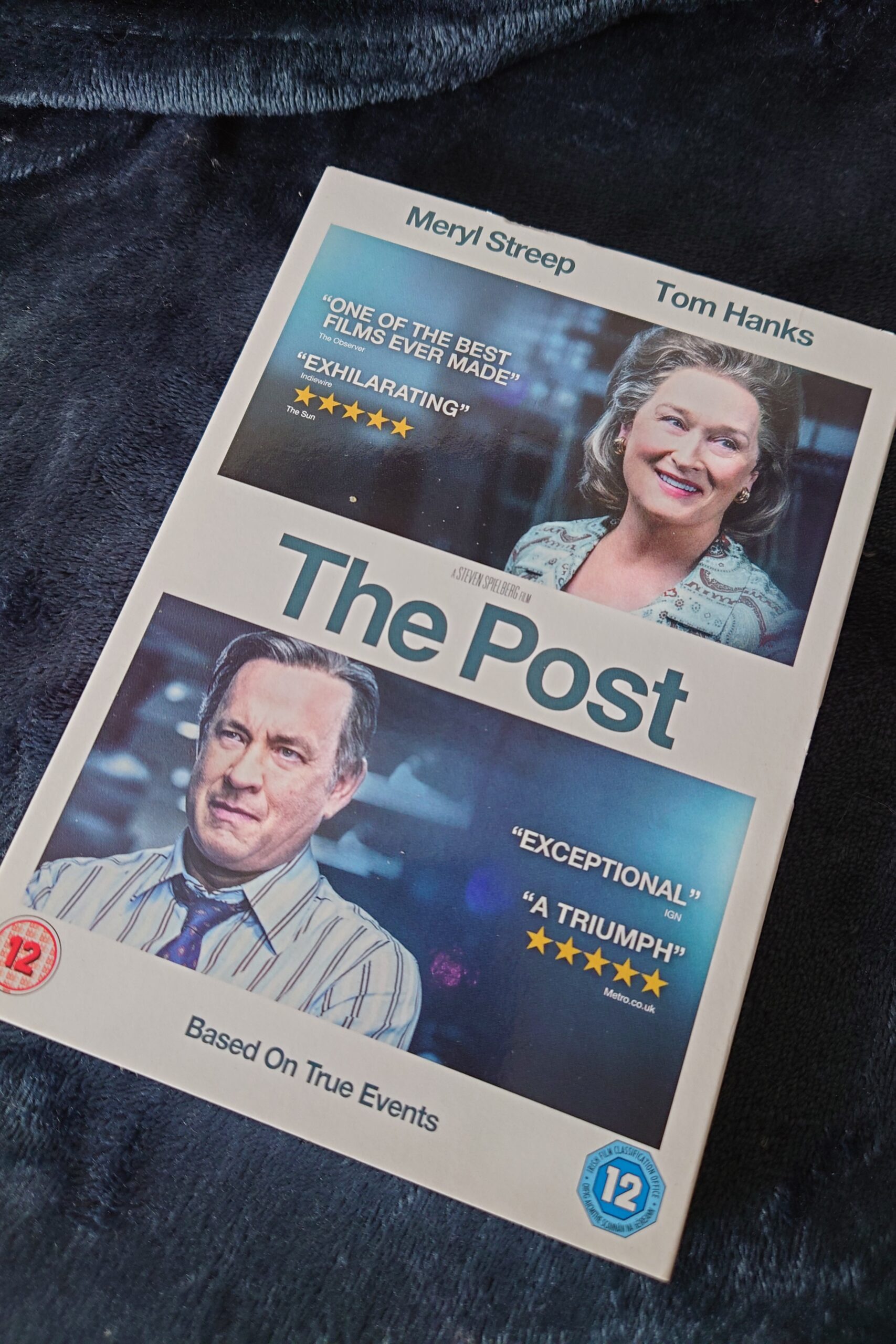
I watched it again recently, right after viewing THE POST (2017), the Steven Spielberg/Tom Hanks/Meryl Streep drama that acts very much as a companion piece, in that it concerns the Washington Post’s attempts to publish the Pentagon Papers, which revealed that the US Government had lied to the public about the extent of its involvement in Vietnam.

A government lying? Imagine that! Must be fiction.

Spielberg’s film doesn’t carry the chilly 70s vibe of President’s Men, but it’s still an engrossing drama, with a fine performance by Streep as the new owner of the paper battling sexism and her own doubts. Hanks is great as Ben Bradlee, the editor, but the shadow of Robards from President’s Men looms large over him.
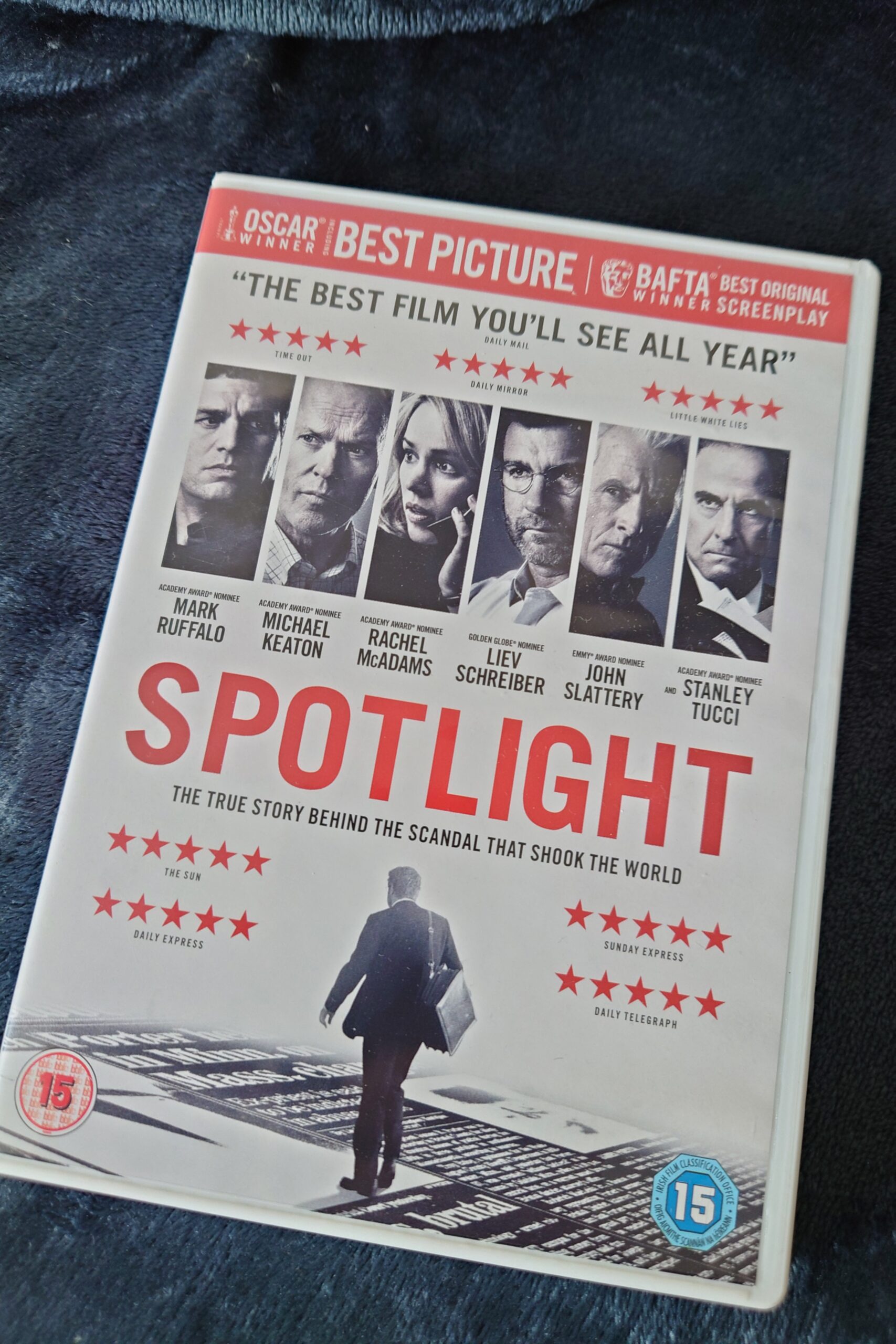
Another, relatively recent, entry in the canon of dedicated journos following the story, no matter what, is SPOTLIGHT (2015).

This true story detailed the work of a team of Boston Globe reporters to reveal the extent of a cover-up of sexual abuse in the city’s Roman Catholic Church.

Mark Ruffalo, always an actor who displayed a fine intelligence (even in super hero nonsense), leads the team, with Michael Keaton as the editor who backed them. It doesn’t turn the reporters into heroes, but showed them as real people, doing their job.

It’s a terrific film, if disturbing, and if you haven’t seen it then seek it out.
It wasn’t Keaton’s first time behind the newsprint. In THE PAPER (1994) he is a city editor battling deadlines and fellow editors as he and his team try to prove that the suspects in a double murder are innocent.

It mixes comedy with drama and boasts a sterling cast that includes Glenn Close, Robert Duvall, Marisa Tomei, with Jason Robards Jnr popping up as the paper’s owner.

Reporters in a race against time to prove someone’s innocence is a common theme in the genre.

In CALL NORTHSIDE 777 (1948), James Stewart is the honourable hack working desperately to prove a man is innocent. Treated in a semi-documentary manner, the story was based on a real-life case.

Despite the title, TRUE CRIME (1999) was not based on real events but rather a book by Andrew Klavan. In it, Clint Eastwood battles his own demons to find out the truth about a man on death row who he believes didn’t commit the crime. Unlike Stewart’s character, Eastwood’s is a reporter on his last legs and this is his final chance to redeem himself.

Ben Hecht was a reporter turned playwright and screenwriter and along with fellow former hack Charles MacArthur, he wrote the Broadway hit THE FRONT PAGE, subsequently filmed in 1931.

It was remade, with an adaptation by Hecht’s friend and sometime collaborator Charles Lederer, as HIS GIRL FRIDAY (1940). The characters talk fast, think fast, so fast that the dialogue and plot I believe would leave modern audiences dazed.

At its heart it’s another race to save an innocent man from the death chamber, but played very much for laughs. At times farcical but never dull, Cary Grant plays the cunning editor, Rosalind Russell the star reporter he wants to keep on the paper. She’s also his ex-wife and he doesn’t want her to marry dull Ralph Bellamy (Director Howard Hawks changed the gender from the original, a decision which adds something extra).

The story was remade in 1974, main character gender returned to its factory setting, by director Billy Wilder and starring Jack Lemmon and Walter Matthau. The storyline popped up again in 1988 as SWITCHING CHANNELS, disastrously ditching the newspaper setting for a TV studio with Burt Reynolds, Kathleen Turner (who apparently didn’t get along) and Christopher Reeve (who later regretted making it).

Are any of these films realistic?

I don’t know and I don’t care. The point is they show us what reporters should be doing, that no matter what they should be seeking out the facts, not rewriting press releases and coming up with clickbait headlines on stories that aren’t stories at all.

That’s the romance of journalism, not necessarily the truth, but certainly not reporting on posh frocks and rock stars.

It’s a cliche that reporters – and journalism whether print or broadcast – should speak truth to power. In an age when we can’t depend on institutions to bring to light abuses of authority, we should depend on the media to do it. They can still do it if they put their minds to it.

GOODNIGHT AND GOOD LUCK (2006) told how TV reporter Edward R. Murrow and his producer, Fred Friendly, fought pressure from the network to expose the lies and character of Red-baiting senator Joseph McCarthy in the 1950s.

David Strathairn brought quiet dignity to his portrayal of the legendary reporter, while George Clooney directed and appeared as Friendly. Robert Downey Jnr, Patricia Clarkson, Frank Langella and Jeff Daniels make telling appearances in lesser roles.

It’s a fine film, shot in black and white, and earlier this year transitioned to Broadway for a limited run, which makes sense as on film, set more or less in the TV studio and its hallways, it has the feel of a stage play.

In THE INSIDER (1999) it’s Al Pacino’s turn to be the dedicated journalist, on TV again, fighting big tobacco corporate power and his own network to reveal the claims of whistleblower Jeffrey Wigand, a marvellous Russell Crowe.

Directed by Michael Mann, the film is based on a true story but like most of the other fact-based films, has been fictionalised. The makers are giving us drama – entertainment, if you will – and facts will be manipulated, even ignored, to bring a truth. Yes, that’s a dangerous route, but as long as the spirit of the piece remains intact, the basic truth, then that’s fine as far as I’m concerned. We know we’re watching drama.

These are not documentaries. Nor are they reality TV – an oxymoron if ever I’ve heard one. As soon as the cameras start to roll, as soon as TV producers rely on so-called reality to stretch to a series, then there will be manipulation. Believe nothing.

So while the reporters in these stories are the way we would wish them to be, remember these are still movies. If you wish to know more about the stories they present, if based on fact, then my advice is go to the source materials, look into the facts behind the drama. Think more, delve more, learn more.

Like on-line sources, not all reporters on film are savoury, though.

In ACE IN THE HOLE (1951), also known as ‘The Big Carnival’, Kirk Douglas did what he did best – playing a complex anti-hero. His reporter milks a story about a man trapped in a cave in order to save his flagging career. That he is a good journalist is clear, that he’s lost his way is also clear.

Many years before he remade ‘The Front Page’, Director Billy Wilder brought his customary cynical zing to the proceedings, his first as co-writer, producer and director, but it failed to hit at the box office, which disappointed him. Of course, it’s now seen as a classic, and rightly so.

I can’t hope to cover every film involving reporters I’ve seen over the years. These are just a few, basically the ones that instantly spring to mind. Some are fact-based, some are completely fictional. They may present an idealised version of reporters, who are just human after all, with all the weaknesses and vices that brings.

And if they don’t present the world as it is, then it presents it as it should be.

If it’s not the way it is, then that’s down to us as well as the commercial and political movers and shakers behind the headlines. The way we consume media. The stories we click on. The newspapers we buy, the channels we watch, the social media accounts we give credence to. The people we vote into power.

Think carefully before committing to any of them.

If only life were as simple as the movies.

A murder that might not have been murder. A family history filled with tragedy. Illicit love, bigamy, incest. And a daring escape from jail. This is the story of Katherine Nairn and Patrick Ogilvy.

(Adapted from a chapter in ‘Dark Heart, the story of the Edinburgh Tolbooth’ by Douglas Skelton. Now out of print)

In the Tolbooth records for 24 June 1765, there is an entry regarding the warding of Katharine Nairn and Patrick Ogilvie who had until then been in custody ‘in Forfar prison and council rooms which were not sufficient.’ They were to be brought to Edinburgh under ‘sure guard’ and placed in the gaol ‘therein to remain until they are liberated in due course of law.’ Appended to the order was a warning that the jailers were ‘to take the utmost care that (they) be kept separate and have no communication with one another.’

The pair had been charged with both murder and incest. Katherine Nairn came from a good family. Her father was Sir Robert Nairn, Baronet of Dunsinnane, and in 1765 she was married off to Thomas Ogilvy, Laird of Eastmiln in Glenisla, Fife. She was a beautiful 19-year-old girl; wilful, high-spirited and able to captivate any man she met. He was the 40-year-old third son of a family already steeped in tragedy. His Jacobite father had marched with Bonnie Prince Charlie but died during an escape attempt from Edinburgh Castle. His depressed eldest brother had taken his own life. Another brother was crushed to death while serving on a Man o’ War. Yet another, although not dead, brought disgrace to the family by marrying beneath him when he took to wife a porter’s daughter. 

Young Katherine’s arrival at the house should have been the beginning of a brighter future for the Ogilvy family. Instead, it brought more death and scandal. Thomas was not a well man, or rather he appeared to enjoy ill-health, but his young and vibrant wife managed, for a time, to bring him out of his hypochondria. He began to dress well, certainly in a manner more fitting to his station in life, and finally, happiness came to live in Eastmiln.

Naturally, it did not last. Thomas had another brother, Patrick, a Lieutenant in the 89th Regiment of Foot, who came home from the East Indies. He was younger, more dashing and, according to the case against them, it was not long before he and Katherine were sharing more than familial affection. Eastmiln was not a large house – the family and servants lived in four rooms – and if such an intrigue was taking place it would not be long before Thomas heard about it. As it was, Anne Clark, a cousin of suspect motive and dubious virtue, had come to stay and she seemed to have been the prime mover in the telling of tales. There was a falling out among brothers after which Patrick left the family home and, within weeks, Thomas was dead. 

Suspicions fell on his young wife and there were stories of poisons being bought by Patrick Ogilvy and delivered to Eastmiln. Matters were further darkened by the arrival of Alexander Ogilvy, the family black sheep who had married poorly. This failed medical student demanded that the funeral be halted because he had a suspicion his brother had been poisoned.

Alexander had led a far from blameless life and had been partnered, professionally and personally, in the past by Ann Clark. It is possible that she planted the poisonous seeds in his mind that Thomas had been done to death by Katherine and her alleged lover. Given Alexander’s own dissolute habits and lifestyle, it is also not unreasonable to suggest that the murder – if murder there was – had been carried out by Ann Clark herself on his direction in order to inherit the estate. 

He insisted that doctors open the corpse to determine if poison had been used. However, although three different medical men scrutinised the body, not one of them conducted a post mortem and based their comments on an exterior examination only. They decided that poison could have been administered but conceded that the symptoms they found could also have their roots in natural causes.

However, Katherine and Patrick Ogilvy were arrested, largely on the testimony of Anne Clark and at the insistence of Alexander. They were accused not only of murder but also incest, for although they were not blood kin, they were related by marriage and the strict laws prohibited any sexual shenanigans among members of the extended family. They were, as we have seen, locked up in Forfar Tolbooth before being transported to the more secure Edinburgh counterpart. Meanwhile, Alexander looted the estate six ways from Sunday, even though he was not yet legally entitled to do so.

The Edinburgh Tolbooth, the town jail

News of the arrival of the young murderess and her soldier lover reached Edinburgh and a vast crowd gathered at Leith to await her arrival. The person who stepped ashore from the ferry was not the demure, penitent lady they expected, even demanded. Instead, she was a beautiful young woman who laughed with her captors and showed no sign of remorse for her deeds. The crowd grew restive and a black mood settled that perhaps they should teach this arrogant wench a lesson in manners. The authorities had to force their way through the ugly mob to lodge the couple in the Tolbooth.

The trial was a farce. The jury was empanelled at 7am on 12 August and, as was the custom then, evidence heard non-stop until 2am on 14 August. The jury wandered about the court room, discussing the case – and no doubt anything else – with witnesses and counsel. As the trial proceeded without a breather, food and drink was necessarily brought in. Three judges sat on the bench on the first day but that whittled down to one, while the other two went off to join the melee in the various parts of the court room. A total of 33 hours was spent listening to the prosecution case but only three to the defence – the judges and jury were simply not interested in hearing what the accused’s lawyers had to say. The accused themselves were prohibited by law from testifying, their words only heard through pre-trial statements.

Much of the damning evidence came from Ann Clark, who had shown great willingness to tell all and sundry that the young couple were guilty but was less than forthcoming to repeat her allegations in court. She had to be taken into custody and kept under lock and key in Edinburgh Castle to ensure her appearance. Unfortunately, she was placed in the same room as servants from Eastmiln who were also due to testify against their erstwhile mistress. There can be little doubt that stories were compared and changed during those hours of enforced captivity. At the close of the trial, the judge, Lord Kames, broke with tradition and summed-up for the jury – the first time this was done in a High Court matter. How fair he was in his summary is open to question, given the prevalent mood in the court. It must come as no surprise that both Katherine Nairn and Patrick Ogilvy were sentenced to death. 

Later, the attitude of the court was criticised in print by an English lawyer, who also lampooned the way the two were charged with two different crimes on the one indictment. Basically, his point was that each of the two charges – one of murder and one of incest – had been used to corroborate the other. 

‘The intrigue was supposed to be certain, because the husband was supposed to have been poisoned; and, on the other hand, the man was believed to have been poisoned, because there was supposed proof of intrigue.’ 

The criticism excited the proud emotions of the Scottish justiciary and the various Scottish publications that had reprinted the article were accused of Contempt (even though the proceedings were done and dusted by that time). The publishers were sharply rebuked but not fined.

The Lieutenant spent his time in his Tolbooth cell perfecting his mastery of the violin. The sad notes he made wafted down the corridors of the Heart of Midlothian and reached the ears of his alleged lover, who had managed a temporary reprieve due to the fact that she was pregnant – by whom is unknown. Ogilvy’s execution was delayed three times as friends tried to have the verdict overturned but to no avail. On 13 November, Patrick Ogilvy was told to lay his fiddle aside for the last time and escorted to the Grassmarket. If he had hoped for a rescue by any of his former messmates, he was to be disappointed for they had been penned up in Edinburgh Castle as a precaution against any such folly. As he stood on the gallows, he continued to proclaim his innocence of the crimes for which he was about to die. As he was turned from the ladder, the rope snapped and he tumbled to the ground. The hangman and a chimney sweep grabbed him and propelled him back up the ladder. A new noose was rigged, this time the drop held and Patrick Ogilvy died. The Society of Tron-Men, the guild of the chimney sweeps, were so incensed at the involvement of their member in this shocking incident that he was drummed from their ranks and banished to Leith for five years.

Katherine Nairn remained in her Tolbooth confinement, enjoying ale, white wine, rum and tea twice a day, until her child, a daughter was born on 27 January 1766. She was visited regularly by members of her family and a well-known midwife named Mrs Sheilds or Shiells. When the child was little more than one month old, the authorities debated on whether her mother was strong enough yet to be put to death. A decision was delayed for seven days. Katherine and her family knew that if something was to be done, it would have to be done soon.

On 15 March, Katherine Nairn vanished, leaving her infant daughter behind. The official version at the time was that she simply walked out of her unlocked cell. Some say she wrapped her slim body in a man’s great coat. 

The most likely method of egress was fulfilled with the connivance of Mrs Shiells, who had continued to visit the new mother. She had feigned a toothache for some time and a large scarf had become something of a fixture over her face. All Katherine had to do was swap clothes with the midwife, swathe the cloth around her face and hobble out of the gaol, apparently receiving a slap on the behind from a turnkey and dismissed as ‘a howling old Jezebel.’

Any legal moves against the midwife when the escape was discovered the following day are not recorded.  It is known she continued in her professional duties, bringing many respected Edinburgh men into the world and hinting to some that there was more to the escape of Katherine Nairn than was generally known. This suggestion that the break-out was ‘winked at’ is underlined by the means with which the fugitive avoided capture.

As has already been stated, she came from a good if not overly wealthy family – hence the need for her marriage to the comfortable but not terribly well-placed Thomas Ogilvy. Her uncle was William Nairn, a respected layer who was at that time Commissary Clerk of Edinburgh and was later promoted to judge when he adopted the title Lord Dunsinnane. Clearly, he was a man not without influence in the Scottish judicial establishment and strings were probably pulled to ease his niece’s departure. 

On leaving the Tolbooth, she was said to have knocked on the door of a house in James’s Court she thought to be that of her father’s lawyer but was in actual fact the home of Lord Alva. The servant who opened the door had supposedly attended the trial (even though it was held in private) and recognised her immediately. He raised the alarm and Katherine, still in her midwife’s garb, scuttled off to the home of her uncle. According to the tale later told, he hid her in a cellar until the furore had passed and it was felt safe enough to smuggle her out of the city in the company of his clerk. 

However, a more likely story is that a coach and horses was waiting for her at the foot of Horse Wynd as soon as she left the Tolbooth. As it sped from the city, she changed into the clothes of an officer, complete with cocked hat, but still caused her companion, James Bremner, some disquiet due to her frivolous manner. Chambers in his Traditions claims that the coachman was ordered to drive the carriage into the sea and drown his passenger if any pursuers managed to catch up with them. 

After that, nothing definite is known of Katherine Nairn, but rumours there are a-plenty. She went to the Continent, they say, and married a French nobleman. She moved to America and died, old and happy, surrounded by her grandchildren. She came through the French Revolution and died in England. She entered a convent in France, or England, and died in regret for her past sins. Her end is as much a mystery as the alleged crime itself, for it cannot be stated with any certainty that Thomas Ogilvy was murdered – although Patrick did buy arsenic in Brechin and sent it, or at least some substance, to Katherine at Eastmiln. But arsenic had other uses then. There is no firm evidence linking them either to murder or incest as most of the damning testimony came from Anne Clark, a woman who, by all accounts, had little more than a nodding acquaintance with the truth. 

The baby daughter born in the Tolbooth died there two months later. They say she was ‘overlaid’, that is smothered, but no-one knows by whom. Mrs Shiells continued to practice her arts until 1805. Anne Clark vanished from history but her proclivities were unlikely to have kept her out of trouble. Alexander Ogilvy, the rascally brother who may or may not have conspired with her either in murder or at least in manoeuvring events to his own ends, failed to profit from his brother’s death. Although he had sold off parts of the estate before Patrick was executed, he was prevented from doing further harm by a court order raised on behalf of her unborn child by Katherine Nairn. On 11 March, 1766, he found himself in the Tolbooth at the same time as his sister-in-law but his crime was one of bigamy. He was legally married to the porter’s daughter, Ann Rattray, but had ‘taken up with one Margaret Don (or Dow), late a milliner’s apprentice and has procured himself to be married to (her) on the twenty-fourth day of February last.’ He pled guilty to the charge and was banished from Scotland for seven years. He was given two months to put his affairs in order and it was during that time that he leaned too far out of a window in one of Edinburgh’s tall tenements and plunged to his death. It is tempting to imagine the shadow of Anne Clark behind him in the room, assisting him in his flight.

They called them bodysnatchers but they weren’t. They were murderers. And they didn’t work alone.

SCOTLAND is only a small country but it has many cases of foul murder that continue to excite the imagination and send gallons of printers ink flowing like blood across acres of paper.

The story of Madeleine Smith is one of ever-lasting mystery.

The trial of Oscar Slater, wrongly convicted of murder in Glasgow, is one of ever-lasting shame.

Peter Manuel is perhaps the most terrifying for not only did he target young girls walking alone but also crept into the homes of innocent people and slaughtered all he found.

Shadowy Bible John, who may have killed at least three women, still haunts the minds of Glaswegians.

But of all the oft-repeated tales of murder, both single and mass, one notorious case resounds through the decades and echoes around the world. It is the first properly documented case of multiple murder in the country and simply naming the two men involved conjures images of a dark and noisome city, of conspiracy and cover-up, of deprivation and decay and death.

Burke.

Hare.

They have been called bodysnatchers and resurrectionists but they were not. The moonlight trade of graverobbing was not for them. They found an easier way to provide their favoured anatomist Robert Knox with study tools and at the same time line their own pockets. Murder was their business and business was brisk. Their death tally has been placed as high as thirty but the most commonly accepted figure is 16, all committed in a period of a few months. 

They did not work alone, however. What is often sidelined in popular retellings of the tale is that there were two other persons involved. They were with the men during the killing time and although they may not have been involved in the actual murders they did benefit from them.  

Helen McDougall and Maggie Laird were, respectively, the wives – if only by bad habit and ill repute – of Burke and Hare.

And they were up to their necks in those dark deeds of 1828 Edinburgh.

OF the principal dancers in the ballet of death that was to follow, only Helen McDougall was a Scot, born in Redding near Falkirk. She had once been an attractive woman but the life of a poor woman in early 19th century Scotland had taken its toll on her features, although when news of the mass murder hit the newspapers she was described as still being ‘tolerably good-looking.’ She took her surname from a man with whom she had once lived and was already the mother of two when she turned to prostitution. What happened to the two children is unknown. Perhaps they stayed with their natural father, or perhaps they were sent out for adoption, or died. Life was hard on adults in those days; it was brutal on the young.

Around 1818/1819 the countryside around Falkirk was filled with Irishmen who had come to Scotland to eke a hard living out of digging the Union Canal, which was to link the Forth and Clyde waterway with Edinburgh in the East. It was backbreaking work but the men, the famed Irish navvies, had fled the dire poverty of their homeland in search of employment. They were hard workers and, more importantly for the employers, they were cheap. This of course did not endear them to the native workforce who often saw them as sub-human.

Human nature and the sex drive being what it is, where there were large bodies of men there were the bodies of women ready to see to their needs – for a price. Helen McDougall was one such woman and it was during this time she met young Irishman William Burke. He had departed his Country Tyrone home, leaving behind his wife and two children, in order to seek his fortune but all he found was the sweat and strain of working in the ditches. 

Helen McDougall must have been attracted to the squat little Irishman with the piercing dark eyes and the love of dancing for he first became a client, then a regular, then, finally, her one and only. Despite his tendency to slap her around, there appeared to be some genuine feeling between the two, for even while he was languishing in the condemned cell in Edinburgh, Burke sought to excuse her from their crimes. 

After four years of working on the canal, the pair dodged around central Scotland and, by 1827, found themselves in Edinburgh, repairing and dealing in second hand boots and shoes. One day in the street they met  an Irish woman called Maggie Laird, who was known to Burke. 

The two had become three.

One contemporary chronicler deliciously described Laird as ‘a poor, miserable, boney, skinny, scranky, wizened jade.’ Clearly she was not as attractive as Nelly McDougall but was just as free with her favours, although unlike Nell she did not take it up professionally. Maggie was a tough customer and had laboured on the canal herself, wielding a pick and shovel, digging out the hard Scottish earth with the best of them. 

Once she set aside her spade, she took up with a man called Logue who ran a down-at-heel lodging house in Tanner’s Close in the area off the Grassmarket known as the West Port. Lodging house is a grand name for what Logue – and many others like him – provided in the filthy, stinking old town. Basically he charged for a leaking roof and a bed of dirty straw that could be shared by up to three people and all the lice they could kill. If patrons did not like what was offered they could move on and God damn their eyes, for there was seldom a shortage of people looking for somewhere to lay their head for a few pence a night. The ragged and the filthy, the poor and the desperate, the honest and the crooked – they were all flooding into the nation’s cities in search of a new life or work or simply a place to hide. 

By the time Laird met up with Burke and McDougall in the street, Logue had died and she had a new squeeze – a man named William Hare.

Hare had also come over from Ireland to graft on the Union Canal and, like the man who was soon to become his partner in crime, gravitated towards Edinburgh where he found labouring work and a bed in Logue’s house. It was here that he first met Maggie Laird, although it is possible he had known her, like Burke, while working on the canal. The two took a fancy to each other and Hare was soon giving her something more than thruppence a night. They were a well-matched pair, for she was no prize and he was far from the answer to a maiden’s prayer – even though Maggie had not been a maiden for many a long year. One contemporary description states the lanky Hare had ‘dull, blackish, dead eyes’ and a ‘coarse-lipped mouth’ which, mixed with his high cheekbones and sunken cheeks, inspired ‘disgust and abhorrence, so utterly loathsome was the whole look of the reptile.’ 

Naturally, Logue took a dim view of the liaison between his woman and the newcomer so sent Hare packing. But after he died Hare was back under the roof and in Maggie Laird’s bed. He, like Burke, was a bit too free with his fists when it came to women and it is said that Maggie Laird was often seen sporting a pair of black eyes. 

And so, during the street conversation and subsequent visit to a tavern, Burke told Laird he and Helen planned leaving Edinburgh for the west, where Burke hoped to set up business as a cobbler. Laird suggested they lodge in Tanner’s Court for a while. There was a room available, she said, and perhaps Burke could try his luck in Edinburgh. There they met William Hare, now styling himself landlord.

And the three became four.

Burke and Hare, both Irishmen, both former navvies, seemed to bond immediately. They made an incongruous pair – Hare was tall and cadaverous, the archetypal ghoul; Burke was short and thick-set with an air of respectability. The women were another matter, for Maggie Laird never fully trusted Helen McDougall. Perhaps it was a racial thing, for Helen was Scottish and many Irish people, particularly Irish Catholics, had first hand experience of prejudice at the hands of the natives, the flame lit by John Knox still burning bright. Perhaps Maggie did not like the idea of having a former prostitute under her roof. Perhaps she had an eye for Burke herself, for it would appear he was the better-looking of the two men – but then, compared to Hare, Quasimodo was a matinee idol.

Business boomed in the lodging house for every day there seemed to be a new influx of transients flooding the city. They joined the thousands living in the tall tenements that clustered round the castle like ticks on a stray dog. They filled the many taverns and drinking dens that lined the roads and alleys.  They clogged the streets, wading through the sewage that ran openly in the gutters and dodging the fresh filth tossed from the windows above. Death and disease walked hand in hand here and often stepped into the overcrowded lodging houses. 

It was sickness that would give the new friends their first item of merchandise for butcher Knox.

Extracted from a chapter in ‘Deadlier Than the Male’, by Douglas Skelton, published 2003 by B&W)

(Click here for part two)

Controversy has dogged Scotland’s Not Proven verdict for decades. Douglas Skelton looks at the history of the ‘Bastard Verdict’

HERE’S a wee legal riddle: When can a man be cleared of murder without a verdict of Not Guilty?

Answer: When the charge is Not Proven.

If you are scratching your head and furrowing your brow, then you clearly are not acquainted with Scotland’s unique three verdict system. Don’t feel too badly – many legal minds find it a puzzle, too.

Sir Walter Scott called it the ‘Caledonian medium quid’.

Thankfully, he let those with no classical education off the hook with the more tabloid-friendly label ‘that bastard verdict.’

It is true that the third verdict does seem mired in the no man’s land between guilt and innocence, even if it does let the accused off Scot Free, as it were. 

William Roughead, that doughty old commentator on all things Scots Law, maintained its message was, ‘Not Guilty, but don’t do it again.’

Judge Gerald Sparrow, author and barrister, compared the systems on both sides of Hadrian’s Wall thus, ‘I have often thought that the distinction typifies the different spirit of Scottish and English law: the Scottish being more logical, the English more sporting….’

And there, as they say, is the rub. 

For a Not Proven verdict is logical in a curiously illogical way. As Lord Justice General Clyde said in 1964, ‘It gives a jury, who have some lingering doubts as to the guilt of an accused and who are certainly on the evidence not prepared to say that he is innocent, the chance to find the charge against him not proven.’

However, if the jury has any lingering doubts, are they not duty-bound to acquit? Yes, but in Scotland, where someone can go down on a simple majority of 8-7 (it being a job for 15 good men and women true) the third verdict is seen as a further safeguard against miscarriages of justice.

And Scotland has in the past been notoriously unwilling to recognise mis-steps in law.

That comes as little solace to the families of murder victims, who watch a person they have been told has robbed them of their loved one walk free, not because the jury thought him innocent but because they could not reach the firm conclusion that he was guilty.

The three verdict system came into being almost by accident.

In days of yore, verdicts under Scots Law were ‘convickt and ‘cleansit’.  

When Oliver Cromwell’s armies emerged victorious against the Royalists (the Civil War also having raged north of the border) he brought judges up from down south and they insisted that ‘Guilty’ and ‘Not Guilty’ verdicts be imposed.

When the Restoration came, courts began to use the terms ‘Proven’ and ‘Not Proven’, guilt or innocence being an irrelevance in law. It’s what can be proven that matters.

But, in 1728, an argument between Scottish noblemen resulted, as their disagreements often did, in harsh words and drawn swords. The Earl of Strathmore found himself on the wrong end of Carnegie of Findhaven’s blade when he inadvertently stepped in its way to protect a friend. Carnegie’s lawyer, Robert Dundas, argued that as his client had been charged with premeditated murder and that the killing was at worst manslaughter (culpable homicide in Scotland these days) it followed that the jury should clear him. The 15 men knew that Carnegie had, in fact, killed the luckless Earl but as he didn’t mean it, they declared him Not Guilty of the charge.

Although a trial two years earlier had also resulted in an identical disposal, it is this case most commonly cited as the one which brought us the three verdict system.

There has been much dissatisfaction with Not Proven ever since. 

Scott made his famous observation following the trial in 1827 of Mary Elder, married name Smith, charged with poisoning maidservant Margaret Warden, who had the misfortune of falling pregnant to the son of the house. To avoid scandal, Smith tried to induce an abortion with various potions and when they did not work turned to arsenic. At least, that’s the position the authorities took but the jury was unconvinced, thanks to the defence raising the possibility that the maid took the poison herself. On the accused, Sir Walter Scott declared later, “If that woman was my wife I should take good care to be my own cook.’ Even one of her lawyers, Henry Cockburn, said that she was a ‘vindictive masculine witch.’

Perhaps the most notable case saw another Smith woman in the dock, the redoubtable and by all accounts beautiful Madeleine, who may, or may not, have laced the cocoa of former lover Pierre L’Angelier with something nastier than a marshmallow past its sell-by date. The trial in 1857 was a cause celebre, as I’m sure the hapless Mr L’Angelier would have called it had he not been the corpse, but the formidable Miss Smith was freed because the jury simply could not bring themselves to fully believe that a lovely young thing from a good family would poison anyone, let alone a fiery foreigner. However, the 15 men clearly could rule out the possibility that she did NOT actually slip the arsenic in the chocolate, so the bastard verdict proved a handy compromise.

(You can find a short account of the case elsewhere on this site).

The notorious case was prefigured by the trial of Christina Gilmour in 1844. Another young woman from a decent family, she also benefited when accused of poisoning her husband and the jury felt it was possible the unhappy man could have killed himself. On the other hand, it was also possible that she had slipped him a lethal mickey or two.

Neither Madeleine nor Christina went on to murder again. Unfortunately the same cannot be said of John Donald Merrett. In 1926 his mother somehow managed to end up with a bullet in her head. She subsequently died of meningitis but Merrett was charged with her murder and forging cheques. He was found Not Proven on the former but went down for a year for the latter.

On his release he squandered his inheritance, changed his name to Ronald Chesney and continued his fraudulent ways. In 1954 he drowned his wife in her bath in order to claim an £8000 trust fund and murdered her mother when she caught him in the act. An international manhunt ended when his body was found in a forest near Cologne with, ironically, a self-inflicted bullet wound to the head.

Not Proven is back in the dock again. Its prosecutors say it is a nonsensical, illogical hybrid that brings closure to neither accused nor victim. Its defenders insist it is a traditional part of Scots Law which must remain and if anything should go, a few of them argue, it’s the Not Guilty option.

Lord McCluskey, one of the wisest heads and safest pair of hands in Scottish justice during recent years, put it this way in 1994, ‘Where the evidence consists of some reliable evidence and the corroboration consists of unreliable evidence…..it is perfectly legitimate for the jury to bring in a not proven verdict.’

It was His Lordship’s opinion that Scots Law would be the poorer if it lost the third verdict.

The jury is still out.

Nine years following the Castle Toward case, a woman who poisoned her neighbour and a lodger caused something a fashion sensation – for the tartan she wore was subsequently shunned by the women of Glasgow for a number of years.

Elizabeth Jaffray, sometimes known as Nickleson, Shafto or Jeffrey, murdered her two victims in Carluke in Lanarkshire. Ailing Ann Newal, or Carl, died on 5 October 1837 after eating some meal and water with whisky prepared by her ‘kindly’ neighbour, who told her it was medicine.

Jaffray’s lodger, Highland miner Hugh Munro, met his death on 30 October after first eating some porridge and then some rhubarb. Her motive was that old faithful, money. The Crown stated that she owed Munro £5 but could not pay it back, so decided that murder would be the cheapest way out of the debt. However, villagers believed that she merely wanted him out of the way to take in a more profitable lodger.

Her motive for killing her neighbour? It was believed she had discussed the easiest way to poison someone with poor Mrs Newal, so that made her a liability. 

Following a trial that lasted 18 hours, Mrs Jaffray was found guilty and sentenced to hang. However, ‘a few Quakers and other eccentric individuals’ campaigned to have the sentence commuted. A broadsheet went on to say that ‘these characters say it was a mighty piece of unheard-of cruelty to execute BURKE!’ 

‘But we have no patience with them,’ the writer continued. ‘Their mawkish ravings are an outrage on nature and common sense, how humane, and kind, and charitable they are to the cold blooded murderer – while not a sigh is given for the innocent butchered victims!’

Mrs Jaffray was executed in Glasgow and a large crowd clustered on the Green to see her go. She had refused to confess to her crimes and feeling against her ran high. As she stepped onto the platform wearing a shawl in the distinctive red and black check of the Rob Roy tartan. Such was the revulsion for her crimes that the design immediately went out of disfavour.

The poison she had used was arsenic which she had purchased under the pretext of poisoning rats. That very substance was allegedly used by another woman six years later.

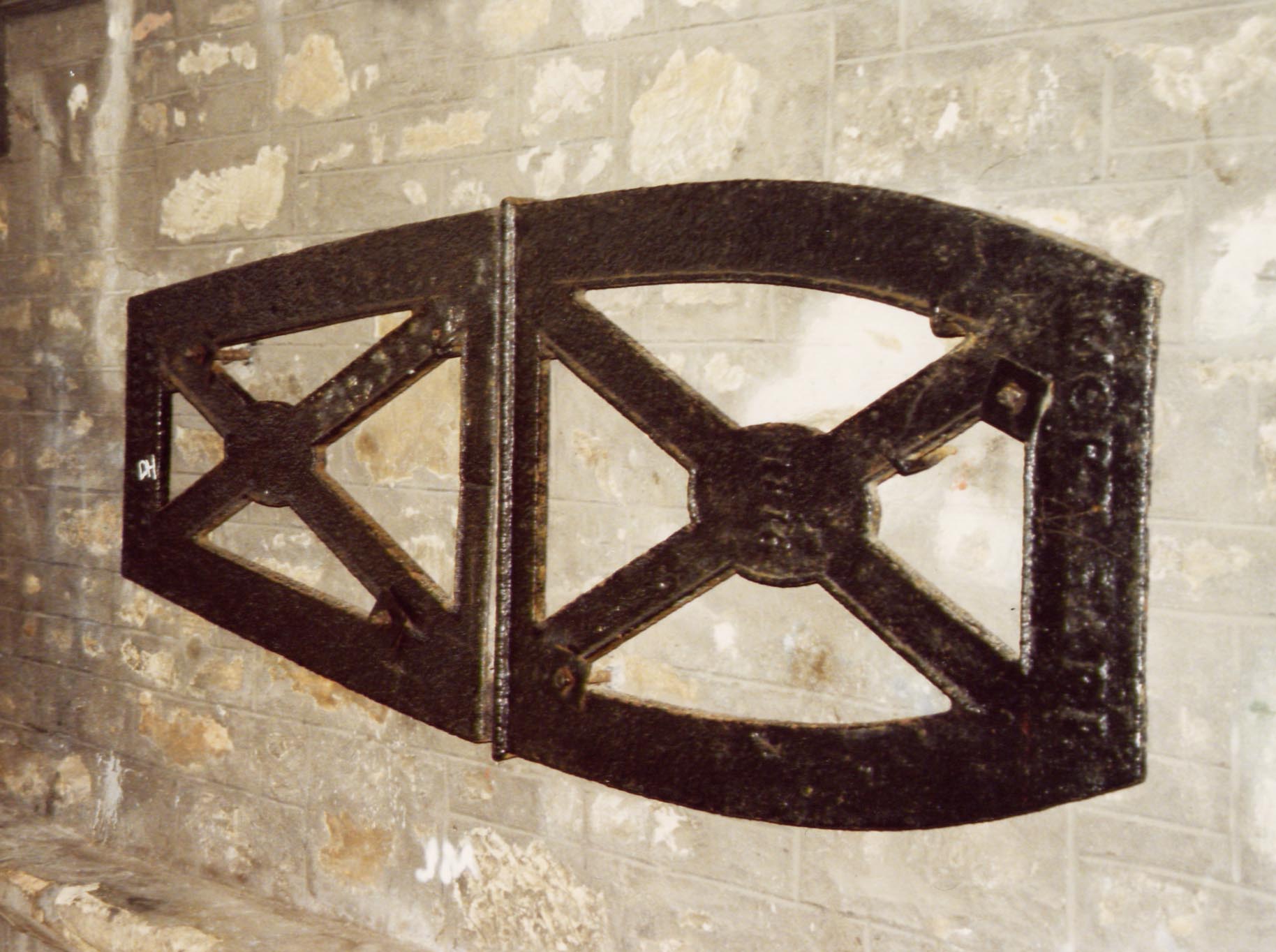
Everyone knew that Christina Gilmour was unhappy in her marriage to Renfrewshire farmer John Gilmour. He was not the man she wished to have by her side. The match was only six weeks old when he died after a violent illness, setting tongues wagging over rat poison she had purchased. What made matters worse, she had fled the country with the aid of her brother. By that time, the heavy mortsafe, which protected her husband’s corpse from bodysnatchers, had been hauled off and the body examined by experts. The rumours proved correct – his body was riddled with arsenic traces.

An example of a mortsafe, heavy metal lids placed over graves to deter bodysnatchers. This one hangs in the lychgate of Ayr Auld Kirk.

A dogged Superintendent of Renfrewshire Rural Police traced Christina’s movements to Liverpool, where she had taken ship for New York in the company of a man she didn’t know until introduced by an intermediary. Supt George McKay took a faster vessel and was on the quayside to meet her. Her companion, who had proved to be far from a gentleman during the voyage by making unseemly advances, vanished into the crowds.

The 24-year-old suspected murderess gamely battled extradition. Her US lawyer cited a recent extradition treaty between the two nations that stated a person accused of a crime could only be sent home if there was clear evidence of criminality. During the hearing she even feigned insanity. It was all to no avail for in August 1843 she was sent home to face the legal music.

In January the following year, Christina Gilmour stood in the High Court at Edinburgh to face trial for murder.

During the two day trial, dressed in black, a simple gold wedding band on her left hand, she listened dispassionately to the evidence. She heard witnesses speak of her purchases of arsenic. She relived her late husband’s extended, agonising death. She watched as medical witnesses produced a grisly succession of the dead man’s internal organs to illustrate their belief that he had been poisoned. 

The law prohibited accused persons from giving evidence but their declarations could be read into the record. In it she denied murdering her husband. The arsenic was not to kill rats, as she had claimed at the time, but to kill herself, such was her unhappiness in her marriage. Her husband was not a bad man but he was not the man for her.

Her defence counsel raised the possibility that John Gilmour had killed himself. He already kept arsenic around the house for the control of vermin and he had shown a somewhat dramatic nature during his courtship when he had threatened to kill himself if Christina, dithering over another man who she saw as her real love, did not agree to marry him. He knew his wife was unhappy, it was even said that the marriage was unconsummated, and it was possible those earlier thoughts of taking his own life had resurfaced.

Would this attempt to raise the famed shadow of a doubt be enough to save this young woman from the gallows?

The jury was out for only an hour.

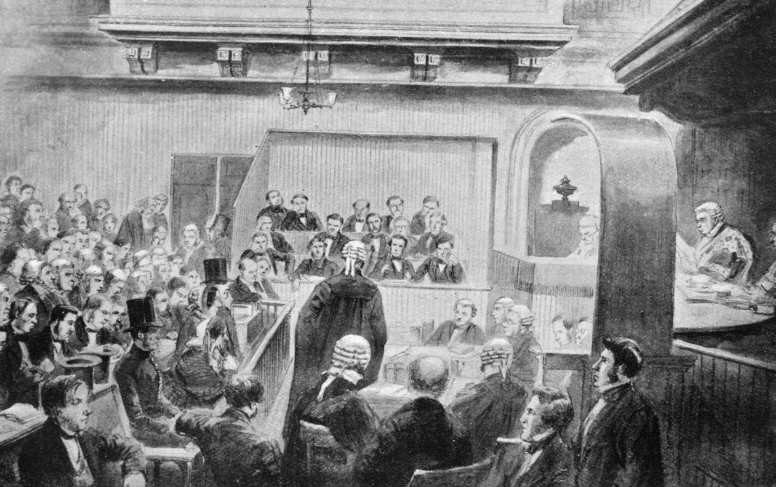
Christina, a cup of water in her hands, sat immobile as the fifteen men delivered their verdict on whether she would live or die. The packed courtroom hushed, as if everyone present was holding their breath, and the solemn voice of the Clerk floated towards the high ceiling. 

‘The jury, after a careful and mature consideration of the evidence brought before them in this case, are unanimously of the opinion that John Gilmour died from the effects of arsenic poisoning.’

That much was expected, the medical evidence had been so compelling. But had the jury decided that his wife had in fact laced his food and drink with the poison? Journalists’ eyes watched for some emotion from the woman in black sitting in the dock but there was none. Then the Clerk spoke again.

‘But find it not proved against the prisoner at the bar, as libelled.’

The court room erupted, for there was strong support for the accused, and the judge demanded order, finally quietening the public gallery with strong threats of contempt. Still Christina’s blank expression did not change. There was not even as much as a flicker of emotion as she left the court. She later returned to her father’s home in Ayrshire and died in Stewarton, aged 87 and still in widow’s weeds, having never married again.

Thirteen years later, Madeleine Smith stood accused of poisoning an inconvenient and mercurial lover with arsenic concealed in hot chocolate. Perhaps Christina read of it and sympathised with the plight of a woman wrongly accused. Or perhaps she smiled a secret smile…

You can find my brief account of the Madeleine Smith case here:

http://douglasskelton.com/a-lethal-dose-of-arsenic/

In 1969, a lethal robbery in Ayr began a decades long chain of violence and death.

The first of a two-part account of the events, based on material included in my non-fiction books. I apologise for any factual inaccuracies.

In the early hours of Sunday 6 July 1969, 67-year-old bingo hall owner Abraham Ross and his 72-year-old wife Rachel suffered a brutal ordeal at the hands of two masked raiders in their Ayr home. Robbery was the motive but the two Glasgow men, who called themselves Pat and Jim, gave Mr Ross a severe beating with an iron bar to force him to part with the keys to his safe. They knew he had money and when the old man finally gave in they found £4,000. They left the old couple bound and gagged and promised to alert the police. 

But they didn’t make the call. 

The couple lay all day and all night untended until their cleaning lady found them on Monday morning. Mrs Ross subsequently died but her husband, despite his horrendous beating, survived. The crime was sickening, disgusting and unnecessarily violent, for any niceties the old underworld may have had were being swept away by the late 60s, if they ever existed in the first place.

 To paraphrase former Prime Minister Harold Macmillan, we’d never had it so nasty.

A safeblower, what they used to call a ‘peterman’, named Paddy Meehan was hoovered up for the crime. Police had been tipped off that he was in Ayrshire at the time and as one of the men had been called Pat, it was reasonably assumed that he could have been responsible. Mr Ross also picked him out of a line-up, but only because of his voice. However, the Glasgow peterman insisted that he had never been called Pat. 

He later claimed that the tip-off had come from MI5, who had tapped his phone. They insisted that they had been monitoring his movements ever since he had tried to warn them that the Russians were going to break spy George Blake out of Wormwood Scrubs. The KGB had arrested former Communist Meehan while he was in Eastern Europe on the run after breaking free from his preventative detention and had questioned him about the Scrubs. On his return to Britain, Meehan said he tried to warn MI5 about the plan but was either not believed or deliberately ignored. Sure enough, Blake escaped in 1966 – Meehan believed allowed to do so – and from then on the Glasgow crook was the man who knew too much. 

Yes, he had been in Ayrshire that night but only passing through, on his way to Stranraer with a buddy to case a motor taxation office. No, he did not do this terrible crime. He was a safeblower, not a murderer – and he had been fitted up by the security services. It all sounds so plausibly implausible that it just might be true.

The man with him that night was James Griffiths, a 34-year-old petty crook from Rochdale with a wicked temper and self-destructive streak. In 1963 he had stabbed two men with a bayonet during a burglary that went wrong and when police arrested he was found with two firearms in his possession. It was suggested that had he not been surprised, he might have been tempted to shoot it out.

He met Meehan in Parkhurst Prison on the Isle of Wight, where they shared a cell with another Glaswegian Roy Fontaine, a conman later to achieve notoriety when, using the name Archibald Hall, he killed five people, including his own brother. Griffiths was not in the Glasgow men’s league but he wanted to be. He impressed them when he walked off a work detail and onto a ferry. Still wearing his prison uniform, he made it to the mainland where he shared a train compartment with a prison officer and his wife and remained at large for several weeks before he was nabbed and sent back to Parkhurst.

Meehan and Fontaine had spoken about Glasgow so much that Griffiths wanted to see the place for himself, so on his release he moved his base of operations to an attic flat in Holyrood Crescent in the city’s West End. He had learned a thing or two from the smooth-talking Fontaine and he posed as a Mr Douglas, an antique dealer. He then exercised his skills as a thief to lift antiques, fast cars, firearms, all the time looking for the big score. He met up with Meehan again, believing that the experienced old hand could help lead him to it.

When Meehan was arrested for the Rachel Ross murder Griffiths knew that his pal was innocent. He wanted to help him but couldn’t do so without firing himself in for a crime. Honour among thieves was one thing but he didn’t relish going back inside. He did everything he could, bar turn up at a police station. He contacted reporters, he even spoke on the phone to DCS Tom Goodall, a legend within Glasgow police, who urged him to give himself up. 

Finally, Meehan under pressure gave up his partner’s name and address and on Tuesday 15 July a posse of police officers was ordered to bring Griffiths in.

And that was when the shooting started.

Griffiths had always boasted that he would go down fighting. He was a violent man – during the burglary in Blackpool he’d hacked at the two guys, almost chopping off the fingers of one man’s hand – and his unbalanced mind now tipped over. He had stolen a number of weapons in his time in Glasgow and when the cops came calling he blasted at them with a shotgun. Detective Constable William Walker took a blast in the back and had to be carried to the home of a retired doctor while other officers laid siege to the flat at 15 Holyrood Crescent. 

But Griffiths wasn’t going to wait it out. He knew he had more weapons and ammo in his car parked in Great Western Road and he came running out of the terraced house, his shotgun booming. He sprinted to the car where he loaded himself up with a high-velocity rifle and telescopic sight then threw a bandolier of ammunition over his shoulder, before dashing back to his flat, pumping his shotgun at anything that moved and screaming, ‘You won’t take me!’

Police reinforcements arrived and immediately came under fire. Windscreens cracked and shattered, a detective fell back, a round nicking his neck. Griffiths had already wounded a number of passers-by during his fusillade. The street was cordoned off. A police marksman stood ready to bring the gunplay to a halt. Men with bullet proof vests hid behind walls and cars and even the army was contacted for reinforcements if needed. 

DCS Tom Goodall took personal charge of the situation and ordered up tear gas but when the bark of gunfire from the attic window ceased he knew instinctively that Griffiths had managed to escape. He’d climbed through a skylight and dashed along the roofs before dropping down into a lane. He was at large in the city and he was armed to the teeth.

In Henderson Street, Griffiths commandeered a dark blue Anglia, wounding the driver, and sped off through the North Woodside area to the Round Toll at Possil. The police had stormed his flat by then and found it empty, now fanned out in a bid to bring him down before anyone else was hurt. 

Griffiths meanwhile had crashed the car and burst into the Round Toll Bar, where he calmly ordered a drink. The few customers present at midday stared in amazement as the short, stocky, wild-eyed man with an English accent stood before them, a rifle in his hand, a shotgun hanging on his shoulder and an ammunition belt crossed over his body. No-one moved, no-one breathed. Outside they could hear the wail of the sirens and they knew the law was coming for him. He seemed crazy, his eyes flaring, his breathing erratic and they knew that it wouldn’t take much for him to start blasting, all it would take was for someone to move.

Then someone moved.

William Hughes was a pub regular, a 65-year-old newsvendor, and all he did was twitch his hand towards his glass but the jumpy Griffiths whirled round, the rifle up, the barrel spitting twice. The poor man fell back, both bullets pumping blood from wounds that killed him five days later. Owner James Connolly seized the chance to grab the gunman and throw him bodily out of the bar. It was a brave act, perhaps a stupid act, but Connolly was used to all kinds of tough guys and he wasn’t having this lunatic shooting his bar or his customers to pieces.  As he reached for the phone, Griffiths came roaring back in, the rifle jerking once. The bullet went wild and Connolly ducked for cover, but then Griffiths was gone again, spooked by the screeching tyres of the police as they converged on the area.

Outside a young man named Ian Shaw tried to capture Griffiths and was shot for his troubles. A lorry was hijacked but a taxi driver kept close tabs on it and was able to keep police informed regarding the route Griffiths was taking. His driving was as erratic as his mind as he skidded round corners, ran red lights and sent motorists swerving. The rifle lay on his lap and every now and then he poked it from the cab of the lorry to fire it with one hand. He reached Springburn and swerved into Kay Street, not knowing it was a cul-de-sac. Still firing, he leaped from the cab and ran up the short street towards the Corporation Baths at the far end, then ducked into the closemouth at number 26. 

Police moved quickly to clear the street for they knew that Griffiths would start shooting again once he found a vantage point. He had pounded up to the top floor of the tenement and blown the locks of a door. From the window he could see the street and he sent bullets raining down on the police. 

He didn’t see the little child in the pram directly below him, but the police did. The baby’s parents wanted to rush out and grab the child but that duty fell to a volunteer officer who carefully crept up the street, his back pressed against the sandstone walls until he reached the pram. The child was carried to safety. 

Griffiths, though, might not have been at the window. After letting loose with a few rounds, he had moved down to the first floor landing to check the rear. There he took pot shots at the children in a playground, hitting an eight-year-old boy, an 18-year-old newly-wed woman and another man. The newly-wed’s young husband had to be dragged down to prevent him racing towards the window to get to the man who had put a bullet in his wife’s leg.

But Griffith’s time was running out. In 105 minutes he had loosed off over 100 rounds and had wounded nine men, two women and a child. Now back in his top floor sniper’s nest perhaps he knew there was no hope but as he had vowed before, he wasn’t going to go down without a fight. He still had ammunition and he still had the will to use it.

Mock up image for illustration purposes only.

The end came when he heard the creak of a letterbox being pushed open behind him. He turned and saw eyes watching him from the landing outside. With a bellow of rage he charged towards the door. The barrel of a gun was thrust hastily through the letterbox and a trigger pulled.

The bullet him in the shoulder but once a round hits flesh there can be no predicting where they will go. Rounds can bounce from bone, glance off sinew and change direction. In this case it surged downwards through his body to career off his ribs, then tore through organs and flesh and blood to end its trajectory in his heart. He fired once more as he hit the floor but the shot went wide. By the time the police forced open the barricaded door and carried him none-too-gently down the stairs to the streets, the gunman was dead. 

He was the first wanted man in Scotland to be gunned down by police officers in the line of duty.

Chief Superintendent Malcolm Finlayson was the man who had pulled the trigger that put the man who was swiftly dubbed ‘Mad Dog’ Griffiths down. He had not meant to kill but kill he had. 

‘That’s not something I will readily forget,’ he said later. 

Both he and Detective Sergeant Ian Smith, who had been with him as they crept up the stairs, were honoured for their gallantry, as were James Connolly, Ian Shaw and ambulanceman John Preston, who braved the bullets to bring aid to the wounded.

Griffiths had alienated his family through years before. His father said they would not come north to attend any funeral.

‘Our son died fifteen years ago,’ he told reporters.

It was left to what was then Glasgow Corporation to bury him somewhere in Linn Park Cemetery on the south side. No stone marks the final resting place of the man who was, for two hours, the most wanted man in Britain.

But that wasn’t the end of this chain of death…

Yesterday I passed the house where, in the 19th century, a young woman is said to have fed her former lover poison and murdered him. I wrote about the case, and others, in my non-fiction book ‘Deadlier Than the Male’ (available in ebook form) and then, later, in ‘Glasgow’s Black Heart’ (now unavailable).

Here is my original, unedited, account from the latter. Any errors of fact are mine.

It’s probably one of the most notorious trials in Scottish legal history. At its centre was a young, beautiful woman from a good family. It involved the use of arsenic and the removal of a man who was, quite simply, in the way. It scandalised Victorian society with its heady mix of passion, sex and murder. There have been articles and books and plays and at least one film, directed by none other than David Lean.

The question remains, though – did Madeleine Smith kill her lover?

She was only 19 when she first met Jersey-born Pierre Emile L’Angelier. He was a lowly clerk in a seed merchant’s warehouse and as such was no match for the eldest daughter of wealthy Glasgow architect James Smith. Educated at a London boarding school, she was a fine beauty, with fair skin, dark eyes that could entice any man and long hair ‘of polished ebony’. She liked to flirt and she liked to enjoy herself and her beauty mixed with a powerful personality meant she could have her pick of the eligible men in Glasgow. But she was also feisty, single-minded and adventurous and each of these qualities would come to the fore over the next two years. 

L’Angelier had engineered a meeting in April 1855 through a mutual acquaintance and she had been captivated by his Gallic charm. Ten years older than the girl he would come to know as ‘Mimi’, he had spent some time in Paris during the revolution of 1848, serving with the National Guard. This appealed to the 19-year-old girl’s repressed Victorian romantic spirit. Although experienced in the intrigues of l’amour, it is to his credit that he did not see the redoubtable Miss Smith as just another conquest. He wanted to make her Mrs L’Angelier in a proper manner and that meant with the permission of her parents. His station in life, however, precluded the stern Mr Smith from even countenancing such a match and Madeleine was forbidden from seeing the handsome pen pusher again. 

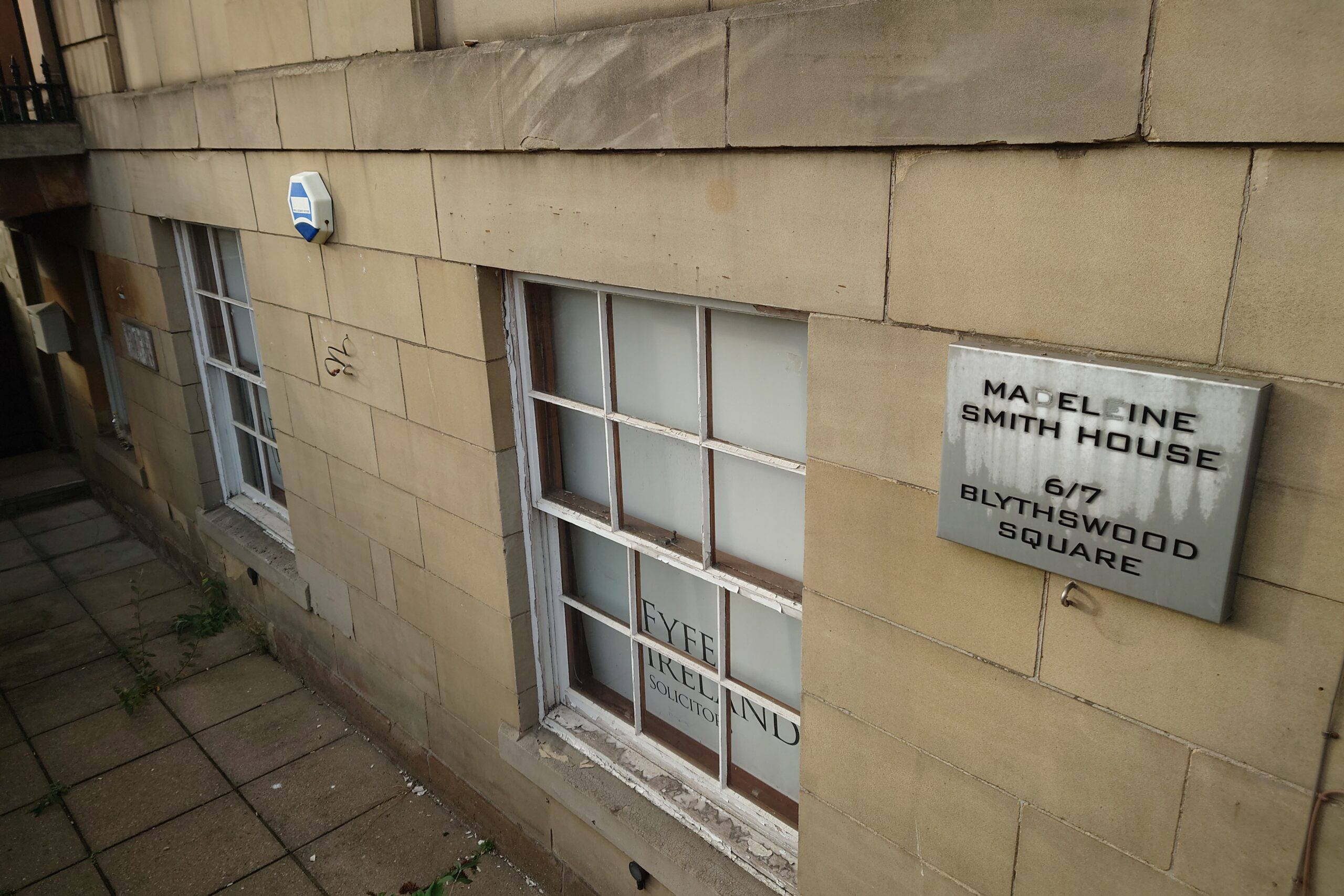
Madeleine, though, was not the girl to meekly accede to such an order. She continued to see Pierre. She smuggled him into the family home, first in India Street and then, from 1856, in Blythswood Square.

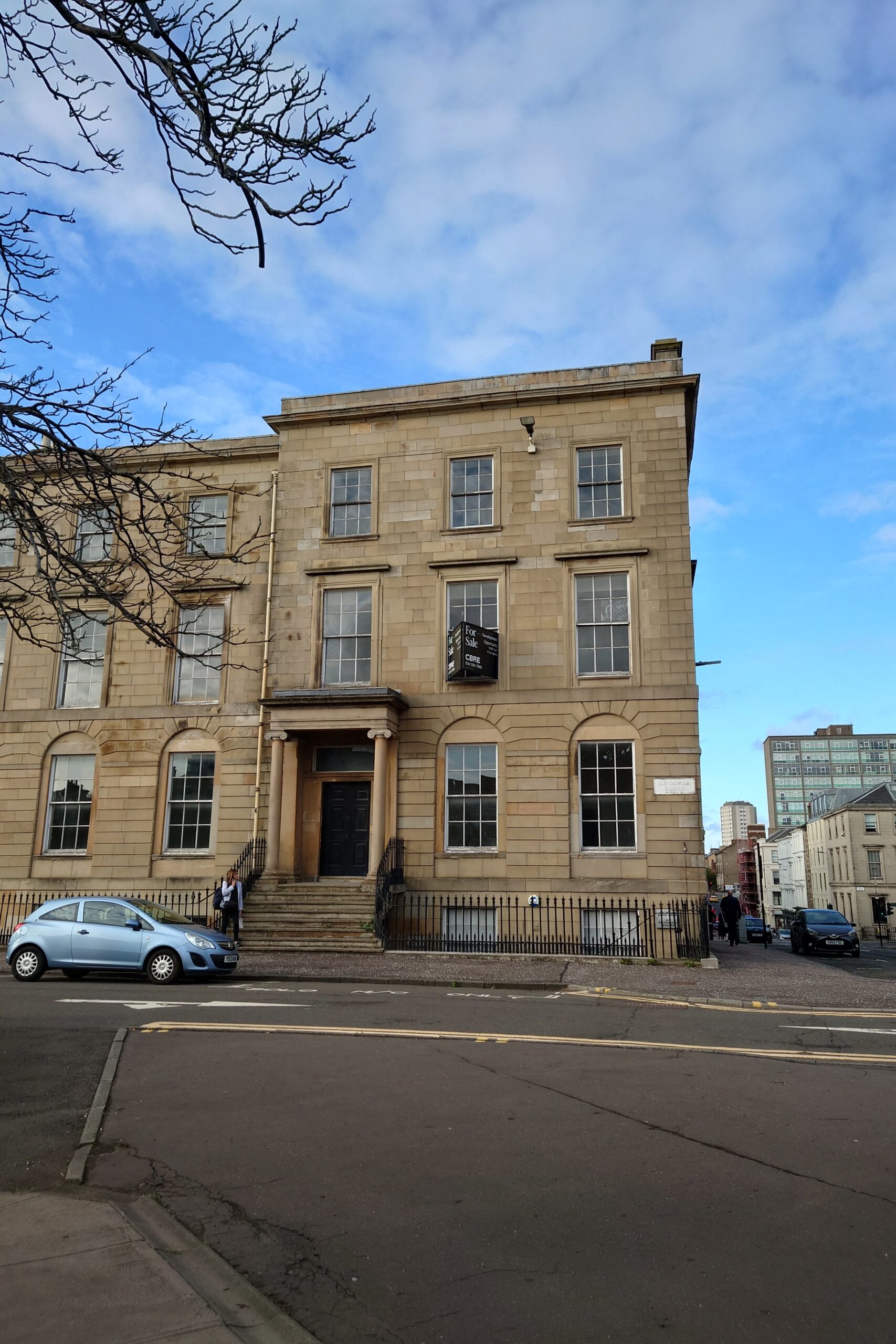
The house in Blythswood Square, Glasgow, once owned by the Smith family.

When the Smith family went to Rowaleyn, their summer home in Row (present day Rhu on the Clyde near Helensburgh), he followed and the couple kept up their midnight liaisons. At some point, probably in the wooded gardens around Rowaleyn, the relationship grew physical – a fact that would scandalise the court the following year. ‘My own, my beloved husband,’ Madeleine wrote afterwards, ‘if we did wrong last night it was in the excitement of our love….I did not bleed in the least last night but I had a good deal of pain during the night. Tell me, pet, were you angry at me for allowing you to do what you did…?’

 L’Angelier may not have been angry but he was certainly disappointed. He seemed to find fault in many things she did and she was forced to grovel at his feet for forgiveness. Her letters in the early stages are peppered with phrases like, ‘I ought never in any way to vex or annoy you’, ‘If I do anything wrong and you check me, I shall never, never do it again…you shall love me and I shall obey you’, ‘It is my duty as a wife to do so. I shall do all you want me.’ She talked of her faults and how he would correct them. She talked of being his ‘wife in every sense of the word’ – a clear sign that their relationship was sexual. Even that was thrown back in her face for he blamed her completely for their having succumbed to their passions. ‘I am sad at what you did,’ he wrote to her, ‘I regret it very much. Why, Mimi, did you give way after your promises?’ He even obliquely suggested that she was not a virgin. ‘I do not understand, my pet, your not bleeding for every woman having her virginity must bleed,’ he wrote. ‘You must have done so some other time. Try to remember if you ever hurt yourself in washing, etc.’ He did not trust her and often reproached her for flirting, so he must have been spying on her for the parties and balls to which she would be invited were closed to him. But then, they had mutual acquaintances and, in the beginning at least, even members of the Smith household were aiding and abetting them in their affair.

Madeleine, though, was cooling. She was young, she was flirtatious and the constant belittling finally got to her. Apart from that, someone else had been paying her attention. Merchant William Minnoch lived next door to her family in Blythswood Square and was, in the eyes of her father at least, a much more desirable candidate for son-in-law. Madeleine thought so, too, and tried to break off the relationship with Pierre but he would hear nothing of it. She was his Mimi and if she tried to end things then he would take her letters – her passionate, revealing, indelicate letters – to her father and her new beau. Once her base nature was revealed would the upright Mr Minnoch still be as interested? L’Angelier stalked her, watching her whenever she was out with Minnoch or her family.  Madeleine somehow found her ardour for him returning and she continued her correspondence and the illicit meetings. When he could not creep into the Blythswood Square house, he stood outside her basement bedroom window and accepted hot chocolate through the bars.

Then L’Angelier began to take ill. In February 1857 he fell victim to sharp, piercing abdominal pains and vomiting. The symptoms returned twice in March – and after the third attack he was found dead in his room. His friends and his employers were suspicious of this sudden and lethal decline in his health and demanded a post-mortem. His body was exhumed from the Ramshorn Kirkyard and examined. The man’s stomach revealed 82 grains of arsenic. Madeleine’s letters were found and the procurator-fiscal decided that he had his culprit. But Madeleine, perhaps seeing the writing on the wall, had taken flight. She did not get far, though, for her brother and William Minnoch found her on the steamer heading for Rowaleyn. Within days she was arrested and remanded for trial in Edinburgh – Glasgow’s courts still not yet good enough for such high-profile proceedings.

The trial lasted nine days during which the Crown tried to paint a picture of a cold-hearted young woman who purchased arsenic, ostensibly for the poisoning of rats, but who served it to her erstwhile lover in dishes of cocoa. Since the Arsenic act of 1851, all purchases of the substance had to be made by persons over the age of 21 and known to the chemist. The substance itself, white in colour, had to be stained with either soot or indigo and the purchaser’s details recorded in a poisons book. None of these regulations prevented Miss Smith from obtaining the poison, which she later claimed she used in diluted form as a cosmetic to wash her face, arms and neck. It was certainly common for women to tone up their complexion with arsenical-based lotions. Both sexes also used arsenious acid as a tonic and it was prescribed as a treatment of fevers. L’Angelier on more than one occasion claimed he was ‘an arsenic eater’, taking it to improve his health and his appearance. The defence used this to suggest that perhaps he had poisoned himself. He was also in the habit of suffering from stomach trouble. (A later theory suggested that L’Angelier had visited a spa where the medicinal waters might have been thick with the poison).

The main problem facing the Crown was that although they had motive – the victim had become something of a liability to her future happiness and had threatened to betray their liaison to her father and her new suitor – they could not prove Madeleine had even seen L’Angelier on the three occasions specified in the indictment, let alone given him a drink laced with poison. Medical evidence was also contradictory. The defence experts thought that given the amount of arsenic found in the stomach there should also have been traced of soot. It was also suggested that L’Angelier would have tasted the mixer, or least felt it scratching his throat. In their mind it followed that, before he died, he would have mentioned something to his landlady or the doctor who attended him. The Crown’s experts refuted this, saying the soot would have evaporated and the strong cocoa would have masked the taste.

There was also a diary kept by L’Angelier in which he wrote, ‘Thursday, 19th February. Saw Mimi a few moments. Was very ill during the night. Friday 20th February. Passed two pleasant hours with Mimi in the drawing-room. Saturday 21st February. Did not feel well. Sunday, 22nd February. Saw Mimi in the drawing-room. Promised me French Bible. Taken very ill.’ The defence, naturally, did not want this book allowed into evidence. They battled hard to have it excluded – and won. It was felt that had L’Angelier been alive to give evidence then it would have been admissible because he would have been open to cross examination. However, had he been alive, the point would not have been debated in the first place. Madeleine did not deny on a few occasions giving L’Angelier cocoa but added, ‘I never administered, or caused to be administered, to Mr L’Angelier arsenic or anything injurious, and this I declare to be the truth.’

Public sympathy was with Madeleine. The case itself filled prodigious amounts of newsprint and her cause was further strengthened by the fact that L’Angelier was a foreigner. Even writing some years after the event, F. Tennyson Jesse called him ‘that little, scheming, sensual, iron-willed lady-killer.’ Madeleine, though, captivated all who saw her. One contemporary report said she entered the court ‘with the air of a belle entering a ballroom or a box at the opera. Her steps were buoyant, and she carried a silver-topped bottle of smelling salts. She was stylishly dressed, and wore a pair of lavender gloves.’

The defence also reminded the jury that murder was a capital crime. Her counsel opened his remarks with ‘Gentlemen, the charge against the prisoner is murder, and the punishment for murder is death.’ Who can say how much the thought of sending the calm, self-possessed young beauty in the dock to the gallows helped convince thirteen of the men on the jury that the case against her was Not Proven. Only two believed beyond the famed shadow of a doubt that she was guilty. Again the courtroom was filled by cheering spectators and the judges called for order.

Madeleine Smith, still calm, still dignified, was taken from the court by her brother through a side door and spirited away to Rowaleyn. Her parents, who had ‘taken to their beds’ during the trial, were waiting for her, having sought refuge from the scandal in the country. The coldness of her family must have hurt her deeply but she could take some solace in the warmth of feeling from other quarters. In a letter to the Matron of Edinburgh Prison, Madeleine stated, ‘I think I must have had several hundred letters, all from gentlemen, some offering me consolation, and some their hearths and homes.’ She also noted that, ‘the feeling in the west is not so good towards me as you kind Edinburgh people showed me. I think it shall be necessary for me to leave Scotland for a few months…’ She was, though, ‘not at all pleased with the verdict.’

William Minnoch was out of the picture. The letter says ‘My friend I know nothing of. I have not seen him. I hear he has been ill, which I don’t much care.’

So if Madeleine Smith did not kill L’Angelier, what happened? He could have taken the arsenic himself, either as a suicide attempt or, more dramatically but perhaps unlikely, as a way of punishing the woman he loved by framing her for his murder. The suicide angle is strengthened by his reaction to an earlier failed romance, when he threatened to take his own life. He could have taken it by accident – as a known arsenic eater perhaps he just ate too much. He was also painted as a womaniser and even a blackmailer, so perhaps someone else took it into their head to remove him from the earth. 

Madeleine later married London artist George Wardle and became part of the smart set, being noted, it is said, for having the daring to uncover the legs of her dining table. It would be interesting to see the faces of her dinner guests if she ever offered them cocoa. Apparently, one who did sup hot chocolate at her naked table was George Bernard Shaw. She subsequently moved to New York, married for a second time, raised a family and died, aged 93, on 12 April 1928. Her gravestone in Mount Hope Cemetery, New Jersey bears the name Lena Wardle Sheehy.

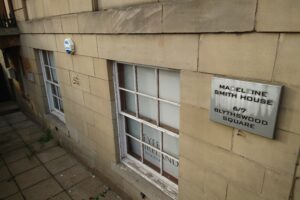
The basement of the house today, complete with plaque.

BBC Scotland is screening a two part documentary on the Bible John case, the first part going out on Monday past (you can catch it on the iPlayer and it’s well worth it).

It’s a case that has haunted Glasgow for decades – and was the very first feature I wrote for the Glasgow Evening Times and effectively setting me off on the true crime journey that led to my current fiction. 

In the dying years of the 1960s, three separate women visited the Barrowland Ballroom in the east end in search of a fun night out at the dancing.

What they found was a killer. Or killers.

The artist’s impression of the suspect

In February 1968, Patricia Docker was found murdered in a lane only yards from her southside home. She had gone out for a night with friends, first to the Majestic – the Magic Stick, as it was known – in Hope Street but then to the popular Barrowland. 

The machinery of a police investigation swung into gear. Inquiries were made. Interviews were conducted. Statements were taken. However, the trail ran cold.

In August 1969, Jemima McDonald was found in a derelict flat in Bridgeton. She had also been at the dance hall and detectives discovered she had left with a man.

The description was sketchy but it did help create an Identikit image of the suspect. For the first time in Scotland, that image was issued to the press.

But again, they drew a blank.

Two months later, the body of Helen Puttock was discovered in a back court in Scotstoun.

Like Patricia and Jemima, she’d been strangled. Like Patricia and Jemima, she had been on a girls’ night at the Barrowland. Three dead women, three tragedies. Three families and their friends left to grieve and wonder who had done this to their loved one.

This time, though, the police thought they had a more accurate description of a man seen with Helen. 

The suspect had shared a taxi with his victim and her sister and by piecing her statement together with others, they were able to create the image of the man they desperately wanted to talk to.

That taxi ride also brought us the nickname that has followed the case from newsprint into dark legend. 

During the journey from east to west, the man talked about himself, including the fact that he’d had a strict religious upbringing. He made reference to Biblical passages. He talked of ‘dens of iniquity.’

And so Bible John was born.

The fames Barrowland Ballroom in Glasgow

The hunt stepped up a number of gears. The murder squad based themselves in Partick Police Station, known as the Marine because it had covered parts of the riverside, because that covered the area where Helen Puttock had been murdered.

They interviewed hundreds of people, took thousands of statement. They made appeals at the Barrowland and other dance halls. They mixed with the dancers, becoming so proficient on the floor that some became known as the Marine Police Formation Dance Team.

They visited tailors to try to match the unusual suit worn by the suspect. They spoke to dentists because his teeth were distinctive. They visited golf courses because he’d talked about a hole in one. 

They tried to trace another John – known as Castlemilk John – who had also been with the women and the suspect for a time but he never came forward. It was common for married men to go out ‘on the pull’ and John was an easy enough pseudonym to cast around.

A portrait in oils was even produced, based on the description of the suspect. However, it was recently pointed out that the portrait bears a striking resemblance to an earlier work by the same artist. Does this discredit it? Maybe, maybe not.

No-one was ever arrested.

Time passed and the largest, most extensive manhunt the city had ever seen had to wind down. There were other crimes to investigate and the manpower was needed elsewhere.

Bible John faded from the neon glare and merged with the shadows. Perhaps he died. Perhaps he moved away. Perhaps he was jailed. The nickname lived on, though, largely thanks to the press and people like me.

The question is, was there a Bible John? Were the three tragedies not connected at all? The then Strathclyde Police stated that the murders had never been officially linked. The reality is that they were and one senior detective told me that was a major mistake. If the three probes had been conducted independently then perhaps a vital piece of evidence could have been uncovered. But perhaps not.

Criticism has also been levelled at the decision to focus on the fuller description from the third murder at the expense of other differing descriptions. Also, the lighting in the dance hall and in the taxi would not be ideal – and the main witness had admitted to have been drinking.

Like other unsolved cases, the so-called Bible John cases will never die. Hundreds of people think they know who he was – it was a guy next door who behaved strangely at the time and had a suit similar to the one police described. It was a relative who was later convicted of rape. It was someone else who had very strange material in his attic. But there’s seldom anything that closely resembles proof. 

A 1995 probe police concentrated on the then relatively new-fangled wonder of DNA profiling. A sample of semen found on Helen Puttock’s tights contained the miracle genetic fingerprint and a search was launched to see if there was a match with any of the suspects. Investigations zeroed in one man, by that time dead. His relatives agreed to give blood and, according to one forensic scientist, the match was the closest she’d ever seen. Permission was granted in 1996 to exhume his body, which became a media cavalcade. Then everything went quiet. What was supposed to take weeks turned into months – until it was somewhat sheepishly revealed that no match could be found.

Cynics believed that the entire affair was merely a bit of PR for DNA profiling, but if that was the case it failed, miracle development for investigators it is. The problem lay with the samples. DNA samples can be easily contaminated and can erode if samples are not stored properly. Genetic fingerprinting was not even a glimmer in a scientist’s eye in the late 1960s and although the original sample would have been stored carefully it may not have been careful enough to protect the material. I was once told by a former officer that material linked to the cases in those days could be hung over radiators in the police station to dry – while many of the productions in this matter were storied in boxes in the attic of Partick Marine. Remember, this was before the massive leaps in scientific detection. Forensic science was far from in its infancy in late 60s but it was not as advanced as it is today. 

In addition, the suspect had been buried in a family lair. The passage of time had seen the coffin break down and the corpse contaminated. In all, the DNA breakthrough in the Bible John case was something of a disaster.

It has also been posited that Peter Tobin could have been responsible. He was convicted of the brutal murders of Angelika Kluk, a Polish student whose body was found buried beneath a Glasgow church, and of teenager Vicky Hamilton, for many years one of the most perplexing of Scotland’s missing person cases. Tobin, it seems, told a prison psychiatrist that he was responsible for 48 murders and the claim was taken seriously enough for a special UK-wide operation codenamed Anagram to be set up to piece together any evidence. In relation to the Bible John killings, Tobin was known to be living in the city at the time of the first two but was resident in Brighton when Helen Puttock was murdered. The methods of murder between the 1968/69 murders and others over the next forty years may be different but Tobin, who may yet prove to the nation’s worst serial sex killer, could have ‘evolved.’ He would have been in his early 20s during the Bible John days and as the years went by he could have perfected his methods and widened his target range, each time driven either by his lust for rape or his desire to kill.

However, Anagram found no cast-iron link to him – and he has refused to confirm or deny any involvement.

If – IF – there was a single Bible John, why did he stop? Was he arrested for another offence? Did he die? Move away? Or did he mature, essentially grow out of the urge to kill? Did he find some other outlet for his violent tendencies?

One jailhouse rumour might be the answer. A well-known crook told more than one person in prison that he murdered a man he believed to be the killer. This man disappeared late in 1969 and the jailhouse chit-chat suggested that he had to die because he was ‘making life too hot for them all.’ 

Possibly. Maybe. Perhaps. Could be.

All words that must be used when discussing the mystery.

Glasgow’s most notorious serial killer, if such a beast ever existed, remains under whatever rock he has hidden for over 50 years.

The final part of a short series on the execution of justice – and of the condemned – in old Glasgow.

John Murdoch had been the assistant to both Young and McArthur, as well as others, for thirty years when he became the ‘go-to guy’ for towns needing someone ‘topped.’ A baker to trade, he performed his official duties on a piecework basis but he was around 70 years old when Young died. Rheumatism had stricken his legs and he could walk only with the aid of a stick. Newspapers commented on the sight of him tottering up the steps to the platform and in 1849 one reporter opined that it was perhaps time that he gave up the work altogether. But old Murdoch grimly hung on – the £30-£40 fee for a topping was not something he was eager to do without – and at the age of 84 he almost botched what was to be his last service for Glasgow.

On 2 October, 1851, Archibald Hare, a man said to be of ‘repulsive and dogged aspect’, was sentenced to death for the stabbing of a man in Blantyre. Murdoch may well have been in the courtroom to hear the verdict, for it was his habit to attend the Circuit Court whenever a capital case was to be heard. Hare, who legend states was the nephew of ‘bodysnatcher’ William Hare (but legend is wrong), was to die on 24 October. The hangman laboriously hauled himself up the gallows steps and fixed the rope around Hare’s neck. In addition to being repulsive and dogged, Hare was a very slight man and when he was turned off he merely twisted on the end of the rope, trying desperately to free his bound hands in order to clutch at the hemp biting into his throat. Murdoch had to speed the man’s end by grabbing hold of his legs and swinging on them until the struggles eased and finally ceased. The authorities concluded that this particular Finisher was too old to continue and allowed him a pension out of the public purse. He died, aged 89, in Bothwell. 

Glasgow then hired hangmen from other parts of Britain to, as Tam Young used to say, ‘get their business done.’

Over thirty years earlier, though, it would have been Tam who did the honours at the first quadruple hanging in Glasgow – during which two of the men facing their doom publicly displayed their affection for each other.

Robert McKinlay, (also known as Rough Rob), William Buchanan, Robert Guthrie, (alias R. Hunter Guthrie), and Alexander Forbes were led to the scaffold on the Green on 8 November, 1819. They had each been found guilty of various counts of housebreaking. McKinlay and Buchanan had been audacious enough to break into Bothwell Castle, near Hamilton, and make off with a gold watch, a silver snuff box, a silver spoon, a silver candlestick, a silver bread toaster ‘and several articles of wearing apparel.’ They had forced open a window and crept around the castle while the owner, the Right Honourable Lord Douglas, slept.

Glasgow-born McKinlay was a 23-year-old former cotton spinner who had, a broadsheet said, ‘long given up the sober pursuits of industry’ to set about ‘gaining a livelihood by fraud and theft’ through the ‘more dangerous way of living by preying on the property of the public.’ At the time of his arrest he was also wanted for a variety of other burglaries. He had earlier broken out of Greenock Jail and had avoided recapture by going to sea for eight months. He was caught on this occasion ‘in the Green asleep’ with some of the stolen items on him and ‘his Lordship’s neckcloth about his neck.’ He was destined to have something less pleasant around his throat. He had perhaps been fingered by his accomplice arrested earlier. 

Buchanan was only 18-years-old and was also a cotton spinner to trade but was of a ‘very unsettled disposition, and much addicted to pilfering’, a state of mind which had already seen him do a twelvemonth in the Bridewell.

Lord Douglas appeared to be a very forgiving man for he had done what he could to have the men’s lives saved, but had failed.

Guthrie, a Paisley weaver, and Forbes, from Glasgow, had been found guilty of a housebreaking in Kilmarnock, during which they had taken a silver watch, five shirts, two pairs of shoes, cloth, food and cakes. A police officer spotted them near Barrhead two days later and with the aid of a ploughman managed to arrest them, finding some of the stolen articles on them.

When condemned to death, Guthrie stated that he thought the sentence ‘very hard.’ The 25-year-old was by trade a Wright but was a known criminal who had also previously tried to break jail, in his case the prison at Ayr, while 18-year-old Forbes was of ‘honest industrious parents’ but had ‘given himself up to idleness and drunkenness.’ He, too, had escaped from prison, having busted out of Paisley. He continued with his life of crime, almost being caught in the Gallowgate once, until he was arrested. Again unsuccessful efforts were made to have their sentence commuted. In the eyes of the law they were all menaces that had to be eradicated.

All four were described by a broadsheet of the day as ‘good-looking young men.’ The writer went on to say, ‘Never did the inhabitants of Glasgow, and the surrounding countryside, witness a more awesome and disturbing spectacle.’

Another broadsheet commented, ‘The melancholy scene we have this day witnessed must have the effect of touching with anguish the heart of every friend of humanity – every lover of our species; four young men (a sight never before witnessed in Glasgow)  suffering ignominiously, shamelessly, and ingloriously on the scaffold, for breaking the laws of their country, whom, had the ability they evidently possessed, been directed aright, might have been an honour to themselves, a happiness to their families, and made them useful members of society.’

This writer hoped that the ‘heartrending spectacle’ the public witnessed would make anyone tempted to follow in their footsteps by ‘preying on the property of the public’ to think twice. What they thought of McKinlay kissing Buchanan farewell as the nooses were draped around their necks can only be surmised. Obviously, there was something more between the two than just friendship. The two young men continued to hold hands, made difficult by their being bound, until Guthrie gave the signal to the hangman. The four men ‘struggled very much’ before they were finally still.

The following year saw yet another quadruple execution. On a Sunday in December 1819 a gang invaded the home of Dr Robert Watt in Crossmyloof, a well-known doctor who had died seven months before. His widow, her young children and servants were in the mansion at the time and the men, their faces blackened, proceeded to ransack every cupboard and drawer before making off with all the cash and silver plate they could find. One held a loaded pistol to the head of the widow while another wrenched the rings from her fingers.

Four men by the name of Grant, Crosbie, O’Connor and McColgin was arrested the following October and tried in Glasgow in November. When condemned to death, lawyer and social campaigner Peter McKenzie noted, all ‘broke out into a loud volley of curses and swearing, and actually attempted to kick some of the witnesses and officers of justice near to them.’ At just after 3pm on Wednesday 8 November they were turned off together by Tam Young. According to one report the four men struggled dreadfully before they died and their bodies hung for 40 minutes before being cut down.

McKenzie went on to detail the tragic life of Mrs Young after the event. She lost much of her fortune through bankruptcy and all but one of her children died before her. Only the youngest girl survived but tragedy hit her, too – just before she was due to marry a distinguished surgeon he died of Typhus Fever.

The following year, Young officiated at a triple execution. On 24 October, Michael Macintyre, William Paterson and Wardrope Dyer were brought from the prison, marched across the road and onto the scaffold. Macintyre and Paterson had been found guilty of breaking into a house and stealing ‘various articles of wearing apparel.’ McIntyre was a 20-year-old Irishman whose parents had ‘endeavoured to gain a livelihood by hawking earthernware through this country.’

Their son was left to his own devices and tried to make a living by selling gingerbread in the streets but also during this time ‘became acquainted with idle and dissolute company’. He soon drifted into crime and was ‘well known to the keeper of the Bridewell.’ He enlisted in the army but his larcenous nature led him to be found ‘several times guilty of plundering his comrades’ so he was punished – no doubt by flogging – and then drummed out of the regiment. He obviously did not learn from the experience for he was arrested fairly soon after returning to Glasgow.

His accomplice William Paterson, born in Manchester of Scottish parentage, came to Glasgow when his father died in the East Indies. His upbringing was such that he very early on ‘fell a prey to every species of vice with which every large city abounds.’

Dyer was a native Glaswegian, having been born to reputable parents in the Drygate. He became a weaver but ‘got acquainted with women of very questionable characters, took up with gamblers, boxers and bullies who were always the first to point out the object of plunder, and ever ready to partake of the booty, but too wary to share in the danger.’ Dyer, though, was all too willing to take the risks and that brought him to the platform in October, 1821, where he would die facing the monument. He was only 22 years of age. In the jail, before they were led out, he had been moved by the preaching of the minister but McIntyre and Paterson were made of sterner stuff and warned other prisoners within earshot that if they ever wished to avoid hanging, then plead guilty. After the execution, it was revealed that Dyer had pointed out the haunts of ‘questionable characters’ and the eye of the Glasgow Police was upon them.

The final declarations of the accused on the platform were generally of a religious nature, leading to a warning against drink, keeping bad company and fornication. Paisley weaver turned housebreaker David Wylie, on 12 November 1823, warned the crowds to beware of gangs of thieves. He urged onlookers to avoid ‘bad company, especially resetters, who haunt young men in their houses; who give their meat and drink to the pilferer which they prompt then to take in a clandestine manner; little money is given to the depredators; and what is gained by these destroyers of youth who sell the property of honest people, is spent in debauchery, drunkenness and everything which degrades human nature.’ He considered ‘bad women and Sabbath breaking’ two of the worst evils, in addition to the one for which he was convicted.

Wylie died, aged 17.

However, perhaps the strangest of all declarations on the scaffold came in 1853, when Hans Smith McFarlane and Helen Blackwood were executed for murder. They had lured ships carpenter Alexander Boyd to a house in the New Vennel. There they drugged him with a mixture of whisky and snuff, robbed him and then threw his body from a window. They denied the charge but the principal witnesses against them were two brothers named Shillingshaw, both less than 12 years of age, who had been sleeping under a bed in the same house and watched the whole scene. The boys had been kept in prison since the murder because they had nowhere else to go. At the trial in Edinburgh, a third person, Ann Marshall, was found guilty along with McFarlane and Blackwood but her sentence was commuted to transportation. There was no such mercy for McFarlane and Blackwood, for they were to hang. ‘We have not got justice,’ remarked the woman. ‘There is a higher judge for us. We are innocent.’

On being returned to Glasgow, McFarlane and Blackwood were lodged in Duke Street Prison. There McFarlane asked the governor if he would be allowed to marry his co-accused. The request was turned down – but McFarlane had his mind set on making an honest woman of her, figuratively speaking at least. On the day of their death, 11 August, they were both moved to the South Prison before being led out to the scaffold. A crowd estimated to be 40,000 strong rippled far into the Green and before them McFarlane shouted, ‘Helen Blackwood, before God and in the presence of these witnesses, I take you to be my wife. Do you consent?’

The stunned ocean of faces waited to hear the woman’s response. ‘I do,’ she said.

‘Then before these witnesses I declare you to be what you have always been to me, a true and faithful wife, and you die an honest woman.’

The officiating clergyman intoned Amen, the bolt was drawn and the newly-weds plunged into the gaping maw beneath them. T.M. Tod remarked in his ‘Scots Black Kalandar’, ‘This marriage, we understand, was not recorded in the Registrar General’s book.’

McFarlane and Blackwood insisted their innocence to the last, as did weaver Andrew Stewart who was condemned for a street assault. Although he admitted he had struck the victim, he insisted that he had not participated in the subsequent robbery. Lawyer Peter McKenzie tended to believe him and labelled the case a miscarriage of justice.

The victim was Italian Filipo Testi, who McKenzie wrote was a ‘mild, fine-looking young man, who scarcely understood the Scots language.’ He earned a living as a street trader, selling ornaments and little works of art from a board which he carried about Glasgow on his head. Belfast-born Andrew Stewart was a weaver who lived in Bridgeton with his parents and had never been in trouble with the law.  One Saturday in August, 1826 (McKenzie says it was May, but he was writing from memory long after the events) he came to Glasgow to be paid by his employer. With money in his pocket, he tarried too long, visiting the Theatre Royal and lingering in the Boat Tavern in the Saltmarket with some friends. As he made his way home via the Gallowgate, he encountered Filipo Testi in East Nile Street. The Italian had lost his way and in his faltering English asked Stewart directions. The 25-year-old weaver, his mind befuddled with drink, did not understand him and began to believe that Testi was making a fool of him. Testi tried again but still could not make himself understood. Then he put his hand on Stewart’s shoulder. Stewart shrugged him off. Testi became more excited in his questions, desperate to make himself understood. Finally, Stewart took offence and punched him. If he had been sober, perhaps he would have been more patient. But he was not and Testi fell to the ground. A policeman standing nearby saw the punch and ‘sprang his rattles’, panicking Stewart who ran off down Charlotte Street and onto the Green, leaping over an iron gate that police had earlier locked to prevent anyone from getting into the park at night. The officer had followed, leaving Testi stunned on the ground, but lost him in the dark.

According to the prosecution, Testi was already being stalked by ‘a gang of ruffians’ who had been told by a woman that he had money on his person. These ‘street blackguards’ then materialised from the darkness and pounced on the man while he lay prone in the street. They robbed him of his gold repeater watch, chain, his gloves, his tobacco and ‘five or six segars’. They also relieved him of two one-pound notes, a guinea note and 10 to 12 shillings in silver. The gang was seen rifling his pockets but anyone who attempted to prevent them was threatened. They did not stop until other officers arrived, alerted by their colleague’s rattle. The gang, like Stewart, bolted for the Green where they argued over the division of the spoils.

Stewart, meanwhile, made it home where he told his mother what had happened. Two days later they came for him while he was eating breakfast. The officer who had chased him identified him and charged him with assault and street robbery. Police also arrested George Buckley and James Dickson, on whom they found Testi’s wallet. The Crown case was that Stewart had acted along with Buckley, Dickson and others to attack and rob Testi. The young weaver insisted he had never seen the men before. He told the police his story. Yes, he had struck the blow but it was in anger not as part of a street robbery. He had not meant to hurt the man. He repeated it to lawyers. He told anyone who would listen. He was not believed. 

The jury, by a majority, condemned Stewart for assault and robbery but acquitted Buckley on a Not Proven verdict. The young man had been identified by witnesses, while Buckley – a known crook – had not. One witness prevaricated so much that he was jailed for two months for contempt, to be fed nothing but bread and water. Dickson, however, was found guilty of robbery – he had, after all, been found with part of the booty. He was to be transported for life but Stewart was to die. The judge said that street robbery was an atrocity and that it was ‘necessary to make a terrible example, especially in the case of the poor foreigner.’ 

‘So it is,’ replied Stewart, ‘but I am not guilty in the way imputed to me.’

The case excited sympathy among the liberal minds of Glasgow and it was hoped that a reprieve would be forthcoming. On the day set for the execution, 1 November, supporters turned up early at the post office in Nelson Street in order to catch the London Mail coach. They hoped that a letter would reach them from the Home Secretary saving the young weaver’s life. No letter was sent. Andrew Stewart walked up the scaffold steps followed by the tall frame of Tam Young. The young man’s mother stood by steps and cried out, ‘My son! My son! My innocent son! May the God of Heaven receive you into his everlasting arms.’

Another Irishman died that day. Edward Kelly had had been convicted with another man, whose sentence of death was respited, of robbery in the Bridgegate. The victim, James Fleming, had picked up a prostitute and while in her company she had learned that he had a sum of money about his person. When he left, she alerted some of her ‘abandoned colleagues’ who set about him in the street, dragged him into a close and robbed him of over £100. Kelly, 21-years-old and ‘never bred to any regular business,’ and his co-accused were arrested while they were splitting the loot. A third man got away with around £40 of the haul and was never caught.

Public executions continued on the Saltmarket until 1865, when multiple murderer Dr Edward William Pritchard had his date with the noose. Hanging continued for almost a century but it moved indoors – to Duke Street and Barlinnie prisons – away from the eyes of the horrified, or entertained, public.

In A RATTLE OF BONES I mention the Oscar Slater case, a notorious miscarriage of justice from the early 20th century that even today stains the reputation of Scottish justice. What follows over the next three posts is an account of the case adapted from my non-fiction book ‘Glasgow’s Black Heart’, now out of print.

IN July 1928, Sir Arthur Conan Doyle sat in a courtroom in Edinburgh’s High Court of Justiciary for four days listening to lawyers argue a case which had caught his attention almost twenty years before. As he listened to the legal points being won or lost, he scanned the faces of those present. Suddenly, he wrote, his eyes were arrested….

‘One terrible face stands out among all those others. It is not an ill-favoured face, nor is it a wicked one, but it is terrible none the less for the brooding sadness that is in it. It is firm and immobile and might be cut from that Peterhead granite which has helped to make it what it is. A sculptor would choose it as the very type of tragedy. You feel that this is no ordinary man, but one who has been fashioned for some strange end. It is indeed the man whose misfortunes have echoed round the world. It is Slater.’

Oscar Slater/Wikimedia

The injustice done to Oscar Slater by the Scottish legal establishment remains an outrage over a century after the events with which it began. The case, sparked by a murder in 1908, stands alongside that of Madeleine Smith as perhaps the city’s most famous historical mystery. It was obvious to many even at the original trial that Slater was innocent and writers have alleged that the authorities of the day conspired to ignore facts and manipulate evidence to win the day. However, for evil to triumph it is only necessary for good men to do nothing – and there were a number of good men in Glasgow, London and Edinburgh who refused to sit back and do nothing. 

For one honourable police officer it meant the end of his career. 

The violent act that caused the scandal took place in a respectable street in Glasgow’s west end. Spinster Marion Gilchrist could be called eccentric, perhaps even reclusive. The 81-year-old woman was of independent means and kept jewellery to the value of £3000 hidden away in her wardrobe. She protected her privacy with an iron will, had the door of her first floor flat at 15 Queen’s Terrace on West Princes Street strengthened by double locks, and had until recently kept a dog but it had been poisoned. No-one was allowed access unless she knew them. She had an arrangement with her downstairs neighbour that she would bang on the floor should she ever need assistance. But on 21 December 1908 someone breached those defences. It was her custom to send her maidservant, Helen Lambie, for a newspaper of an evening and that night was no exception. The young woman was gone for about ten minutes. 

At about 7pm on that Monday night, musician Arthur Adams in the flat below heard a noise from above as if something had fallen. The arrangement with his elderly neighbour in mind, he climbed the stairs to see if he could help and through the locked door heard another noise, ‘as if it was someone chopping sticks.’ Receiving no answer from the door he returned to his sisters below and for the next few minutes the noises from Miss Gilchrist’s flat continued, gaining in volume until it sounded as if  ‘the ceiling was like to crack.’ He went back upstairs and met Helen Lambie, who unlocked the double locks and they both walked in. 

It is at this point that the mystery takes an unusual turn.

As Mr Adams and Helen entered the hallway, a man emerged from the bedroom. Lambie did not acknowledge him nor show any surprise or fear. One might even say she expected him to be there.  Mr Adams noted that the ‘most gentlemanly-looking man’, who he took to be a relative, walked past them ‘quite pleasantly’ before darting out the door and rushing down the stairs like ‘greased lightning.’ He felt that Lambie knew him, although she did not acknowledge him. The descriptions they gave to police later were combined to form a picture of a 25-30 year old man, five foot eight to nine inches tall, of slim build, clean shaven with dark hair. They said he was wearing a light grey overcoat and a dark cloth cap. 

They found Miss Gilchrist in her dining room, her head mashed to a pulp, blood spatter on the fireplace. In the bedroom, her personal papers had been rifled – she had kept them locked in a wooden box – and jewellery lay scattered on the floor. However, all that appeared to be missing was a heart-shaped diamond brooch. 

Mr Adams and the maid rushed back downstairs to intercept the man they had seen but the rain-swept, gas-lit street was empty. Arthur Adams called his own doctor – coincidentally also named Adams – while Lambie hurried to Miss Gilchrist’s cousin to tell her what had happened. It was not until Dr John Adams arrived that police were called. While he waited, the GP surveyed the scene of the crime and surmised that the leg of a smashed chair had been used to inflict the bloody wounds. Also evident was a bloody palm print beside the fireplace. A coal box, which had moved slightly from its customary position beside the fire, was damaged and carried traces of blood.

Police very swiftly found a third witness, 14-year-old message girl Mary Barrowman. She said that she had been passing the house when a man burst out of the door and almost knocked her down before running towards West Cumberland Street and Woodlands Road. Despite having only seen him for an instant in the dimly-lit street, she was able to provide a much fuller description. She narrowed his age to between 28 and 30. He was tall, thin and clean shaven. His nose was slightly turned to one side, she thought to the right. He wore a round hat known as a Donegal hat and a fawn-coloured overcoat which may have been a waterproof. He had on dark trousers and brown boots.

At first, police were convinced that the murderer was known to Miss Gilchrist and that perhaps there were two men involved. However, all other lines of inquiry were abandoned on Christmas Day when information came in that a man named Oscar Slater had been trying to offload a pawn ticket for a diamond brooch.  

Slater was something of a ne’er-do-well, a gambler living with his mistress under the name Anderson. His real name, though, was Oscar Joseph Leschziner, a 39-year-old German Jew who often claimed to be a dentist or a diamond trader. There was a problem, though –  he did not fit the various descriptions given by the three witnesses. He was of medium height and heavy build. More importantly, he had a short black moustache although his nose, which appeared to be broken, could have been said to turn to one side. 

Despite that, here was a suspect the police could really get behind – and when they discovered that he had fled the city they set off in pursuit. On 27 December, Chief Superintendent John Ord wrote to chief constables across the country to ask that their forces be on the alert for Slater. It was believed he may have fled to Nottingham so on 27 December, that city’s top policeman received a letter saying that ‘a man named Oscar Slater alias Anderson, describing himself as a dentist…left this city hurriedly and may have gone to your City as two single railway tickets were issued for passengers by the 9.30pm train…’

A telegram sent by Glasgow’s Chief Constable that night to ‘Handcuffs, London’ (presumably shorthand for Scotland Yard) said in customary unpunctuated form, ‘Slater supposed left Glasgow with train due Euston 6-30 am Saturday His nose has been fractured and slightly twisted to one side Supposed accompanied by a woman about 30 tall stout good looking dark hair dressed dark costume set stable furs large blue or black hat.’

Meanwhile, the following day’s press carried an advertisement placed by Glasgow’s Chief Constable James Verdier Stevenson asking for any hotel proprietor, landlady or lodging-house keeper to communicate without delay ‘any information to the Subscriber regarding the sudden or unexpected disappearance of any Lodger or Boarder on the night of the murder or after; of it any person of a suspicious nature sought for or obtained lodgings about the time stated.’ 

The public also became enthusiastically involved in the hunt for Miss Gilchrist’s killer, which had received widespread newspaper attention. Anyone with a theory or a suspicion wrote to the police; at least one urged them to ‘look for a relative’ while a man signing himself ‘The Prince of Darkness’ wrote from Edinburgh on 18 January claiming responsibility and gloating that ‘he was still at large’. He also admitted stabbing a woman in Dublin on 9 November. 

Although some officers continued to believe that two men had been involved, the focus rather quickly narrowed on Slater. He had left his homeland to avoid conscription and had drifted around Britain and abroad as far as New York. He frequented and ran gambling clubs. He was a rogue, of that there is no doubt, but was no killer. Neither is there any real evidence that he was a pimp, as was claimed in court but never substantiated, although at the time of the murder he was living with French prostitute Andrée Junio Antoine, better known as Madame Junio. In court, emphasis would be placed on his alleged flight from justice and it would be claimed – again falsely – that he had run from Glasgow as soon as his name appeared in the newspapers as a person of interest and tried to cover his steps as he made his way to Liverpool and on to New York. 

However, he and his partner had planned to quit the city some weeks before the murder and actually left before the police made his name public. Furthermore, he both travelled to Liverpool, and lodged there, quite openly under the name Oscar Slater. It is true that he had a habit of using other names – Anderson and George being two – but for a man who lived on the fringes of the law such a pose was commonplace. Although it is also true that he had booked passage under the name Otto Sando, this was no flight from justice. His move to the States had been planned and, in fact, it was his intention to move on to San Francisco where he would run a gaming club with an old friend. What’s more, the brooch he had pawned was not the one taken from Miss Gilchrist’s house and had in fact been pledged prior to the murder. 

None of that seemed to matter to Glasgow’s finest. The facts did not seem to matter. The varying descriptions of their suspect did not seem to matter. Oscar Slater was a seedy character, a liar, a cheat and a foreigner to boot. If ever there was a usual suspect, he was it.

While attempts were made to track him down in New York, the two different descriptions furnished by Lambie and Barrowman – the ‘short-sighted’ Arthur Adams stressing that he could not identify the man again – were duly finessed. Lambie had insisted that she could not identify the man she saw that night but police worked on her. They showed her a picture of Slater. They badgered both her and Barrowman until the two differing descriptions merged into one, ‘which made it much simpler for all concerned,’ observed crime chronicler William Roughead in his usual wry tone. During the extradition proceedings, Lambie and Barrowman were taken to New York and just happened to be in a corridor when a handcuffed Slater was brought by. A Glasgow detective pointed him out and said, ‘That’s the man.’ 

Unsurprisingly when asked in court in front of a New York judge, they had no difficulty in picking him out.

Slater could have fought the extradition proceedings. The brooch ‘clue’ had already been proved false and all that was left was the evidence of Lambie and Barrowman, which was far from conclusive. However, Slater elected to accede to the Crown’s request and return to Scotland. He was innocent of the crime and believed that the truth would out. 

That belief in the legal system, though touching, was to cost him 19 years of his life. 

PART TWO WILL BE POSTED SOON