Controversy has dogged Scotland’s Not Proven verdict for decades. Douglas Skelton looks at the history of the ‘Bastard Verdict’
HERE’S a wee legal riddle: When can a man be cleared of murder without a verdict of Not Guilty?
Answer: When the charge is Not Proven.
If you are scratching your head and furrowing your brow, then you clearly are not acquainted with Scotland’s unique three verdict system. Don’t feel too badly – many legal minds find it a puzzle, too.
Sir Walter Scott called it the ‘Caledonian medium quid’.
Thankfully, he let those with no classical education off the hook with the more tabloid-friendly label ‘that bastard verdict.’
It is true that the third verdict does seem mired in the no man’s land between guilt and innocence, even if it does let the accused off Scot Free, as it were.
William Roughead, that doughty old commentator on all things Scots Law, maintained its message was, ‘Not Guilty, but don’t do it again.’
Judge Gerald Sparrow, author and barrister, compared the systems on both sides of Hadrian’s Wall thus, ‘I have often thought that the distinction typifies the different spirit of Scottish and English law: the Scottish being more logical, the English more sporting….’
And there, as they say, is the rub.
For a Not Proven verdict is logical in a curiously illogical way. As Lord Justice General Clyde said in 1964, ‘It gives a jury, who have some lingering doubts as to the guilt of an accused and who are certainly on the evidence not prepared to say that he is innocent, the chance to find the charge against him not proven.’
However, if the jury has any lingering doubts, are they not duty-bound to acquit? Yes, but in Scotland, where someone can go down on a simple majority of 8-7 (it being a job for 15 good men and women true) the third verdict is seen as a further safeguard against miscarriages of justice.
And Scotland has in the past been notoriously unwilling to recognise mis-steps in law.
That comes as little solace to the families of murder victims, who watch a person they have been told has robbed them of their loved one walk free, not because the jury thought him innocent but because they could not reach the firm conclusion that he was guilty.
The three verdict system came into being almost by accident.
In days of yore, verdicts under Scots Law were ‘convickt and ‘cleansit’.
When Oliver Cromwell’s armies emerged victorious against the Royalists (the Civil War also having raged north of the border) he brought judges up from down south and they insisted that ‘Guilty’ and ‘Not Guilty’ verdicts be imposed.
When the Restoration came, courts began to use the terms ‘Proven’ and ‘Not Proven’, guilt or innocence being an irrelevance in law. It’s what can be proven that matters.
But, in 1728, an argument between Scottish noblemen resulted, as their disagreements often did, in harsh words and drawn swords. The Earl of Strathmore found himself on the wrong end of Carnegie of Findhaven’s blade when he inadvertently stepped in its way to protect a friend. Carnegie’s lawyer, Robert Dundas, argued that as his client had been charged with premeditated murder and that the killing was at worst manslaughter (culpable homicide in Scotland these days) it followed that the jury should clear him. The 15 men knew that Carnegie had, in fact, killed the luckless Earl but as he didn’t mean it, they declared him Not Guilty of the charge.
Although a trial two years earlier had also resulted in an identical disposal, it is this case most commonly cited as the one which brought us the three verdict system.
There has been much dissatisfaction with Not Proven ever since.
Scott made his famous observation following the trial in 1827 of Mary Elder, married name Smith, charged with poisoning maidservant Margaret Warden, who had the misfortune of falling pregnant to the son of the house. To avoid scandal, Smith tried to induce an abortion with various potions and when they did not work turned to arsenic. At least, that’s the position the authorities took but the jury was unconvinced, thanks to the defence raising the possibility that the maid took the poison herself. On the accused, Sir Walter Scott declared later, “If that woman was my wife I should take good care to be my own cook.’ Even one of her lawyers, Henry Cockburn, said that she was a ‘vindictive masculine witch.’
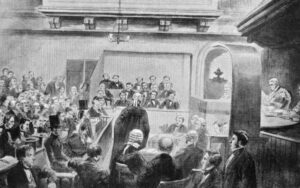
Perhaps the most notable case saw another Smith woman in the dock, the redoubtable and by all accounts beautiful Madeleine, who may, or may not, have laced the cocoa of former lover Pierre L’Angelier with something nastier than a marshmallow past its sell-by date. The trial in 1857 was a cause celebre, as I’m sure the hapless Mr L’Angelier would have called it had he not been the corpse, but the formidable Miss Smith was freed because the jury simply could not bring themselves to fully believe that a lovely young thing from a good family would poison anyone, let alone a fiery foreigner. However, the 15 men clearly could rule out the possibility that she did NOT actually slip the arsenic in the chocolate, so the bastard verdict proved a handy compromise.
(You can find a short account of the case elsewhere on this site).
The notorious case was prefigured by the trial of Christina Gilmour in 1844. Another young woman from a decent family, she also benefited when accused of poisoning her husband and the jury felt it was possible the unhappy man could have killed himself. On the other hand, it was also possible that she had slipped him a lethal mickey or two.
Neither Madeleine nor Christina went on to murder again. Unfortunately the same cannot be said of John Donald Merrett. In 1926 his mother somehow managed to end up with a bullet in her head. She subsequently died of meningitis but Merrett was charged with her murder and forging cheques. He was found Not Proven on the former but went down for a year for the latter.
On his release he squandered his inheritance, changed his name to Ronald Chesney and continued his fraudulent ways. In 1954 he drowned his wife in her bath in order to claim an £8000 trust fund and murdered her mother when she caught him in the act. An international manhunt ended when his body was found in a forest near Cologne with, ironically, a self-inflicted bullet wound to the head.
Not Proven is back in the dock again. Its prosecutors say it is a nonsensical, illogical hybrid that brings closure to neither accused nor victim. Its defenders insist it is a traditional part of Scots Law which must remain and if anything should go, a few of them argue, it’s the Not Guilty option.
Lord McCluskey, one of the wisest heads and safest pair of hands in Scottish justice during recent years, put it this way in 1994, ‘Where the evidence consists of some reliable evidence and the corroboration consists of unreliable evidence…..it is perfectly legitimate for the jury to bring in a not proven verdict.’
It was His Lordship’s opinion that Scots Law would be the poorer if it lost the third verdict.
The jury is still out.