
I began my writing career with journalism and then non-fiction, specialising in true crime and Scottish criminal history. What follows is a short piece about the birth of the Glasgow force I wrote a few years ago to coincide with the publicatuion of my final work of non-fiction, Glasgow’s Black Heart, which chronicled the history of my home city’s underworld from 1800.
The book is now out of print and the rights have reverted to me – so if any publishers fancy doing a reprint, get in touch!
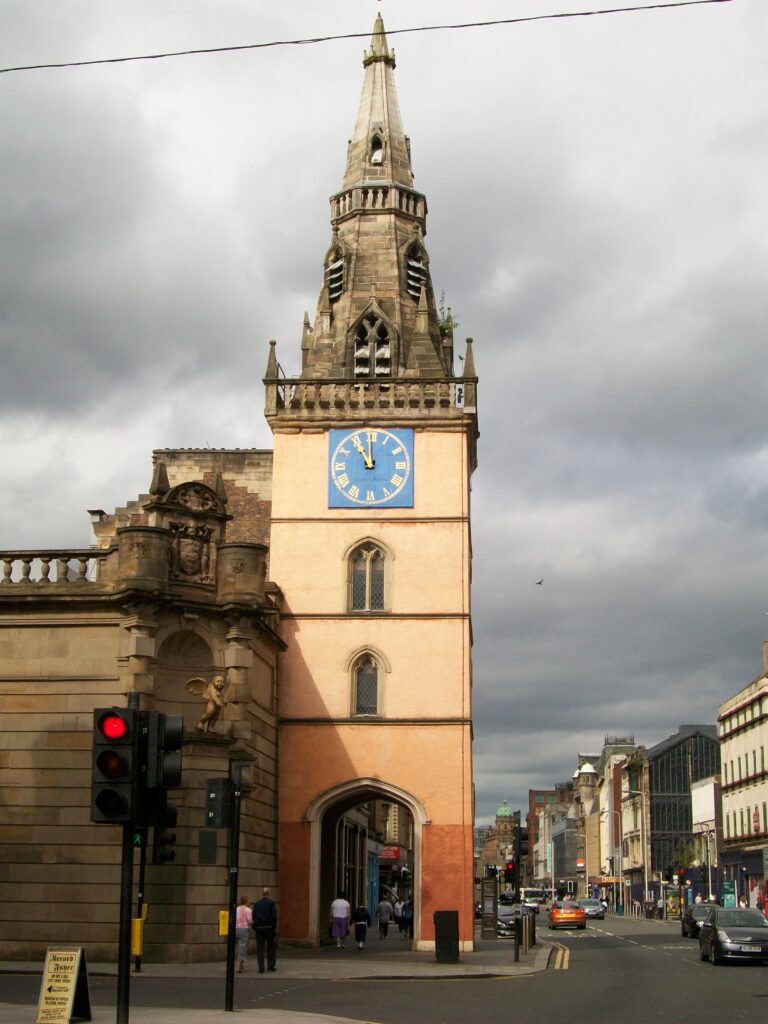
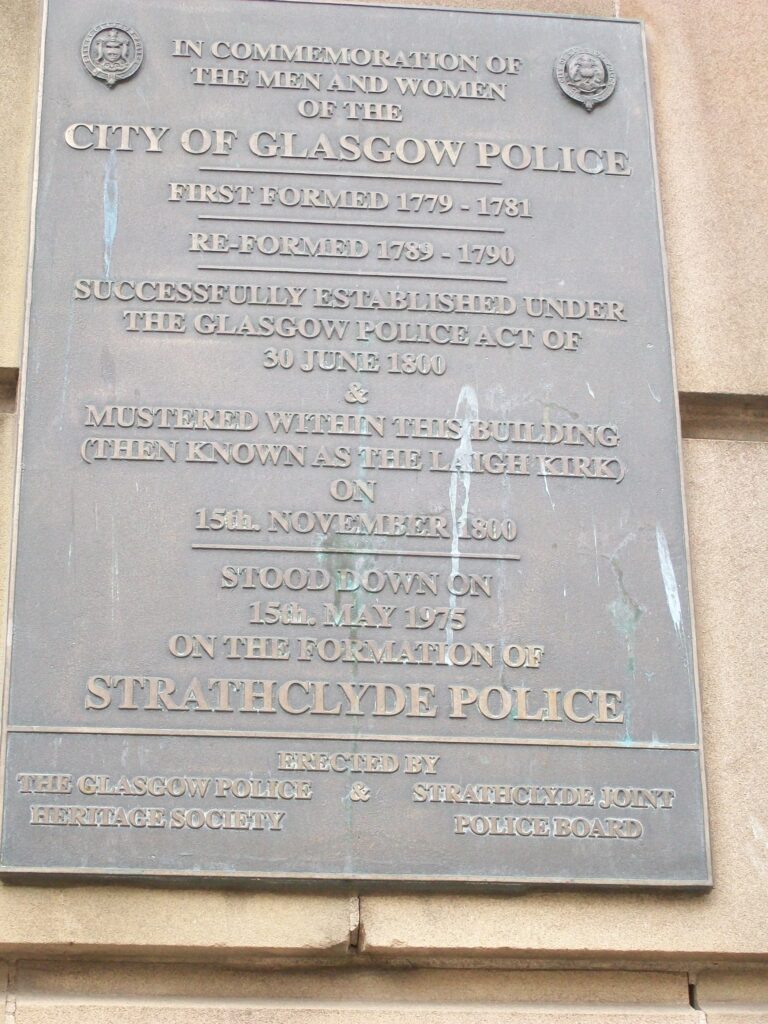
The first members of the Glasgow Police Force met here, in what was then the Session House, in 1800
A few years ago there was a minor fall-out when the Met suggested that it was the longest established force in the country, for Glasgow had one almost 30 years before the ‘Peelers’ were born.
There had been attempts at creating such a force before, notably in 1778 and 1788, but these had foundered. The citizenry recognised the need for a crime-busting body of men but were just not happy with the idea of having to pay for it. The old watchman system had proved insufficient to the growing crime problem. These watchmen, known as ‘Charlies’, were invariably elderly men whose job it was to patrol the streets after dark and raise the alarm in the event of anything untoward occurring. Fond of a tot of rum or two and often found asleep in their guardhouse, they were the butt of many a joke played by the young dandies of the day. On one momentous occasion, in February 1793, members of the notorious Hellfire Club lived up to their name when they set fire to the Session House.
By 1800 Parliament had agreed that a new force be established, at public expense, to police the city streets. Although under the control of the local authority, the tax-payers of the city were to have a say in its running, even to the election of the Master of Police.
On 15 November, 1800, the new City of Glasgow Police Force gathered in the rebuilt Session House. Under the Master of Police, city merchant John Stenhouse, there were two sergeants, six officers and 68 watchmen. The only uniform the latter received was a greatcoat with a number in white on the back, their only weapon a four-foot long stave. The sergeants and the officers, however, were presented with tall hats and a blue coat, vest and breeches.
The boys in blue had been born.
Dr John Aitken, one of the first police commissioners appointed to oversee the new force, said after the first gathering, ‘Our first impression was that the force was so large and overwhelming that it would drive iniquity out of the city as though by a hurricane.’
That hurricane, though, proved to be little more than a puff of air for it would be many years before it would be a force to be reckoned with.
The new force of watchmen was still required to patrol the night-dark streets of the town and call out the hour. In addition, they were also expected to update the inhabitants on the weather. They still had to sweep the streets of all the dung that had gathered during the day. There are police officers today who say they are doing the same thing.
At first they patrolled in large squads but very soon a system of beat patrols was devised and each watchman was given a lantern and candles to light his way. The men, still elderly, tried to use these candles as little as possible so that they could be sold in order to supplement their 10 shilling weekly wage. They were also issued with a rattle which was used to alert other watchmen and the uniformed officers also on patrol. This rattle, very like the kind of thing later used by football fans, was the first method of communication issued to the fledgling force. Later, the whistle, the police box, the radio and the mobile phone would replace it. But in the narrow warren of streets of early 19th century Glasgow, a rattle croaking in the still of the night was all that was needed to have colleagues running – whether it was toward or away from the flashpoint depended on their character and devotion to duty. It may also be the source of the phrase ‘rattled nerves.’
Even though the watchmen still spent too much of their time dozing in the various guardboxes sited on each beat, they did have an effect on Glasgow’s night people. The Session House proved to be somewhat cramped as a police station and so the headquarters moved across the Trongate to the north-west corner of Bell Street and Candleriggs, very near to where the Glasgow Police Museum is now. There, one storey up, the force had a large room and two ‘walled presses or closets’ for prisoners. They also had a large room on the ground floor with a further seven cells. ‘We now thought that there was no danger to us,’ said Dr Aitken, ‘and that we had provided prison accommodation to serve us for a generation.’
Within two years they had to move again, to a former joiners yard in South Albion Street.
After three years as Master of Police, John Stenhouse resigned and publican Walter Graham took his place. His lofty manner, both in attitude and in bearing for he stood at over six foot, soon brought him the nickname ‘the General’. It was his nature that saw him removed from his post two years later when he refused to go out on night patrol. His successor was the equally as tall James Mitchell, a former officer of the Lanarkshire Militia and a stickler for discipline. Although he worked hard to hone his men into a tight unit, they still had a long way to go before they would be little more than the nightwatchmen of old. The police force was not an investigative body in those early days, probing offences being the realm of the Sheriffs, procurators and their officers. However, that did not prevent magistrates at the police court intoning dolefully to those before them, ‘The eye of Almighty God and the Glasgow police will be on you, so be careful of your future conduct.’
The City of Glasgow Force vanished in 1975 into the behemoth that was Strathclyde Police which itself became part of the even larger Police Scotland.