
Many months ago I published here an account of a riot in Glasgow that prefigured the more famous 1919 Bloody Friday in George Square. I promised then I would publish the second part, my account of the events around the latter. Finally, here it is.
Both pieces were taken from my non-fiction book GLASGOW’S BLACK HEART (Mainstream 2009), which is now out of print.
As before, my account was gleaned from the newspaper articles of the time and from other accounts. Yes, I may have made errors of fact but not purposely and not for any political reasons. They would simply be errors.
You can read the first post here:
On 27 January 1919 over 3000 men crammed into Glasgow’s St Andrew’s Halls, where the Mitchell Theatre now stands, for a meeting over the 40-hour week demand. More jammed the streets outside. A call went out for other workers to join the strike and by the end of the month over 60,000 men had hit the cobbles. Shipworkers, steelworkers, factory workers, power workers all rallied round the flag. Only some of the tramworkers resisted the call and kept a service running on the city’s streets.
Flying pickets – teams of men from one industry who targeted workers from another – were employed to urge, or intimidate, doubters into joining the ranks and a daily newspaper The Strike Bulletin was produced.
The government refused to intercede, privately siding with the bosses while officially stating that it was a matter for the two sides to work out. The employers were at first unconcerned, feeling that the dispute would peter out. However, as support grew, the men in power viewed the events with some alarm, many seeing the hand of Bolshevism in it.
The Russian Revolution had taken place in 1917 and the threat of similar events taking place in Western Europe was taken very seriously. Germany had already seen blood flowing in its streets during the uprising by the Spartacists, socialists who took the name of the famed slave who had rebelled against Rome. Events in Glasgow were not designed to overthrow the government, despite the hopes of Glasgow Communist John MacLean, but what happened on ‘Bloody Friday’ did strengthen feeling amongst the working classes against the bosses, the government and the police.
After the meeting in the St Andrew’s Halls, the strikers staged a march to George Square. A band played and the men sang, cheered and shouted slogans as they made their way to the Square via Argyle Street and Buchanan Street, a slightly circuitous route designed to attract more support. The feeling against tramworkers who failed to come out led to one man being arrested for pulling the trolley pole from the overhead power wires. Another man was later fined £8 8s for punching a woman driver in the face in St Enoch Square.
At George Square, Willie Gallacher, Manny Shinwell and other strike leaders climbed onto the square bases of the pillars in front of the City Chambers and delivered more speeches. Gallacher urged those present to convince any doubters to join their struggle.
‘Take them gently by the hand,’ he yelled, ‘and lead them from the evil preserve of their masters.’
A red flag was passed over the heads of the men and handed up to him and he waved it in the air, much to delight of the strikers. It was then run up a flagpole nearby and the centre of Glasgow was filled with the sound of thousands of men and women singing the Communist anthem, ‘The Red Flag.’
Then Gallacher seemed to notice the eyes of the Glasgow police upon them and he addressed the boys in blue, urging them to join the National Union of Policemen, then also in dispute over pay. He said he understood there were more Bolsheviks on the Glasgow force than anywhere.
Strike leaders asked the Lord Provost to appeal to the Government to intercede in the dispute. They gave him until Friday 31 October to come back with a reply.
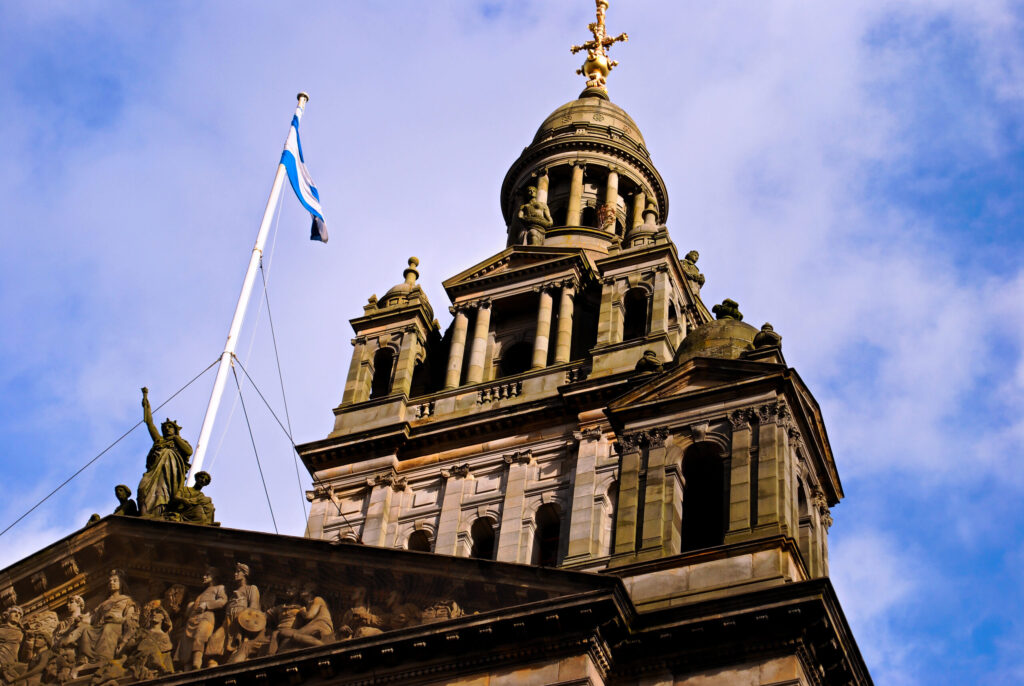
On the Friday, strikers attended a mass rally in the Square. The square, seen now as the city’s heart, had changed from the days when women used to hang their washing on it. It had become in the late 19th century Glasgow’s hotel centre and a line of smart-looking buildings had grown up around it. At either side stood the impressive Merchant’s House building, erected on the site of a hotel in 1877, and the imposing City Chambers. Built in Italian Renaissance style, it is the very image of Victorian magnificence both inside and out. It was designed to tell the world that here was a building that wielded the full power of Empire. Queen Victoria was never a big fan of her nation’s second city, despite having made the first Royal visit (in 1847) since Bonne Prince Charlie over one hundred years before, but she was delighted with the building when she opened it in 1888.
By 1919, the large open Square was mostly paved over and dotted with statues of great men. Former Prime Minister Gladstone was there, Sir John Moore, the hero of Corunna, was there first, Poet Thomas Campbell was there. But pride of place, on a huge column, stands Sir Walter Scott, not a Glasgow man, but taking centre stage nonetheless. It was the presence of the City Chambers and, perhaps more importantly, the Main Post Office on the periphery of the Square that prompted the events of Bloody Friday. Memories of the 1916 Easter Rebellion in Ireland when rebel forces took possession of the Dublin post office building remained fresh and the authorities were fearful that the strike was merely the precursor to an uprising.
There had been a cold rain the night before and the 60,000 men, women and children crowded together on the paving stones and floral areas, thousands of feet churning the earth into mud. They already knew of the Government’s refusal to intervene for it had been printed in the morning papers but the leaders duly met with the Lord Provost anyway to hear it officially.
It was while Shinwell and Kirkwood were in the City Chambers that the strikers saw files of police officers lining up around them. In the enclosed square behind the imposing council building another force of officers, some on horseback, waited. The Mounted Branch was not formed until August 1924 but former Chief Constable James Smart had bought a number of saddles and horses were hired.
Chief Constable Stevenson himself was in charge on the day. He had already attracted controversy as the first non-Scot to be appointed to the position. A tough Irishman, he had proved his hard-nosed credentials on his home soil by wielding an iron fist in sectarian disputes. Events this day would not change his reputation. The government refused to interfere with the process because, they said, the strike was ‘unofficial’. As labour leader William Gallacher addressed the crowd, thousands more converged on the square – men brought their wives and children and the police grew restless in the electric atmosphere.
There are conflicting stories as to what sparked the riot. Police sources claimed that strikers prevented trams from moving around the Square and when politely asked to stop they turned ugly. Labour leaders said that police had allowed the trolleys to turn into the crowd, resulting in two men being knocked down. When organisers asked them to stop traffic, the attack began. Another version claims that the sight of a scarlet flag flying above the crowd made the police see red.
Whatever the cause, the officers around the square led the onslaught, clubbing civilians down. When strike leader David Kirkwood emerged from the City Chambers he was battered to the ground and subsequently arrested. Manny Shinwell was luckier – he was surrounded by a phalanx of strikers and moved clear of the carnage.
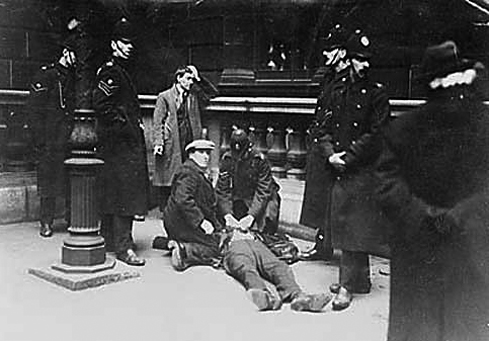

After the initial shock, the strikers regrouped and fought back. The now traditional weapons of rioters in the city – iron railings – were hauled from the ground and men who were used to battle in the muddy ditches on the Western Front showed their mettle. Bottles were liberated from a truck and used as missiles. Willie Gallacher pushed his way through the sea of blue, grey and red to launch a personal attack on the Chief Constable. Still the police moved forward like a well-ordered machine, the piston-like rise and fall of their batons leaving the Square dotted with the prone figures of men, women and children. Lists of the injured later showed that most of the wounds were to the head and scalp. The police were outnumbered though and their ranks withered and broke.
However, they were simply the shock – the awe was yet to come.
Chief Constable Stevenson called in the reserves forces waiting behind the Chambers. The mounted officers surged from their hiding place and charged into the throng. Strike literature claimed that ‘in a display of trick riding, two of them allowed their horses to fall.’ This seems unlikely and the ‘trick riding’ claim merely a means of excusing the attack on the fallen officers and animals.
Sheriff Principal McKenzie tried to bring order by reading the Riot Act, which prohibited gatherings of 12 or more people if they were behaving ‘riotously and tumultously’, which certainly covered the behaviour that day – on both sides. The Act, first passed in 1714, told offenders that force would be used if they did not disperse within an hour, although this could be ignored if the authorities deemed it necessary. Force had already been used and the paper was snatched out of McKenzie’s hands, while a well-aimed bottle hit him on the arm. It was the last time the Act was read in Scotland.
The police began to gain the upper hand and Gallacher and Kirkwood, although in custody, were allowed to address the crowd, urging for calm and telling the strikers to leave George Square and regroup on Glasgow Green.
‘We are asking you to go on the march, for God’s sake,’ cried Gallacher. ‘Are you going to do that for us?’
The men gave a throaty answer in the assent and began to drift away, only to regroup in North Frederick Street. They marched to Glasgow Green via Glassford Street, the Trongate and the Saltmarket, gathering further numbers as they went. Trams were halted, boarded and wrecked, windows were smashed – particularly in the Court Buildings and the Central Police station, which had moved to the Low Green (Turnbull Street) in 1906.
Anything that could be used as a weapon – railing, bottle, stick – was pressed into service when police charged again in Clyde Street. Further running battles took place on the Green and feelings continued to run high. When darkness fell, gangs of looters came out to pillage shops and stores. The cold January night was filled by the guttural roar of angry voices and the shrill shriek of police whistles.
In the aftermath, the government, now certain that a workers revolution was taking place in Glasgow, despatched 10,000 troops to patrol the city. They may even have been in transit prior to the riot beginning. Scottish soldiers of the Highland Light Infantry were locked into Maryhill Barracks for fear that they might revolt and join forces with the workers. According to legend, tanks rumbled through the streets from their garage in the Saltmarket and machine-gun posts were set up on rooftops while nervous and inexperienced young soldiers with bayonets fixed marched past surly Glaswegians.

There had been trouble in another part of Lanarkshire that day. A crowd of up to 6000 men tried to picket the coalfields, coming up against a small army of police officers at Bellshill Cross who staged a baton charge. Eight strikers were subsequently arrested.
The Strike Bulletin called the events of Bloody Friday ‘a brutal attack on defenceless strikers.’ The police, it said, had ‘once more been used as hirelings to bludgeon the workers’ and the events looked like ‘a prearranged affair by the master class’ to satisfy their ‘lust for broken skulls.’ The Manifesto of the Joint Strike Committee, sent afterwards to trade union offices across the country, called the events a ‘dastardly attempt to smash trade unionism.’ It read:
‘Three years ago we were told by spokesmen of the employers that, after the war, the workers would have to be content with longer hours. Here then is the secret of the determination to crush by any and every means attempts to secure shorter hours.
‘The organised workers of Scotland put forward an orderly and legitimate demand for the Forty Hours. The government’s reply is bludgeons, machine-guns, bayonets and tanks. In one word, the institution of a Reign of Terror!’
David Kirkwood, Manny Shinwell, William Gallacher and other strike leaders were charged with incitement to riot. After a trial that lasted for 11 days, with a total of 12 men in the dock, only Shinwell and Gallacher were jailed, the former to five months, the latter to three. Kirkwood was able to prove, by using photographs, that he had not been involved in the riot, having been halted forcibly by a police baton as soon as he rushed out of the City Chambers. Despite a well supported public petition against the sentences, the Scottish Secretary Robert Munro had deemed the strike and its aftermath a ‘Bolshevist uprising’ and refused to budge.
On 10 February, the strike was abandoned having failed to reach the national proportions its leaders had hoped. They did not win their 40 hour week but there was a concession for engineers and shipbuilders of a 47 hour week. Years later, William Gallacher said that in hindsight perhaps they should have pressed for revolution. ‘Revolt was seething everywhere, especially in the army. We had within our hands the possibility of giving actual expression and leadership to it, but it never entered our heads to do so. We were carrying on a strike when we ought to have been making a revolution.’
The events of 31 January 1919 damaged the always delicate relationship between the police and the ordinary working man. The mutual distrust would continue, despite the fact that, apart from an incident during the General Strike of 1926, police were not again used to suppress a dispute until the bitter Miners Strike of 1984. It has often been argued by critics that Governments look after the police to allow them to be used in such a way. What is not widely known is that in 1919, the police were themselves unhappy with their lot. However, in July, a report recommended that a constable’s pay should start at £3/10 shillings a week, rising over ten years to £4/10 and then further long service rises. Glasgow officers accepted the offer, although their colleagues in other parts of the UK were less inclined. In London and Liverpool, police officers went on strike – and many were subsequently sacked.
Manny Shinwell and David Kirkwood enjoyed a long career in politics, with both being elevated to the House of Lords. Gallacher, an ardent Communist – although elected as MP for West Fife in 1935 – received no such honour. In October 1925, Special Branch officers travelled from London to arrest him in his Paisley home. The authorities were cracking down on the Communist Party of Great Britain, of which he was a founding member, and had staged various raids in London. He and fellow executive member Thomas Bell, arrested in Glasgow, appeared in court and were then whisked down to London to face trial. The Branch took the view that the Party was financed by Russia and its principal aim was the overthrow of the British government. They, and MI5, wanted membership made illegal. Gallacher and eleven other committee members were charged under the 1797 Incitement to Mutiny Act in that they had ‘unlawfully conspired together to utter and publish seditious libels and to incite divers persons’ to commit breaches of the act ‘against the peace of our lord the King, his Crown and Dignity.’ All twelve were later found guilty at the Old Bailey and Gallacher, thanks to his previous record, was sentenced to 12 months in prison.
On 1 June, 1919, a young man who should have enjoyed a long career died. Constable William McGregor, aged 26, succumbed to injuries he had received during riots six months earlier, which could only have been the George Square incident.
