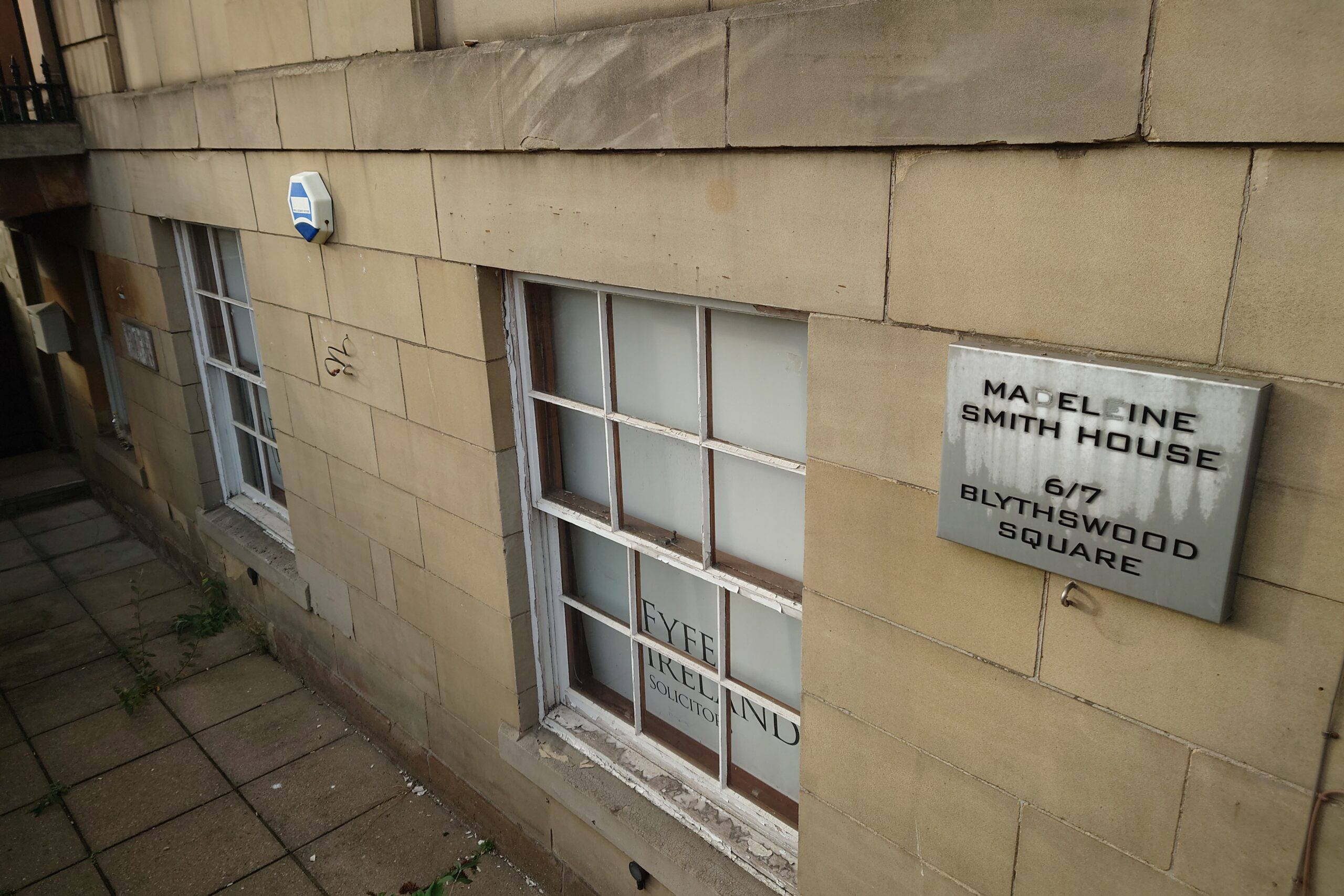
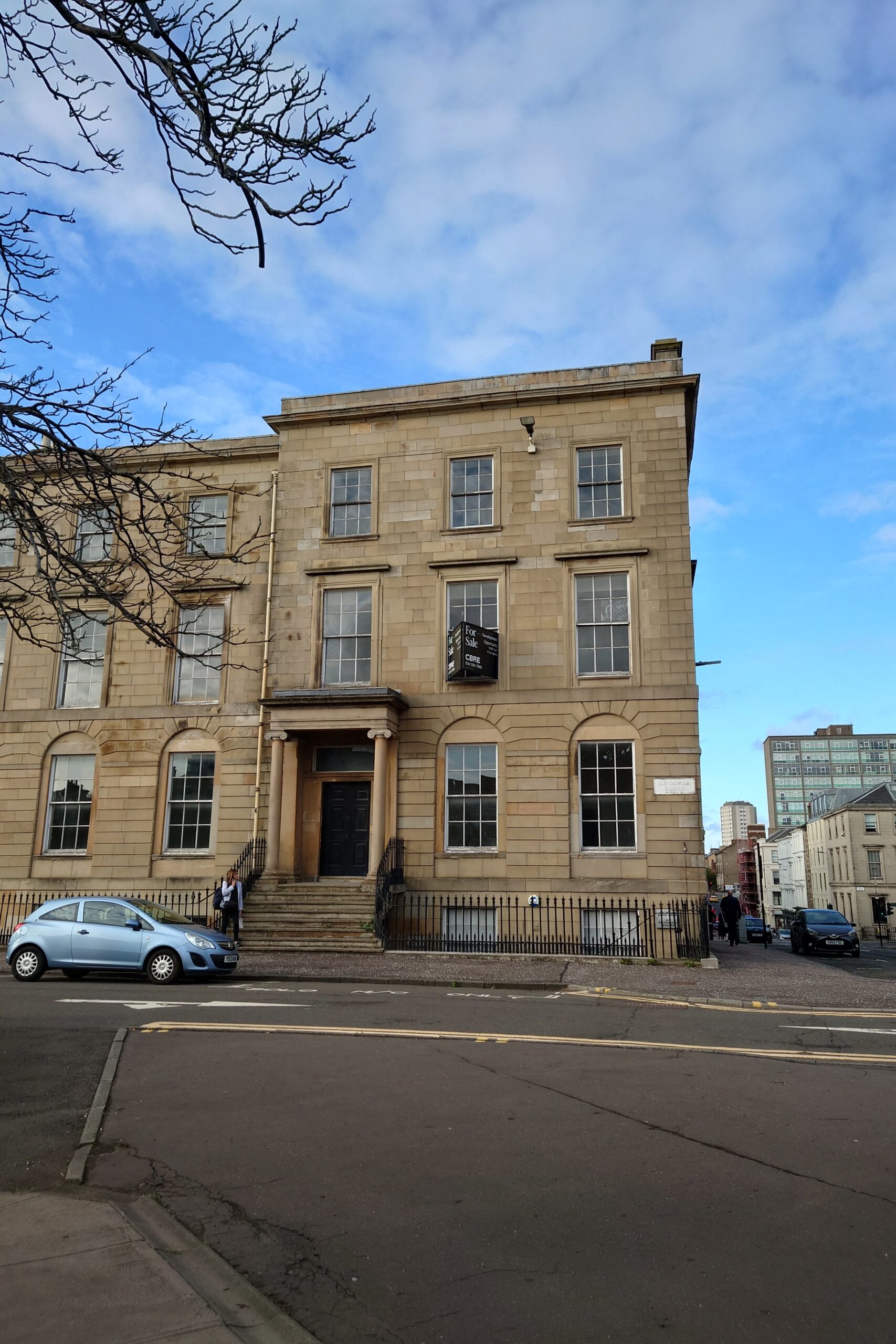
Yesterday I passed the house where, in the 19th century, a young woman is said to have fed her former lover poison and murdered him. I wrote about the case, and others, in my non-fiction book ‘Deadlier Than the Male’ (available in ebook form) and then, later, in ‘Glasgow’s Black Heart’ (now unavailable).
Here is my original, unedited, account from the latter. Any errors of fact are mine.
It’s probably one of the most notorious trials in Scottish legal history. At its centre was a young, beautiful woman from a good family. It involved the use of arsenic and the removal of a man who was, quite simply, in the way. It scandalised Victorian society with its heady mix of passion, sex and murder. There have been articles and books and plays and at least one film, directed by none other than David Lean.
The question remains, though – did Madeleine Smith kill her lover?
She was only 19 when she first met Jersey-born Pierre Emile L’Angelier. He was a lowly clerk in a seed merchant’s warehouse and as such was no match for the eldest daughter of wealthy Glasgow architect James Smith. Educated at a London boarding school, she was a fine beauty, with fair skin, dark eyes that could entice any man and long hair ‘of polished ebony’. She liked to flirt and she liked to enjoy herself and her beauty mixed with a powerful personality meant she could have her pick of the eligible men in Glasgow. But she was also feisty, single-minded and adventurous and each of these qualities would come to the fore over the next two years.
L’Angelier had engineered a meeting in April 1855 through a mutual acquaintance and she had been captivated by his Gallic charm. Ten years older than the girl he would come to know as ‘Mimi’, he had spent some time in Paris during the revolution of 1848, serving with the National Guard. This appealed to the 19-year-old girl’s repressed Victorian romantic spirit. Although experienced in the intrigues of l’amour, it is to his credit that he did not see the redoubtable Miss Smith as just another conquest. He wanted to make her Mrs L’Angelier in a proper manner and that meant with the permission of her parents. His station in life, however, precluded the stern Mr Smith from even countenancing such a match and Madeleine was forbidden from seeing the handsome pen pusher again.
Madeleine, though, was not the girl to meekly accede to such an order. She continued to see Pierre. She smuggled him into the family home, first in India Street and then, from 1856, in Blythswood Square.
When the Smith family went to Rowaleyn, their summer home in Row (present day Rhu on the Clyde near Helensburgh), he followed and the couple kept up their midnight liaisons. At some point, probably in the wooded gardens around Rowaleyn, the relationship grew physical – a fact that would scandalise the court the following year. ‘My own, my beloved husband,’ Madeleine wrote afterwards, ‘if we did wrong last night it was in the excitement of our love….I did not bleed in the least last night but I had a good deal of pain during the night. Tell me, pet, were you angry at me for allowing you to do what you did…?’
L’Angelier may not have been angry but he was certainly disappointed. He seemed to find fault in many things she did and she was forced to grovel at his feet for forgiveness. Her letters in the early stages are peppered with phrases like, ‘I ought never in any way to vex or annoy you’, ‘If I do anything wrong and you check me, I shall never, never do it again…you shall love me and I shall obey you’, ‘It is my duty as a wife to do so. I shall do all you want me.’ She talked of her faults and how he would correct them. She talked of being his ‘wife in every sense of the word’ – a clear sign that their relationship was sexual. Even that was thrown back in her face for he blamed her completely for their having succumbed to their passions. ‘I am sad at what you did,’ he wrote to her, ‘I regret it very much. Why, Mimi, did you give way after your promises?’ He even obliquely suggested that she was not a virgin. ‘I do not understand, my pet, your not bleeding for every woman having her virginity must bleed,’ he wrote. ‘You must have done so some other time. Try to remember if you ever hurt yourself in washing, etc.’ He did not trust her and often reproached her for flirting, so he must have been spying on her for the parties and balls to which she would be invited were closed to him. But then, they had mutual acquaintances and, in the beginning at least, even members of the Smith household were aiding and abetting them in their affair.
Madeleine, though, was cooling. She was young, she was flirtatious and the constant belittling finally got to her. Apart from that, someone else had been paying her attention. Merchant William Minnoch lived next door to her family in Blythswood Square and was, in the eyes of her father at least, a much more desirable candidate for son-in-law. Madeleine thought so, too, and tried to break off the relationship with Pierre but he would hear nothing of it. She was his Mimi and if she tried to end things then he would take her letters – her passionate, revealing, indelicate letters – to her father and her new beau. Once her base nature was revealed would the upright Mr Minnoch still be as interested? L’Angelier stalked her, watching her whenever she was out with Minnoch or her family. Madeleine somehow found her ardour for him returning and she continued her correspondence and the illicit meetings. When he could not creep into the Blythswood Square house, he stood outside her basement bedroom window and accepted hot chocolate through the bars.
Then L’Angelier began to take ill. In February 1857 he fell victim to sharp, piercing abdominal pains and vomiting. The symptoms returned twice in March – and after the third attack he was found dead in his room. His friends and his employers were suspicious of this sudden and lethal decline in his health and demanded a post-mortem. His body was exhumed from the Ramshorn Kirkyard and examined. The man’s stomach revealed 82 grains of arsenic. Madeleine’s letters were found and the procurator-fiscal decided that he had his culprit. But Madeleine, perhaps seeing the writing on the wall, had taken flight. She did not get far, though, for her brother and William Minnoch found her on the steamer heading for Rowaleyn. Within days she was arrested and remanded for trial in Edinburgh – Glasgow’s courts still not yet good enough for such high-profile proceedings.
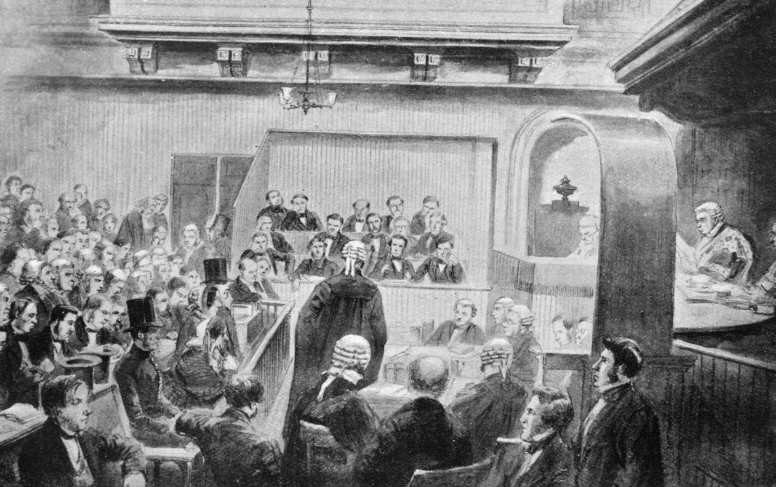
The trial lasted nine days during which the Crown tried to paint a picture of a cold-hearted young woman who purchased arsenic, ostensibly for the poisoning of rats, but who served it to her erstwhile lover in dishes of cocoa. Since the Arsenic act of 1851, all purchases of the substance had to be made by persons over the age of 21 and known to the chemist. The substance itself, white in colour, had to be stained with either soot or indigo and the purchaser’s details recorded in a poisons book. None of these regulations prevented Miss Smith from obtaining the poison, which she later claimed she used in diluted form as a cosmetic to wash her face, arms and neck. It was certainly common for women to tone up their complexion with arsenical-based lotions. Both sexes also used arsenious acid as a tonic and it was prescribed as a treatment of fevers. L’Angelier on more than one occasion claimed he was ‘an arsenic eater’, taking it to improve his health and his appearance. The defence used this to suggest that perhaps he had poisoned himself. He was also in the habit of suffering from stomach trouble. (A later theory suggested that L’Angelier had visited a spa where the medicinal waters might have been thick with the poison).
The main problem facing the Crown was that although they had motive – the victim had become something of a liability to her future happiness and had threatened to betray their liaison to her father and her new suitor – they could not prove Madeleine had even seen L’Angelier on the three occasions specified in the indictment, let alone given him a drink laced with poison. Medical evidence was also contradictory. The defence experts thought that given the amount of arsenic found in the stomach there should also have been traced of soot. It was also suggested that L’Angelier would have tasted the mixer, or least felt it scratching his throat. In their mind it followed that, before he died, he would have mentioned something to his landlady or the doctor who attended him. The Crown’s experts refuted this, saying the soot would have evaporated and the strong cocoa would have masked the taste.
There was also a diary kept by L’Angelier in which he wrote, ‘Thursday, 19th February. Saw Mimi a few moments. Was very ill during the night. Friday 20th February. Passed two pleasant hours with Mimi in the drawing-room. Saturday 21st February. Did not feel well. Sunday, 22nd February. Saw Mimi in the drawing-room. Promised me French Bible. Taken very ill.’ The defence, naturally, did not want this book allowed into evidence. They battled hard to have it excluded – and won. It was felt that had L’Angelier been alive to give evidence then it would have been admissible because he would have been open to cross examination. However, had he been alive, the point would not have been debated in the first place. Madeleine did not deny on a few occasions giving L’Angelier cocoa but added, ‘I never administered, or caused to be administered, to Mr L’Angelier arsenic or anything injurious, and this I declare to be the truth.’
Public sympathy was with Madeleine. The case itself filled prodigious amounts of newsprint and her cause was further strengthened by the fact that L’Angelier was a foreigner. Even writing some years after the event, F. Tennyson Jesse called him ‘that little, scheming, sensual, iron-willed lady-killer.’ Madeleine, though, captivated all who saw her. One contemporary report said she entered the court ‘with the air of a belle entering a ballroom or a box at the opera. Her steps were buoyant, and she carried a silver-topped bottle of smelling salts. She was stylishly dressed, and wore a pair of lavender gloves.’
The defence also reminded the jury that murder was a capital crime. Her counsel opened his remarks with ‘Gentlemen, the charge against the prisoner is murder, and the punishment for murder is death.’ Who can say how much the thought of sending the calm, self-possessed young beauty in the dock to the gallows helped convince thirteen of the men on the jury that the case against her was Not Proven. Only two believed beyond the famed shadow of a doubt that she was guilty. Again the courtroom was filled by cheering spectators and the judges called for order.
Madeleine Smith, still calm, still dignified, was taken from the court by her brother through a side door and spirited away to Rowaleyn. Her parents, who had ‘taken to their beds’ during the trial, were waiting for her, having sought refuge from the scandal in the country. The coldness of her family must have hurt her deeply but she could take some solace in the warmth of feeling from other quarters. In a letter to the Matron of Edinburgh Prison, Madeleine stated, ‘I think I must have had several hundred letters, all from gentlemen, some offering me consolation, and some their hearths and homes.’ She also noted that, ‘the feeling in the west is not so good towards me as you kind Edinburgh people showed me. I think it shall be necessary for me to leave Scotland for a few months…’ She was, though, ‘not at all pleased with the verdict.’
William Minnoch was out of the picture. The letter says ‘My friend I know nothing of. I have not seen him. I hear he has been ill, which I don’t much care.’
So if Madeleine Smith did not kill L’Angelier, what happened? He could have taken the arsenic himself, either as a suicide attempt or, more dramatically but perhaps unlikely, as a way of punishing the woman he loved by framing her for his murder. The suicide angle is strengthened by his reaction to an earlier failed romance, when he threatened to take his own life. He could have taken it by accident – as a known arsenic eater perhaps he just ate too much. He was also painted as a womaniser and even a blackmailer, so perhaps someone else took it into their head to remove him from the earth.
Madeleine later married London artist George Wardle and became part of the smart set, being noted, it is said, for having the daring to uncover the legs of her dining table. It would be interesting to see the faces of her dinner guests if she ever offered them cocoa. Apparently, one who did sup hot chocolate at her naked table was George Bernard Shaw. She subsequently moved to New York, married for a second time, raised a family and died, aged 93, on 12 April 1928. Her gravestone in Mount Hope Cemetery, New Jersey bears the name Lena Wardle Sheehy.