A murder that might not have been murder. A family history filled with tragedy. Illicit love, bigamy, incest. And a daring escape from jail. This is the story of Katherine Nairn and Patrick Ogilvy.

(Adapted from a chapter in ‘Dark Heart, the story of the Edinburgh Tolbooth’ by Douglas Skelton. Now out of print)

In the Tolbooth records for 24 June 1765, there is an entry regarding the warding of Katharine Nairn and Patrick Ogilvie who had until then been in custody ‘in Forfar prison and council rooms which were not sufficient.’ They were to be brought to Edinburgh under ‘sure guard’ and placed in the gaol ‘therein to remain until they are liberated in due course of law.’ Appended to the order was a warning that the jailers were ‘to take the utmost care that (they) be kept separate and have no communication with one another.’

The pair had been charged with both murder and incest. Katherine Nairn came from a good family. Her father was Sir Robert Nairn, Baronet of Dunsinnane, and in 1765 she was married off to Thomas Ogilvy, Laird of Eastmiln in Glenisla, Fife. She was a beautiful 19-year-old girl; wilful, high-spirited and able to captivate any man she met. He was the 40-year-old third son of a family already steeped in tragedy. His Jacobite father had marched with Bonnie Prince Charlie but died during an escape attempt from Edinburgh Castle. His depressed eldest brother had taken his own life. Another brother was crushed to death while serving on a Man o’ War. Yet another, although not dead, brought disgrace to the family by marrying beneath him when he took to wife a porter’s daughter. 

Young Katherine’s arrival at the house should have been the beginning of a brighter future for the Ogilvy family. Instead, it brought more death and scandal. Thomas was not a well man, or rather he appeared to enjoy ill-health, but his young and vibrant wife managed, for a time, to bring him out of his hypochondria. He began to dress well, certainly in a manner more fitting to his station in life, and finally, happiness came to live in Eastmiln.

Naturally, it did not last. Thomas had another brother, Patrick, a Lieutenant in the 89th Regiment of Foot, who came home from the East Indies. He was younger, more dashing and, according to the case against them, it was not long before he and Katherine were sharing more than familial affection. Eastmiln was not a large house – the family and servants lived in four rooms – and if such an intrigue was taking place it would not be long before Thomas heard about it. As it was, Anne Clark, a cousin of suspect motive and dubious virtue, had come to stay and she seemed to have been the prime mover in the telling of tales. There was a falling out among brothers after which Patrick left the family home and, within weeks, Thomas was dead. 

Suspicions fell on his young wife and there were stories of poisons being bought by Patrick Ogilvy and delivered to Eastmiln. Matters were further darkened by the arrival of Alexander Ogilvy, the family black sheep who had married poorly. This failed medical student demanded that the funeral be halted because he had a suspicion his brother had been poisoned.

Alexander had led a far from blameless life and had been partnered, professionally and personally, in the past by Ann Clark. It is possible that she planted the poisonous seeds in his mind that Thomas had been done to death by Katherine and her alleged lover. Given Alexander’s own dissolute habits and lifestyle, it is also not unreasonable to suggest that the murder – if murder there was – had been carried out by Ann Clark herself on his direction in order to inherit the estate. 

He insisted that doctors open the corpse to determine if poison had been used. However, although three different medical men scrutinised the body, not one of them conducted a post mortem and based their comments on an exterior examination only. They decided that poison could have been administered but conceded that the symptoms they found could also have their roots in natural causes.

However, Katherine and Patrick Ogilvy were arrested, largely on the testimony of Anne Clark and at the insistence of Alexander. They were accused not only of murder but also incest, for although they were not blood kin, they were related by marriage and the strict laws prohibited any sexual shenanigans among members of the extended family. They were, as we have seen, locked up in Forfar Tolbooth before being transported to the more secure Edinburgh counterpart. Meanwhile, Alexander looted the estate six ways from Sunday, even though he was not yet legally entitled to do so.

The Edinburgh Tolbooth, the town jail

News of the arrival of the young murderess and her soldier lover reached Edinburgh and a vast crowd gathered at Leith to await her arrival. The person who stepped ashore from the ferry was not the demure, penitent lady they expected, even demanded. Instead, she was a beautiful young woman who laughed with her captors and showed no sign of remorse for her deeds. The crowd grew restive and a black mood settled that perhaps they should teach this arrogant wench a lesson in manners. The authorities had to force their way through the ugly mob to lodge the couple in the Tolbooth.

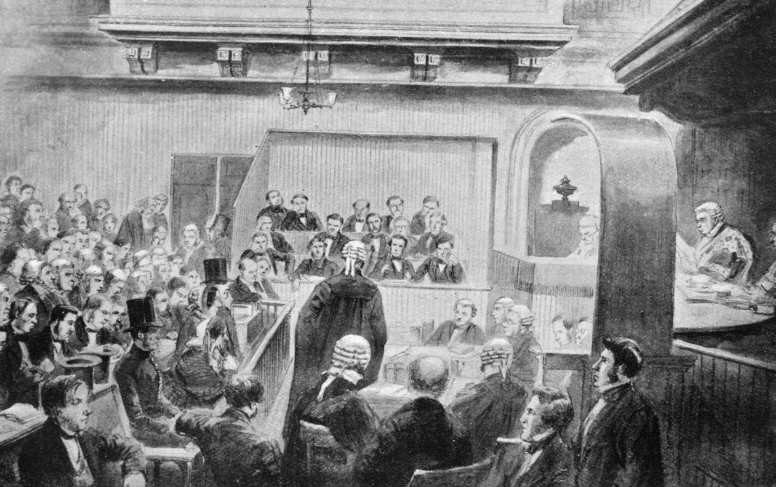
The trial was a farce. The jury was empanelled at 7am on 12 August and, as was the custom then, evidence heard non-stop until 2am on 14 August. The jury wandered about the court room, discussing the case – and no doubt anything else – with witnesses and counsel. As the trial proceeded without a breather, food and drink was necessarily brought in. Three judges sat on the bench on the first day but that whittled down to one, while the other two went off to join the melee in the various parts of the court room. A total of 33 hours was spent listening to the prosecution case but only three to the defence – the judges and jury were simply not interested in hearing what the accused’s lawyers had to say. The accused themselves were prohibited by law from testifying, their words only heard through pre-trial statements.

Much of the damning evidence came from Ann Clark, who had shown great willingness to tell all and sundry that the young couple were guilty but was less than forthcoming to repeat her allegations in court. She had to be taken into custody and kept under lock and key in Edinburgh Castle to ensure her appearance. Unfortunately, she was placed in the same room as servants from Eastmiln who were also due to testify against their erstwhile mistress. There can be little doubt that stories were compared and changed during those hours of enforced captivity. At the close of the trial, the judge, Lord Kames, broke with tradition and summed-up for the jury – the first time this was done in a High Court matter. How fair he was in his summary is open to question, given the prevalent mood in the court. It must come as no surprise that both Katherine Nairn and Patrick Ogilvy were sentenced to death. 

Later, the attitude of the court was criticised in print by an English lawyer, who also lampooned the way the two were charged with two different crimes on the one indictment. Basically, his point was that each of the two charges – one of murder and one of incest – had been used to corroborate the other. 

‘The intrigue was supposed to be certain, because the husband was supposed to have been poisoned; and, on the other hand, the man was believed to have been poisoned, because there was supposed proof of intrigue.’ 

The criticism excited the proud emotions of the Scottish justiciary and the various Scottish publications that had reprinted the article were accused of Contempt (even though the proceedings were done and dusted by that time). The publishers were sharply rebuked but not fined.

The Lieutenant spent his time in his Tolbooth cell perfecting his mastery of the violin. The sad notes he made wafted down the corridors of the Heart of Midlothian and reached the ears of his alleged lover, who had managed a temporary reprieve due to the fact that she was pregnant – by whom is unknown. Ogilvy’s execution was delayed three times as friends tried to have the verdict overturned but to no avail. On 13 November, Patrick Ogilvy was told to lay his fiddle aside for the last time and escorted to the Grassmarket. If he had hoped for a rescue by any of his former messmates, he was to be disappointed for they had been penned up in Edinburgh Castle as a precaution against any such folly. As he stood on the gallows, he continued to proclaim his innocence of the crimes for which he was about to die. As he was turned from the ladder, the rope snapped and he tumbled to the ground. The hangman and a chimney sweep grabbed him and propelled him back up the ladder. A new noose was rigged, this time the drop held and Patrick Ogilvy died. The Society of Tron-Men, the guild of the chimney sweeps, were so incensed at the involvement of their member in this shocking incident that he was drummed from their ranks and banished to Leith for five years.

Katherine Nairn remained in her Tolbooth confinement, enjoying ale, white wine, rum and tea twice a day, until her child, a daughter was born on 27 January 1766. She was visited regularly by members of her family and a well-known midwife named Mrs Sheilds or Shiells. When the child was little more than one month old, the authorities debated on whether her mother was strong enough yet to be put to death. A decision was delayed for seven days. Katherine and her family knew that if something was to be done, it would have to be done soon.

On 15 March, Katherine Nairn vanished, leaving her infant daughter behind. The official version at the time was that she simply walked out of her unlocked cell. Some say she wrapped her slim body in a man’s great coat. 

The most likely method of egress was fulfilled with the connivance of Mrs Shiells, who had continued to visit the new mother. She had feigned a toothache for some time and a large scarf had become something of a fixture over her face. All Katherine had to do was swap clothes with the midwife, swathe the cloth around her face and hobble out of the gaol, apparently receiving a slap on the behind from a turnkey and dismissed as ‘a howling old Jezebel.’

Any legal moves against the midwife when the escape was discovered the following day are not recorded.  It is known she continued in her professional duties, bringing many respected Edinburgh men into the world and hinting to some that there was more to the escape of Katherine Nairn than was generally known. This suggestion that the break-out was ‘winked at’ is underlined by the means with which the fugitive avoided capture.

As has already been stated, she came from a good if not overly wealthy family – hence the need for her marriage to the comfortable but not terribly well-placed Thomas Ogilvy. Her uncle was William Nairn, a respected layer who was at that time Commissary Clerk of Edinburgh and was later promoted to judge when he adopted the title Lord Dunsinnane. Clearly, he was a man not without influence in the Scottish judicial establishment and strings were probably pulled to ease his niece’s departure. 

On leaving the Tolbooth, she was said to have knocked on the door of a house in James’s Court she thought to be that of her father’s lawyer but was in actual fact the home of Lord Alva. The servant who opened the door had supposedly attended the trial (even though it was held in private) and recognised her immediately. He raised the alarm and Katherine, still in her midwife’s garb, scuttled off to the home of her uncle. According to the tale later told, he hid her in a cellar until the furore had passed and it was felt safe enough to smuggle her out of the city in the company of his clerk. 

However, a more likely story is that a coach and horses was waiting for her at the foot of Horse Wynd as soon as she left the Tolbooth. As it sped from the city, she changed into the clothes of an officer, complete with cocked hat, but still caused her companion, James Bremner, some disquiet due to her frivolous manner. Chambers in his Traditions claims that the coachman was ordered to drive the carriage into the sea and drown his passenger if any pursuers managed to catch up with them. 

After that, nothing definite is known of Katherine Nairn, but rumours there are a-plenty. She went to the Continent, they say, and married a French nobleman. She moved to America and died, old and happy, surrounded by her grandchildren. She came through the French Revolution and died in England. She entered a convent in France, or England, and died in regret for her past sins. Her end is as much a mystery as the alleged crime itself, for it cannot be stated with any certainty that Thomas Ogilvy was murdered – although Patrick did buy arsenic in Brechin and sent it, or at least some substance, to Katherine at Eastmiln. But arsenic had other uses then. There is no firm evidence linking them either to murder or incest as most of the damning testimony came from Anne Clark, a woman who, by all accounts, had little more than a nodding acquaintance with the truth. 

The baby daughter born in the Tolbooth died there two months later. They say she was ‘overlaid’, that is smothered, but no-one knows by whom. Mrs Shiells continued to practice her arts until 1805. Anne Clark vanished from history but her proclivities were unlikely to have kept her out of trouble. Alexander Ogilvy, the rascally brother who may or may not have conspired with her either in murder or at least in manoeuvring events to his own ends, failed to profit from his brother’s death. Although he had sold off parts of the estate before Patrick was executed, he was prevented from doing further harm by a court order raised on behalf of her unborn child by Katherine Nairn. On 11 March, 1766, he found himself in the Tolbooth at the same time as his sister-in-law but his crime was one of bigamy. He was legally married to the porter’s daughter, Ann Rattray, but had ‘taken up with one Margaret Don (or Dow), late a milliner’s apprentice and has procured himself to be married to (her) on the twenty-fourth day of February last.’ He pled guilty to the charge and was banished from Scotland for seven years. He was given two months to put his affairs in order and it was during that time that he leaned too far out of a window in one of Edinburgh’s tall tenements and plunged to his death. It is tempting to imagine the shadow of Anne Clark behind him in the room, assisting him in his flight.

They called them bodysnatchers but they weren’t. They were murderers. And they didn’t work alone.

SCOTLAND is only a small country but it has many cases of foul murder that continue to excite the imagination and send gallons of printers ink flowing like blood across acres of paper.

The story of Madeleine Smith is one of ever-lasting mystery.

The trial of Oscar Slater, wrongly convicted of murder in Glasgow, is one of ever-lasting shame.

Peter Manuel is perhaps the most terrifying for not only did he target young girls walking alone but also crept into the homes of innocent people and slaughtered all he found.

Shadowy Bible John, who may have killed at least three women, still haunts the minds of Glaswegians.

But of all the oft-repeated tales of murder, both single and mass, one notorious case resounds through the decades and echoes around the world. It is the first properly documented case of multiple murder in the country and simply naming the two men involved conjures images of a dark and noisome city, of conspiracy and cover-up, of deprivation and decay and death.

Burke.

Hare.

They have been called bodysnatchers and resurrectionists but they were not. The moonlight trade of graverobbing was not for them. They found an easier way to provide their favoured anatomist Robert Knox with study tools and at the same time line their own pockets. Murder was their business and business was brisk. Their death tally has been placed as high as thirty but the most commonly accepted figure is 16, all committed in a period of a few months. 

They did not work alone, however. What is often sidelined in popular retellings of the tale is that there were two other persons involved. They were with the men during the killing time and although they may not have been involved in the actual murders they did benefit from them.  

Helen McDougall and Maggie Laird were, respectively, the wives – if only by bad habit and ill repute – of Burke and Hare.

And they were up to their necks in those dark deeds of 1828 Edinburgh.

OF the principal dancers in the ballet of death that was to follow, only Helen McDougall was a Scot, born in Redding near Falkirk. She had once been an attractive woman but the life of a poor woman in early 19th century Scotland had taken its toll on her features, although when news of the mass murder hit the newspapers she was described as still being ‘tolerably good-looking.’ She took her surname from a man with whom she had once lived and was already the mother of two when she turned to prostitution. What happened to the two children is unknown. Perhaps they stayed with their natural father, or perhaps they were sent out for adoption, or died. Life was hard on adults in those days; it was brutal on the young.

Around 1818/1819 the countryside around Falkirk was filled with Irishmen who had come to Scotland to eke a hard living out of digging the Union Canal, which was to link the Forth and Clyde waterway with Edinburgh in the East. It was backbreaking work but the men, the famed Irish navvies, had fled the dire poverty of their homeland in search of employment. They were hard workers and, more importantly for the employers, they were cheap. This of course did not endear them to the native workforce who often saw them as sub-human.

Human nature and the sex drive being what it is, where there were large bodies of men there were the bodies of women ready to see to their needs – for a price. Helen McDougall was one such woman and it was during this time she met young Irishman William Burke. He had departed his Country Tyrone home, leaving behind his wife and two children, in order to seek his fortune but all he found was the sweat and strain of working in the ditches. 

Helen McDougall must have been attracted to the squat little Irishman with the piercing dark eyes and the love of dancing for he first became a client, then a regular, then, finally, her one and only. Despite his tendency to slap her around, there appeared to be some genuine feeling between the two, for even while he was languishing in the condemned cell in Edinburgh, Burke sought to excuse her from their crimes. 

After four years of working on the canal, the pair dodged around central Scotland and, by 1827, found themselves in Edinburgh, repairing and dealing in second hand boots and shoes. One day in the street they met  an Irish woman called Maggie Laird, who was known to Burke. 

The two had become three.

One contemporary chronicler deliciously described Laird as ‘a poor, miserable, boney, skinny, scranky, wizened jade.’ Clearly she was not as attractive as Nelly McDougall but was just as free with her favours, although unlike Nell she did not take it up professionally. Maggie was a tough customer and had laboured on the canal herself, wielding a pick and shovel, digging out the hard Scottish earth with the best of them. 

Once she set aside her spade, she took up with a man called Logue who ran a down-at-heel lodging house in Tanner’s Close in the area off the Grassmarket known as the West Port. Lodging house is a grand name for what Logue – and many others like him – provided in the filthy, stinking old town. Basically he charged for a leaking roof and a bed of dirty straw that could be shared by up to three people and all the lice they could kill. If patrons did not like what was offered they could move on and God damn their eyes, for there was seldom a shortage of people looking for somewhere to lay their head for a few pence a night. The ragged and the filthy, the poor and the desperate, the honest and the crooked – they were all flooding into the nation’s cities in search of a new life or work or simply a place to hide. 

By the time Laird met up with Burke and McDougall in the street, Logue had died and she had a new squeeze – a man named William Hare.

Hare had also come over from Ireland to graft on the Union Canal and, like the man who was soon to become his partner in crime, gravitated towards Edinburgh where he found labouring work and a bed in Logue’s house. It was here that he first met Maggie Laird, although it is possible he had known her, like Burke, while working on the canal. The two took a fancy to each other and Hare was soon giving her something more than thruppence a night. They were a well-matched pair, for she was no prize and he was far from the answer to a maiden’s prayer – even though Maggie had not been a maiden for many a long year. One contemporary description states the lanky Hare had ‘dull, blackish, dead eyes’ and a ‘coarse-lipped mouth’ which, mixed with his high cheekbones and sunken cheeks, inspired ‘disgust and abhorrence, so utterly loathsome was the whole look of the reptile.’ 

Naturally, Logue took a dim view of the liaison between his woman and the newcomer so sent Hare packing. But after he died Hare was back under the roof and in Maggie Laird’s bed. He, like Burke, was a bit too free with his fists when it came to women and it is said that Maggie Laird was often seen sporting a pair of black eyes. 

And so, during the street conversation and subsequent visit to a tavern, Burke told Laird he and Helen planned leaving Edinburgh for the west, where Burke hoped to set up business as a cobbler. Laird suggested they lodge in Tanner’s Court for a while. There was a room available, she said, and perhaps Burke could try his luck in Edinburgh. There they met William Hare, now styling himself landlord.

And the three became four.

Burke and Hare, both Irishmen, both former navvies, seemed to bond immediately. They made an incongruous pair – Hare was tall and cadaverous, the archetypal ghoul; Burke was short and thick-set with an air of respectability. The women were another matter, for Maggie Laird never fully trusted Helen McDougall. Perhaps it was a racial thing, for Helen was Scottish and many Irish people, particularly Irish Catholics, had first hand experience of prejudice at the hands of the natives, the flame lit by John Knox still burning bright. Perhaps Maggie did not like the idea of having a former prostitute under her roof. Perhaps she had an eye for Burke herself, for it would appear he was the better-looking of the two men – but then, compared to Hare, Quasimodo was a matinee idol.

Business boomed in the lodging house for every day there seemed to be a new influx of transients flooding the city. They joined the thousands living in the tall tenements that clustered round the castle like ticks on a stray dog. They filled the many taverns and drinking dens that lined the roads and alleys.  They clogged the streets, wading through the sewage that ran openly in the gutters and dodging the fresh filth tossed from the windows above. Death and disease walked hand in hand here and often stepped into the overcrowded lodging houses. 

It was sickness that would give the new friends their first item of merchandise for butcher Knox.

Extracted from a chapter in ‘Deadlier Than the Male’, by Douglas Skelton, published 2003 by B&W)

(Click here for part two)

Yesterday I passed the house where, in the 19th century, a young woman is said to have fed her former lover poison and murdered him. I wrote about the case, and others, in my non-fiction book ‘Deadlier Than the Male’ (available in ebook form) and then, later, in ‘Glasgow’s Black Heart’ (now unavailable).

Here is my original, unedited, account from the latter. Any errors of fact are mine.

It’s probably one of the most notorious trials in Scottish legal history. At its centre was a young, beautiful woman from a good family. It involved the use of arsenic and the removal of a man who was, quite simply, in the way. It scandalised Victorian society with its heady mix of passion, sex and murder. There have been articles and books and plays and at least one film, directed by none other than David Lean.

The question remains, though – did Madeleine Smith kill her lover?

She was only 19 when she first met Jersey-born Pierre Emile L’Angelier. He was a lowly clerk in a seed merchant’s warehouse and as such was no match for the eldest daughter of wealthy Glasgow architect James Smith. Educated at a London boarding school, she was a fine beauty, with fair skin, dark eyes that could entice any man and long hair ‘of polished ebony’. She liked to flirt and she liked to enjoy herself and her beauty mixed with a powerful personality meant she could have her pick of the eligible men in Glasgow. But she was also feisty, single-minded and adventurous and each of these qualities would come to the fore over the next two years. 

L’Angelier had engineered a meeting in April 1855 through a mutual acquaintance and she had been captivated by his Gallic charm. Ten years older than the girl he would come to know as ‘Mimi’, he had spent some time in Paris during the revolution of 1848, serving with the National Guard. This appealed to the 19-year-old girl’s repressed Victorian romantic spirit. Although experienced in the intrigues of l’amour, it is to his credit that he did not see the redoubtable Miss Smith as just another conquest. He wanted to make her Mrs L’Angelier in a proper manner and that meant with the permission of her parents. His station in life, however, precluded the stern Mr Smith from even countenancing such a match and Madeleine was forbidden from seeing the handsome pen pusher again. 

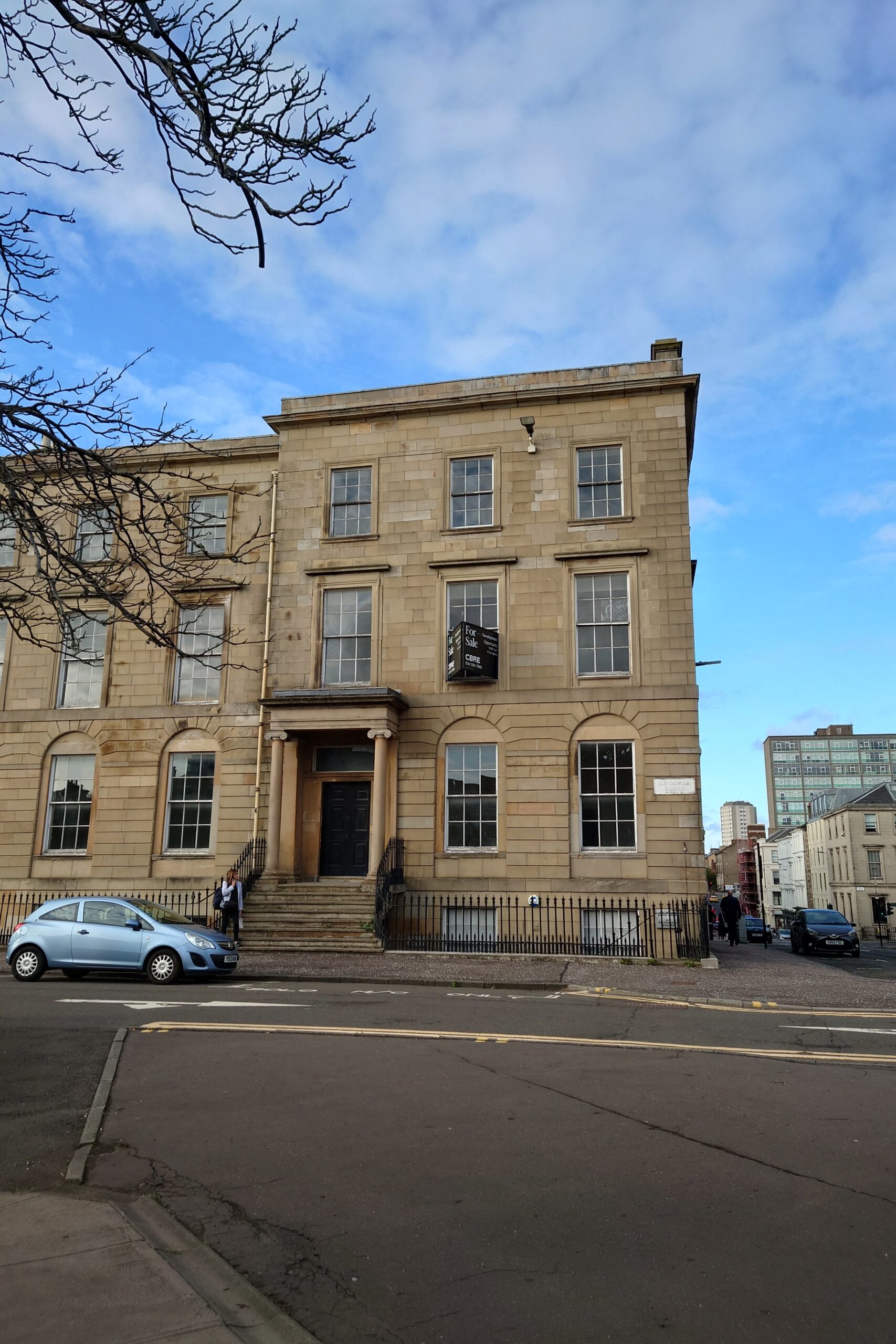
Madeleine, though, was not the girl to meekly accede to such an order. She continued to see Pierre. She smuggled him into the family home, first in India Street and then, from 1856, in Blythswood Square.

The house in Blythswood Square, Glasgow, once owned by the Smith family.

When the Smith family went to Rowaleyn, their summer home in Row (present day Rhu on the Clyde near Helensburgh), he followed and the couple kept up their midnight liaisons. At some point, probably in the wooded gardens around Rowaleyn, the relationship grew physical – a fact that would scandalise the court the following year. ‘My own, my beloved husband,’ Madeleine wrote afterwards, ‘if we did wrong last night it was in the excitement of our love….I did not bleed in the least last night but I had a good deal of pain during the night. Tell me, pet, were you angry at me for allowing you to do what you did…?’

 L’Angelier may not have been angry but he was certainly disappointed. He seemed to find fault in many things she did and she was forced to grovel at his feet for forgiveness. Her letters in the early stages are peppered with phrases like, ‘I ought never in any way to vex or annoy you’, ‘If I do anything wrong and you check me, I shall never, never do it again…you shall love me and I shall obey you’, ‘It is my duty as a wife to do so. I shall do all you want me.’ She talked of her faults and how he would correct them. She talked of being his ‘wife in every sense of the word’ – a clear sign that their relationship was sexual. Even that was thrown back in her face for he blamed her completely for their having succumbed to their passions. ‘I am sad at what you did,’ he wrote to her, ‘I regret it very much. Why, Mimi, did you give way after your promises?’ He even obliquely suggested that she was not a virgin. ‘I do not understand, my pet, your not bleeding for every woman having her virginity must bleed,’ he wrote. ‘You must have done so some other time. Try to remember if you ever hurt yourself in washing, etc.’ He did not trust her and often reproached her for flirting, so he must have been spying on her for the parties and balls to which she would be invited were closed to him. But then, they had mutual acquaintances and, in the beginning at least, even members of the Smith household were aiding and abetting them in their affair.

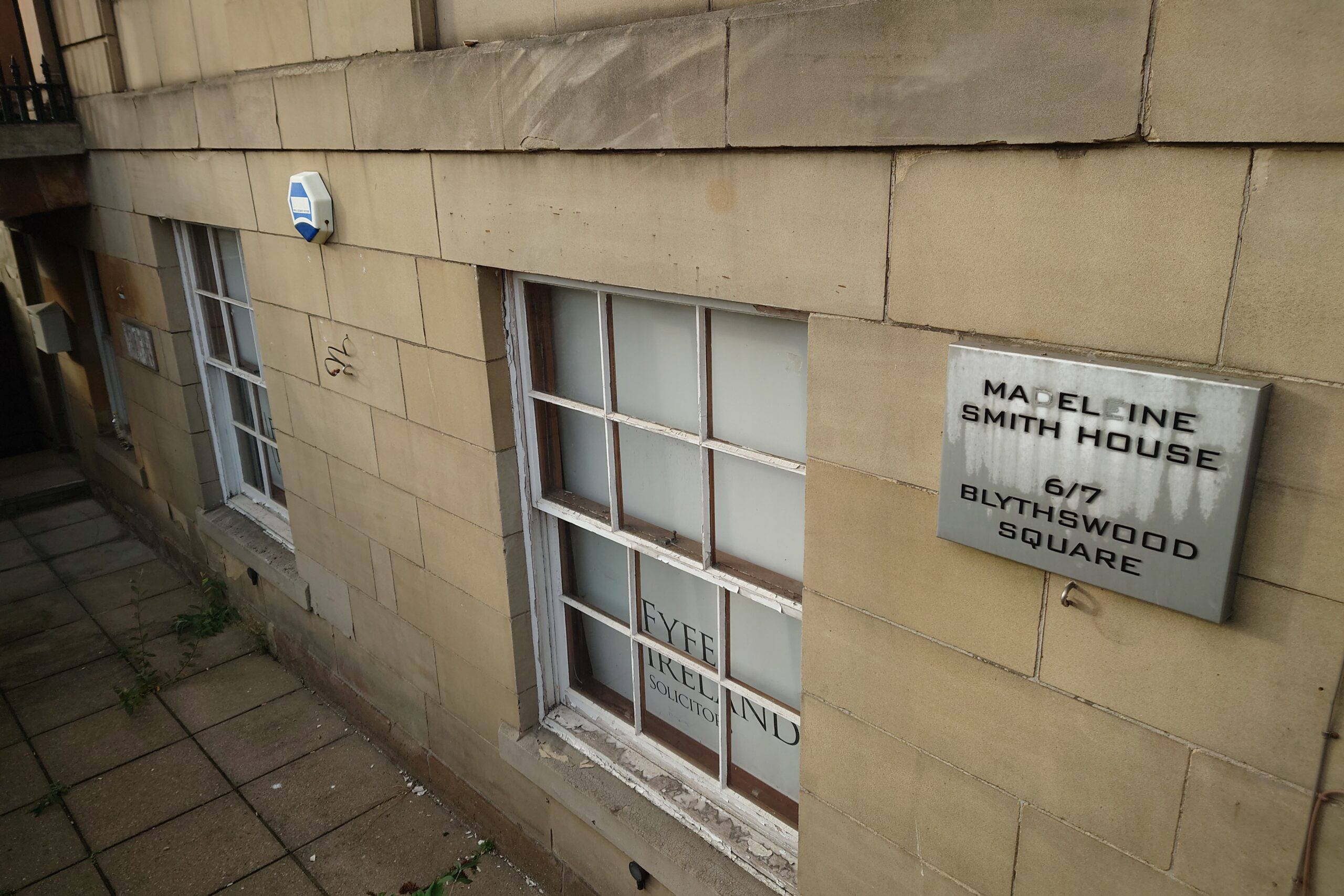
Madeleine, though, was cooling. She was young, she was flirtatious and the constant belittling finally got to her. Apart from that, someone else had been paying her attention. Merchant William Minnoch lived next door to her family in Blythswood Square and was, in the eyes of her father at least, a much more desirable candidate for son-in-law. Madeleine thought so, too, and tried to break off the relationship with Pierre but he would hear nothing of it. She was his Mimi and if she tried to end things then he would take her letters – her passionate, revealing, indelicate letters – to her father and her new beau. Once her base nature was revealed would the upright Mr Minnoch still be as interested? L’Angelier stalked her, watching her whenever she was out with Minnoch or her family.  Madeleine somehow found her ardour for him returning and she continued her correspondence and the illicit meetings. When he could not creep into the Blythswood Square house, he stood outside her basement bedroom window and accepted hot chocolate through the bars.

Then L’Angelier began to take ill. In February 1857 he fell victim to sharp, piercing abdominal pains and vomiting. The symptoms returned twice in March – and after the third attack he was found dead in his room. His friends and his employers were suspicious of this sudden and lethal decline in his health and demanded a post-mortem. His body was exhumed from the Ramshorn Kirkyard and examined. The man’s stomach revealed 82 grains of arsenic. Madeleine’s letters were found and the procurator-fiscal decided that he had his culprit. But Madeleine, perhaps seeing the writing on the wall, had taken flight. She did not get far, though, for her brother and William Minnoch found her on the steamer heading for Rowaleyn. Within days she was arrested and remanded for trial in Edinburgh – Glasgow’s courts still not yet good enough for such high-profile proceedings.

The trial lasted nine days during which the Crown tried to paint a picture of a cold-hearted young woman who purchased arsenic, ostensibly for the poisoning of rats, but who served it to her erstwhile lover in dishes of cocoa. Since the Arsenic act of 1851, all purchases of the substance had to be made by persons over the age of 21 and known to the chemist. The substance itself, white in colour, had to be stained with either soot or indigo and the purchaser’s details recorded in a poisons book. None of these regulations prevented Miss Smith from obtaining the poison, which she later claimed she used in diluted form as a cosmetic to wash her face, arms and neck. It was certainly common for women to tone up their complexion with arsenical-based lotions. Both sexes also used arsenious acid as a tonic and it was prescribed as a treatment of fevers. L’Angelier on more than one occasion claimed he was ‘an arsenic eater’, taking it to improve his health and his appearance. The defence used this to suggest that perhaps he had poisoned himself. He was also in the habit of suffering from stomach trouble. (A later theory suggested that L’Angelier had visited a spa where the medicinal waters might have been thick with the poison).

The main problem facing the Crown was that although they had motive – the victim had become something of a liability to her future happiness and had threatened to betray their liaison to her father and her new suitor – they could not prove Madeleine had even seen L’Angelier on the three occasions specified in the indictment, let alone given him a drink laced with poison. Medical evidence was also contradictory. The defence experts thought that given the amount of arsenic found in the stomach there should also have been traced of soot. It was also suggested that L’Angelier would have tasted the mixer, or least felt it scratching his throat. In their mind it followed that, before he died, he would have mentioned something to his landlady or the doctor who attended him. The Crown’s experts refuted this, saying the soot would have evaporated and the strong cocoa would have masked the taste.

There was also a diary kept by L’Angelier in which he wrote, ‘Thursday, 19th February. Saw Mimi a few moments. Was very ill during the night. Friday 20th February. Passed two pleasant hours with Mimi in the drawing-room. Saturday 21st February. Did not feel well. Sunday, 22nd February. Saw Mimi in the drawing-room. Promised me French Bible. Taken very ill.’ The defence, naturally, did not want this book allowed into evidence. They battled hard to have it excluded – and won. It was felt that had L’Angelier been alive to give evidence then it would have been admissible because he would have been open to cross examination. However, had he been alive, the point would not have been debated in the first place. Madeleine did not deny on a few occasions giving L’Angelier cocoa but added, ‘I never administered, or caused to be administered, to Mr L’Angelier arsenic or anything injurious, and this I declare to be the truth.’

Public sympathy was with Madeleine. The case itself filled prodigious amounts of newsprint and her cause was further strengthened by the fact that L’Angelier was a foreigner. Even writing some years after the event, F. Tennyson Jesse called him ‘that little, scheming, sensual, iron-willed lady-killer.’ Madeleine, though, captivated all who saw her. One contemporary report said she entered the court ‘with the air of a belle entering a ballroom or a box at the opera. Her steps were buoyant, and she carried a silver-topped bottle of smelling salts. She was stylishly dressed, and wore a pair of lavender gloves.’

The defence also reminded the jury that murder was a capital crime. Her counsel opened his remarks with ‘Gentlemen, the charge against the prisoner is murder, and the punishment for murder is death.’ Who can say how much the thought of sending the calm, self-possessed young beauty in the dock to the gallows helped convince thirteen of the men on the jury that the case against her was Not Proven. Only two believed beyond the famed shadow of a doubt that she was guilty. Again the courtroom was filled by cheering spectators and the judges called for order.

Madeleine Smith, still calm, still dignified, was taken from the court by her brother through a side door and spirited away to Rowaleyn. Her parents, who had ‘taken to their beds’ during the trial, were waiting for her, having sought refuge from the scandal in the country. The coldness of her family must have hurt her deeply but she could take some solace in the warmth of feeling from other quarters. In a letter to the Matron of Edinburgh Prison, Madeleine stated, ‘I think I must have had several hundred letters, all from gentlemen, some offering me consolation, and some their hearths and homes.’ She also noted that, ‘the feeling in the west is not so good towards me as you kind Edinburgh people showed me. I think it shall be necessary for me to leave Scotland for a few months…’ She was, though, ‘not at all pleased with the verdict.’

William Minnoch was out of the picture. The letter says ‘My friend I know nothing of. I have not seen him. I hear he has been ill, which I don’t much care.’

So if Madeleine Smith did not kill L’Angelier, what happened? He could have taken the arsenic himself, either as a suicide attempt or, more dramatically but perhaps unlikely, as a way of punishing the woman he loved by framing her for his murder. The suicide angle is strengthened by his reaction to an earlier failed romance, when he threatened to take his own life. He could have taken it by accident – as a known arsenic eater perhaps he just ate too much. He was also painted as a womaniser and even a blackmailer, so perhaps someone else took it into their head to remove him from the earth. 

Madeleine later married London artist George Wardle and became part of the smart set, being noted, it is said, for having the daring to uncover the legs of her dining table. It would be interesting to see the faces of her dinner guests if she ever offered them cocoa. Apparently, one who did sup hot chocolate at her naked table was George Bernard Shaw. She subsequently moved to New York, married for a second time, raised a family and died, aged 93, on 12 April 1928. Her gravestone in Mount Hope Cemetery, New Jersey bears the name Lena Wardle Sheehy.

The basement of the house today, complete with plaque.