
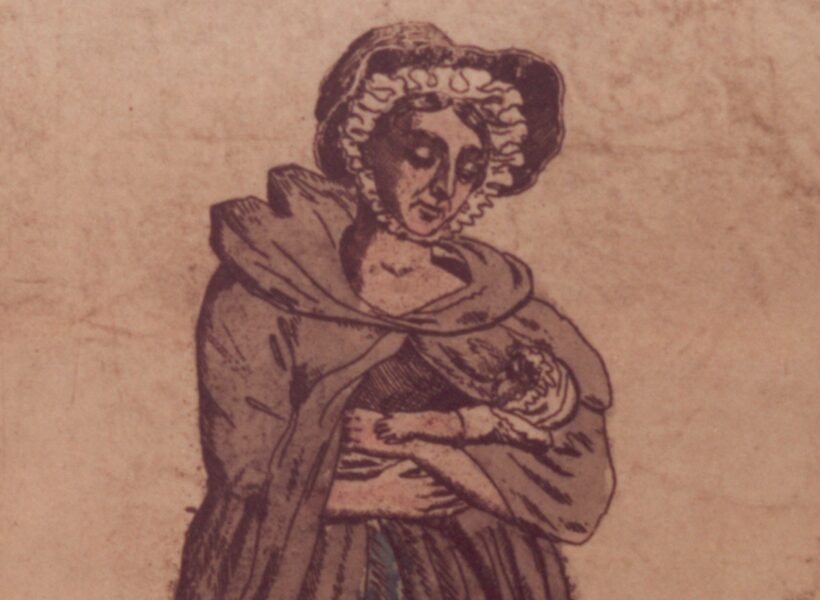
(Pictured: Maggie Laird at the time of the trial)
Burke and Hare are two of Scotland’s most notorious murderers, but they were aided and abetted by two women.
In the second extract from an account I wrote over 20 years ago, their murderous activities which helped stock the anatomy table of respectable surgeon Dr Robert Knox, gathers pace.
IN November 1827, with William Burke and Helen McDougall ensconced in Tanner’s Court, an old soldier named Donald had the audacity to die while owing landlord William Hare the sum of four pounds. Hare was not the fellow to let such a debt go uncollected so the body was howked out of the coffin as it lay awaiting burial and sacks of bark put in its place.
It was well-known that doctors paid handsomely for fresh cadavers so Hare suggested they cart old Donald round to Surgeon’s Square and see what they could get for him. In the end they received over £7 from the well-respected Dr Robert Knox. Before they left his premises, Burke and Hare were told the surgeons would be happy to see them again should they have any further bodies to dispose of.
Heading back to Tanner’s Close, the two would have discussed how to obtain such goods. It would be realised very early on that they could not simply wait around for tenants to die – and the idea of stealing into graveyards in the middle of the night to rob graves was not one that appealed to them. They’d had enough of digging during their years on the canal, thank you very much.
After a couple of months of inactivity they reached the conclusion there was only one way they could guarantee a steady supply such merchandise. They would have to kill the people themselves.
The correct order of the murders is not known for certain. The next victim was either an old tenant named Joseph, a nameless Englishman or a woman named Abigail Simpson.
Joseph’s situation was most inconvenient for his landlords because he had developed a fever and if word of sickness in the house got out they could lose their business. Their tenants may not have been too choosy but they were not stupid enough to leave themselves open to infection. Joseph was also proving tardy in actually dying so after discussion, in which Hare’s paramour Maggie Laird may well have been involved, it was decided to put Joseph out of his misery.
The old, sickly man was first made insensible with whisky and then smothered, Hare’s hand clamped over his nose and mouth, Burke’s body draped across his chest to keep him still and to prevent him from making any noise that may alert the other tenants. In subsequent murders they swapped their roles – one would smother, the other sit on the victim’s chest – but the end result was always the same and Dr Knox had a fresh and unmarked corpse ready for the cutting.
It later became known as ‘Burking.’
Plying their victims with liquor also became a vital part of their modus operandi. Maggie Laird may have taken a more active role by enticing intended victims into the slaughterhouse. She was certainly with Hare when they met elderly Abigail Simpson. The pair got her drunk then lured her back to Tanner’s Close where he and Burke duly killed her.
The Englishman, like Joseph, was a tenant who fell ill and had to be removed. For each of the cadavers they received £10, a far from paltry amount in those days. Hare took half while Burke received only four pounds. The remaining pound went into Maggie Laird’s greedy little hand. After all, it was reasoned, the work was being done under her roof.
Whatever the order of death, they were getting away with murder. There was no outcry over the disappearance of these unfortunates. They were the lost and the lonely and no-one seemed to notice they were even missing. That was until Burke selected the good-looking prostitute Mary Paterson as his next victim – and for the first time Helen McDougall was known to have played a part.
Teenage Mary and her friend Janet Brown met William Burke in a city tavern where they had dropped in for an early morning tightener having spent the night in the lock-up for a breach of the peace. He chatted the pair of them up and invited them back to the home of his brother Constantine in Gibb’s Close, lying off the Canongate. At this stage he may have had nothing more on his mind than sex with two women so returning to Tanner’s Close, where Helen McDougall was waiting, would have been out of the question.
Con Burke had left for his street sweeping job but his wife, displaying some fine Irish hospitality, made the three some breakfast, and watched as they swilled copious amounts of whisky. Soon Mary had drunk herself unconscious so Burke turned his amorous intentions to her friend Janet. Unfortunately, he had forgotten to tell her he was already spoken for, an omission soon remedied when Helen McDougall arrived looking for her man. She took one look at Burke with the drunken beauty and launched a tirade of verbal vitriol at them both. Burke halted the flow with a well-aimed glass, slicing a bloody gash on Nelly’s temple, before throwing her out of the room and slamming the door against her furious screeching. By this time, whatever ardour Janet may have been feeling had cooled and she wanted to leave, so Burke – ever the gentleman – escorted her from the house, leaving Mary Paterson snoring softly behind them.
By the time he returned, Con’s wife had alerted William Hare and Maggie Laird. The men swiftly realised that in the body of the still unconscious Mary Paterson they had an ideal opportunity for some trade so ushered their respective wives out of the room, with Nell still breathing fire and venom. The young girl soon ended up on the anatomist’s slab, much to the delight of the many doctors, whose fascination with her beauty bordered on the necrophilic. An artist was even called to record it for posterity, while the body itself was preserved in alcohol for some time.
Did Laird and McDougall know what was going to happen when they left the room? It is entirely probable. Their men had come into quite a bit of money lately and it could not all have been earned through renting rooms and repairing shoes. The men had hinted they were moonlighting as resurrectionists but surely their women knew them better than that. Maggie Laird had already assisted in luring one victim to her doom, and had even, it seems, fetched a chest for the body to be placed in. And then there was McDougall’s jealous rage to consider. Would she allow him to remain in a room, even with Hare, while an equally beautiful young girl lay insensate over the table?
However, Mary Paterson was no stranger to the city. She was a well-known street walker – even one of Knox’s students recognised her – and her disappearance was noted. And this time there was a witness – Janet Brown, who returned to the rooms in search of her friend. But Mary was dead by this time and hidden behind a curtain. While Burke went out to find a tea chest to put her in before she was carted round to Surgeon’s Square, Janet sipped whisky with Hare, Laird and a still seething McDougall. She may have gone the way of her friend had not her brothel-keeper sent someone to fetch her.
Maggie and Helen had a part to play in a double slaying, that of a woman from Glasgow and her deaf mute grandson. They helped get the old woman drunk and then sat at the fireside with the twelve-year-old boy while their menfolk committed murder in another room. What did they think was going to happen when Burke and Hare, their faces flushed from their exertions and deeply lined by the dancing light of the flames, took the lad from them? And did they ask no questions when, come first light, neither grandmother nor grandson was anywhere to be seen? Did they ask no questions at all when the victims vanished? Or did they just help drink away the money earned from the sale of the corpses and prefer not to think about it?
But Maggie Laird continued to mistrust Helen McDougall until at one point, according to Burke, she suggested they do away with her. Burke, of course, refused but it was clear the team was beginning to fragment. In June 1828 Burke and Helen left Edinburgh to visit her father in Falkirk. While they were away Hare committed another murder, either a solo effort or in conjunction with his wife. Burke was displeased at this attempt at sole trading and, with Maggie Laird’s homicidal thoughts towards his woman fresh in his mind, moved out of Tanner’s Close and took a room with a cousin nearby.
Burke and Hare may no longer have been bosom buddies but their murdering ways continued. They had come too far together to stop – and if a system isn’t broke, don’t fix it. The victims came fast and furious now. There was an ageing prostitute, then her daughter. Then Anne McDougall, a Falkirk woman who was related to Nelly’s former partner and had the misfortune to come visiting. But they made a mistake this time – and one that could have proved fatal. Her body was actually seen by John Broggan, the husband of Burke’s cousin. However, a few glasses of whisky and some pound notes ensured his silence. The money was supposed to pay Broggan’s back rent but he made off with it, leaving Burke to foot the bill.
Here, again, the question of Helen McDougall’s complicity must be raised. Anne McDougall was a friend of hers who had apparently vanished without a word during a visit. What did she think had happened? Did she even care?
Later, her actions proved she knew exactly what her man had been up to all this time.
But before that, Maggie Laird took an active role in another murder.
(Click here for Part Three)
