
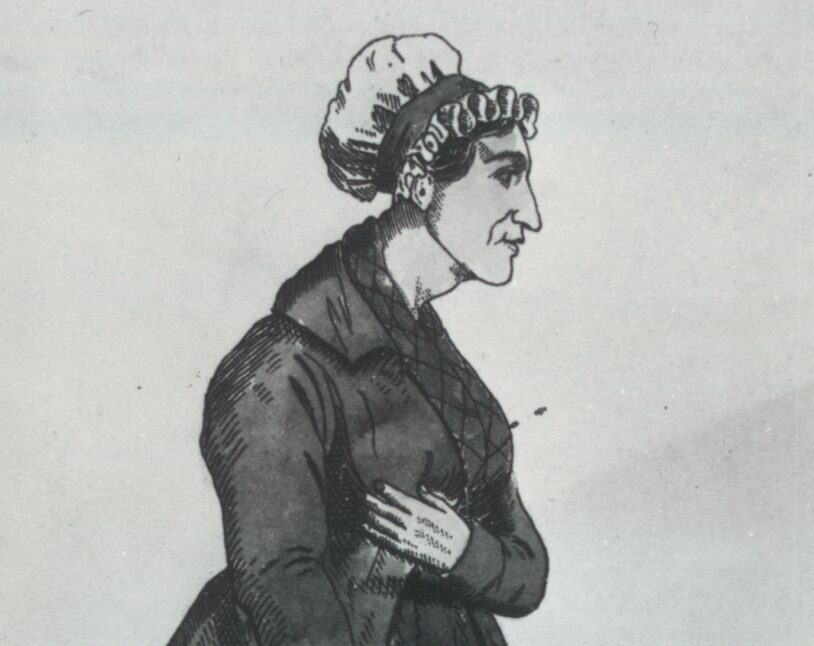
(Pictured: Helen MacDougall at the time of the trial)
Aided by their partners, Helen MacDougall and Maggie Laird, killers William Burke and William Hare are in the money.
But they are about to take a murderous step too far.
‘DAFT’ Jamie Wilson, like Mary Paterson, was well known in the streets of the old town as he limped about on his deformed bare feet. The eighteen-year-old was retarded but was well liked and wholly dependent on the charity of locals. While Burke was in a tavern enjoying his now customary early morning drink he spotted Maggie Laird leading the lad towards Tanner’s close. Later the woman returned, asked him to buy her a drink and while they sat together she touched his foot with her own. Burke knew this was the signal that they had another pigeon for the plucking. Clearly they had done this before. Later, Laird left Jamie in a room alone with Burke and Hare and a bottle of whisky. Just to make sure they were not disturbed she locked the door behind her.
She knew what she was doing. She knew it when she took the boy into her home. She knew it when she gave Burke the signal. She knew it when she left the three of them alone in that bleak back room and locked the door.
Jamie was too well known a victim. News of his disappearance spread quickly and reached the ears of Dr Knox while the body lay on his examination table. There were no signs of foul play, the method of murder saw to that, but nevertheless he ordered that it be anatomized quickly with one assistant cutting off the head and deformed feet to avoid it being recognised.
Killing Jamie was a mistake but they had once again got away with it. However, time was running out for the fearsome foursome. They were about to go a victim too far.
And this time they would all be involved.
IT was smooth-talking William Burke who brought the woman Docherty back to the room he shared with Helen McDougall. It was Halloween, which was fitting considering the dark work that was to be done that night. He had come across the destitute Irishwoman begging in a pub and had inveigled his way into her trust her by suggesting they might be related. At that time they were sharing the room with James Gray and his wife Ann, the daughter of Helen McDougall’s first partner. Burke and Nelly would regret ever being tempted to sub-let their space.
Burke told the Grays that he had arranged for them to have a bed at Tanner’s Close with his good friends the Hares. Mrs Docherty was a relative, he explained, and it was his wish that she spend the night. Hare and Laird duly turned up to escort the Grays to their establishment but returned to Burke’s room shortly after.
Later, the four were seen drinking, singing and dancing with the woman who was to form part of their stock in trade.
The following day the Grays returned to find the Irish woman gone. Helen McDougall told them she had been ‘using too much freedom with William’ (meaning Burke) and she had been forced to kick ‘the damned bitch’s backside out the door.’ At one point Mrs Gray settled herself down on the edge of the bed snd Burke had snapped at her, ‘Keep out of there, keep out of the straw.’
The Grays were bustled out of the room but later stole back in when Burke and McDougall had gone. Rooting around in the straw they uncovered Mary Docherty’s naked body, blood crusting around her mouth and nose. Shocked, they hurried from the room and came face to face with Helen McDougall on the stairs. Mr Gray challenged her over the dead body and she slumped to her knees and begged him not to say anything, offering him money for his silence.
But the Grays were not like John Broggan, who had accepted cash to forget he’d seen the body of Ann McDougall. They rushed out into the street to fetch the police only to find Maggie Laird. She tried to talk them into going back into the house to discuss the matter but the Grays, wisely, refused to go. They did, however, go to a nearby pub.
By the time the police were alerted and stirred themselves to investigate the claims of foul murder, the body of Mrs Docherty had been folded into a tea chest, bought by Burke but collected by Maggie Laird, and whisked off to the waiting hands and scalpels of the doctors. But an examination of the bedding and straw revealed the dead woman’s clothes and some blood. On questioning, Burke said the woman had left early that morning, but McDougall said she had left the previous night – and she had spoken to her since. Presented with an obvious contradiction, police took the couple into custody.
Further inquiries unearthed a local man who had carried the tea chest to Surgeon’s Square. He knew there was a body inside because he himself had tucked some hair away that was hanging out. On arriving at Dr Knox’s establishment, police found the corpse still in its makeshift coffin. Hare and his wife were arrested but denied ever having seen the dead woman, which was folly on their part for they knew a number of people, including the Grays, had seen them all with Mrs Docherty while she was alive.
After being charged, Burke changed his story, inventing a mysterious hooded stranger carrying a large box who came to have his shoes mended. While Burke was busy cobbling he heard the rustle of straw behind him and after the mystery man left found the body of the woman hidden beneath the bed. Later he tried a new tack. He admitted the dead woman was Mrs Docherty, that she had been with them that night but had somehow suffocated herself while drunk. He and Hare had seized the opportunity to make some cash by selling the corpse to the anatomists. Hare, meanwhile, blamed another tenant, saying he had struck the woman. McDougall insisted she knew nothing of the murder, while no-one knows what Maggie Laird was saying.
The authorities had a body. They had witnesses who placed the victim in the company of the Burkes and Hares on the night she died. Unfortunately, they had very little else. A post mortem revealed that although the woman had been suffocated, it was impossible to state with any certainty she was a victim of murder. What was needed was an eyewitness to the killing – and unfortunately the only people who knew what went on in that room was the accused foursome. Unless one or more of the alleged accomplices decided to confess or inform on the others there was every chance they would all be freed on a Not Proven verdict. Perhaps a deal could be made. Perhaps one or more of them could be offered immunity in return for their freedom. Scottish justice is renowned for turning a blind eye to the misdeeds of witnesses testifying on the Crown’s behalf. A conviction, any conviction, is better than nothing.
The offer was made to William Hare and Maggie Laird.
And they accepted.
With further information coming in regarding the disappearances of Mary Paterson and Jamie Wilson, that left only William Burke on three counts of murder. Helen McDougall faced charges regarding Mary Docherty only. In the end, thanks to protests from Burke’s crack defence team – acting, as was the custom, free of charge – only Mary Docherty’s death would trouble the court.
The trial began on Christmas Eve morning, 1828, and sat without break for a full 24 hours. There were 55 witnesses cited to appear. Dr Knox was listed but amazingly was not called – fuelling conspiracy theories that the entire case was somehow designed to cover up the involvement of influential medical men and to protect the establishment of the day. However the most important among witnesses were undoubtedly William Hare and his wife Maggie Laird.
Hare, of course, blamed Burke for just about everything while being careful not to implicate himself too much. He was allowed to decline answers to certain questions that may have shown he was more involved in murders than he claimed. Although Burke’s defence tried to break this wall of silence, the prosecution defended Hare’s stance. They were there to obtain a conviction not unearth the truth.
Laird appeared holding a young child sick with whooping cough. The youngster was possibly Hare’s, but she used it like a prop, tending to it while she thought about what she was saying. She did, however, make one slip of the tongue that may have passed unnoticed at the time but has been seized by writers since. She claimed she and Helen McDougall had fled the room when Burke fell on Mrs Docherty and was then asked what she thought had happened to the woman. She said she ‘had a supposition that she had been murdered,’ Then she added, ‘I have seen such tricks before.’
She had seen such tricks before. Maggie Laird, a star prosecution witness, knew of previous murders. And she was getting away with it. None of the lawyers picked up on the remark. Perhaps their wits were dulled by the hours of continual evidence. Perhaps they caught it but chose to let it go – the prosecution because it had already agreed to try only the one murder, the defence because there was no benefit to its client. Or perhaps they did not want the full extent of the West Port horrors to come out in a court of law.
The jury took just under an hour to reach their guilty verdict on William Burke. But it was only a majority verdict – two of the jurors remained unconvinced of his complete guilt. The press and populace at large were happy he had been convicted but felt the courts had not gone far enough. They felt equally nefarious villains were escaping the noose – William Hare, Maggie Laird and Dr Robert Knox, who, it was believed, must have known just how his two suppliers were gathering their merchandise.
The charge against Helen McDougall was found Not Proven. When he heard the verdict on his lover, Burke remarked, ‘Nelly, you’re out of the scrape.’
Much to the relief of the medical establishment, and even the prosecuting authorities, there was no need to try Burke on the other two charges, that of Mary Paterson and Jamie Wilson. After all, he could only hang once. The presiding judge, Lord Justice Clerk Boyle, stated Burke had no chance of a pardon. He continued: ‘The only doubt I have in my mind in order to satisfy the violated laws of your country and the voice of public indignation is whether your body should not be exhibited in chains to bleach in the winds, to deter others from the commission of such offences, but taking into consideration the public eye would be offended by such a dismal spectacle I am willing to accede to a more lenient execution of your sentence, that your body should be publicly dissected.’
It was an ironic twist in the tale, considering the way Burke had made his most recent living. But the judge had another comment to make, opining that if it was ever customary for the skeletons of murderers to be kept after dissection then he hoped Burke’s would be one ‘in order that posterity may keep in remembrance of your atrocious crimes.’
The Edinburgh Tollbooth having been demolished in 1817, Burke was taken first to Calton Jail then, in preparation for his final public appearance, to the lock-up house in Libberton’s Wynd. He made two confessions during this time, admitting sixteen murders but claiming William Hare had more to do with them than he had stated in court. He also removed any blame from his lover Helen McDougall and, to an extent, Maggie Laird.
However, there can be little doubt that both women knew exactly what was going on, if not at first then certainly as the death tally rose. They had stood outside the room in Gibb’s Close while their husbands finished off poor Mary Paterson; they had sat at the table drinking as her body cooled behind a curtained bed. Maggie Laird had helped lure Daft Jamie and others to their doom. Helen McDougall had remained silent when her cousin Ann McDougall disappeared. They had both waited with the deaf mute Glasgow lad while the men slaughtered his grandmother – then allowed him to be led away to his own certain death. They had both been present when Burke and Hare plied poor Mrs Docherty with drink, although they had fled as the murder began. Helen had tried to buy the Grays’ silence when they found the corpse, Maggie had attempted to calm them down. They had lied to the police over the night’s events. Maggie Laird had admitted in court that ‘she had seen such tricks before’ after supposing Mrs Docherty had been murdered.
But guilty or innocent, only Burke paid the price for their misdeeds on Wednesday January 28, 1829. The gallows itself was constructed in the Lawnmarket, not far from the lock-up house. The event was to be quite a spectacle. Signs were posted on windows on the tall buildings overlooking the execution site advertising an uninterrupted vantage point from which to witness the hanging. Despite fees being set as high as a guinea demand was stiff. Sir Walter Scott found himself such a window at 423 High Street to watch the show. The streets below were a sea of people, as many as 25,000 it has been estimated, and as Burke was led onto the platform a great wave of revulsion rose from their throats. This tide of hatred was not just aimed at the man on the scaffold but also the two men who public indignation had decreed were just as guilty – William Hare and Robert Knox. However, they had to be satisfied with just one hanging. The huge crowd celebrated with three loud cheers.
His body hung for an hour before it was taken down and transported to the dissecting rooms of Dr Alexander Monro. The butchery was to be a public event and, again, demand was great. The lecture theatre was filled to capacity and the usual angry crowd gathered outside. Police had to be called to keep order but, in the way that police often can, only managed to make a bad situation worse. Anger turned to fury and fury turned to violence with the mob trading blows with baton-wielding officers. While Burke’s blood flowed in the lecture room, more blood was spilled in the streets and order was not restored until some arrangement could be made to allow as many people as possible to see Burke’s corpse. Medical students were given priority to see the actual anatomizing but the following day the public would be allowed to view it lying on the slab. Again it is estimated that as many as 25,000 people filed past the sliced up cadaver. The body was then flayed and the skeleton sent to Edinburgh University’s anatomical museum for display. The skin was cut up into strips and sold as macabre keepsakes. One strip of skin, died blue, eventually came into the possession of Strathclyde Police’s Black Museum at Pitt Street, Glasgow. Meanwhile, the rope used to hang him was sold for half a crown an inch.
During the dissection, it was revealed Burke was suffering from testicular cancer. Had justice waited much longer to catch up with him then he would have cheated the hangman.
Perhaps Helen McDougall was in the Lawnmarket that Thursday to see her man die but probably not. Courtroom sketches had been well circulated and after being released from prison she had found her face too well-kent in the streets for her comfort. During an early excursion to buy liquor she was recognised and surrounded by angry townsfolk. The fifteen good men and true of the jury may not have been convinced of her guilt but they were. Rough justice would almost certainly have been dispensed there and then had not police officers rescued the miserable woman and spirited her away. Later, disguised as a man, she was led from the police station and set free again. She thought it best to leave Edinburgh and return home to Falkirk but her welcome there was somewhat on the chilly side so she once again found herself back in Auld Reekie. She did not tarry there long but left Scotland altogether, winding up in Newcastle. There was talk she emigrated to Australia but no concrete evidence.
Maggie Laird fared little better at the hands of the mob. She was given her liberation on Saturday January 24, 1829 but did not actually leave the jail until the following Monday when, like Helen McDougall, she was spotted in the streets. A dangerous crowd surrounded her in the High Street and would have done her some mischief had she not had her young child in her arms. The furious people contented themselves with pelting her with snowballs, although one gent did succeed in delivering a violent kick to her leg. Again police came to the rescue and steered her away from the jeering mob. She also realised Edinburgh had grown too hot for her and wandered the country, finally arriving in Glasgow with a view to hopping aboard a boat bound for Ireland. But even there she was recognised and had to be rescued by police officers. Finally, she did book passage for the Emerald Isle but nothing more is known of her.
William Hare was kept locked up for a period. His promise of immunity from prosecution did not prevent the mother and sister of Jamie Wilson from attempting to raise a private prosecution. Despite a public subscription being raised to help meet the costs the action failed. Six judges pondered the matter and rejected it by four votes to two. It was agreed that the Lord Advocate’s decision to grant immunity from prosecution meant immunity from any prosecution. In their opinion justice was best served by sticking to the original deal while the good name of the Scottish system was best not besmirched by any further investigation. In any case, by the time their lordships made their decision Burke, who would necessarily be an important witness, was dead.
And so William Hare was set free. The multiple murderer had assisted Scottish justice and that was that. It may have been a necessary evil to ensure at least one person was punished for the horrors but even today, almost 200 years later, it leaves a bad taste in the mouth. In February he boarded a coach bound for England and, apart from a stopover in Dumfries where he experienced the kind of treatment already meted out to his female confederates, little definite is known about his movements. They say he wound up in London, begging in the streets. They say he was recognised by workmen and blinded with quicklime. They say he was lynched in Dublin. They say he was lynched in New York. They say he made his way back to Ireland where he was reunited with Maggie Laird. But no-one knows for sure. He, Maggie and Helen, became shadows on the pages of history.
It is worth noting that although William Hare avoided the drop, a man reputed to be his nephew did fulfill a date with the hangman. On October 24 1851, Archibald Hare was hung in Glasgow for stabbing a man in Blantyre. Like his alleged uncle, this Hare was described as being ‘of repulsive and dogged aspect’. His drop was too short and he spun on the rope trying desperately to relieve the pressure on his neck with his hands. The hangman pulled down on his legs until he died.
Despite the best efforts of the establishment to protect him, Dr Robert Knox’s medical career was more or less ruined, at least in Edinburgh. Angry townspeople thirsted for his blood and if they could not hang him in earnest they would hang him in effigy. His house was attacked and stoned, as was his anatomy theatre in Surgeon’s Square. An inquiry was held, but in the Scottish way – in private and in secret. Its findings failed to satisfy the public’s expectations by clearing Knox of any knowledge in regard to the murders. But although many of his students still held him in high regard, his classes began to shrink. Shunned by friends and colleagues, his professional abilities called into question, he left Edinburgh in 1840 and died in Hackney in 1862.
Revulsion over this case and others led to the system of providing corpses to medical science being reviewed. In 1832, MP Henry Warburton’s bill to regulate the supply of bodies and make grave-robbing a felony was passed. With the stroke of a pen, the government had finally seen sense and brought this particular skin trade to an end.
But there is another character, albeit a bit player, in this drama whose fate is worth mentioning – John Broggan, the man who had accepted money to keep quiet about seeing the body of Anne McDougall in Burke and McDougall’s house. He had made off with the money and in July 1829 was arrested in Glasgow for attempting to murder a man with laudanum. The appearance of this drug in connection with the Burke and Hare case is interesting.
For while the furore over the West Port murders continued to rage in the early part of 1829, another pair of serial killers was operating.
And their favoured method of murder was this opium-based narcotic.
(To learn more, click here Tipping the Doctor)
