
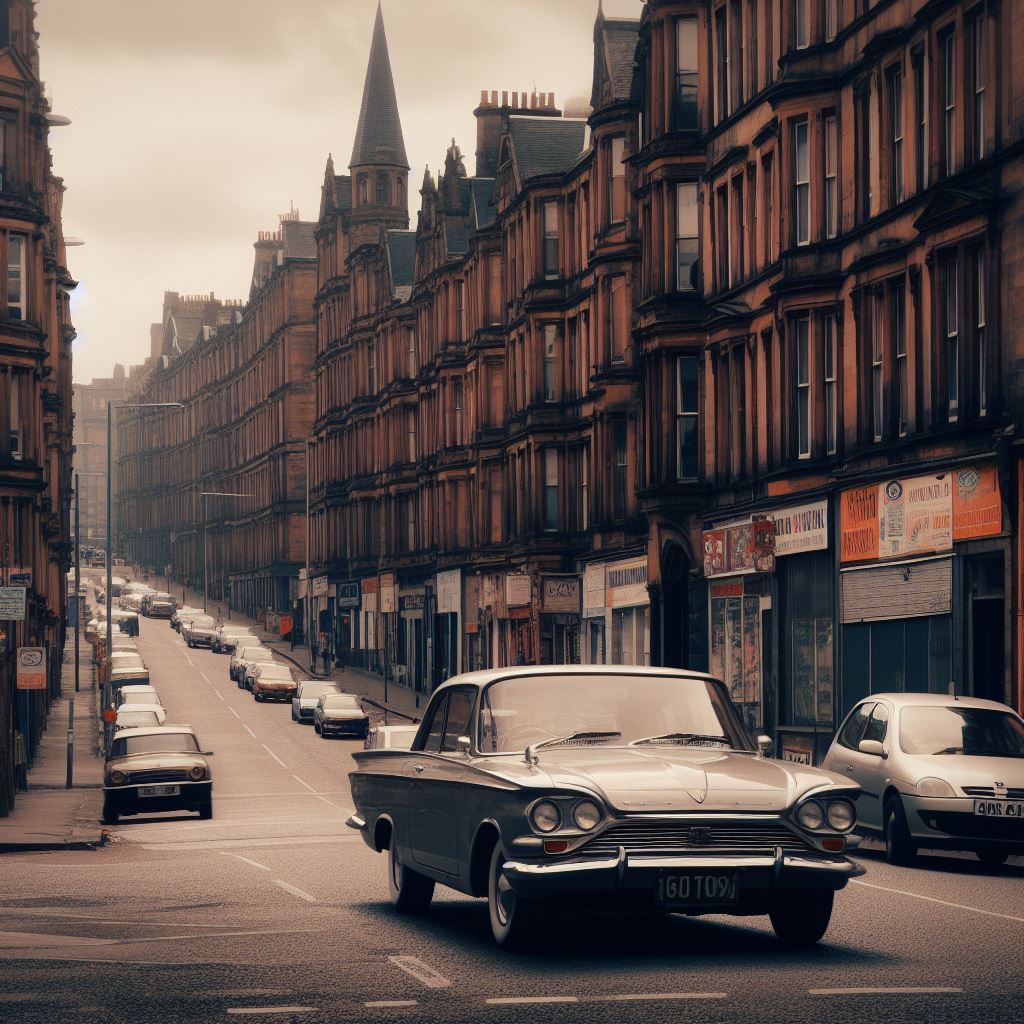
In 1969, a lethal robbery in Ayr began a decades long chain of violence and death.
The first of a two-part account of the events, based on material included in my non-fiction books. I apologise for any factual inaccuracies.
In the early hours of Sunday 6 July 1969, 67-year-old bingo hall owner Abraham Ross and his 72-year-old wife Rachel suffered a brutal ordeal at the hands of two masked raiders in their Ayr home. Robbery was the motive but the two Glasgow men, who called themselves Pat and Jim, gave Mr Ross a severe beating with an iron bar to force him to part with the keys to his safe. They knew he had money and when the old man finally gave in they found £4,000. They left the old couple bound and gagged and promised to alert the police.
But they didn’t make the call.
The couple lay all day and all night untended until their cleaning lady found them on Monday morning. Mrs Ross subsequently died but her husband, despite his horrendous beating, survived. The crime was sickening, disgusting and unnecessarily violent, for any niceties the old underworld may have had were being swept away by the late 60s, if they ever existed in the first place.
To paraphrase former Prime Minister Harold Macmillan, we’d never had it so nasty.
A safeblower, what they used to call a ‘peterman’, named Paddy Meehan was hoovered up for the crime. Police had been tipped off that he was in Ayrshire at the time and as one of the men had been called Pat, it was reasonably assumed that he could have been responsible. Mr Ross also picked him out of a line-up, but only because of his voice. However, the Glasgow peterman insisted that he had never been called Pat.
He later claimed that the tip-off had come from MI5, who had tapped his phone. They insisted that they had been monitoring his movements ever since he had tried to warn them that the Russians were going to break spy George Blake out of Wormwood Scrubs. The KGB had arrested former Communist Meehan while he was in Eastern Europe on the run after breaking free from his preventative detention and had questioned him about the Scrubs. On his return to Britain, Meehan said he tried to warn MI5 about the plan but was either not believed or deliberately ignored. Sure enough, Blake escaped in 1966 – Meehan believed allowed to do so – and from then on the Glasgow crook was the man who knew too much.
Yes, he had been in Ayrshire that night but only passing through, on his way to Stranraer with a buddy to case a motor taxation office. No, he did not do this terrible crime. He was a safeblower, not a murderer – and he had been fitted up by the security services. It all sounds so plausibly implausible that it just might be true.
The man with him that night was James Griffiths, a 34-year-old petty crook from Rochdale with a wicked temper and self-destructive streak. In 1963 he had stabbed two men with a bayonet during a burglary that went wrong and when police arrested he was found with two firearms in his possession. It was suggested that had he not been surprised, he might have been tempted to shoot it out.
He met Meehan in Parkhurst Prison on the Isle of Wight, where they shared a cell with another Glaswegian Roy Fontaine, a conman later to achieve notoriety when, using the name Archibald Hall, he killed five people, including his own brother. Griffiths was not in the Glasgow men’s league but he wanted to be. He impressed them when he walked off a work detail and onto a ferry. Still wearing his prison uniform, he made it to the mainland where he shared a train compartment with a prison officer and his wife and remained at large for several weeks before he was nabbed and sent back to Parkhurst.
Meehan and Fontaine had spoken about Glasgow so much that Griffiths wanted to see the place for himself, so on his release he moved his base of operations to an attic flat in Holyrood Crescent in the city’s West End. He had learned a thing or two from the smooth-talking Fontaine and he posed as a Mr Douglas, an antique dealer. He then exercised his skills as a thief to lift antiques, fast cars, firearms, all the time looking for the big score. He met up with Meehan again, believing that the experienced old hand could help lead him to it.
When Meehan was arrested for the Rachel Ross murder Griffiths knew that his pal was innocent. He wanted to help him but couldn’t do so without firing himself in for a crime. Honour among thieves was one thing but he didn’t relish going back inside. He did everything he could, bar turn up at a police station. He contacted reporters, he even spoke on the phone to DCS Tom Goodall, a legend within Glasgow police, who urged him to give himself up.
Finally, Meehan under pressure gave up his partner’s name and address and on Tuesday 15 July a posse of police officers was ordered to bring Griffiths in.
And that was when the shooting started.
Griffiths had always boasted that he would go down fighting. He was a violent man – during the burglary in Blackpool he’d hacked at the two guys, almost chopping off the fingers of one man’s hand – and his unbalanced mind now tipped over. He had stolen a number of weapons in his time in Glasgow and when the cops came calling he blasted at them with a shotgun. Detective Constable William Walker took a blast in the back and had to be carried to the home of a retired doctor while other officers laid siege to the flat at 15 Holyrood Crescent.
But Griffiths wasn’t going to wait it out. He knew he had more weapons and ammo in his car parked in Great Western Road and he came running out of the terraced house, his shotgun booming. He sprinted to the car where he loaded himself up with a high-velocity rifle and telescopic sight then threw a bandolier of ammunition over his shoulder, before dashing back to his flat, pumping his shotgun at anything that moved and screaming, ‘You won’t take me!’
Police reinforcements arrived and immediately came under fire. Windscreens cracked and shattered, a detective fell back, a round nicking his neck. Griffiths had already wounded a number of passers-by during his fusillade. The street was cordoned off. A police marksman stood ready to bring the gunplay to a halt. Men with bullet proof vests hid behind walls and cars and even the army was contacted for reinforcements if needed.
DCS Tom Goodall took personal charge of the situation and ordered up tear gas but when the bark of gunfire from the attic window ceased he knew instinctively that Griffiths had managed to escape. He’d climbed through a skylight and dashed along the roofs before dropping down into a lane. He was at large in the city and he was armed to the teeth.
In Henderson Street, Griffiths commandeered a dark blue Anglia, wounding the driver, and sped off through the North Woodside area to the Round Toll at Possil. The police had stormed his flat by then and found it empty, now fanned out in a bid to bring him down before anyone else was hurt.
Griffiths meanwhile had crashed the car and burst into the Round Toll Bar, where he calmly ordered a drink. The few customers present at midday stared in amazement as the short, stocky, wild-eyed man with an English accent stood before them, a rifle in his hand, a shotgun hanging on his shoulder and an ammunition belt crossed over his body. No-one moved, no-one breathed. Outside they could hear the wail of the sirens and they knew the law was coming for him. He seemed crazy, his eyes flaring, his breathing erratic and they knew that it wouldn’t take much for him to start blasting, all it would take was for someone to move.
Then someone moved.
William Hughes was a pub regular, a 65-year-old newsvendor, and all he did was twitch his hand towards his glass but the jumpy Griffiths whirled round, the rifle up, the barrel spitting twice. The poor man fell back, both bullets pumping blood from wounds that killed him five days later. Owner James Connolly seized the chance to grab the gunman and throw him bodily out of the bar. It was a brave act, perhaps a stupid act, but Connolly was used to all kinds of tough guys and he wasn’t having this lunatic shooting his bar or his customers to pieces. As he reached for the phone, Griffiths came roaring back in, the rifle jerking once. The bullet went wild and Connolly ducked for cover, but then Griffiths was gone again, spooked by the screeching tyres of the police as they converged on the area.
Outside a young man named Ian Shaw tried to capture Griffiths and was shot for his troubles. A lorry was hijacked but a taxi driver kept close tabs on it and was able to keep police informed regarding the route Griffiths was taking. His driving was as erratic as his mind as he skidded round corners, ran red lights and sent motorists swerving. The rifle lay on his lap and every now and then he poked it from the cab of the lorry to fire it with one hand. He reached Springburn and swerved into Kay Street, not knowing it was a cul-de-sac. Still firing, he leaped from the cab and ran up the short street towards the Corporation Baths at the far end, then ducked into the closemouth at number 26.
Police moved quickly to clear the street for they knew that Griffiths would start shooting again once he found a vantage point. He had pounded up to the top floor of the tenement and blown the locks of a door. From the window he could see the street and he sent bullets raining down on the police.
He didn’t see the little child in the pram directly below him, but the police did. The baby’s parents wanted to rush out and grab the child but that duty fell to a volunteer officer who carefully crept up the street, his back pressed against the sandstone walls until he reached the pram. The child was carried to safety.
Griffiths, though, might not have been at the window. After letting loose with a few rounds, he had moved down to the first floor landing to check the rear. There he took pot shots at the children in a playground, hitting an eight-year-old boy, an 18-year-old newly-wed woman and another man. The newly-wed’s young husband had to be dragged down to prevent him racing towards the window to get to the man who had put a bullet in his wife’s leg.
But Griffith’s time was running out. In 105 minutes he had loosed off over 100 rounds and had wounded nine men, two women and a child. Now back in his top floor sniper’s nest perhaps he knew there was no hope but as he had vowed before, he wasn’t going to go down without a fight. He still had ammunition and he still had the will to use it.
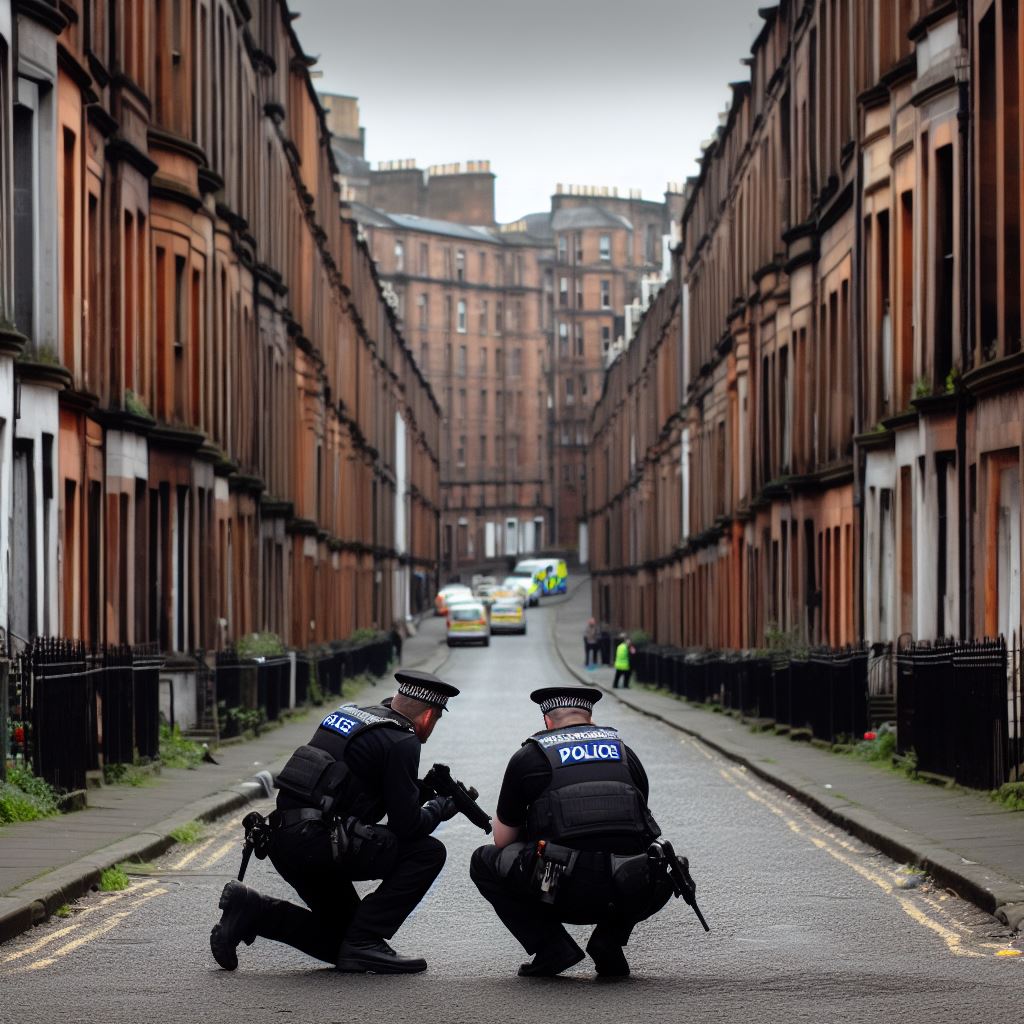
The end came when he heard the creak of a letterbox being pushed open behind him. He turned and saw eyes watching him from the landing outside. With a bellow of rage he charged towards the door. The barrel of a gun was thrust hastily through the letterbox and a trigger pulled.
The bullet him in the shoulder but once a round hits flesh there can be no predicting where they will go. Rounds can bounce from bone, glance off sinew and change direction. In this case it surged downwards through his body to career off his ribs, then tore through organs and flesh and blood to end its trajectory in his heart. He fired once more as he hit the floor but the shot went wide. By the time the police forced open the barricaded door and carried him none-too-gently down the stairs to the streets, the gunman was dead.
He was the first wanted man in Scotland to be gunned down by police officers in the line of duty.
Chief Superintendent Malcolm Finlayson was the man who had pulled the trigger that put the man who was swiftly dubbed ‘Mad Dog’ Griffiths down. He had not meant to kill but kill he had.
‘That’s not something I will readily forget,’ he said later.
Both he and Detective Sergeant Ian Smith, who had been with him as they crept up the stairs, were honoured for their gallantry, as were James Connolly, Ian Shaw and ambulanceman John Preston, who braved the bullets to bring aid to the wounded.
Griffiths had alienated his family through years before. His father said they would not come north to attend any funeral.
‘Our son died fifteen years ago,’ he told reporters.
It was left to what was then Glasgow Corporation to bury him somewhere in Linn Park Cemetery on the south side. No stone marks the final resting place of the man who was, for two hours, the most wanted man in Britain.
But that wasn’t the end of this chain of death…
