
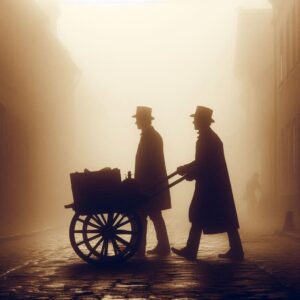
They called them bodysnatchers but they weren’t. They were murderers. And they didn’t work alone.
SCOTLAND is only a small country but it has many cases of foul murder that continue to excite the imagination and send gallons of printers ink flowing like blood across acres of paper.
The story of Madeleine Smith is one of ever-lasting mystery.
The trial of Oscar Slater, wrongly convicted of murder in Glasgow, is one of ever-lasting shame.
Peter Manuel is perhaps the most terrifying for not only did he target young girls walking alone but also crept into the homes of innocent people and slaughtered all he found.
Shadowy Bible John, who may have killed at least three women, still haunts the minds of Glaswegians.
But of all the oft-repeated tales of murder, both single and mass, one notorious case resounds through the decades and echoes around the world. It is the first properly documented case of multiple murder in the country and simply naming the two men involved conjures images of a dark and noisome city, of conspiracy and cover-up, of deprivation and decay and death.
Burke.
Hare.
They have been called bodysnatchers and resurrectionists but they were not. The moonlight trade of graverobbing was not for them. They found an easier way to provide their favoured anatomist Robert Knox with study tools and at the same time line their own pockets. Murder was their business and business was brisk. Their death tally has been placed as high as thirty but the most commonly accepted figure is 16, all committed in a period of a few months.
They did not work alone, however. What is often sidelined in popular retellings of the tale is that there were two other persons involved. They were with the men during the killing time and although they may not have been involved in the actual murders they did benefit from them.
Helen McDougall and Maggie Laird were, respectively, the wives – if only by bad habit and ill repute – of Burke and Hare.
And they were up to their necks in those dark deeds of 1828 Edinburgh.
OF the principal dancers in the ballet of death that was to follow, only Helen McDougall was a Scot, born in Redding near Falkirk. She had once been an attractive woman but the life of a poor woman in early 19th century Scotland had taken its toll on her features, although when news of the mass murder hit the newspapers she was described as still being ‘tolerably good-looking.’ She took her surname from a man with whom she had once lived and was already the mother of two when she turned to prostitution. What happened to the two children is unknown. Perhaps they stayed with their natural father, or perhaps they were sent out for adoption, or died. Life was hard on adults in those days; it was brutal on the young.
Around 1818/1819 the countryside around Falkirk was filled with Irishmen who had come to Scotland to eke a hard living out of digging the Union Canal, which was to link the Forth and Clyde waterway with Edinburgh in the East. It was backbreaking work but the men, the famed Irish navvies, had fled the dire poverty of their homeland in search of employment. They were hard workers and, more importantly for the employers, they were cheap. This of course did not endear them to the native workforce who often saw them as sub-human.
Human nature and the sex drive being what it is, where there were large bodies of men there were the bodies of women ready to see to their needs – for a price. Helen McDougall was one such woman and it was during this time she met young Irishman William Burke. He had departed his Country Tyrone home, leaving behind his wife and two children, in order to seek his fortune but all he found was the sweat and strain of working in the ditches.
Helen McDougall must have been attracted to the squat little Irishman with the piercing dark eyes and the love of dancing for he first became a client, then a regular, then, finally, her one and only. Despite his tendency to slap her around, there appeared to be some genuine feeling between the two, for even while he was languishing in the condemned cell in Edinburgh, Burke sought to excuse her from their crimes.
After four years of working on the canal, the pair dodged around central Scotland and, by 1827, found themselves in Edinburgh, repairing and dealing in second hand boots and shoes. One day in the street they met an Irish woman called Maggie Laird, who was known to Burke.
The two had become three.
One contemporary chronicler deliciously described Laird as ‘a poor, miserable, boney, skinny, scranky, wizened jade.’ Clearly she was not as attractive as Nelly McDougall but was just as free with her favours, although unlike Nell she did not take it up professionally. Maggie was a tough customer and had laboured on the canal herself, wielding a pick and shovel, digging out the hard Scottish earth with the best of them.
Once she set aside her spade, she took up with a man called Logue who ran a down-at-heel lodging house in Tanner’s Close in the area off the Grassmarket known as the West Port. Lodging house is a grand name for what Logue – and many others like him – provided in the filthy, stinking old town. Basically he charged for a leaking roof and a bed of dirty straw that could be shared by up to three people and all the lice they could kill. If patrons did not like what was offered they could move on and God damn their eyes, for there was seldom a shortage of people looking for somewhere to lay their head for a few pence a night. The ragged and the filthy, the poor and the desperate, the honest and the crooked – they were all flooding into the nation’s cities in search of a new life or work or simply a place to hide.
By the time Laird met up with Burke and McDougall in the street, Logue had died and she had a new squeeze – a man named William Hare.
Hare had also come over from Ireland to graft on the Union Canal and, like the man who was soon to become his partner in crime, gravitated towards Edinburgh where he found labouring work and a bed in Logue’s house. It was here that he first met Maggie Laird, although it is possible he had known her, like Burke, while working on the canal. The two took a fancy to each other and Hare was soon giving her something more than thruppence a night. They were a well-matched pair, for she was no prize and he was far from the answer to a maiden’s prayer – even though Maggie had not been a maiden for many a long year. One contemporary description states the lanky Hare had ‘dull, blackish, dead eyes’ and a ‘coarse-lipped mouth’ which, mixed with his high cheekbones and sunken cheeks, inspired ‘disgust and abhorrence, so utterly loathsome was the whole look of the reptile.’
Naturally, Logue took a dim view of the liaison between his woman and the newcomer so sent Hare packing. But after he died Hare was back under the roof and in Maggie Laird’s bed. He, like Burke, was a bit too free with his fists when it came to women and it is said that Maggie Laird was often seen sporting a pair of black eyes.
And so, during the street conversation and subsequent visit to a tavern, Burke told Laird he and Helen planned leaving Edinburgh for the west, where Burke hoped to set up business as a cobbler. Laird suggested they lodge in Tanner’s Court for a while. There was a room available, she said, and perhaps Burke could try his luck in Edinburgh. There they met William Hare, now styling himself landlord.
And the three became four.
Burke and Hare, both Irishmen, both former navvies, seemed to bond immediately. They made an incongruous pair – Hare was tall and cadaverous, the archetypal ghoul; Burke was short and thick-set with an air of respectability. The women were another matter, for Maggie Laird never fully trusted Helen McDougall. Perhaps it was a racial thing, for Helen was Scottish and many Irish people, particularly Irish Catholics, had first hand experience of prejudice at the hands of the natives, the flame lit by John Knox still burning bright. Perhaps Maggie did not like the idea of having a former prostitute under her roof. Perhaps she had an eye for Burke herself, for it would appear he was the better-looking of the two men – but then, compared to Hare, Quasimodo was a matinee idol.
Business boomed in the lodging house for every day there seemed to be a new influx of transients flooding the city. They joined the thousands living in the tall tenements that clustered round the castle like ticks on a stray dog. They filled the many taverns and drinking dens that lined the roads and alleys. They clogged the streets, wading through the sewage that ran openly in the gutters and dodging the fresh filth tossed from the windows above. Death and disease walked hand in hand here and often stepped into the overcrowded lodging houses.
It was sickness that would give the new friends their first item of merchandise for butcher Knox.
Extracted from a chapter in ‘Deadlier Than the Male’, by Douglas Skelton, published 2003 by B&W)
(Click here for part two)