

BBC Scotland is screening a two part documentary on the Bible John case, the first part going out on Monday past (you can catch it on the iPlayer and it’s well worth it).
It’s a case that has haunted Glasgow for decades – and was the very first feature I wrote for the Glasgow Evening Times and effectively setting me off on the true crime journey that led to my current fiction.
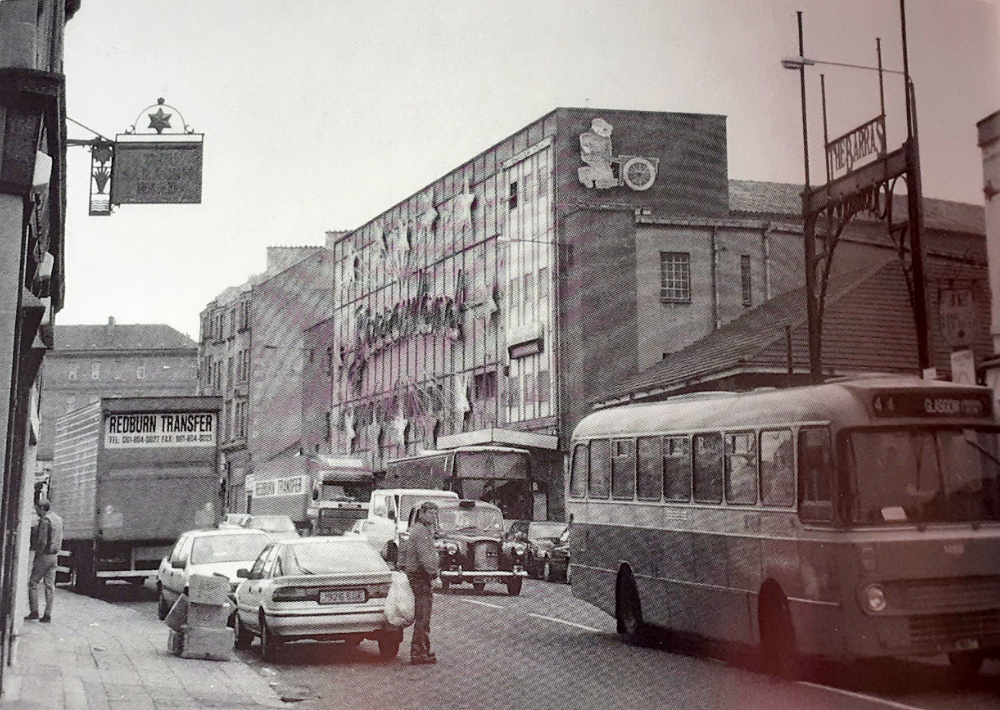
In the dying years of the 1960s, three separate women visited the Barrowland Ballroom in the east end in search of a fun night out at the dancing.
What they found was a killer. Or killers.

In February 1968, Patricia Docker was found murdered in a lane only yards from her southside home. She had gone out for a night with friends, first to the Majestic – the Magic Stick, as it was known – in Hope Street but then to the popular Barrowland.
The machinery of a police investigation swung into gear. Inquiries were made. Interviews were conducted. Statements were taken. However, the trail ran cold.
In August 1969, Jemima McDonald was found in a derelict flat in Bridgeton. She had also been at the dance hall and detectives discovered she had left with a man.
The description was sketchy but it did help create an Identikit image of the suspect. For the first time in Scotland, that image was issued to the press.
But again, they drew a blank.
Two months later, the body of Helen Puttock was discovered in a back court in Scotstoun.
Like Patricia and Jemima, she’d been strangled. Like Patricia and Jemima, she had been on a girls’ night at the Barrowland. Three dead women, three tragedies. Three families and their friends left to grieve and wonder who had done this to their loved one.
This time, though, the police thought they had a more accurate description of a man seen with Helen.
The suspect had shared a taxi with his victim and her sister and by piecing her statement together with others, they were able to create the image of the man they desperately wanted to talk to.
That taxi ride also brought us the nickname that has followed the case from newsprint into dark legend.
During the journey from east to west, the man talked about himself, including the fact that he’d had a strict religious upbringing. He made reference to Biblical passages. He talked of ‘dens of iniquity.’
And so Bible John was born.
The hunt stepped up a number of gears. The murder squad based themselves in Partick Police Station, known as the Marine because it had covered parts of the riverside, because that covered the area where Helen Puttock had been murdered.
They interviewed hundreds of people, took thousands of statement. They made appeals at the Barrowland and other dance halls. They mixed with the dancers, becoming so proficient on the floor that some became known as the Marine Police Formation Dance Team.
They visited tailors to try to match the unusual suit worn by the suspect. They spoke to dentists because his teeth were distinctive. They visited golf courses because he’d talked about a hole in one.
They tried to trace another John – known as Castlemilk John – who had also been with the women and the suspect for a time but he never came forward. It was common for married men to go out ‘on the pull’ and John was an easy enough pseudonym to cast around.
A portrait in oils was even produced, based on the description of the suspect. However, it was recently pointed out that the portrait bears a striking resemblance to an earlier work by the same artist. Does this discredit it? Maybe, maybe not.
No-one was ever arrested.
Time passed and the largest, most extensive manhunt the city had ever seen had to wind down. There were other crimes to investigate and the manpower was needed elsewhere.
Bible John faded from the neon glare and merged with the shadows. Perhaps he died. Perhaps he moved away. Perhaps he was jailed. The nickname lived on, though, largely thanks to the press and people like me.
The question is, was there a Bible John? Were the three tragedies not connected at all? The then Strathclyde Police stated that the murders had never been officially linked. The reality is that they were and one senior detective told me that was a major mistake. If the three probes had been conducted independently then perhaps a vital piece of evidence could have been uncovered. But perhaps not.
Criticism has also been levelled at the decision to focus on the fuller description from the third murder at the expense of other differing descriptions. Also, the lighting in the dance hall and in the taxi would not be ideal – and the main witness had admitted to have been drinking.
Like other unsolved cases, the so-called Bible John cases will never die. Hundreds of people think they know who he was – it was a guy next door who behaved strangely at the time and had a suit similar to the one police described. It was a relative who was later convicted of rape. It was someone else who had very strange material in his attic. But there’s seldom anything that closely resembles proof.
A 1995 probe police concentrated on the then relatively new-fangled wonder of DNA profiling. A sample of semen found on Helen Puttock’s tights contained the miracle genetic fingerprint and a search was launched to see if there was a match with any of the suspects. Investigations zeroed in one man, by that time dead. His relatives agreed to give blood and, according to one forensic scientist, the match was the closest she’d ever seen. Permission was granted in 1996 to exhume his body, which became a media cavalcade. Then everything went quiet. What was supposed to take weeks turned into months – until it was somewhat sheepishly revealed that no match could be found.
Cynics believed that the entire affair was merely a bit of PR for DNA profiling, but if that was the case it failed, miracle development for investigators it is. The problem lay with the samples. DNA samples can be easily contaminated and can erode if samples are not stored properly. Genetic fingerprinting was not even a glimmer in a scientist’s eye in the late 1960s and although the original sample would have been stored carefully it may not have been careful enough to protect the material. I was once told by a former officer that material linked to the cases in those days could be hung over radiators in the police station to dry – while many of the productions in this matter were storied in boxes in the attic of Partick Marine. Remember, this was before the massive leaps in scientific detection. Forensic science was far from in its infancy in late 60s but it was not as advanced as it is today.
In addition, the suspect had been buried in a family lair. The passage of time had seen the coffin break down and the corpse contaminated. In all, the DNA breakthrough in the Bible John case was something of a disaster.
It has also been posited that Peter Tobin could have been responsible. He was convicted of the brutal murders of Angelika Kluk, a Polish student whose body was found buried beneath a Glasgow church, and of teenager Vicky Hamilton, for many years one of the most perplexing of Scotland’s missing person cases. Tobin, it seems, told a prison psychiatrist that he was responsible for 48 murders and the claim was taken seriously enough for a special UK-wide operation codenamed Anagram to be set up to piece together any evidence. In relation to the Bible John killings, Tobin was known to be living in the city at the time of the first two but was resident in Brighton when Helen Puttock was murdered. The methods of murder between the 1968/69 murders and others over the next forty years may be different but Tobin, who may yet prove to the nation’s worst serial sex killer, could have ‘evolved.’ He would have been in his early 20s during the Bible John days and as the years went by he could have perfected his methods and widened his target range, each time driven either by his lust for rape or his desire to kill.
However, Anagram found no cast-iron link to him – and he has refused to confirm or deny any involvement.
If – IF – there was a single Bible John, why did he stop? Was he arrested for another offence? Did he die? Move away? Or did he mature, essentially grow out of the urge to kill? Did he find some other outlet for his violent tendencies?
One jailhouse rumour might be the answer. A well-known crook told more than one person in prison that he murdered a man he believed to be the killer. This man disappeared late in 1969 and the jailhouse chit-chat suggested that he had to die because he was ‘making life too hot for them all.’
Possibly. Maybe. Perhaps. Could be.
All words that must be used when discussing the mystery.
Glasgow’s most notorious serial killer, if such a beast ever existed, remains under whatever rock he has hidden for over 50 years.