My latest novel A RATTLE OF BONES sees Rebecca Connolly investigating a miscarriage of justice. In it, I mention the notorious Oscar Slater case, a case that continues to haunt the Scottish legal system. In part one of this three-part series I outlined the crime and the hunt for the killer, which swiftly focussed on Oscar Slater, who was eventually arrested in New York.

In part two I look at the case against him and the aftermath of the trial – including the attempts by one gallant Glasgow detective to reveal the iniquities of the prosecution. His crusade cost him dear.
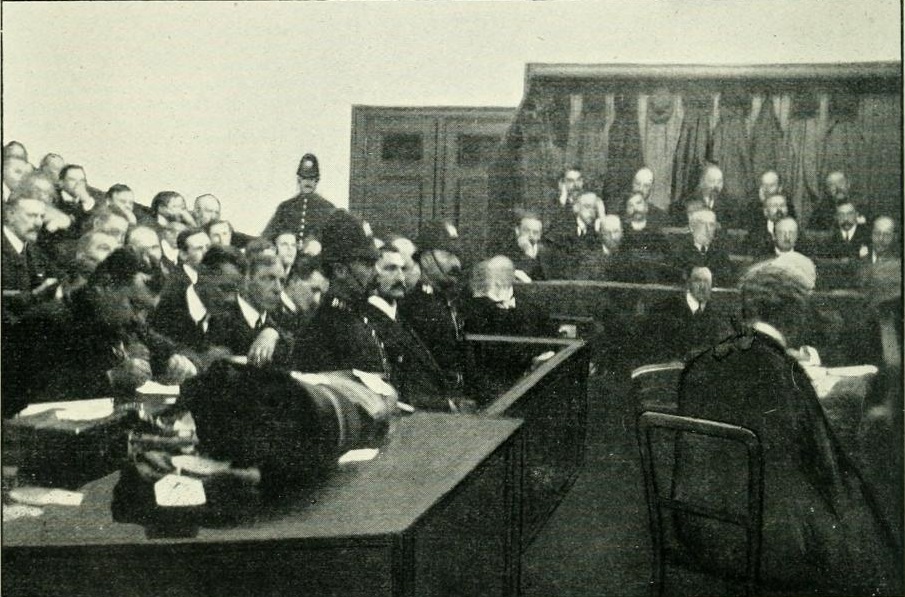
Oscar Slater, centre, in court/Wikimedia

Not the practice in Glasgow

The motive, the Crown insisted, was robbery. But if that were the case, why was there only one item of any value stolen and others left discarded? And how would a man like Slater even get through the securely-locked door? Reports suggested that Miss Gilchrist was unlikely to let him in and there was no sign of forced entry. 

No murder weapon had been found – Dr Adams’ theory that the chair leg had been used was ignored or discounted for he was listed as a witness but never called, which is unusual as he was the first medical man on the scene and had actually pronounced life extinct. However, in Slater’s bags they found a small hammer which they insisted had been used to inflict the killer blows. No traces of blood were found on this weapon and there was no explanation why he would hold onto it during his ‘flight from justice’. 

They produced a series of witnesses who identified Slater as a man seen watching Miss Gilchrist’s apartment. However, in what was becoming a motif for this investigation, each of these witnesses had previously been shown, or had seen in the press, a photograph of the suspect. In an ID parade he had appeared with eleven other men – nine plainclothes cops and two railway officials – who looked nothing like him. During the trial, a police officer was asked if it would be fairer to exhibit a suspect in a parade of similar looking men. 

‘It might be the fairest way,’ the officer conceded, ‘but it is not the practice in Glasgow.’ 

Only one of the witnesses had spoken to the mysterious watcher and she had not noted anything foreign about his speech – Slater spoke with a pronounced accent. One of Arthur Adams sisters said she had seen a man in the street at 6.55pm, five minutes before the murder, and identified Slater by his profile. Unfortunately, she said that the man she saw was wearing a heavy tweed overcoat and ‘had the appearance of a delicate man.’ Naturally, this did not gel with the now accepted description of what the suspect was wearing or the fact that Slater was powerfully built and deep-chested.

Slater produced witnesses who placed him in another part of the city at the time of the murder. At 6.12pm he was in Central Station sending a telegram, at 6.30pm he was in Renfield Street dressed in a waterproof and a bowler hat. Madame Junio and their maid insisted he was home at 7pm. But most of the witnesses were dismissed by the prosecution as low-lives and therefore their acquaintance with the truth was, at best, a passing one. 

A ticket girl at Kelvinbridge Railway Station had identified Slater as the man who had burst through the barrier some time between 7.30pm and 8pm. The prosecution picture was that Slater had ‘taken a train to some remote part of the city and then came strolling back to his house’. The Crown contended that there nothing more was known of his movements until 9.45pm. 

But there was one witness who was neither a low-life nor a friend of the accused. Grocer’s assistant Duncan MacBrayne knew Slater as a customer and had told police that he had seen him at the door of his flat in St George’s Road at 8.15pm. Slater was neither anguished nor flustered. MacBrayne was shown Slater in the police station and the suspect said, ‘Oh, you are the man in the big shop in Sauchiehall Street.’ 

Of course, it is not inconceivable that Slater could have reached his home from Queen’s Terrace in that time but his demeanour did not fit the picture the Crown was trying to paint. 

In hindsight unsurprisingly, MacBrayne’s name did not appear on the list of witnesses and he was not interviewed by the defence at the time of the trial. Another witness, a female school teacher who saw two men running in the street in the opposite direction to the man Barrowman claimed to have seen, was cited to appear but was never called. She did identify one of them as the accused but said he was wearing a completely different style of coat and colour. The coat worn by the killer was, as William Roughead noted in his dry way, ‘already in respect of hues (resembling) that of Joseph.’ 

The Crown had decided that the description furnished by Lambie and Barrowman, now in accord, was the main plank in their case. The rest was mud-slinging.

Lies were told at the trial, of that we can be sure – and not just by the witnesses. The Lord Advocate made his final speech without the aid of notes. 

‘Possibly that accounts for its many inaccuracies,’ observed noted English barrister Sir Edward Marshall Hall, who took an interest in the case. 

Lord Guthrie’s charge to the jury was one-sided and questioned the accused’s character, which had not been properly explored in evidence. The judge had said, ‘A man of that kind has not the presumption of innocence in his favour…’ 

In other words, Slater was not a good man, therefore he did not deserve to be judged as one. What he ignored was the fact that every man is innocent until proven guilty of the particular charge he faced, irrespective of his past, background, nationality or religion. And it is strongly believed that all four of these facets coloured the establishment view of Slater. 

Nine of the jurors thought Slater Guilty, one Not Guilty and five Not Proven. Still protesting his innocence, and having been advised by counsel not to give evidence on his own behalf, he was sentenced to die, the date set at 27 May 1909. Two days before the due date, the sentence was commuted to life in prison. 

Many rejoiced that a brutal murderer was no longer at large but there was disquiet over the case from the start. While Oscar Slater laboured away in the grim fortress that was Peterhead Prison, men of influence tried to have the case re-examined. Sir Arthur Conan Doyle, the creator of Sherlock Holmes, took an interest and was a stalwart campaigner over the next 19 years, despite Slater’s personal life being a source of distaste to him. He believed that Miss Gilchrist was murdered because of a will and not her jewels – and that theory pointed to someone in the family. The august pages of The Times and The Spectator carried letters and articles attacking the verdict and finally in 1914, with no Court of Appeal yet formed in Scotland, a ‘Secret Inquiry’ was held in Glasgow. Limited in remit, no-one represented Slater although both the Chief Constable and Procurator-Fiscal both had input. Naturally, it was nothing but a whitewash.

That year saw the sacking of Police Detective Lieutenant John Thomson Trench. He had been with the Glasgow force for 21 years and was, as force historian Douglas Grant said, ‘a brilliant officer’ who held the King’s Police Medal for Meritorious Service. He had been on the squad investigating the case and believed that the old woman had been murdered by someone close to her. 

He also believed that Helen Lambie was intimately acquainted with the killer. 

He had discovered that on the night of the murder, when the maidservant ran to the home of the deceased’s cousin, Miss Birrell, she had blurted out, ‘I saw the man who did it. I think it was….’ and here the only reference in documents are the initials ‘A.B’. Trench reported his findings to his superiors but was told that ‘A.B.’ had been fully investigated and cleared, even though no-one had, as far as is known, mentioned him during the initial investigation. 

Trench, though, was a man of conscience. He had already averted one Scottish Miscarriage of Justice based on suspect identification – the so-called ‘Broughty Ferry’ case of 1912 which was very similar to the 1908 murder of Miss Gilchrist. In that, an elderly spinster was murdered in her own home, her house ransacked but little taken. A stranger had been seen around the house, was identified by English police and a photograph shown to potential witnesses, who were later prepared to swear to their identification in court. Trench, whose expertise had ensured he was called in on the case, was unconvinced and proved that the man had been in Antwerp at the time of the murder. The Broughty Ferry case remains unsolved.

With no notice being taken of his pleas over the Slater case Trench, with what he thought was an assurance from the Scottish Secretary of State that there would be no backlash against him, took his information to lawyer David Cook. He in turn passed it on to the Secretary of State who ordered the ‘Secret Inquiry’ – but tied its hands so much that there was no hope of the truth being found. 

When its predictable findings were returned, Trench learned he should not have put his faith in politicians for there followed a severe backlash against him. He had communicated official information to a third party and Glasgow Police took a dim view of him stepping outside the ranks. On 14 September 1914, John Trench, one of the best officers on the force, was ignominiously dismissed. 

The war with Germany had begun and he enlisted in the Royal Scots Fusiliers but his vindictive superiors had not finished with him. It seems they would not be happy until his reputation was completely destroyed. Before he could be sent to fight Trench and David Cook were accused of receiving stolen goods in relation to the recovery of items stolen in a burglary. Everything he did in that case was done with the full knowledge of his superiors – and he had received a glowing commendation from an insurance company. But that did not matter and the two men were brought to trial. Luckily though, the system worked in the way it should and the judge ordered the jury to dismiss the charges. This low treachery in high places haunted the Force for decades and it never apologised for its actions. 

Trench survived the war but did not live to see Oscar Slater – or himself – vindicated. He died on 13 May 1919. Lawyer David Cook never fully recovered from his treatment at the hands of the system in which he believed and died in 1916.

However, if the authorities thought the case would go away, they were wrong.

Part three will be posted soon
In A RATTLE OF BONES I mention the Oscar Slater case, a notorious miscarriage of justice from the early 20th century that even today stains the reputation of Scottish justice. What follows over the next three posts is an account of the case adapted from my non-fiction book ‘Glasgow’s Black Heart’, now out of print.

IN July 1928, Sir Arthur Conan Doyle sat in a courtroom in Edinburgh’s High Court of Justiciary for four days listening to lawyers argue a case which had caught his attention almost twenty years before. As he listened to the legal points being won or lost, he scanned the faces of those present. Suddenly, he wrote, his eyes were arrested….

‘One terrible face stands out among all those others. It is not an ill-favoured face, nor is it a wicked one, but it is terrible none the less for the brooding sadness that is in it. It is firm and immobile and might be cut from that Peterhead granite which has helped to make it what it is. A sculptor would choose it as the very type of tragedy. You feel that this is no ordinary man, but one who has been fashioned for some strange end. It is indeed the man whose misfortunes have echoed round the world. It is Slater.’

Oscar Slater/Wikimedia

The injustice done to Oscar Slater by the Scottish legal establishment remains an outrage over a century after the events with which it began. The case, sparked by a murder in 1908, stands alongside that of Madeleine Smith as perhaps the city’s most famous historical mystery. It was obvious to many even at the original trial that Slater was innocent and writers have alleged that the authorities of the day conspired to ignore facts and manipulate evidence to win the day. However, for evil to triumph it is only necessary for good men to do nothing – and there were a number of good men in Glasgow, London and Edinburgh who refused to sit back and do nothing. 

For one honourable police officer it meant the end of his career. 

The violent act that caused the scandal took place in a respectable street in Glasgow’s west end. Spinster Marion Gilchrist could be called eccentric, perhaps even reclusive. The 81-year-old woman was of independent means and kept jewellery to the value of £3000 hidden away in her wardrobe. She protected her privacy with an iron will, had the door of her first floor flat at 15 Queen’s Terrace on West Princes Street strengthened by double locks, and had until recently kept a dog but it had been poisoned. No-one was allowed access unless she knew them. She had an arrangement with her downstairs neighbour that she would bang on the floor should she ever need assistance. But on 21 December 1908 someone breached those defences. It was her custom to send her maidservant, Helen Lambie, for a newspaper of an evening and that night was no exception. The young woman was gone for about ten minutes. 

At about 7pm on that Monday night, musician Arthur Adams in the flat below heard a noise from above as if something had fallen. The arrangement with his elderly neighbour in mind, he climbed the stairs to see if he could help and through the locked door heard another noise, ‘as if it was someone chopping sticks.’ Receiving no answer from the door he returned to his sisters below and for the next few minutes the noises from Miss Gilchrist’s flat continued, gaining in volume until it sounded as if  ‘the ceiling was like to crack.’ He went back upstairs and met Helen Lambie, who unlocked the double locks and they both walked in. 

It is at this point that the mystery takes an unusual turn.

As Mr Adams and Helen entered the hallway, a man emerged from the bedroom. Lambie did not acknowledge him nor show any surprise or fear. One might even say she expected him to be there.  Mr Adams noted that the ‘most gentlemanly-looking man’, who he took to be a relative, walked past them ‘quite pleasantly’ before darting out the door and rushing down the stairs like ‘greased lightning.’ He felt that Lambie knew him, although she did not acknowledge him. The descriptions they gave to police later were combined to form a picture of a 25-30 year old man, five foot eight to nine inches tall, of slim build, clean shaven with dark hair. They said he was wearing a light grey overcoat and a dark cloth cap. 

They found Miss Gilchrist in her dining room, her head mashed to a pulp, blood spatter on the fireplace. In the bedroom, her personal papers had been rifled – she had kept them locked in a wooden box – and jewellery lay scattered on the floor. However, all that appeared to be missing was a heart-shaped diamond brooch. 

Mr Adams and the maid rushed back downstairs to intercept the man they had seen but the rain-swept, gas-lit street was empty. Arthur Adams called his own doctor – coincidentally also named Adams – while Lambie hurried to Miss Gilchrist’s cousin to tell her what had happened. It was not until Dr John Adams arrived that police were called. While he waited, the GP surveyed the scene of the crime and surmised that the leg of a smashed chair had been used to inflict the bloody wounds. Also evident was a bloody palm print beside the fireplace. A coal box, which had moved slightly from its customary position beside the fire, was damaged and carried traces of blood.

Police very swiftly found a third witness, 14-year-old message girl Mary Barrowman. She said that she had been passing the house when a man burst out of the door and almost knocked her down before running towards West Cumberland Street and Woodlands Road. Despite having only seen him for an instant in the dimly-lit street, she was able to provide a much fuller description. She narrowed his age to between 28 and 30. He was tall, thin and clean shaven. His nose was slightly turned to one side, she thought to the right. He wore a round hat known as a Donegal hat and a fawn-coloured overcoat which may have been a waterproof. He had on dark trousers and brown boots.

At first, police were convinced that the murderer was known to Miss Gilchrist and that perhaps there were two men involved. However, all other lines of inquiry were abandoned on Christmas Day when information came in that a man named Oscar Slater had been trying to offload a pawn ticket for a diamond brooch.  

Slater was something of a ne’er-do-well, a gambler living with his mistress under the name Anderson. His real name, though, was Oscar Joseph Leschziner, a 39-year-old German Jew who often claimed to be a dentist or a diamond trader. There was a problem, though –  he did not fit the various descriptions given by the three witnesses. He was of medium height and heavy build. More importantly, he had a short black moustache although his nose, which appeared to be broken, could have been said to turn to one side. 

Despite that, here was a suspect the police could really get behind – and when they discovered that he had fled the city they set off in pursuit. On 27 December, Chief Superintendent John Ord wrote to chief constables across the country to ask that their forces be on the alert for Slater. It was believed he may have fled to Nottingham so on 27 December, that city’s top policeman received a letter saying that ‘a man named Oscar Slater alias Anderson, describing himself as a dentist…left this city hurriedly and may have gone to your City as two single railway tickets were issued for passengers by the 9.30pm train…’

A telegram sent by Glasgow’s Chief Constable that night to ‘Handcuffs, London’ (presumably shorthand for Scotland Yard) said in customary unpunctuated form, ‘Slater supposed left Glasgow with train due Euston 6-30 am Saturday His nose has been fractured and slightly twisted to one side Supposed accompanied by a woman about 30 tall stout good looking dark hair dressed dark costume set stable furs large blue or black hat.’

Meanwhile, the following day’s press carried an advertisement placed by Glasgow’s Chief Constable James Verdier Stevenson asking for any hotel proprietor, landlady or lodging-house keeper to communicate without delay ‘any information to the Subscriber regarding the sudden or unexpected disappearance of any Lodger or Boarder on the night of the murder or after; of it any person of a suspicious nature sought for or obtained lodgings about the time stated.’ 

The public also became enthusiastically involved in the hunt for Miss Gilchrist’s killer, which had received widespread newspaper attention. Anyone with a theory or a suspicion wrote to the police; at least one urged them to ‘look for a relative’ while a man signing himself ‘The Prince of Darkness’ wrote from Edinburgh on 18 January claiming responsibility and gloating that ‘he was still at large’. He also admitted stabbing a woman in Dublin on 9 November. 

Although some officers continued to believe that two men had been involved, the focus rather quickly narrowed on Slater. He had left his homeland to avoid conscription and had drifted around Britain and abroad as far as New York. He frequented and ran gambling clubs. He was a rogue, of that there is no doubt, but was no killer. Neither is there any real evidence that he was a pimp, as was claimed in court but never substantiated, although at the time of the murder he was living with French prostitute Andrée Junio Antoine, better known as Madame Junio. In court, emphasis would be placed on his alleged flight from justice and it would be claimed – again falsely – that he had run from Glasgow as soon as his name appeared in the newspapers as a person of interest and tried to cover his steps as he made his way to Liverpool and on to New York. 

However, he and his partner had planned to quit the city some weeks before the murder and actually left before the police made his name public. Furthermore, he both travelled to Liverpool, and lodged there, quite openly under the name Oscar Slater. It is true that he had a habit of using other names – Anderson and George being two – but for a man who lived on the fringes of the law such a pose was commonplace. Although it is also true that he had booked passage under the name Otto Sando, this was no flight from justice. His move to the States had been planned and, in fact, it was his intention to move on to San Francisco where he would run a gaming club with an old friend. What’s more, the brooch he had pawned was not the one taken from Miss Gilchrist’s house and had in fact been pledged prior to the murder. 

None of that seemed to matter to Glasgow’s finest. The facts did not seem to matter. The varying descriptions of their suspect did not seem to matter. Oscar Slater was a seedy character, a liar, a cheat and a foreigner to boot. If ever there was a usual suspect, he was it.

While attempts were made to track him down in New York, the two different descriptions furnished by Lambie and Barrowman – the ‘short-sighted’ Arthur Adams stressing that he could not identify the man again – were duly finessed. Lambie had insisted that she could not identify the man she saw that night but police worked on her. They showed her a picture of Slater. They badgered both her and Barrowman until the two differing descriptions merged into one, ‘which made it much simpler for all concerned,’ observed crime chronicler William Roughead in his usual wry tone. During the extradition proceedings, Lambie and Barrowman were taken to New York and just happened to be in a corridor when a handcuffed Slater was brought by. A Glasgow detective pointed him out and said, ‘That’s the man.’ 

Unsurprisingly when asked in court in front of a New York judge, they had no difficulty in picking him out.

Slater could have fought the extradition proceedings. The brooch ‘clue’ had already been proved false and all that was left was the evidence of Lambie and Barrowman, which was far from conclusive. However, Slater elected to accede to the Crown’s request and return to Scotland. He was innocent of the crime and believed that the truth would out. 

That belief in the legal system, though touching, was to cost him 19 years of his life. 

PART TWO WILL BE POSTED SOON