
Glasgow’s judicial industry was now well-established at the foot of the Saltmarket, with prisoners being kept in the south prison, either ahead of appearing in the adjacent courts or after sentencing. But the area can lay another claim to being the black heart of the city – for this was where the gallows were erected come execution day.
Today, at the mouth of Glasgow Green, there is an archway that once formed part of the Assembly Room building in Ingram Street. Partly designed by Robert and James Adam and built in 1796, the Assembly Rooms were the centre of Glasgow’s social life for half a century (superceding the old Tontine Hotel near the Tolbooth at the Cross) before it was demolished to make way for the city’s main post office.
Its central archway, however, was retained and eventually rebuilt on Glasgow Green. Its current situation bore very little relation to the colour and gaiety of the Assembly Rooms for it was here, between 1814 and 1865, that Glasgow staged its public executions.
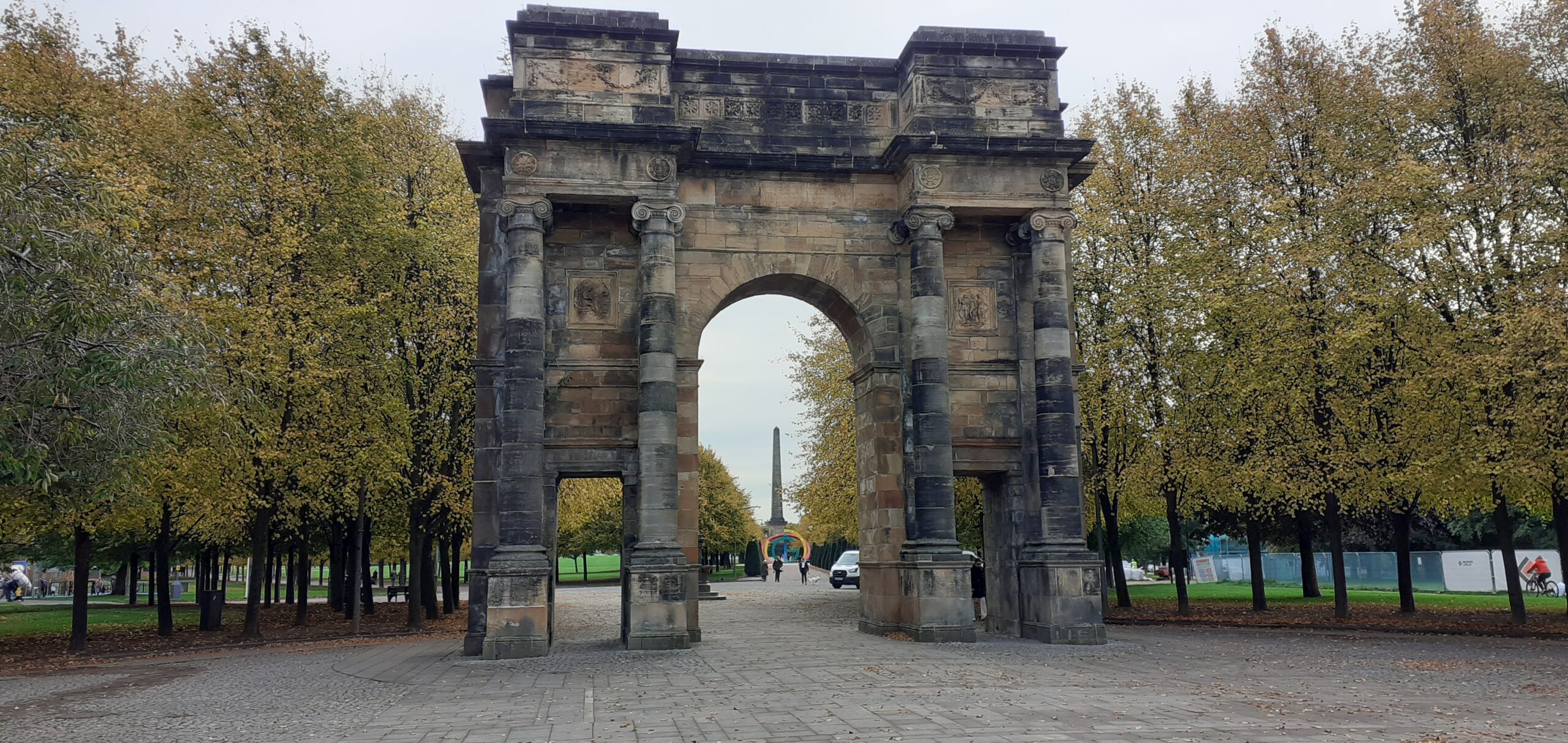
‘You will die facing the monument’ became a well-known Glasgow expression during this time, for one of the last things the condemned saw was Nelson’s column reaching to the heavens from Glasgow Green. In 1819, murderer John Buchanan sought to confound the prophecy which had been laid on him by a friend. He vowed he would never die facing the monument and when he found himself on the scaffold he kept his word by turning to the side.
One man, though, may have ultimately seen a little bit more … and caused panic in a university dissecting room in the process.
Lanarkshire miner Matthew Clydesdale had killed an 80-year-old old man with a pick axe and was sentenced to hang on 4 November, 1818 with his body to be ‘delivered up by the magistrates of Glasgow, or their officers, to Dr James Jeffrey, Professor of Anatomy in the University of Glasgow, there to be publicly dissected and anatomised.’ Such was the practice then, for trainee doctors and surgeons needed cadavers for research purposes and society at large frowned on the opening up of anyone other than convicted murderers or unbaptised foundlings.
Clydesdale’s execution went without a hitch, courtesy of Glasgow hangman Thomas Young, and the body placed in a cart to be escorted by soldiers to the college dissecting rooms at the top of the High Street. One of the legal stipulations of the sentence was that the dissection could be viewed not just by students and medical men but any members of the general public interested in such a grisly spectacle so there was generally a number of curious laymen packed into the seating area. This time, though, they were in for a shock.
Clydesdale’s body, his face still covered in the white cap, his hands and feet still tied, was laid on the table. So far, so routine. But then there was a change, for instead of Dr Jeffrey slicing and dicing his way through the corpse, it was lifted again, placed in an armchair and the bindings cut away. Into one nostril was placed an air tube, the other end of the tube attached to a bellows and the corpse wired up to an early form of electric battery, known as a voltaic pile.
The object of the exercise about to be carried out by Dr Andrew Ure, Professor of Natural Philosophy, was galvanism, a test of the nervous system, which saw new-fangled electricity being used to seemingly reanimate dead tissue. That same year, author Mary Shelley used the theory to allow her fictional Dr Frankenstein to create the famed creature. When the bellows were blown, Clydesdale’s chest appeared to heave until the corpse seemed to breathe on its own. Then when the battery was activated, a leg shot out with such force that it almost knocked over a student standing nearby. The dead man’s face began to contort and twitch, some swore that it flashed them a ghastly grin. Some accounts state that the eyes opened and the arms and legs moved until finally the cadaver began to rise from the chair but this was a tale that grew in the telling.
Nevertheless, what they did see terrified many of the spectators. Dr Ure later wrote that many of them attempted to flee. ‘One gentleman fainted,’ he noted wryly. The exhibition came to an end when, reports state, Dr Jeffrey seized a lancet (a long surgical needle) and plunged it into Clydesdale’s jugular vein. The creature fell to the floor ‘like a slaughtered ox on the blow of a butcher.’ Apparently – and perhaps not surprisingly – such shocking, not to mention blasphemous, scenes ensured that it was the last time the Glasgow magistrates allowed a felon’s corpse to be sent to the dissecting table. The anatomists in search of knowledge would have to find other means of obtaining their raw materials.
The murderous acts of Burke and Hare in Edinburgh in 1820 did lead to a relaxation of the rules regarding cadavers for the dissection tables but writer Andrew Aird in 1894 recalled fears that there remained ‘cruel men’ in the city’s ‘dark and lonely places’ who ‘lay lurking about supplied with plasters which they stuck over the mouths of such persons as came near them, and whom they put to death….carrying the dead bodies to the dissecting rooms of hospitals or giving them to doctors as “subjects” for dissection. I recollect it was the custom for timorous people when passing the wynds to put their hands upon their mouths, so as to ward off the death-dealing plaster.’
For a time, hangmen in Glasgow were known by their his uniform of a yellow-buttoned blue coat and a blood red collar. One holder of the office. One who didn’t was Archibald McArthur, known as ‘Buffy’. However, it was not vampires he slew but the city’s thieves and murderers. McArthur was just over five foot tall, stout, bandy-legged with a ‘big bullet-shaped head.’ He was said to have been ‘a good-natured, inoffensive creature’, despite his unhappy home life – his wife was known to enjoy a good drink, while his hunchbacked son died young in the Infirmary. The council provided his family with a home in South Montrose Street, near the Ramshorn Kirk, but the post of hangie – or Finisher of the Law – was not a popular one, even though it was his job to despatch rogues into eternity. Mobs took to attacking his home so he moved to an almshouse in the High Street. He died, aged 40, like his son in the Infirmary.
His successor was Tam Young was something of a legend in what was a tight little noose of executioners. The lanky finisher became well-known in the city for the calm, dispassionate way he sent his customers to their doom.
He was a Borderer who was an unemployed labourer in the Calton area when, in 1814, he spotted a newspaper advertisement for the post of Glasgow hangman. Tam took up the position at a salary of £52 per year, plus a guinea for every execution. In addition to a house – within the grounds of the prison, to keep him safe from the ire of the mob – the council also agreed to provide him with two new pairs of shoes every year as well as coal and candles. As additional protection against assault, Tam kept two dogs by his side, one a giant Newfoundland he named ‘Hero’. Over the next 23 years he sent 56 people in Glasgow to their doom – one of them beheaded – and a further 14 in other parts of the country. He was also responsible for administering the public floggings, an event possibly even more horrendous than the sight of a hanging.
In 1822, Edward Hand was sentenced to be whipped through the streets of Glasgow having been found guilty of an assault in Greenock. He was to receive 80 strokes, twenty at the prison, twenty at Stockwell Street, twenty at Glassford Street and the final twenty at the Cross. If he survived this brutal treatment then he was to be banished for life.
Tam may have been a quiet soul but he was not slow in coming forward when he thought he was not receiving his due or being treated with disrespect. In this instance, he disputed with the magistrates over who should carry out the task of tying Hand to the cart that would wheel him around the town. Part of his duties may have been to perform labouring duties around the jail but this, Young believed, was beneath his station as public executioner. He also queried who it was that would carry the spare cat o’nine tails.
The two issues were resolved, Hand was finally bound to the cart and the portage of the whip was solved by tying it to the end of the cart. Satisfied, Young carried out his office, watched by a large crowd. His naked back lacerated by the eighty strokes, Hand survived and was duly banished. It was the second time that year such a punishment was meted out in Glasgow, while in 1825, cotton spinner John Kean received a similar punishment for attempting to murder a fellow worker. His full eighty strokes, however, were delivered on a platform in front of the prison.
Tam Young died in 1837 following a long illness. The city never appointed an official executioner after that, although there were hangings a-plenty.
To be continued…
