The final part of a short series on the execution of justice – and of the condemned – in old Glasgow.

John Murdoch had been the assistant to both Young and McArthur, as well as others, for thirty years when he became the ‘go-to guy’ for towns needing someone ‘topped.’ A baker to trade, he performed his official duties on a piecework basis but he was around 70 years old when Young died. Rheumatism had stricken his legs and he could walk only with the aid of a stick. Newspapers commented on the sight of him tottering up the steps to the platform and in 1849 one reporter opined that it was perhaps time that he gave up the work altogether. But old Murdoch grimly hung on – the £30-£40 fee for a topping was not something he was eager to do without – and at the age of 84 he almost botched what was to be his last service for Glasgow.

On 2 October, 1851, Archibald Hare, a man said to be of ‘repulsive and dogged aspect’, was sentenced to death for the stabbing of a man in Blantyre. Murdoch may well have been in the courtroom to hear the verdict, for it was his habit to attend the Circuit Court whenever a capital case was to be heard. Hare, who legend states was the nephew of ‘bodysnatcher’ William Hare (but legend is wrong), was to die on 24 October. The hangman laboriously hauled himself up the gallows steps and fixed the rope around Hare’s neck. In addition to being repulsive and dogged, Hare was a very slight man and when he was turned off he merely twisted on the end of the rope, trying desperately to free his bound hands in order to clutch at the hemp biting into his throat. Murdoch had to speed the man’s end by grabbing hold of his legs and swinging on them until the struggles eased and finally ceased. The authorities concluded that this particular Finisher was too old to continue and allowed him a pension out of the public purse. He died, aged 89, in Bothwell. 

Glasgow then hired hangmen from other parts of Britain to, as Tam Young used to say, ‘get their business done.’

Over thirty years earlier, though, it would have been Tam who did the honours at the first quadruple hanging in Glasgow – during which two of the men facing their doom publicly displayed their affection for each other.

Robert McKinlay, (also known as Rough Rob), William Buchanan, Robert Guthrie, (alias R. Hunter Guthrie), and Alexander Forbes were led to the scaffold on the Green on 8 November, 1819. They had each been found guilty of various counts of housebreaking. McKinlay and Buchanan had been audacious enough to break into Bothwell Castle, near Hamilton, and make off with a gold watch, a silver snuff box, a silver spoon, a silver candlestick, a silver bread toaster ‘and several articles of wearing apparel.’ They had forced open a window and crept around the castle while the owner, the Right Honourable Lord Douglas, slept.

Glasgow-born McKinlay was a 23-year-old former cotton spinner who had, a broadsheet said, ‘long given up the sober pursuits of industry’ to set about ‘gaining a livelihood by fraud and theft’ through the ‘more dangerous way of living by preying on the property of the public.’ At the time of his arrest he was also wanted for a variety of other burglaries. He had earlier broken out of Greenock Jail and had avoided recapture by going to sea for eight months. He was caught on this occasion ‘in the Green asleep’ with some of the stolen items on him and ‘his Lordship’s neckcloth about his neck.’ He was destined to have something less pleasant around his throat. He had perhaps been fingered by his accomplice arrested earlier. 

Buchanan was only 18-years-old and was also a cotton spinner to trade but was of a ‘very unsettled disposition, and much addicted to pilfering’, a state of mind which had already seen him do a twelvemonth in the Bridewell.

Lord Douglas appeared to be a very forgiving man for he had done what he could to have the men’s lives saved, but had failed.

Guthrie, a Paisley weaver, and Forbes, from Glasgow, had been found guilty of a housebreaking in Kilmarnock, during which they had taken a silver watch, five shirts, two pairs of shoes, cloth, food and cakes. A police officer spotted them near Barrhead two days later and with the aid of a ploughman managed to arrest them, finding some of the stolen articles on them.

When condemned to death, Guthrie stated that he thought the sentence ‘very hard.’ The 25-year-old was by trade a Wright but was a known criminal who had also previously tried to break jail, in his case the prison at Ayr, while 18-year-old Forbes was of ‘honest industrious parents’ but had ‘given himself up to idleness and drunkenness.’ He, too, had escaped from prison, having busted out of Paisley. He continued with his life of crime, almost being caught in the Gallowgate once, until he was arrested. Again unsuccessful efforts were made to have their sentence commuted. In the eyes of the law they were all menaces that had to be eradicated.

All four were described by a broadsheet of the day as ‘good-looking young men.’ The writer went on to say, ‘Never did the inhabitants of Glasgow, and the surrounding countryside, witness a more awesome and disturbing spectacle.’

Another broadsheet commented, ‘The melancholy scene we have this day witnessed must have the effect of touching with anguish the heart of every friend of humanity – every lover of our species; four young men (a sight never before witnessed in Glasgow)  suffering ignominiously, shamelessly, and ingloriously on the scaffold, for breaking the laws of their country, whom, had the ability they evidently possessed, been directed aright, might have been an honour to themselves, a happiness to their families, and made them useful members of society.’

This writer hoped that the ‘heartrending spectacle’ the public witnessed would make anyone tempted to follow in their footsteps by ‘preying on the property of the public’ to think twice. What they thought of McKinlay kissing Buchanan farewell as the nooses were draped around their necks can only be surmised. Obviously, there was something more between the two than just friendship. The two young men continued to hold hands, made difficult by their being bound, until Guthrie gave the signal to the hangman. The four men ‘struggled very much’ before they were finally still.

The following year saw yet another quadruple execution. On a Sunday in December 1819 a gang invaded the home of Dr Robert Watt in Crossmyloof, a well-known doctor who had died seven months before. His widow, her young children and servants were in the mansion at the time and the men, their faces blackened, proceeded to ransack every cupboard and drawer before making off with all the cash and silver plate they could find. One held a loaded pistol to the head of the widow while another wrenched the rings from her fingers.

Four men by the name of Grant, Crosbie, O’Connor and McColgin was arrested the following October and tried in Glasgow in November. When condemned to death, lawyer and social campaigner Peter McKenzie noted, all ‘broke out into a loud volley of curses and swearing, and actually attempted to kick some of the witnesses and officers of justice near to them.’ At just after 3pm on Wednesday 8 November they were turned off together by Tam Young. According to one report the four men struggled dreadfully before they died and their bodies hung for 40 minutes before being cut down.

McKenzie went on to detail the tragic life of Mrs Young after the event. She lost much of her fortune through bankruptcy and all but one of her children died before her. Only the youngest girl survived but tragedy hit her, too – just before she was due to marry a distinguished surgeon he died of Typhus Fever.

The following year, Young officiated at a triple execution. On 24 October, Michael Macintyre, William Paterson and Wardrope Dyer were brought from the prison, marched across the road and onto the scaffold. Macintyre and Paterson had been found guilty of breaking into a house and stealing ‘various articles of wearing apparel.’ McIntyre was a 20-year-old Irishman whose parents had ‘endeavoured to gain a livelihood by hawking earthernware through this country.’

Their son was left to his own devices and tried to make a living by selling gingerbread in the streets but also during this time ‘became acquainted with idle and dissolute company’. He soon drifted into crime and was ‘well known to the keeper of the Bridewell.’ He enlisted in the army but his larcenous nature led him to be found ‘several times guilty of plundering his comrades’ so he was punished – no doubt by flogging – and then drummed out of the regiment. He obviously did not learn from the experience for he was arrested fairly soon after returning to Glasgow.

His accomplice William Paterson, born in Manchester of Scottish parentage, came to Glasgow when his father died in the East Indies. His upbringing was such that he very early on ‘fell a prey to every species of vice with which every large city abounds.’

Dyer was a native Glaswegian, having been born to reputable parents in the Drygate. He became a weaver but ‘got acquainted with women of very questionable characters, took up with gamblers, boxers and bullies who were always the first to point out the object of plunder, and ever ready to partake of the booty, but too wary to share in the danger.’ Dyer, though, was all too willing to take the risks and that brought him to the platform in October, 1821, where he would die facing the monument. He was only 22 years of age. In the jail, before they were led out, he had been moved by the preaching of the minister but McIntyre and Paterson were made of sterner stuff and warned other prisoners within earshot that if they ever wished to avoid hanging, then plead guilty. After the execution, it was revealed that Dyer had pointed out the haunts of ‘questionable characters’ and the eye of the Glasgow Police was upon them.

The final declarations of the accused on the platform were generally of a religious nature, leading to a warning against drink, keeping bad company and fornication. Paisley weaver turned housebreaker David Wylie, on 12 November 1823, warned the crowds to beware of gangs of thieves. He urged onlookers to avoid ‘bad company, especially resetters, who haunt young men in their houses; who give their meat and drink to the pilferer which they prompt then to take in a clandestine manner; little money is given to the depredators; and what is gained by these destroyers of youth who sell the property of honest people, is spent in debauchery, drunkenness and everything which degrades human nature.’ He considered ‘bad women and Sabbath breaking’ two of the worst evils, in addition to the one for which he was convicted.

Wylie died, aged 17.

However, perhaps the strangest of all declarations on the scaffold came in 1853, when Hans Smith McFarlane and Helen Blackwood were executed for murder. They had lured ships carpenter Alexander Boyd to a house in the New Vennel. There they drugged him with a mixture of whisky and snuff, robbed him and then threw his body from a window. They denied the charge but the principal witnesses against them were two brothers named Shillingshaw, both less than 12 years of age, who had been sleeping under a bed in the same house and watched the whole scene. The boys had been kept in prison since the murder because they had nowhere else to go. At the trial in Edinburgh, a third person, Ann Marshall, was found guilty along with McFarlane and Blackwood but her sentence was commuted to transportation. There was no such mercy for McFarlane and Blackwood, for they were to hang. ‘We have not got justice,’ remarked the woman. ‘There is a higher judge for us. We are innocent.’

On being returned to Glasgow, McFarlane and Blackwood were lodged in Duke Street Prison. There McFarlane asked the governor if he would be allowed to marry his co-accused. The request was turned down – but McFarlane had his mind set on making an honest woman of her, figuratively speaking at least. On the day of their death, 11 August, they were both moved to the South Prison before being led out to the scaffold. A crowd estimated to be 40,000 strong rippled far into the Green and before them McFarlane shouted, ‘Helen Blackwood, before God and in the presence of these witnesses, I take you to be my wife. Do you consent?’

The stunned ocean of faces waited to hear the woman’s response. ‘I do,’ she said.

‘Then before these witnesses I declare you to be what you have always been to me, a true and faithful wife, and you die an honest woman.’

The officiating clergyman intoned Amen, the bolt was drawn and the newly-weds plunged into the gaping maw beneath them. T.M. Tod remarked in his ‘Scots Black Kalandar’, ‘This marriage, we understand, was not recorded in the Registrar General’s book.’

McFarlane and Blackwood insisted their innocence to the last, as did weaver Andrew Stewart who was condemned for a street assault. Although he admitted he had struck the victim, he insisted that he had not participated in the subsequent robbery. Lawyer Peter McKenzie tended to believe him and labelled the case a miscarriage of justice.

The victim was Italian Filipo Testi, who McKenzie wrote was a ‘mild, fine-looking young man, who scarcely understood the Scots language.’ He earned a living as a street trader, selling ornaments and little works of art from a board which he carried about Glasgow on his head. Belfast-born Andrew Stewart was a weaver who lived in Bridgeton with his parents and had never been in trouble with the law.  One Saturday in August, 1826 (McKenzie says it was May, but he was writing from memory long after the events) he came to Glasgow to be paid by his employer. With money in his pocket, he tarried too long, visiting the Theatre Royal and lingering in the Boat Tavern in the Saltmarket with some friends. As he made his way home via the Gallowgate, he encountered Filipo Testi in East Nile Street. The Italian had lost his way and in his faltering English asked Stewart directions. The 25-year-old weaver, his mind befuddled with drink, did not understand him and began to believe that Testi was making a fool of him. Testi tried again but still could not make himself understood. Then he put his hand on Stewart’s shoulder. Stewart shrugged him off. Testi became more excited in his questions, desperate to make himself understood. Finally, Stewart took offence and punched him. If he had been sober, perhaps he would have been more patient. But he was not and Testi fell to the ground. A policeman standing nearby saw the punch and ‘sprang his rattles’, panicking Stewart who ran off down Charlotte Street and onto the Green, leaping over an iron gate that police had earlier locked to prevent anyone from getting into the park at night. The officer had followed, leaving Testi stunned on the ground, but lost him in the dark.

According to the prosecution, Testi was already being stalked by ‘a gang of ruffians’ who had been told by a woman that he had money on his person. These ‘street blackguards’ then materialised from the darkness and pounced on the man while he lay prone in the street. They robbed him of his gold repeater watch, chain, his gloves, his tobacco and ‘five or six segars’. They also relieved him of two one-pound notes, a guinea note and 10 to 12 shillings in silver. The gang was seen rifling his pockets but anyone who attempted to prevent them was threatened. They did not stop until other officers arrived, alerted by their colleague’s rattle. The gang, like Stewart, bolted for the Green where they argued over the division of the spoils.

Stewart, meanwhile, made it home where he told his mother what had happened. Two days later they came for him while he was eating breakfast. The officer who had chased him identified him and charged him with assault and street robbery. Police also arrested George Buckley and James Dickson, on whom they found Testi’s wallet. The Crown case was that Stewart had acted along with Buckley, Dickson and others to attack and rob Testi. The young weaver insisted he had never seen the men before. He told the police his story. Yes, he had struck the blow but it was in anger not as part of a street robbery. He had not meant to hurt the man. He repeated it to lawyers. He told anyone who would listen. He was not believed. 

The jury, by a majority, condemned Stewart for assault and robbery but acquitted Buckley on a Not Proven verdict. The young man had been identified by witnesses, while Buckley – a known crook – had not. One witness prevaricated so much that he was jailed for two months for contempt, to be fed nothing but bread and water. Dickson, however, was found guilty of robbery – he had, after all, been found with part of the booty. He was to be transported for life but Stewart was to die. The judge said that street robbery was an atrocity and that it was ‘necessary to make a terrible example, especially in the case of the poor foreigner.’ 

‘So it is,’ replied Stewart, ‘but I am not guilty in the way imputed to me.’

The case excited sympathy among the liberal minds of Glasgow and it was hoped that a reprieve would be forthcoming. On the day set for the execution, 1 November, supporters turned up early at the post office in Nelson Street in order to catch the London Mail coach. They hoped that a letter would reach them from the Home Secretary saving the young weaver’s life. No letter was sent. Andrew Stewart walked up the scaffold steps followed by the tall frame of Tam Young. The young man’s mother stood by steps and cried out, ‘My son! My son! My innocent son! May the God of Heaven receive you into his everlasting arms.’

Another Irishman died that day. Edward Kelly had had been convicted with another man, whose sentence of death was respited, of robbery in the Bridgegate. The victim, James Fleming, had picked up a prostitute and while in her company she had learned that he had a sum of money about his person. When he left, she alerted some of her ‘abandoned colleagues’ who set about him in the street, dragged him into a close and robbed him of over £100. Kelly, 21-years-old and ‘never bred to any regular business,’ and his co-accused were arrested while they were splitting the loot. A third man got away with around £40 of the haul and was never caught.

Public executions continued on the Saltmarket until 1865, when multiple murderer Dr Edward William Pritchard had his date with the noose. Hanging continued for almost a century but it moved indoors – to Duke Street and Barlinnie prisons – away from the eyes of the horrified, or entertained, public.


Another series of extracts from Glasgow’s Black Heart, my history of the city’s crime and punishment, now out of print.

This time I’m looking at the area between Glasgow Cross and the river, which became the centre of the judicial process. Here were jails, courts – and execution sites.

Part 1 looks at the old Tolbooth.

Apart from the few cells in the police headquarters, Glasgow’s prison provision was catered for by the Tolbooth, built in 1626 on the site of an older structure, and in the next century, a ‘Bridewell’ – a House of Correction – in Duke Street. In addition to crooks, the jails also had to cater for vagabonds and debtors. The Tolbooth jailer was also expected to supply coals for the council and court meetings but in addition to his salary he received monies from the prisoners themselves, particularly the debtors.

In the jail’s early days, for the first eight days incarceration, he could demand two shillings Scots or tuppence a day if the inmate was a townsman or four shillings Scots, fourpence a day, if they were ‘Outintownsmen’. After eight days he received whatever the magistrate decided. Fees for beggars and vagabonds were also fixed by the serving magistrate but were kept low as these were paid out of the public purse. From 1696, the Scottish Parliament passed an Act of Grace which decreed that the creditor at whose hands the debtor was jailed also had to pay towards his or her upkeep. However, not every jailer profited from the arrangement. In 1661, the city treasurer was ordered by the council to give jailer Charles McCleane £20 Scots or One pound, 13 shillings and fourpence Sterling ‘for his extraordinary pains in keeping the Tolbooth and getting no profit thereby, having only thieves and lounes (insane persons) as prisoners.’ 

Prisoners, meanwhile, were allowed to supplement their funds by begging from the windows. They did this by lowering a bag or a basket with a length of rope to the street in the hope that a friend, relative or a kind-hearted stranger would drop in a few pennies. On one occasion, an inmate thrust his head out to see if anyone was making a deposit to his jail fund and ended up wedged between the bars on the window. As a punishment, the jailer left him in that position for some time before he sent someone to cut him free. Naturally, other implements could also be placed in the makeshift hoist, implements that may well have been used in furthering the many escape attempts. In October 1791, convicted thief James Plunkett escaped from the Tolbooth. He was rearrested on 25 November when he tried to steal four pairs of silk stockings from a shop on the Trongate. He was chased into the Saltmarket where he was caught when he stumbled over a bag of stones which was to be used for building a causeway. Determined not to be returned to the jail, he tried to pull his pistol but his pursuers managed to disarm him. He knew the jig was up when someone in the crowd recognised him as the prisoner who had fled the jail the month before, even though he had tried to disguise himself by cutting his hair.

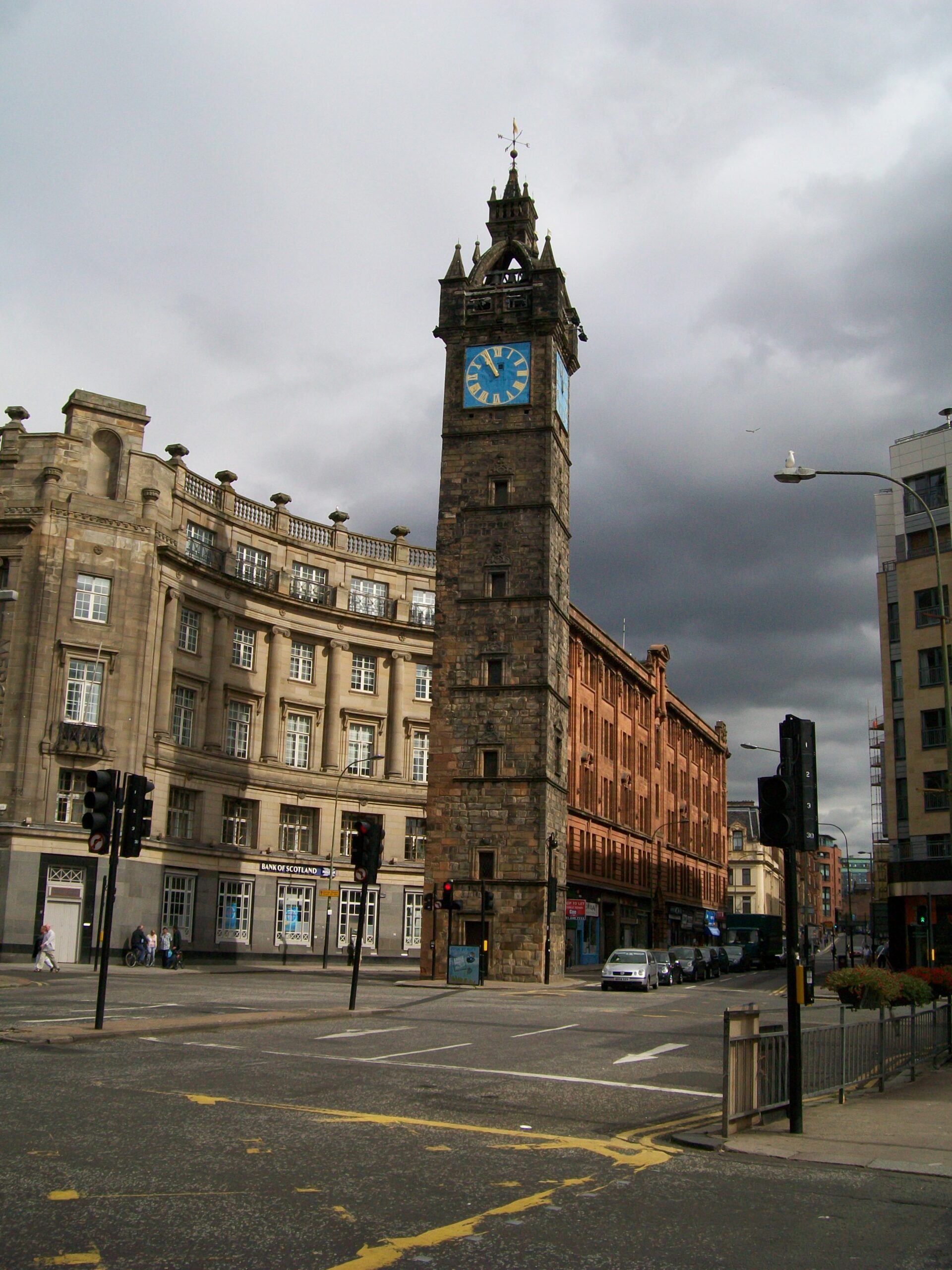
The Tolbooth buildings had first been erected in 1626. All that is left now is the 113 foot high steeple with its four-dial clock. It is imposing enough today, sited in the centre of the confluence of High Street, Trongate, Gallowgate and Saltmarket but in the 17th to 19th centuries it must have been a most impressive sight. And it needed to be, for it was not only the centre of civic authority, but also the symbol of judicial power.  The sheriff court met once a week and, along with the police court, dealt with relatively minor offences. Often the sheriff or the magistrate presiding sat on the bench reading a newspaper or even drinking, paying little heed to the proceedings and only looking up to pass sentence, generally guilty. It was left to a clerk to make sure everything ran smoothly. There was no permanent High Court of Justiciary sitting in Glasgow so more serious cases were dealt with by the West Circuit Court which arrived in the city every April and September amid great pomp and ceremony and situated itself in a room that formed part of the Tolbooth complex. The old judges, more used to the comforts and splendour of Edinburgh, found coming to Glasgow something of a chore. The old building was somewhat cramped, what with the burgeoning civic authority and the legal hierarchy all sharing the same ground with the ever-growing band of miscreants. By 1807, there were just under 2000 criminal cases being heard each and every year. Punishments were swift and hard and not every sentence entailed prison for any length of time. Serious cases, which could include some petty thefts, meant death by hanging (from the Tolbooth condemned cell those who were about to die could salute the gallows paraphernalia dangling from the steeple). Whipping was also common – a record from 1575 said that the common hangman was paid five shillings ‘for scourging of ane hussy throw the town.’ Men could be nailed by an ear to a post and could only get free if they could were able to pull or cut the nail out. A few took the opportunity to wrench their head clear. But others could have their liberty removed for periods of time – and that was the cause of the serious overcrowding. 

By 1807 the old jail was deemed insufficient for purpose. The prison population had exploded to four times the number it could comfortably house and its 32 cells were crammed with criminals and debtors from Lanarkshire, Renfrewshire and Dunbartonshire awaiting trial. Sanitary conditions were intolerable, even in those days when the most basic conditions were something akin to luxury.

Just over a century later, a speaker at the Old Glasgow Club told his audience, ‘Innocent and guilty, young and old, diseased and infirm were confined together, without courtyards for exercise, chapel or infirmary. No wonder that jail fever (typhus) was a scourge, and incarceration was not only punishment, but a direct cause of degradation to those who were convicted of a first offence and not beyond redemption.’

The gentlemen of the town council approached Parliament for the funds to build a new prison but were refused, so the magistrates and bailies resolved to go it alone. They had grand plans – the new facility would house not only a jail but a court house, for the increase in the number arrests obviously had a knock-on effect on the business of trials and sentencing. And a site had been selected that was thought ideal, although as author Bill Knox wrote, ‘their choice was hardly a beauty spot.’

TO BE CONTINUED

Nobody likes to be taxed but in previous centuries displeasure at the levying of duty could lead to displeasure becoming violence. In the wake of the Act of Union in 1707, feelings ran high in Scotland and the unpopular Malt Tax imposed by Parliament led to a riot and bloodshed in Glasgow.

THE tall man’s slim shoulders stooped as usual, his slight chest tucked in. It was the Sabbath and he was dressed in his Sunday best, his mind many miles away from the city parkland on which he walked. At other times he might have pondered his own mortality, for he was obsessed with his own health, the result perhaps of his brothers and sisters all dying as infants and a mother who therefore spoiled him. But hypochondria was not his concern on this day. Neither was his mind on his young wife, waiting at home, nor was he contemplating spiritual matters. No, on this fine Sunday afternoon on Glasgow’s Green, the tall, sensitive young man dressed in his finery was wrestling with more earthly matters, which would certainly not have pleased the stern Presbyterian ministers, for even in the latter half of the 18th Century it was still deemed a sin to do anything other than contemplate the Father, the Son and the Holy Ghost on the Sabbath.

The mystery on his mind was not the holy trinity but how to crack a new way of making steam engines more efficient and more powerful.

It was May 1765 and during that stroll across the Green, James Watt’s agile mind lit on the separate condenser. Contrary to popular legend, there was no boiling kettle but there was a flash of inspiration that would help kick-start what became known as the Industrial Revolution – a revolution that was to transform Glasgow into a powerhouse of industry.

Glasgow, though, was already prosperous. When St Mungo first led his oxen into that dear, green spot by the Molendinar Burn there were already men making some kind of living, sparse and basic though it may have been. As the settlement grew, so did its fortunes. The River Clyde swam nearby and could be forded at what would later become known as the Stockwell. However, the waterway was too shallow to allow anything but the most basic shipping to take coal, cloth and herring to the Continent. Something had to be done to deepen it and that was a problem that would eat at the city traders and engineers for three centuries. A port was established down river, nearer to the estuary, and it took its name from the burgeoning city inland. Port Glasgow became the city’s business gateway to the world until the advances by James Watt and others led to the creation of machines that were able to dredge channels deep enough to allow the great ships to proceed further.

Business may have ticked along but there were dark times in the late 17th and early 18th centuries. Scottish traders were prevented by their more powerful English counterparts from doing business to any great degree in the promised lands of the New World. The Darien Scheme, an ambitious plan to break the stranglehold the Spanish and English had on trade in that quadrant, ended in disaster. The colony was lost and much of Scotland’s capital with it. Then, six years later in 1707, the Scottish and English Parliaments became one. There were many in Glasgow who opposed the Union and took to the streets to voice their opinions but others, magistrates and merchants, saw that there was benefit – and profit – in the idea. With the Union came the scrapping of the Navigation Acts that prevented fair trade – and Glasgow’s first golden age arrived. Traders were soon making fortunes from sugar and tobacco, not to mention the sale of flesh, for many of the city’s great men were also slavers. They took the human cargo on board at the markets of West Africa, shipped them across the Atlantic to the plantations of the West Indies and the American Colonies then returned with the sugar and tobacco, and later cotton, from the fields. By the latter half of the 18th Century, Glasgow’s Tobacco Lords were responsible for over half of the valuable leaf imported to this country. From Glasgow the bulk of it moved on to Europe.

Beneficial as the Union ultimately proved to the pockets of the rich and growing ever richer, there were drawbacks. One was taxation. In addition to the costs of running a country, governments had very expensive wars and growing bands of politicians and bureaucrats to pay for so many forms of taxation were applied. A tax on income was mooted but viewed by the landed gentry with some suspicion (it being considered somehow ungentlemanly for one to disclose how much money one earned) so other means of duty were devised to help fill the central coffers.

The Window Tax was a property tax which was a forerunner to the much later rateable value system and the Council Tax, for it was deemed that the more windows a landowner had in his home, then the better off he would be. But homeowners simply bricked up windows to avoid paying the duty.

The Malt Tax was one of the most unpopular. It was already in operation in England and influential MPs there ensured that it was extended to Scotland. Malt was used for making ale and yeast for bread and so the tax was viewed as a government attack on two basic staples of life. After a long period of wrangling, it was finally levied on Scotland in 1725.

And for Glasgow, it was to bring trouble – and death – to the streets.

The Tollbooth tower at Glasgow Cross, all that remains of the old municipal building and jail

Glasgow merchant Daniel Campbell of Shawfield was one of the Scottish MPs believed to have supported the levy on his homeland. On 23 June the tax was due to be collected for the first time and crowds of people, many described as ‘idle women and boys’, thronged the streets and by-ways in and around the city to prevent the excise officers from entering those barns and premises where beer and bread were made. Wherever a group congregated, a magistrate did his best to move them along.

At this stage everything was peaceful, if somewhat voluble, and there was no pressing cause for alarm, which was just as well because there was no real military presence to keep the peace, there being only a group of town guards who were little more than nightwatchmen. It was their job to walk the streets at night and raise the alarm in cases of fire and also to tackle drunken or larcenous behaviour.  However, by the following day the mob had increased in strength and in determination – and that night two companies of Lord Delorain’s Regiment of Foot arrived to take control.

They were commanded by a Captain Bushel and the town council ordered that the guard house be cleared to allow the soldiers to billet there. The mob, though, would have none of it. They attacked the men who were emptying the guard house at the south west corner of what was then known as Candle Street – now Candleriggs – and seized the keys. They then locked the doors. Lord Provost Charles Miller seemed eager not to enflame the situation so he did not ask that the soldiers force their way in but decided to have them lodged with local families. Convinced that further trouble had been avoided, he and his fellow magistrates retired to a nearby tavern for some refreshment. 

Trouble, though, had not been avoided. At about ten-thirty, while they were enjoying a convivial glass or two, word reached them that the mob had turned its attention to the home of Daniel Campbell, which was ‘in one of the extremities of the town’. When they reached the mansion, near present day Glassford Street, they found a boisterous congregation of men and women armed with axes and hammers preparing to demolish it. As luck would have it, the MP and his wife were spending a few nights in their country residence just outside Glasgow. Nevertheless, the crowd wished to tax him for the duty that he had played a role in inflicting on them and his property would do just nicely.

Lord Provost Miller and his colleagues tried to convince the ‘sturdy young fellows’ to desist but they were ignored. Matters turned ugly when another group of locals showed up and threatened to ‘cut the provost and his company to pieces’ if they did not leave them to their work. The magistrates attempted to stand their ground but eventually broke ranks and fled when the rioters showed they had every intention of being as good as their word. The house was attacked with gusto and soon was wrecked.

‘The rioters being thus absolute masters of the house’, wrote a Glasgow gentleman afterwards, ‘spared nothing but the walls, floors, and roof, which they could neither so easily, nor so suddenly pull down; of the household goods, some part they destroy’d, and other part carried off: yet a good part of the most valuable furniture was saved for Mr Campbell’s use, being carried off by honest people who went in to save what they could.’

Word reached Captain Bushel at his billet, and he sent a sergeant to ask the Provost what he would have him do. The Provost considered the situation and again decided that the deployment of the military would only exacerbate an already volatile situation. The soldiers were tired after their march to the city and it was feared the beating of the drum to call them to arms could enflame the passions of the rioters. Tired soldiers, frightened soldiers, could be trigger happy. Miller sent word back that the Captain and his men were to remain in place.

At first it seemed his decision was the right one. Having vented its fury on the bricks and mortar, the mob dispersed and the following day the council ensured that the building was boarded up. By lunchtime, the soldiers were lodged in the Guard-House and the events of the past two days seemed settled – at least until mid-afternoon, when a huge crowd of people was seen heading back to Daniel Campbell’s house for another bout of ad-hoc demolition. At their head was a man for some reason dressed as an old woman, beating a drum. And those he led were armed with clubs.

The Tollbooth as it would have appeared at the time of the riot

At the Guard-House they paused to jeer at the soldiers standing sentry. Captain Bushel heard the commotion and ordered his men out into the streets, where they formed ‘a hollow square’ facing out into the four streets that converged on the area. Flintlocks were primed and ready and there on a summer’s afternoon the two sides faced each other – the soldiers in their proper formation with the ragged edged mob, said to consist mainly of women and young boys, crowding on all sides. Then, someone threw a stone and this was seen as a signal for others to launch a fusillade of rocks at the soldiers. Bushel picked out one young man closest to him and attacked him with his cane. It was said that he beat the man so violently that his ‘half pike’ broke into pieces. Still the shower of stones rained on he and his men.

‘If you do not immediately desist from this course of action,’ Captain Bushel cried out, ‘then I swear by God I will cause my men to fire.’

Another volley of stones was lobbed and the Captain made good on his promise. His men were ordered to present their arms and some people at the front realised what was going to happen. They tried to edge back, to get away from the broadside that was sure to follow. But those at the rear had no real idea of the danger ahead and continued to push forward. There was a rattle of gunfire and smoke puffed up from barrel and flashpan. There were screams then, as the crowd panicked and broke up but two men, said to have been innocent bystanders going about their lawful business, already lay dead, while others were wounded.

Some men playing bowls in Candle Street heard the gunfire and dashed to the corner to find out what was going on. Unarmed and guilty only of curiosity, they had to duck for cover as they were fired upon. A blacksmith walking by was hit in the head by a ball from an officer’s pistol. The same officer pulled another pistol and put another ball into a tradesman who was also passing by.

As the cries of the wounded and the dying filled the air, the crowd began to disperse, some dragging friends away from the continuing fire of the soldiers, who were now shooting at anything that moved and not just in the street. One woman was hit as she stood on a stairway in her home, another as she looked from her window.

The Provost, in the council building at the Tolbooth, accused the Captain of acting rashly in ordering his men to fire and that he should not have done so without an order from the civil authorities. The Captain replied that he and his men could not stand idly by and be knocked down in the street with stones.

While these messages were being relayed, angry citizens had broken into the council’s own armoury and carried off a variety of weapons. They also rang the fire bell for good measure, and that brought many others to the Cross to see what was going on. The Provost, fearing that further bloodshed was to follow, ordered the Captain and his men to retreat from the town. But as the soldiers began to leave the mob caught up with them and attacked.

Captain Bushell once again ordered his men to fire and a further seven people were killed instantly, with a number more wounded. A few of them would later succumb to their wounds. Among them was a shoemaker who had known nothing of what was going on. The body count has been placed as a high as twenty while a further seventeen were wounded. Only one soldier was injured. He was one of two stragglers captured during the retreat beaten by friends of the dead. The other managed to escape with the help of other townsfolk. 

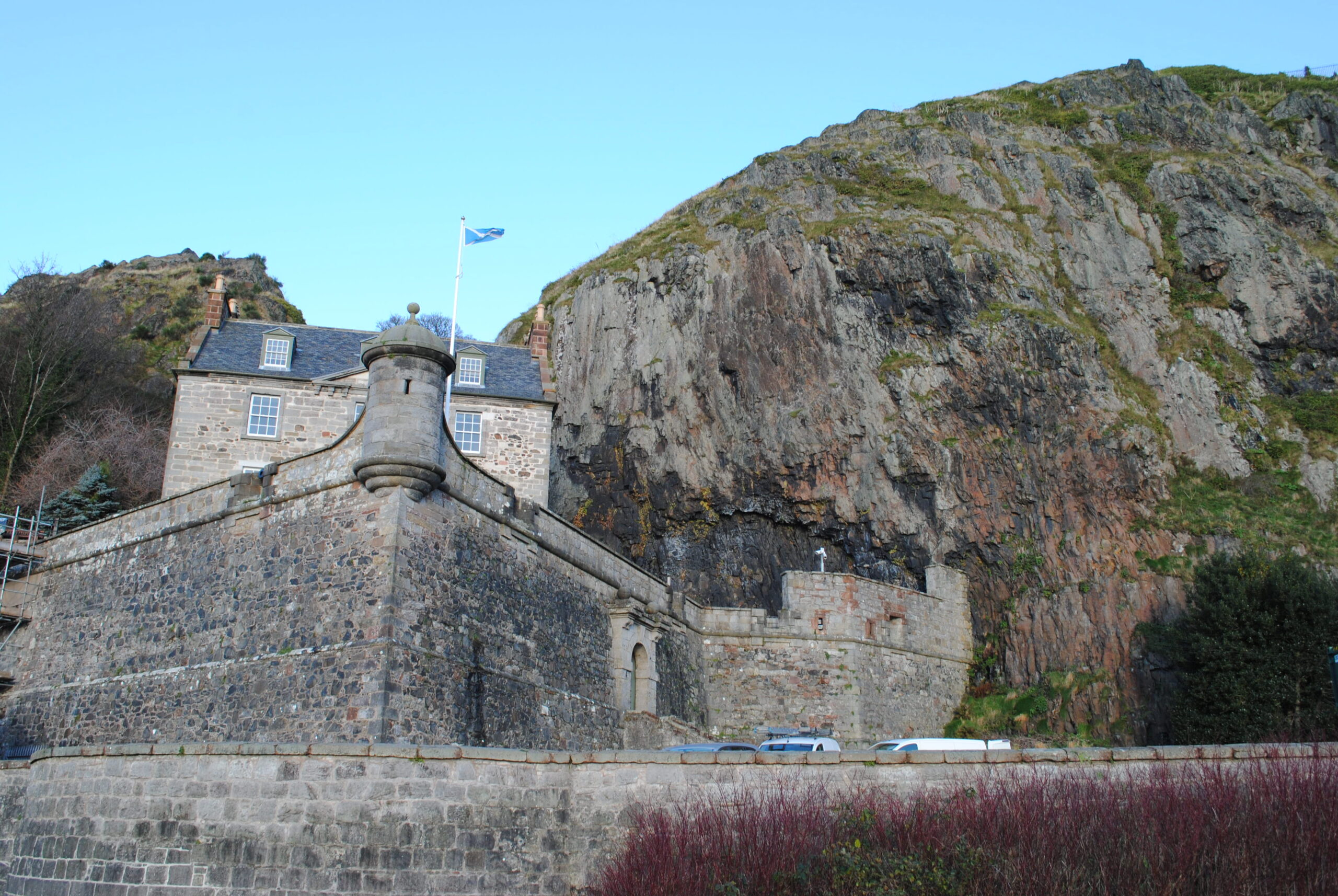
The fortress at Dumbarton Rock

The soldiers marched to Dumbarton Castle and word was sent to Edinburgh about the Glasgow insurrection. On 9 July, 1725, General Wade – famed for his roadbuilding programme in the Highlands – was despatched to Glasgow to quell any further disturbance and to make what arrests he could. He took with him the rest of Lord Delorain’s foot soldiers as well as six troops of Royal Scotch Dragoons and a troop of the Earl of Stair’s Dragoons along with an independent company of highlanders. And just to show that he meant business, he also had a train of artillery with him. If those rebellious Glaswegians started anything with him, he would finish it.

Lord Advocate Duncan Forbes was also in the long convoy snaking its way from the east and while Wade stamped his military authority on the town, he fully intended to do the same in a legal manner. His agents mingles with the people on the streets and reported back with the names of the ringleaders. He soon had nineteen persons locked in the Glasgow Tolbooth for their part in the riots – as well as the Lord Provost and some of his fellow magistrates. It was the Crown’s belief that they had not been as ardent as they might have been in quelling the unrest.

While the nineteen men were dragged from the Tolbooth, their hands bound, and placed in the care of none other than Captain Bushel to be transported to Edinburgh for trial, the provost and his magistrates were placed under the guard of the Royal Scotch Dragoons and also taken east. It took two to three days for the prisoners to reach the capital, followed by a fifty strong party of their fellow Glaswegians who wished to show their support. There the prisoners were to be formally committed before being lodged in Edinburgh’s Tolbooth in the High Street, the notorious Heart of Midlothian. Luckily for the Provost and his friends they did not bide for long in that place for they were bailed by the Lords of Justiciary the following day and allowed to leave. On their return to Glasgow they were met by two hundred citizens on the outskirts and accompanied into the town by the ringing of bells and the cheering of crowds. No further action was taken and it was believed that the Lord Advocate had exceeded his authority in having them arrested in the first place. The nineteen named rioters were not so lucky. Some were sentenced to be whipped through the streets of Glasgow, some were banished but others were freed.

Captain Bushel was heavily criticised for his actions and faced charges relating to them. He was found guilty but subsequently was pardoned by the King and promoted to command a company of Dragoons. Many educated men believed he acted at best with ‘the utmost precipitation’, at worst that he was guilty of murder.

Daniel Campbell, it was felt, had prior knowledge that his home was to be targeted and had decamped to his country home with his family just in time. It was noted that he had managed to leave with his cash, jewels and other smaller items of value but failed to warn the authorities of the reports. However, this did not prevent him from claiming up to £9,000 in damages from the town’s authorities. The house later came into the possession of tobacco merchant and ship builder John Glasfford who gave his name to the street that now sits on the site.