

Another series of extracts from Glasgow’s Black Heart, my history of the city’s crime and punishment, now out of print.
This time I’m looking at the area between Glasgow Cross and the river, which became the centre of the judicial process. Here were jails, courts – and execution sites.
Part 1 looks at the old Tolbooth.

Apart from the few cells in the police headquarters, Glasgow’s prison provision was catered for by the Tolbooth, built in 1626 on the site of an older structure, and in the next century, a ‘Bridewell’ – a House of Correction – in Duke Street. In addition to crooks, the jails also had to cater for vagabonds and debtors. The Tolbooth jailer was also expected to supply coals for the council and court meetings but in addition to his salary he received monies from the prisoners themselves, particularly the debtors.
In the jail’s early days, for the first eight days incarceration, he could demand two shillings Scots or tuppence a day if the inmate was a townsman or four shillings Scots, fourpence a day, if they were ‘Outintownsmen’. After eight days he received whatever the magistrate decided. Fees for beggars and vagabonds were also fixed by the serving magistrate but were kept low as these were paid out of the public purse. From 1696, the Scottish Parliament passed an Act of Grace which decreed that the creditor at whose hands the debtor was jailed also had to pay towards his or her upkeep. However, not every jailer profited from the arrangement. In 1661, the city treasurer was ordered by the council to give jailer Charles McCleane £20 Scots or One pound, 13 shillings and fourpence Sterling ‘for his extraordinary pains in keeping the Tolbooth and getting no profit thereby, having only thieves and lounes (insane persons) as prisoners.’
Prisoners, meanwhile, were allowed to supplement their funds by begging from the windows. They did this by lowering a bag or a basket with a length of rope to the street in the hope that a friend, relative or a kind-hearted stranger would drop in a few pennies. On one occasion, an inmate thrust his head out to see if anyone was making a deposit to his jail fund and ended up wedged between the bars on the window. As a punishment, the jailer left him in that position for some time before he sent someone to cut him free. Naturally, other implements could also be placed in the makeshift hoist, implements that may well have been used in furthering the many escape attempts. In October 1791, convicted thief James Plunkett escaped from the Tolbooth. He was rearrested on 25 November when he tried to steal four pairs of silk stockings from a shop on the Trongate. He was chased into the Saltmarket where he was caught when he stumbled over a bag of stones which was to be used for building a causeway. Determined not to be returned to the jail, he tried to pull his pistol but his pursuers managed to disarm him. He knew the jig was up when someone in the crowd recognised him as the prisoner who had fled the jail the month before, even though he had tried to disguise himself by cutting his hair.
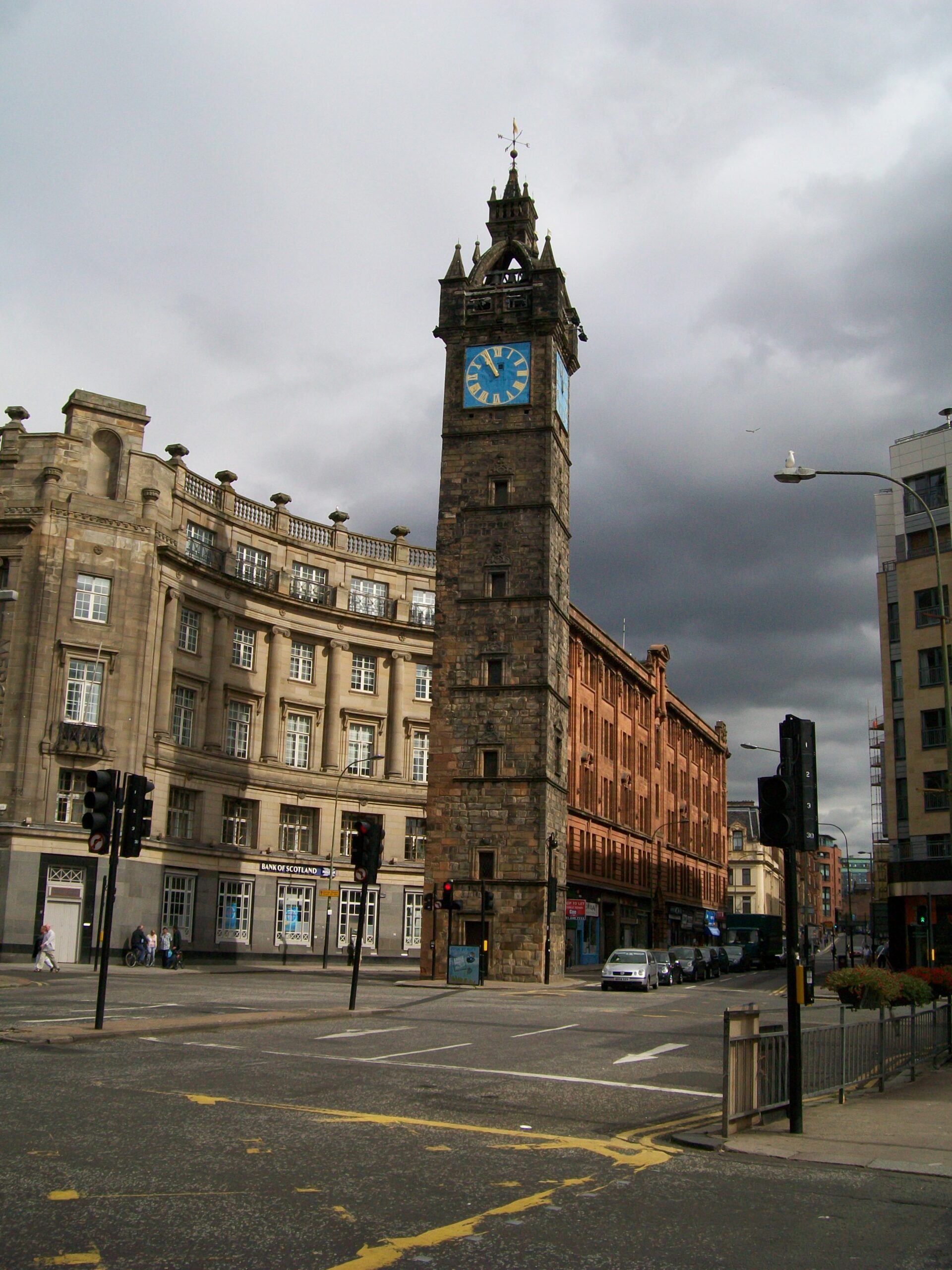
The Tolbooth buildings had first been erected in 1626. All that is left now is the 113 foot high steeple with its four-dial clock. It is imposing enough today, sited in the centre of the confluence of High Street, Trongate, Gallowgate and Saltmarket but in the 17th to 19th centuries it must have been a most impressive sight. And it needed to be, for it was not only the centre of civic authority, but also the symbol of judicial power. The sheriff court met once a week and, along with the police court, dealt with relatively minor offences. Often the sheriff or the magistrate presiding sat on the bench reading a newspaper or even drinking, paying little heed to the proceedings and only looking up to pass sentence, generally guilty. It was left to a clerk to make sure everything ran smoothly. There was no permanent High Court of Justiciary sitting in Glasgow so more serious cases were dealt with by the West Circuit Court which arrived in the city every April and September amid great pomp and ceremony and situated itself in a room that formed part of the Tolbooth complex. The old judges, more used to the comforts and splendour of Edinburgh, found coming to Glasgow something of a chore. The old building was somewhat cramped, what with the burgeoning civic authority and the legal hierarchy all sharing the same ground with the ever-growing band of miscreants. By 1807, there were just under 2000 criminal cases being heard each and every year. Punishments were swift and hard and not every sentence entailed prison for any length of time. Serious cases, which could include some petty thefts, meant death by hanging (from the Tolbooth condemned cell those who were about to die could salute the gallows paraphernalia dangling from the steeple). Whipping was also common – a record from 1575 said that the common hangman was paid five shillings ‘for scourging of ane hussy throw the town.’ Men could be nailed by an ear to a post and could only get free if they could were able to pull or cut the nail out. A few took the opportunity to wrench their head clear. But others could have their liberty removed for periods of time – and that was the cause of the serious overcrowding.
By 1807 the old jail was deemed insufficient for purpose. The prison population had exploded to four times the number it could comfortably house and its 32 cells were crammed with criminals and debtors from Lanarkshire, Renfrewshire and Dunbartonshire awaiting trial. Sanitary conditions were intolerable, even in those days when the most basic conditions were something akin to luxury.
Just over a century later, a speaker at the Old Glasgow Club told his audience, ‘Innocent and guilty, young and old, diseased and infirm were confined together, without courtyards for exercise, chapel or infirmary. No wonder that jail fever (typhus) was a scourge, and incarceration was not only punishment, but a direct cause of degradation to those who were convicted of a first offence and not beyond redemption.’
The gentlemen of the town council approached Parliament for the funds to build a new prison but were refused, so the magistrates and bailies resolved to go it alone. They had grand plans – the new facility would house not only a jail but a court house, for the increase in the number arrests obviously had a knock-on effect on the business of trials and sentencing. And a site had been selected that was thought ideal, although as author Bill Knox wrote, ‘their choice was hardly a beauty spot.’
TO BE CONTINUED…