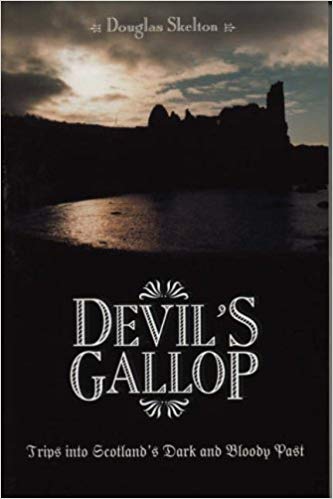
To explain what I’ll be doing every now and again regarding the extracts from DEVIL’S GALLOP, here is the original introduction to the book.
THE woman in the tourist information centre sounded puzzled.

  “You’re looking for what?”

  “Sawney Beane’s cave,” I repeated into the telephone, suddenly feeling very foolish. I mean, these people are more used to dealing with inquiries about Rabbie Burns, not the bogey man of yesteryear. “He and his family was supposed to live somewhere on the south Ayrshire coast, in a cave.”

  “How long ago was this?”

  “Oh, centuries ago. They were quite an extended family who operated as a band of robbers and their cave was like Aladdin’s cave, if you know what I mean. And they ate people.”

  “Ate people?” I heard her voice change then. Up until that point in the conversation she had been attentive and ready to be helpful, but now my query had wandered into the realm of Hannibal Lecter and a nice chianti.

  “Well, so the legend goes,” I added quickly, trying to keep my voice light, lest she think I’m the kind of person who would make a bid at auction for Jeffrey Dahmer’s fridge.

  “And you want to find this cave?”

  “Well, yes. I’m writing a book, you see, on famous Scottish murderers and I want to do a chapter on Sawney Beane. So I thought I’d like to visit his cave, just to get a feel for it, you know?”

   “A feel for eating people, you mean?” I thought I could hear a smile in her voice, but I wasn’t sure. It’s a reaction I’ve grown used to over the years whenever I express my interest in the darker side of history. Most people either take an involuntary step backwards, thoughts of rushing home to lock up their daughters uppermost in their mind, or smile indulgently, while thinking of rushing home to lock up their daughters.

  I’m exaggerating, of course – something you’ll find I do quite bit as you read on. I was a journalist. It’s what I did. In fact, I’ve told myself a million times not to exaggerate but it never works.

  The fact is, there are many people out there interested in the grisly side of history, but the problem is the tourist trade, certainly in Britain, singularly fails to cater for their interests. That is not to say these people spend their free time biting the heads off live chickens while watching snuff movies. Personally, I find it difficult to even pull the giblets out of a frozen fowl, and I grew nauseous watching ‘The Evil Dead’.

  The tourist information lady could not help me, although someone in her office had heard of the villainous Beane clan and believed the cave was reputed to be somewhere near Ballantrae.

  That was ten years ago (NOTE – A helluva lot more than that now!) The Sawney Beane chapter never made it into Blood on the Thistle, my book on famous Scottish murders. However, my trip from Glasgow to Ballantrae that day – and in many subsequent forays down the west coast – yielded up more grisly nuggets than Scotland’s own family of cannibalistic human underground dwellers. Meanwhile, trips all over Scotland provided further material on this small country’s bloody past in fact and legend.

  Someone once said that Scotland is becoming one vast theme park and I see nothing particularly wrong with that. As long as the tourist trade creates employment and generates income, then there is no reason why we should not capitalise on our past. The problem is, we don’t do it enough. We have a rich and fascinating history that is there to be merchandised and – dare I say it? Yes, I dare – EXPLOITED. There is more to Scotland than tartan and shortbread, more than Burns and bagpipes. The movies Braveheart and Rob Roy showed there is an international interest in our past. As long as it’s bloody.

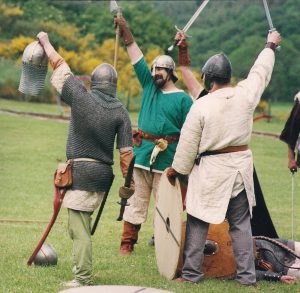
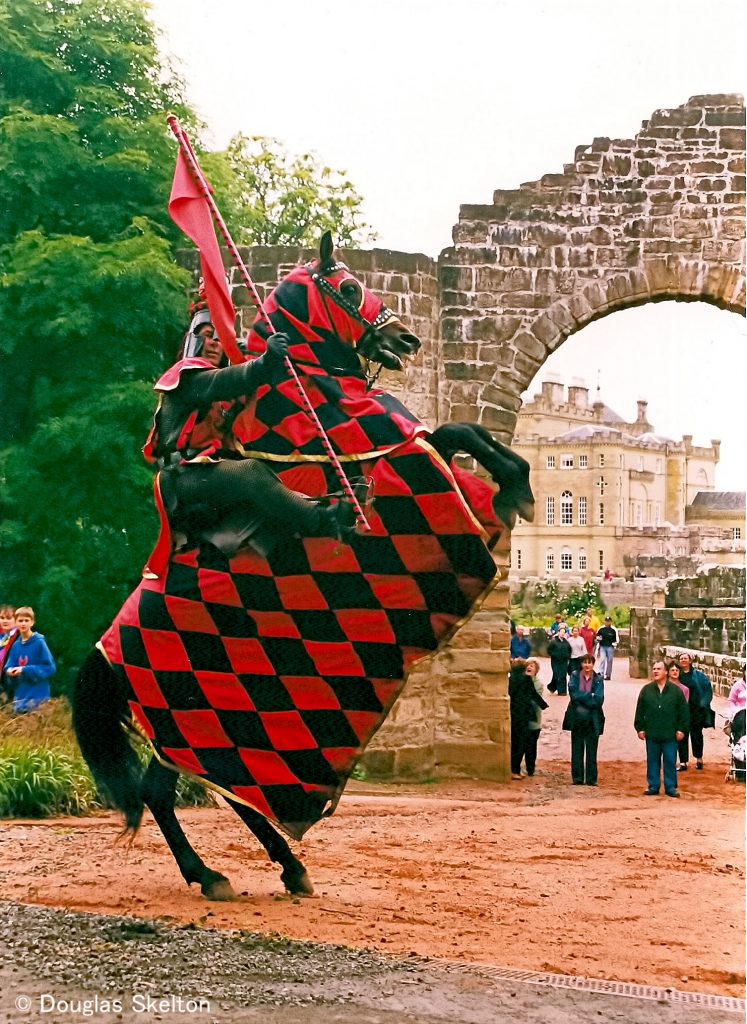
  Glencoe and Cullodden continue to draw visitors. One of the west coast’s most popular tourist attractions is Inverary Jail, with its tales of crime and punishment. When people visit our castles the first thing many want to see are the dungeons – and their first question is often whether or not the place is haunted. Meanwhile, lines of visitors gawp at instruments of torture and execution in museums. Not long ago I was part of an appreciative crowd in Culzean Castle gardens, watching members of an historical society knocking lumps out of each other in hand-to-hand combat. I heard many different languages spoken that day, but all of them loved the spectacle. We enjoy a bit of violence – as long as no-one actually gets hurt, of course.
   But guide books to castles and other sites often spend more time on the architecture and provenance of historic artefacts. It’s all very interesting but it’s not what myself and many others have come to see. It’s not very PC to admit it, but when I tour Holyrood Palace I don’t want to know about a seventeenth century sideboard, I want to see the spot where Mary Stuart’s Italian chum Rizzio was murdered. When I go on a tour of Glasgow, I don’t care which buildings Alexander ‘Greek’ Thomson designed, I want to see where the public gallows were once situated.

  Oh hell, maybe I should be biting the heads off live chickens.

  Of course, there are tours in Edinburgh and Glasgow specialising in ghosts and gristle and what jolly fun they are too. The London Dungeon was the most fun I’ve had with my clothes on for a long time and the Edinburgh one is said to be just as enjoyable. However, if they ever extend their repertoire to include the sites of more recent murders, then I would be among the first to complain. I have no desire to go the Hollywood route, where guides show you the hotel in which John Belushi overdosed and other such scandals. No, let us stick to past horrors, which have become less distasteful with the passing of centuries.

  So in the following chapters you will find tours a traveller could take if he or she was of a mind to delve into darkness of the past. Each one begins in Glasgow because it’s my home town and every journey has to start somewhere.

You will find facts and fiction nestling side by side here. There will be blood and tears and laughs, because that’s the way I want to approach it.


NOTE – no chapters on the website, of course, and rather than tours I will select extracts from the book and update them (in other words, try to improve the writing!).
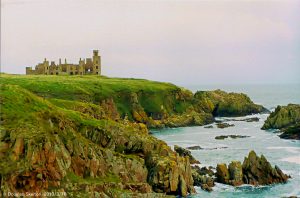
With the most recent adaptation of DRACULA garnering raves, I thought I’d share something I wrote many years ago about Cruden Bay, a town on the north east coast of Scotland that played a significant part in the creation of what became a horror classic.

What follows is adapted from my book DEVIL’S GALLOP (Mainstream, 2001), which was a tongue-in-cheek travelogue into Scotland’s dark and bloody past.

Cruden Bay is popular among golfers thanks to its championship course but in the Victorian age it was a favourite resort for the rich and famous, who came to stay in a high class railway hotel, now gone.

I was told the hotel possessed the first electrified tram built in 1899, which is now at a transport museum at Alford.

I made my way down to Port Errol harbour beside the great arch of golden sands that fringes the bay and climbed up the hill to a stretch of waste ground peppered with decaying buildings dating from the second world war. There was a secret bunker here, not so secret now certainly because its door had been torn open. I would have climbed down to investigate but I did not have the necessary torch or courage.

I met a lady walking her dog who told me that the land I was loitering on with intent to take photographs was once a golf course, although there’s no sign of that now. Seabirds dip and wheel among the cliffs of red granite, crying to each other against the wind. TE Lawrence, who visited this area in between bouts of sweaty action and chatting up arab boys, called their sound “the saddest, most cold disembodied voices in the world.”

There are herons here too – those great, grey creatures that look prehistoric in flight. But nature study was no what had brought me here. The object of my visit was looming out of the late evening gloom across a rocky chasm – the ruins of Slains Castle. (You can’t reach the castle from where I stood. To do so, you must go through the town and park in a small area after a ruined farm steading. Then it’s a fairly short walk along a track to the castle. However, the building is dangerous and visitors are strongly advised not to go too close).

The 16th century castle, once owned by the Earls of Errol (who snapped their fingers less than the Dukes of Earl), is derelict but in its day it must have been quite some shack. Dr Johnson and his sidekick James Boswell visited and both remarked on how much they admired the house and its clifftop views. Boswell claimed to have seen the ghost of Lord Kilmarnock, the then Lord Errol’s father, who had been beheaded at London’s Tower Hill in 1746 for his part in the Jacobite Uprising. But I think he had perhaps been sampling too much of the old vino collapse.

In 1916, with the family fortunes in sharp decline, the castle was sold to a shipping magnate who had it partially torn down.

In 1893, Abraham Stoker, an Irish-born theatrical manager, was on holiday at Peterhead when he found Cruden Bay during a walk south. He liked what he saw and decided to decamp to the Kilmarnock Arms hotel in the town. This was the first of many visits to the resort.

It was during one such trip that he wrote the first draft of parts of the book that would make Bram Stoker a household name – Dracula, published in 1897.

They say Slains Castle high on the clifftop provided inspiration, but in those days it was still a bustling house and very far from the image of Castle Dracula. They also say that in that draft the vampire count first landed in this area, but that he later changed it to Whitby in Yorkshire. Whether true or not, Stoker did set three other short stories in the area and even bought himself a house nearby – the Crookit Lum in Whinnyfold across the bay – with his first royalties from Dracula.

Stoker is still remembered in the area, even though he has been dead for almost 90 years. I received some cold looks and exasperated shakes of the head in Whinnyfold when I asked which house was his, while in Cruden Bay I was told that the grandfather of a local doctor treated the writer during one of his stays for some ailment or other. In gratitude, Stoker presented him with a silver cigarette case, which is still in the family.

A later member of the Hay family has a place in the dark hall of infamy, although it was for an incident that took place thousands of miles away from the harsh winds and misty rain of the Buchan coast.

Josslyn Hay was the 22nd Earl of Errol and in January 1941 he was shot to death in Kenya. He was an old Africa hand, having lived there since 1923 – he called his bungalow Slains – and at the time of his death was military secretary. The murder brought to light some pretty raunchy goings-on among the ex-patriot British community and these were detailed in the book ‘White Mischief’. The film version wasn’t nearly as exciting as the actual events although men of a certain vintage do remember it fondly for the sight of Greta Scaachi sans kit. Not me, of course, because I’m far too young.

Coughs, looks away.

The murder remains unsolved, although the husband of one of the victim’s many consorts did stand trial and was acquitted.

Way back in 2001 I went on a space odyssey. The space in question was Scotland and the odyssey was research for a book called ‘Devil’s Gallop.’

I’d written a few true crime books by then, including the epic task that was ‘Frightener’, the campaigning book about the so-called Ice Cream Wars.

I wanted to do something lighter. I wanted to be fun and frothy. But, being me, I still wanted to deal with dark subjects.

The result was ‘Devil’s Gallop’, a series of trips into Scotland’s dark and bloody past laced with a liberal dose of humour. The idea was to outline what people could see on a series of tours from Glasgow all over the country that were of a bloody nature – whether fact or myth – but get some fun out of it. Horrible Histories was then only just taking shape and I thought the jokey nature of the approach was novel. I enjoyed doing it but the result was patchy at best and Bill Bryson has very little to worry about.

The book is now out of print so every now and again I’ll post a wee snippet along with a photograph of the location in question.

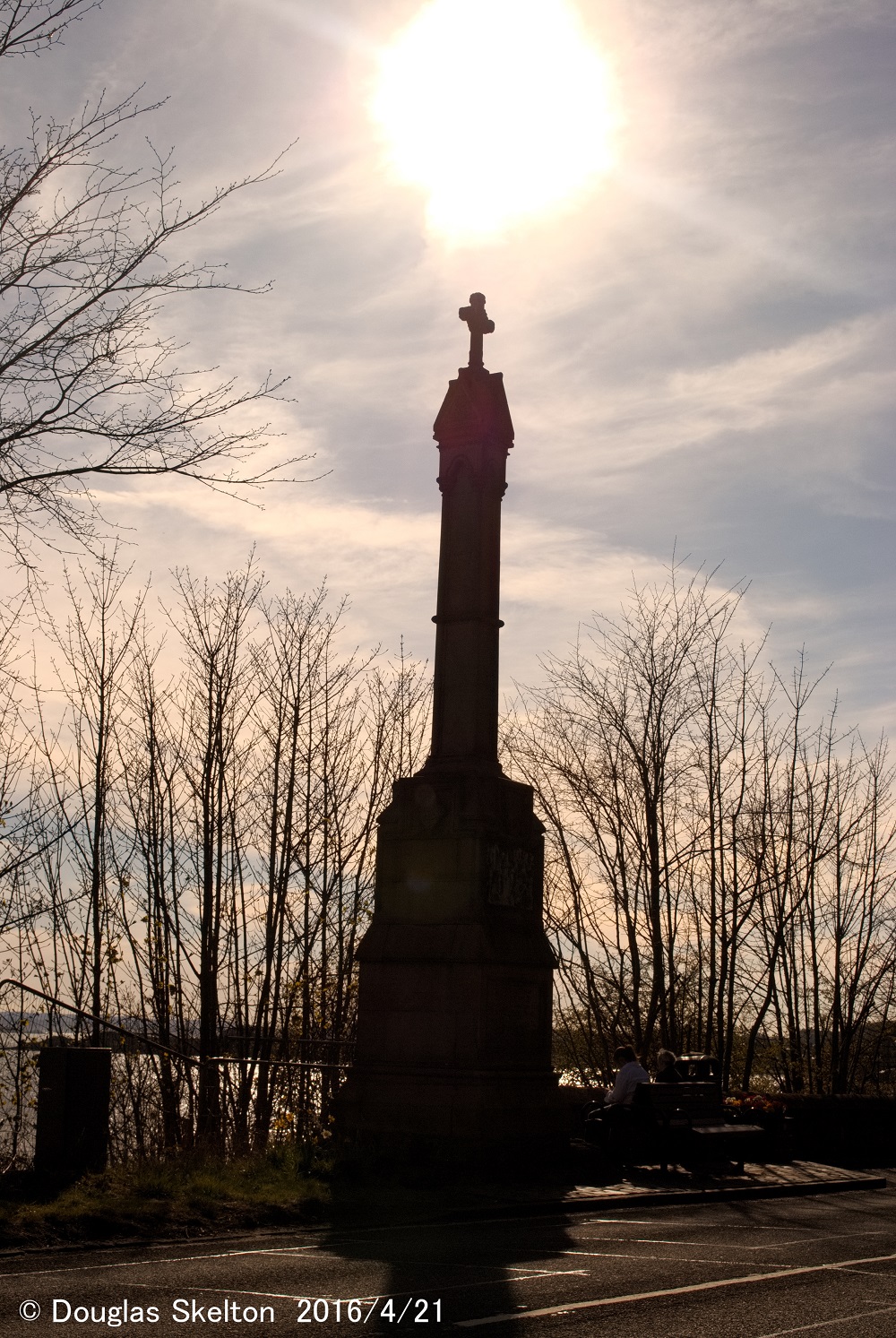
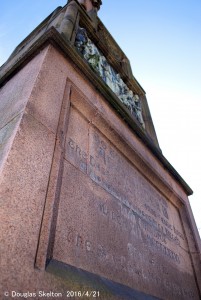
This first one occurred to me yesterday as I drove to Kirkcaldy and I passed the monument at Kinghorn. People drive past these things and never wonder what they’re for.

Kinghorn 3-1 web

DEATH OF A KING

A short distance from Burntisland, a tall memorial marking the spot where Alexander 111 was found dead looms over the Firth of Forth.

This was the event that led to the rise and fall of William Wallace, the bloody wars of Independence and the emergence of Robert the Bruce as a nation’s hero.

Alexander had come to throne in 1249, when he was just eight years of age. Whilst on the throne he had done much for his country, most notably defeating giving the Vikings a bloody Norse at Largs in 1263.

He also formed an alliance, albeit an uneasy one with much sticking out of tongues, with the English king Edward Plantagenet by marrying his sister Margaret.

She gave him two sons and a daughter but Alexander outlived them all.

Then, in 1285, he married Yolande, daughter of a powerful French noble.

Kinghorn 2-1 web

On 18 March 1286, Alexander left Edinburgh to travel across the Forth to Fife, where his young wife was waiting at Kinghorn Castle (of which nothing now remains).

The weather was filthy and the ferrymen had to be bribed to take the king across the choppy waters. Once safely on the other side the King dashed ahead, no doubt eager to get down to the business of providing the nation with a male air by entering the promised Yolande. That gives the name Kinghorn a whole new meaning.

But on the cliffs above where the monument now stands his horse stumbled and the king was thrown from the saddle to his death on the shore below. He was the last of Scotland’s Celtic kings.

The question remain, though – did he fall? Or was he pushed?