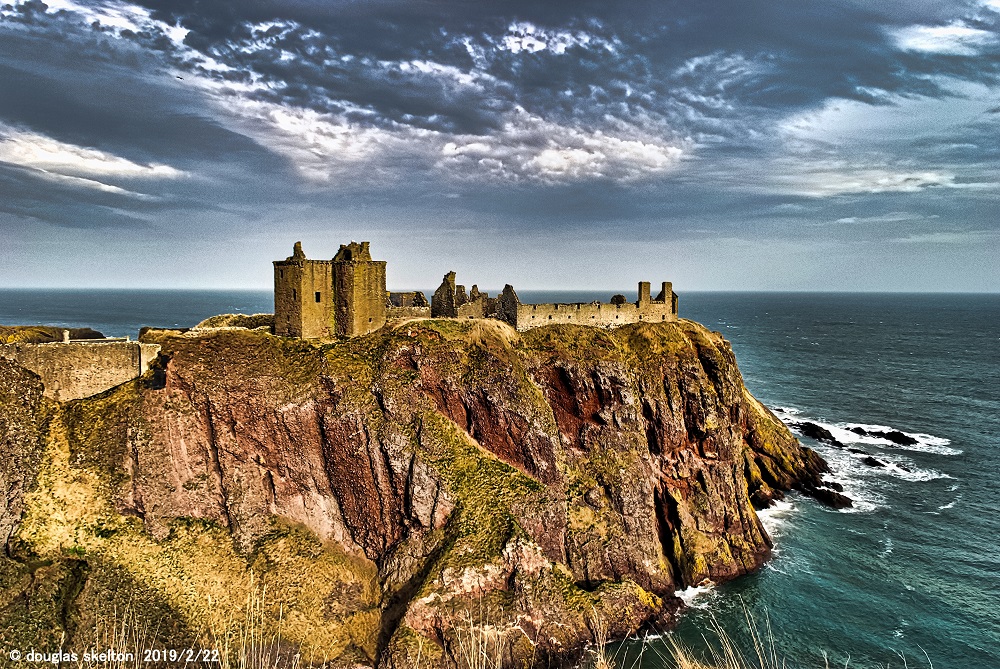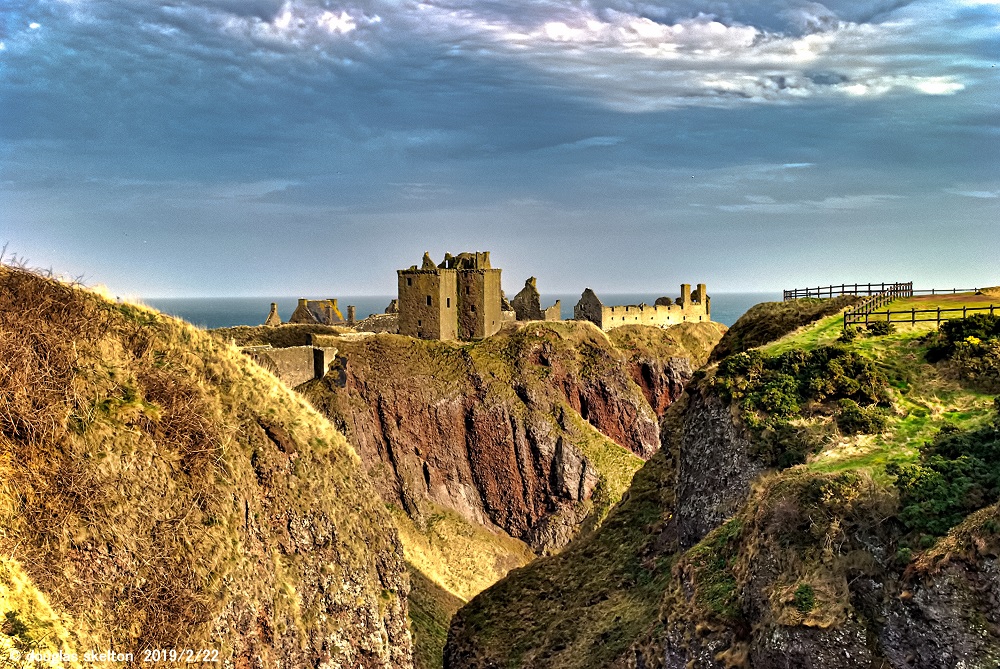
As part of my very occasional wander down the byways of Scotland’s dark history – based on my book Devil’s Gallop – I thought I’d share some stories about one of the most dramatic castles in Scotland. As usual, although the actual history is (more or less) accurate, my tongue is very firmly wedged in my cheek. Which luckily doesn’t prevent me from typing, although singing is a challenge.
Along with Eilean Donan and Kilchurn, Dunottar Castle is without doubt one of the most photographed castles in Scotland and as you park in the small car park and walk towards it, all you see is people framing a picture and all you hear is the click of shutters. Naturally, I was no exception. Its photogenic properties were not lost in director Franco Zefferelli, who used it as one of the locations for his version of Hamlet, starring Mel Gibson
Dunottar covers a four and half acre site on top of a rocky mound 160 feet above the beach and only a thin strip of rock links it to the mainland. The deep chasm which all but separates it from the land has proved very handy over the centuries, both for keeping people out and keeping them in. When Oliver Cromwell’s troops besieged the place for eight months in 1652, they were surprised to find that only 35 men had kept them at bay. The defenders had also managed to smuggle out the Crown Jewels of Scotland during the siege, which would have had Cromwell stamping his foot with rage.
Charles ll had been crowned at Scone, which naturally Cromwell, as Lord Protector of the Commonwealth and Big Noise in Parliament, saw as a direct challenge to his authority.
‘Where is my army?’ He cried.
‘Up thy sleevie,’ one puritan wag replied.
I know that’s an old joke but that’s when it originated.
So, with Elvis Costello strumming and warbling, Oliver’s Army marched northwards, killing and burning anything that got in their way. They finally pitched up at castle gates and Sid James called out, ‘Ho there, we’re here to get our hands on the King’s Crown Jewels.’
‘Ooh, matron,’ replied Kenneth Williams.
‘Let us in!’ Demanded another Englishman not impressed by all this carry on
‘Not by the hairs on our chinny-chin-chins,’ came the reply from a Scot who had wandered in from another script.
So the English huffed and puffed but failed to blow the walls down because Dunottar was built to withstand everything but the heaviest of siege engines. Unfortunately, said heavy stuff arrived after a few months and a few well placed shots soon had the Scottish forces realising that they were not as secure as they once thought. So it was decided to somehow spirit the Royal Regalia away.
The King’s papers were sewn into a belt worn by Anne Lindsay, who was related to the wife of the castle’s commander George Ogilvy, and being a lady was then allowed to saunter through the English lines. Meanwhile, the Crown Jewels were said to have been concealed in the clothing of a woman and her servant, who were also allowed through unmolested. When it was discovered they had allowed the papers and the baubles to slip through their fingers the English officers would have regretted such gallantry.
An alternative tale says the regalia was lowered on a rope – a very long rope – from the castle walls where a servant girl was ostensibly out collecting dulse, a form of edible seaweed. She hid the crown, mace and sceptre among the seaweed in her basket and took them to the parish church at Kinneff where they were hidden under the floor until Cromwell’s death and the Reformation in 1660. The rampaging roundheads, raging at the removal of the regalia (which is easier to type than say) tortured George Ogilvy and his wife but they insisted the jewels had been shipped abroad.
These days, the Crown Jewels can be seen in Edinburgh Castle, alrhough over the centuries it has been suggested that some of the jewels were, in fact, replaced with paste replicas, the Stuart monarchs often being in serious need of quick cash.
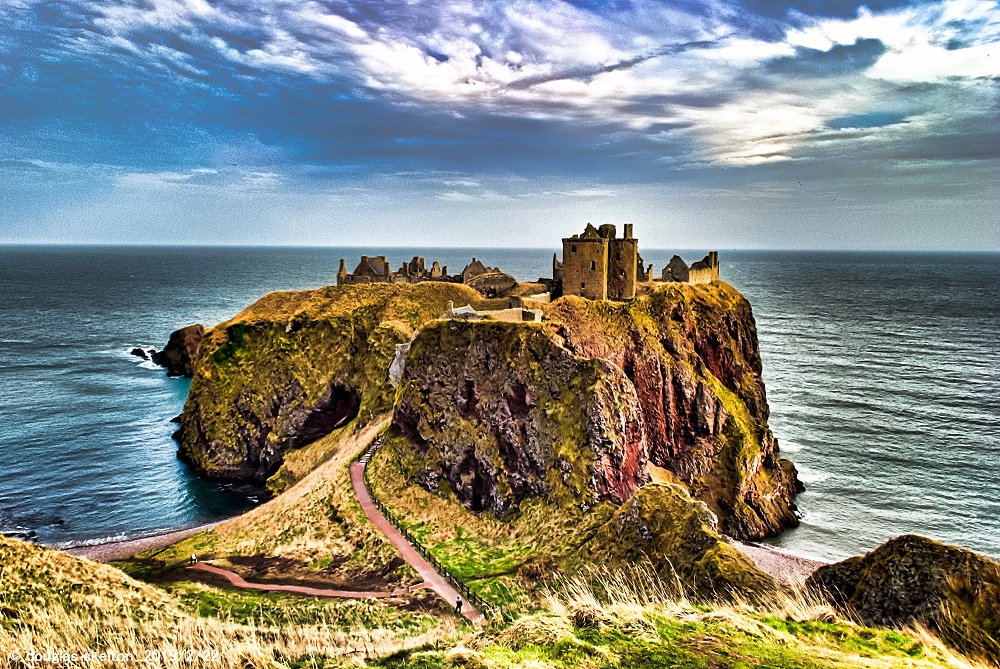
Prior to all this, around 1297, the castle had a visit from William Wallace, who trapped the garrison of occupying English troops in the church and burned them alive. Blind Harry said that some of the soldiers tried to escape by climbing down the steep rocks face but fell to their deaths on the shore below or into the sea. There is some doubt as to whether the Scots were conscience stricken over this bloodthirsty deed but Blind Harry has Wallace telling them, “Thai rewid nocht was in to the toun of Ayr, our trew barrownis quhen that hair hangyt that.”
So I hope that clears that up.
In 1645, while The Marquis of Montrose, on behalf of the King, was burning Stonehaven a few miles to the north, the Earl Marischal, who had closed the castle gates against him and refused to come out to play, watched with sadness from the battlements. He was comforted by the words of a minister, Andrew Cant, who told him, “Trouble not, for the reek will be a sweet smelling savour in the nostrils of the Lord.”
I wonder how much comfort God’s olfactory pleasures gave those people whose houses were going up in smoke.
But histories of the castle say the blackest period was when it was used as a Covenanter prison. In May 1684, 122 men and 45 women were sent here accused of recusancy, basically not acknowledging the authority of the King over the church. Sir Walter Scott wrote they were and driven north “like a flock of bullocks” and herded together in a cellar, soon to be known as the Whig’s Vault. It will come as no surprise that they were not treated well. Light came from one window in their prison, looking out onto the North Sea, or German Ocean as it was known. Unfortunately, the wind and the rain also came in and soon they were wading around in two feet of muck, much of it their own, for they had no access “to ease of nature”, as one church historian so delicately put it. If they had money they could bribe the guards for small luxuries, like food and water. If they had no means they were left to starve and die of thirst.
The dungeon was so crowded they could not sit down without one leaning on the other and many died from disease and neglect. Although some of them were moved to slightly better accommodation, the prisoners decided they’d had enough of this treatment and tried to escape through the window and along a narrow ledge. Local women saw them and raised the alarm but by then 25 had escaped. Eventually fifteen of the weakest were recaptured. The king’s men beat them and dragged them back to the castle, where some were tied hand and foot on their backs, with lighted matches placed between their fingers. The soldiers took it in turns to keep them alight until the flesh was scorched. Some died under this torture, others had their fingers burned, “the very bone turned to ashes.”
When the pregnant wife of one of the Covenanters travelled from the south to see her husband, the governor took her prisoner also and she was thrown into the Whig’s Vault, where she later died. Finally, those left alive were transferred to Leith, where some were sold to the owner of a West Indies plantation as slave labour. However, fever cut a swathe through the boat carrying them to the colonies. The entire crew, apart from the captain another man, died as did the plantation owner and his wife. The prisoners were dropping at the rate of three or four a day and were casually tossed overboard. Fifteen weeks later the ship limped into port – but not Jamaica, as planned. The winds had carried the ship to New Jersey where the surviving prisoners were offered their freedom and the chance to remain. The rigours of frontier life would be nothing compared to the hell they had been through.
The survivors remembered their dead comrades with a simple stone in Dunnottar’s churchyard.