
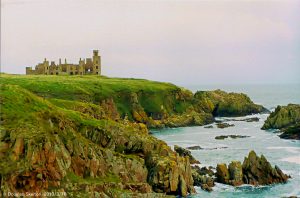
With the most recent adaptation of DRACULA garnering raves, I thought I’d share something I wrote many years ago about Cruden Bay, a town on the north east coast of Scotland that played a significant part in the creation of what became a horror classic.
What follows is adapted from my book DEVIL’S GALLOP (Mainstream, 2001), which was a tongue-in-cheek travelogue into Scotland’s dark and bloody past.
Cruden Bay is popular among golfers thanks to its championship course but in the Victorian age it was a favourite resort for the rich and famous, who came to stay in a high class railway hotel, now gone.
I was told the hotel possessed the first electrified tram built in 1899, which is now at a transport museum at Alford.
I made my way down to Port Errol harbour beside the great arch of golden sands that fringes the bay and climbed up the hill to a stretch of waste ground peppered with decaying buildings dating from the second world war. There was a secret bunker here, not so secret now certainly because its door had been torn open. I would have climbed down to investigate but I did not have the necessary torch or courage.
I met a lady walking her dog who told me that the land I was loitering on with intent to take photographs was once a golf course, although there’s no sign of that now. Seabirds dip and wheel among the cliffs of red granite, crying to each other against the wind. TE Lawrence, who visited this area in between bouts of sweaty action and chatting up arab boys, called their sound “the saddest, most cold disembodied voices in the world.”
There are herons here too – those great, grey creatures that look prehistoric in flight. But nature study was no what had brought me here. The object of my visit was looming out of the late evening gloom across a rocky chasm – the ruins of Slains Castle. (You can’t reach the castle from where I stood. To do so, you must go through the town and park in a small area after a ruined farm steading. Then it’s a fairly short walk along a track to the castle. However, the building is dangerous and visitors are strongly advised not to go too close).
The 16th century castle, once owned by the Earls of Errol (who snapped their fingers less than the Dukes of Earl), is derelict but in its day it must have been quite some shack. Dr Johnson and his sidekick James Boswell visited and both remarked on how much they admired the house and its clifftop views. Boswell claimed to have seen the ghost of Lord Kilmarnock, the then Lord Errol’s father, who had been beheaded at London’s Tower Hill in 1746 for his part in the Jacobite Uprising. But I think he had perhaps been sampling too much of the old vino collapse.
In 1916, with the family fortunes in sharp decline, the castle was sold to a shipping magnate who had it partially torn down.
In 1893, Abraham Stoker, an Irish-born theatrical manager, was on holiday at Peterhead when he found Cruden Bay during a walk south. He liked what he saw and decided to decamp to the Kilmarnock Arms hotel in the town. This was the first of many visits to the resort.
It was during one such trip that he wrote the first draft of parts of the book that would make Bram Stoker a household name – Dracula, published in 1897.
They say Slains Castle high on the clifftop provided inspiration, but in those days it was still a bustling house and very far from the image of Castle Dracula. They also say that in that draft the vampire count first landed in this area, but that he later changed it to Whitby in Yorkshire. Whether true or not, Stoker did set three other short stories in the area and even bought himself a house nearby – the Crookit Lum in Whinnyfold across the bay – with his first royalties from Dracula.
Stoker is still remembered in the area, even though he has been dead for almost 90 years. I received some cold looks and exasperated shakes of the head in Whinnyfold when I asked which house was his, while in Cruden Bay I was told that the grandfather of a local doctor treated the writer during one of his stays for some ailment or other. In gratitude, Stoker presented him with a silver cigarette case, which is still in the family.
A later member of the Hay family has a place in the dark hall of infamy, although it was for an incident that took place thousands of miles away from the harsh winds and misty rain of the Buchan coast.
Josslyn Hay was the 22nd Earl of Errol and in January 1941 he was shot to death in Kenya. He was an old Africa hand, having lived there since 1923 – he called his bungalow Slains – and at the time of his death was military secretary. The murder brought to light some pretty raunchy goings-on among the ex-patriot British community and these were detailed in the book ‘White Mischief’. The film version wasn’t nearly as exciting as the actual events although men of a certain vintage do remember it fondly for the sight of Greta Scaachi sans kit. Not me, of course, because I’m far too young.
Coughs, looks away.
The murder remains unsolved, although the husband of one of the victim’s many consorts did stand trial and was acquitted.