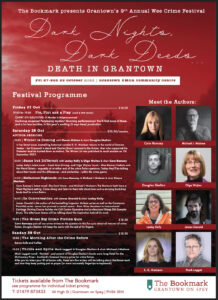
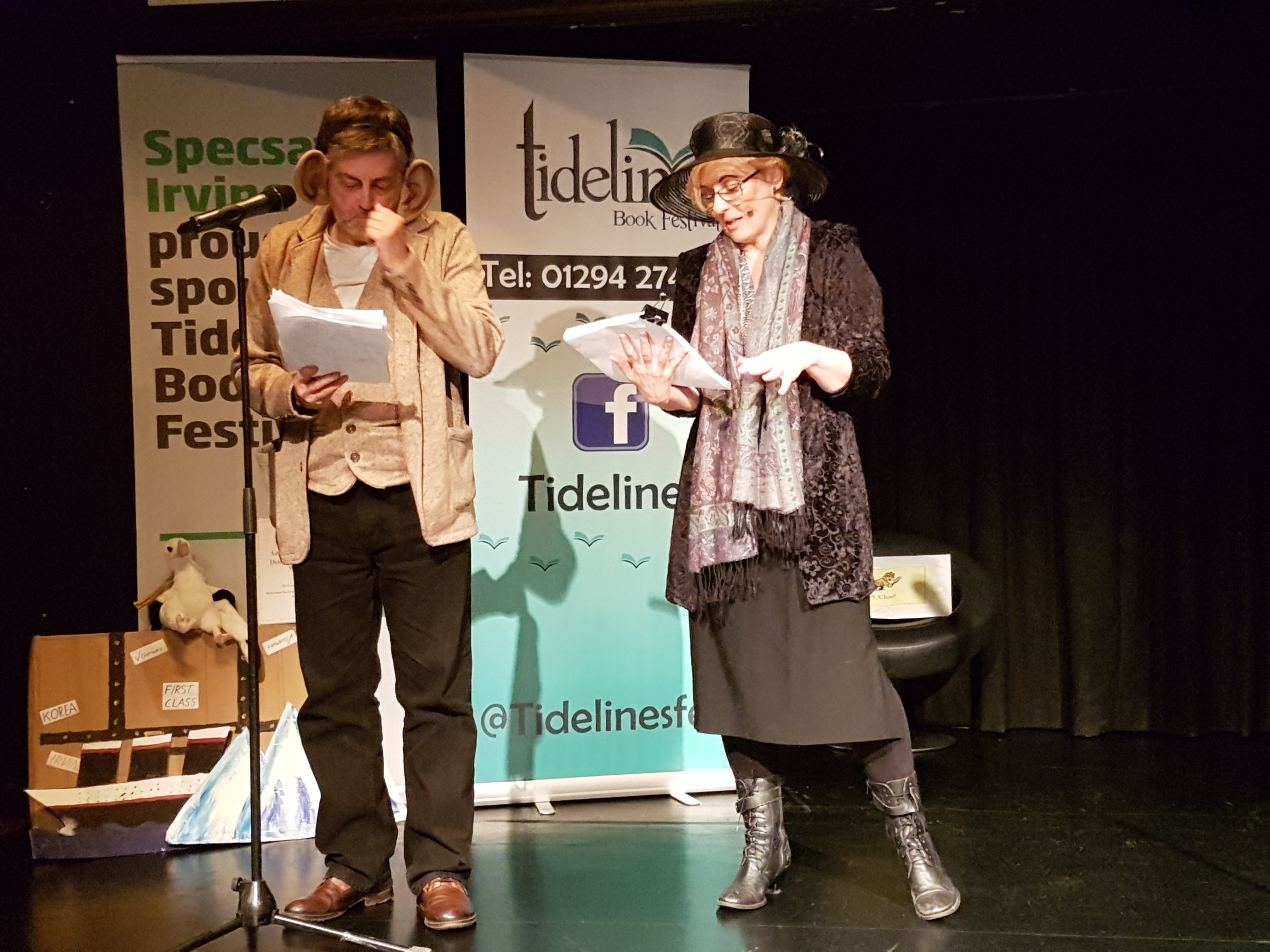
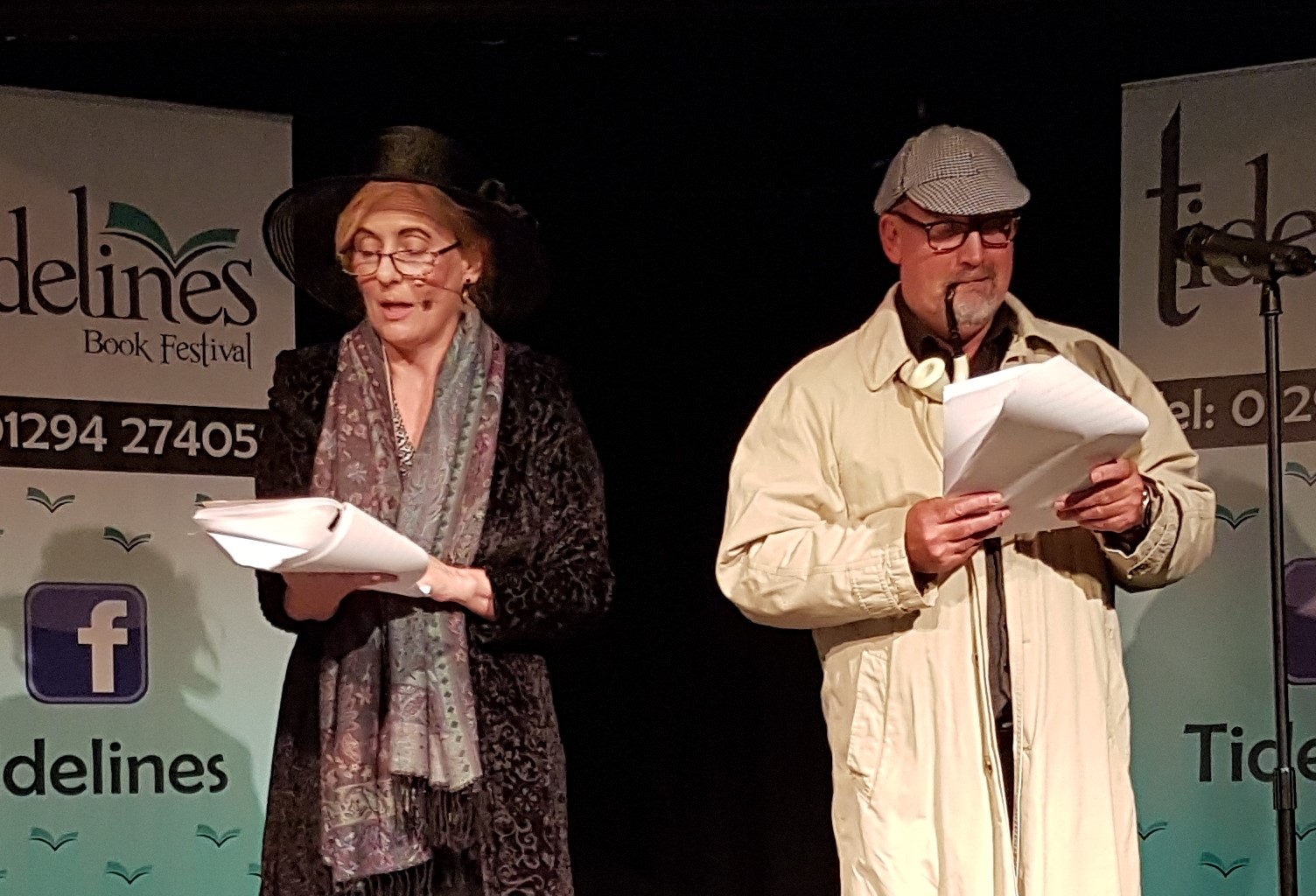
It’s autumn so that means it’s time to return to Grantown for the Halloween weekend.
This is always a high spot on my calendar, not the least because we get to do Carry on Sleuthing.
OK, maybe audiences don’t share our enthusiasm but the cast enjoy themselves. Well, most of them.
And this year, it’s a BRAND NEW show, entitled A MURDER IS MISPRONOUNCED!
Regular cast mates Caro Ramsay, Michael J. Malone and I will the joined by guests stars SG MacLean, Lesley Kelly, Olga Wojtas and James Oswald in the comedy. For want of a better word.
Shona MacLean has walked the boards before, so she should know better. Lesley Kelly has also appeared in a previous show. Olga and James are fresh meat…sorry, newcomers.
The play kicks off the festival weekend during which all the above will be joined by author Mark Leggatt for panels and chats and, on Saturday night, a quiz being concocted by Caro Ramsay.
It really is a fun weekend and if you can get to this lovely town nestling at the foot of the Cairngorms, then we’d love to see you.
See the poster illustrations for details. All events will take place in the newly refurbished Grantown YMCA Community Centre on the Main Street.
I visited Wales for the first time at the weekend, to take part in the Gwyl Crime Cymru Festival in Aberystwyth.
And it was absolutely fantastic.
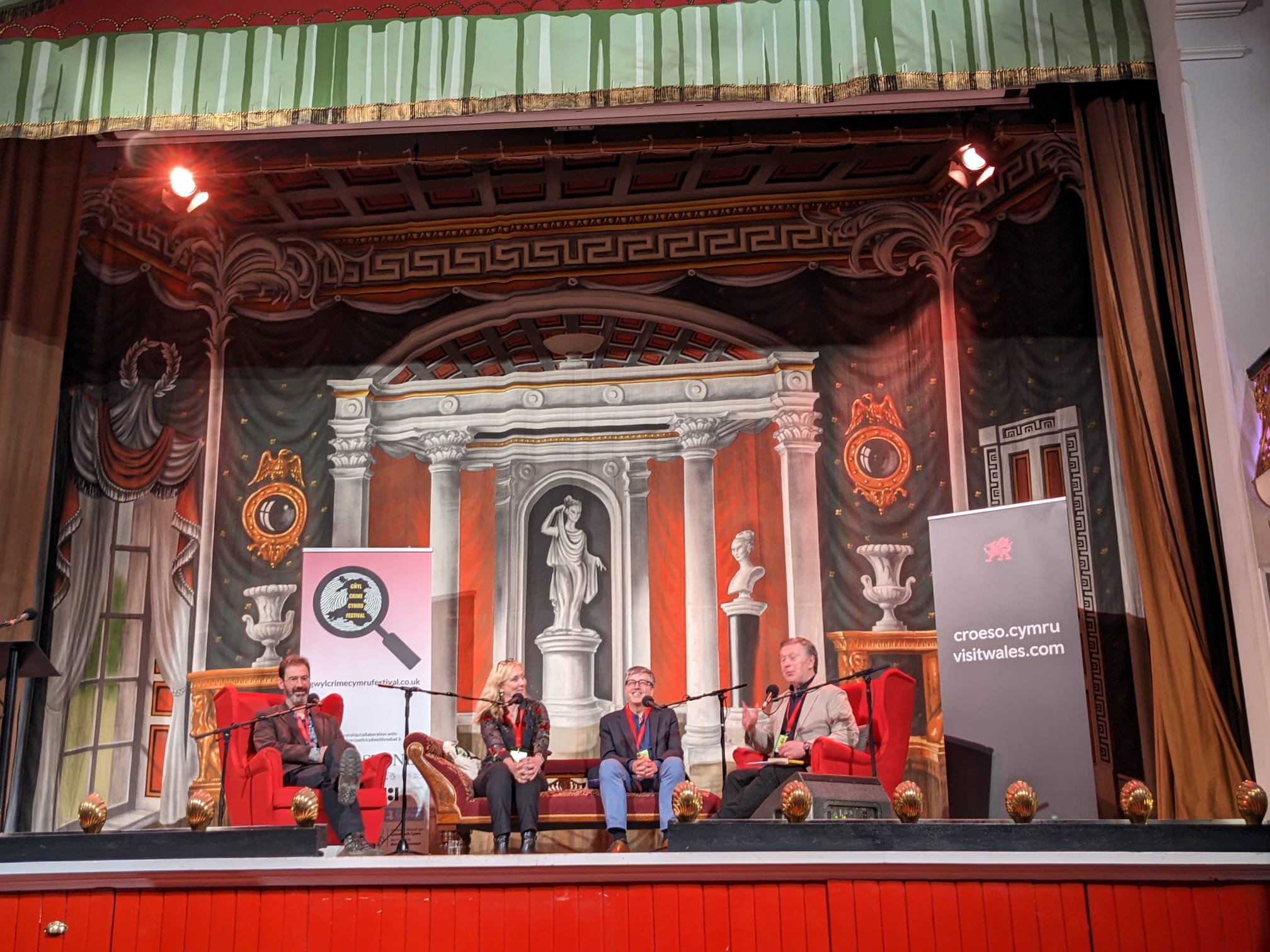
I was invited to take part in two panels, one on historical crime in the town’s library with bestselling – and prizewinning – author Chris Lloyd (below right), chaired by the urbane Barry Forshaw (left). In case you didn’t realise, that’s me in the middle.
The audience was informed and engaged and I thoroughly enjoyed the chat and it was a delight to meet the guys.
Later I appeared with old pal Caro Ramsay (yeah, she’ll dispute that) and the always gentlemanly James Oswald to talk about Scottish Noir.
This panel took place in the Ceredigion Museum, an Edwardian theatre and a fantastic venue.
Again, Barry was in the chair and the event was hugely enjoyable.
When I wasn’t being an important author type, or at least pretending to be, my partner, Sarah, and I took in some of the town, walking round the ruins of the castle and taking the funicular to the top of some cliffs. It’s a beautiful place and the weather was kind.
We later visited a very important TV location and made a foray into England to spend some time in another new location for me. But I’ll tell you about that in another blog.
In the meantime, here’s me being an important author type at the castle. Or to put it another way, posing like a posey thing.
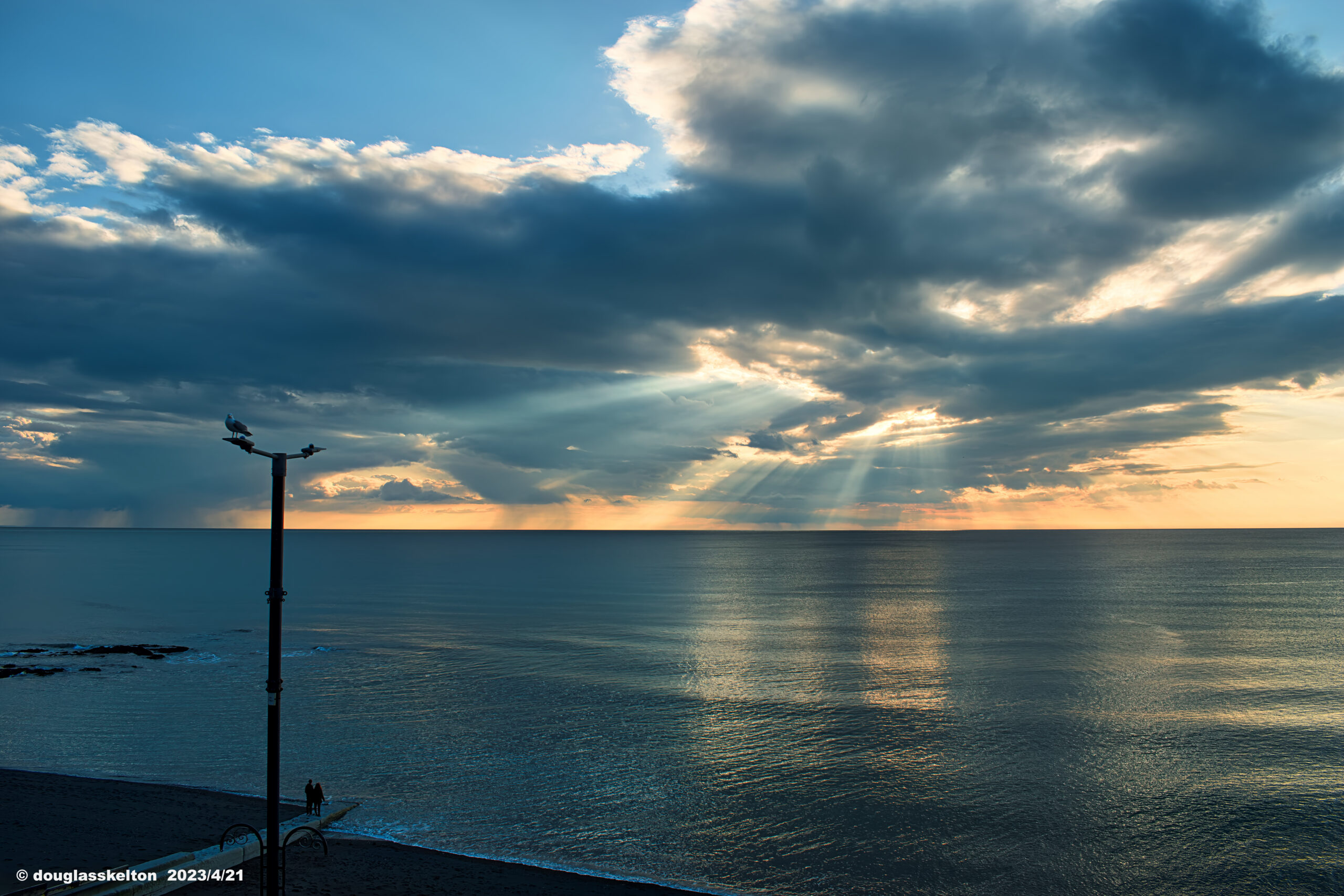
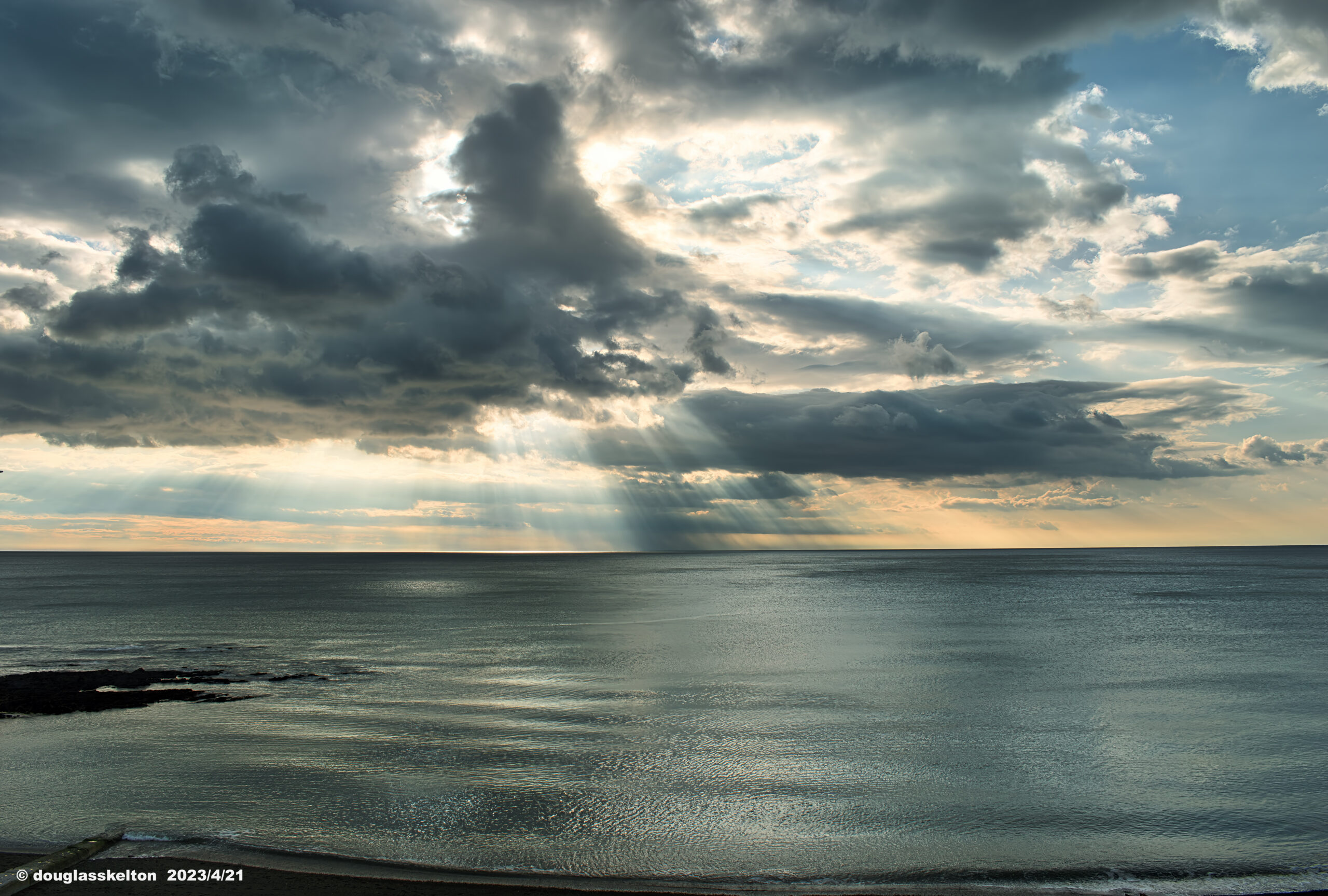
Also, as a wee extra, here’s a couple of seascapes, because the weather was fabulous overall.
Scottish legends have travelled the globe and sparked the imagination of artists for centuries. One particularly grisly tale has helped spawn a notorious shocker and is now at the heart of a new book by a bestselling author.
Here then is the story of Sawney Beane, Devil’s Gallop style…
Sawney, or Alexander, Beane was born, it is said, during the 14th century in East Lothian. His father was a hedger and ditcher, an honest man who believed in a good day’s work. He tried to train his son in his trade, hoping he would follow him, but the younger Beane was lazy and with no interest in honest toil. Preferring to cut throats than hedges, Sawney showed a desire to make his living dishonestly. A career in the city or Westminster would beckon these days but these were not open to a common Scots lad back then. And so, taking with him a woman of the streets supposedly named Black Agnes with the same nasty tendencies as himself, he set off for the west coast and the lands of Carrick, which were then sparsely populated.
The couple found the cave on Bennane Head, which they realised would be ideal for their purposes. It had a narrow mouth which opened up a mile inside into a large cavern. And because it was a seacave, they were safe from pursuit whenever the tide was in – that is if anyone could find the cave in the first place.
So, the Beane’s began their careers as bandits, becoming the scourge of the area. It would be another 25 years before they visited town or village again. Whatever they wanted by way of supplies, they stole. And during that 25 years they bred prodigiously, their sons and daughters intermarrying and in turn begetting sons and daughters, who then went on to beget a further fearsome brood of children.
But no-one knew of their existence. Not for sure anyway. There were stories, of course, tales to frighten children, but no real evidence that a pack of monsters roamed the countryside by night.
The Beanes lived by robbing and murdering unwary travellers. And in the spirit of waste not want not, their victims were carried off, cut into quarters and pickled for when times were lean.
Individual Meat Pies (ingredients: one individual) were regular dishes at the Beane Family table.
But business was so good for the cannibals that their larder was full to overflowing, forcing them to dispose of some of their stores by throwing it into the sea. But these remains drifted along the coast and were picked up by the tides to be washed ashore near settlements. Fear was already rife in the area due to the number of mysterious disappearances: the discovery of limbs apparently hacked from the bodies sent further terror rippling through the citizenry.
(One victim had dandruff, because he left his head and shoulders on the beach).
(Sorry).
Soon paranoia set in.
Honest travellers were arrested on suspicion of murder and wrongfully hanged. Innkeepers fell under suspicion because missing people spent their last night in their establishment. Many were lynched, others closed their inns and left the area. Businesses began to feel the pinch as families packed up and moved away.
But despite all this, the tides still brought bits of flesh onto local beaches as the Beanes continued to enjoy Kate and Sidney Pie.
Searches were made to root out any bandits but no-one thought to see search the cave because it was such an inhospitable place and the tide washed two hundreds into its mouth.
Then, one day, a man and woman were making their way home from a local fair, having grown tired of the coconut shie, the byngoe and ye olde dodgems. They picked their way through a forest on the same horse, the man in front, the woman behind. Naturally, they knew all about the disappearances but such tragedies only affect other people. It would never happen to them. But it did.
The Beane clan ambushed them, leaping out from behind trees and rocks. They were a fearsome sight they were, clothed in rags, hair long and lank, skin matted with filth and blood, nails long and talon-like, teeth sharp and snapping. The horse reared, throwing the woman from the saddle. The man drew his sword and fought the creatures off, hacking to the left and right, thrusting and slashing at the press of bodies around him.
In a scene that would have the makers of Italian horror movies rubbing their wallets together in glee, the Beanes fell on the woman like starving wolves. Her throat was ripped open and her horrified husband, still defending himself, could only watch as the Beanes “fell to sucking her blood…as if it had been wine”, as a court later heard. Then they clawed at her clothes, ripping them from her and tearing at her body until the flesh ruptured and they dragged her entrails forth, biting into them hungrily.
Her husband may have gone the same way had they not been disturbed by a band of twenty stout men – and few thin ones – and forced the hideous bandits to melt like wraiths into the shadows.
The travellers listened with mounting horror as the man told them what had happened. He was then taken over 60 miles to Glasgow to tell his tale again to magistrates. Those worthies sent word to the king in Edinburgh, who was so disturbed at such events in his land that he personally led a cadre of 500 armed men to Carrick to hunt down and bring these creatures to justice.
Again, the Carrick countryside resounded to the baying of bloodhounds as the search party roamed all over the territory, searching hill, dale, nook and cranny. They also interrogated known felons and child minders, so they searched every crook and nanny, too. But, like many other search parties before them, they ignored the water-filled cave.
The dogs, however, knew better.
At the cave mouth the hounds set up “a most hideous barking, howling and yelping” and refused to leave. The king’s men knew they would have to search the cavern. At first they could see nothing in the darkness but, convinced by the dogs straining at their leashes, they ventured further. Torches were brought forth (I don’t know what they used the first three times) and threw strange dancing shadows on the cold, wet walls. Further and further into the gloom they went, the hounds still baying, the sounds echoing back and forth around them. Deeper and deeper into the cave they went until finally the roof opened above them and they found themselves in a vast arched cavern. And here they saw the first trace of their quarry – and it was a sight they would remember for the rest of their days. For all round them hung disembodied arms and legs and hands and feet, and torsoes stripped of limbs, all hung up in rows like carcasses in a butchers shop. And there were barrels filled with entrails and brains and eyes, all pickled and preserved.
The scene was not so much gourmet than goremet.
They also found a fortune in gold, silver and jewels, all stolen from victims.
And then there were the Beanes themselves, spitting and snarling at their pursuers from the shadows – Sawney and his wife, eight sons, six daughters, 18 grandsons and 14 grandsons. Clearly there had been quite a bit of begetting over the years.
The king ordered the remains to be given a Christian burial and the Beane brood to be taken back to Edinburgh. There they were thrown into the tollbooth before execution the next day. The king had been horrified by what he had seen in that cavern and was in no mood for legal niceties. There would be no trial, no lawyers pleading, no evidence lodged. The Beanes were guilty and by God they were to pay.
The male members were disposed of first. Their hands and feet were cut off before being castrated. Then they were hung on stakes to bleed slowly to death. Finally, when they were dead, their corpses were thrown onto a huge fire and burned until only a powder remained. The Beane women were forced to witness the deaths of their men before they were burned at the stake in three separate fires. They died cursing their executioners and society at large, screaming and “venting the most dreadful imprecations until the very last gasp of life.”
There is, however, no actual record of the murders, the chase and no mention of any baked Beanes in official documents. As to which king led the hunt, even that is open to some doubt. Some accounts (as I have) place it during James 1 (1394-1437) while others say it was James Vl of Scotland, the first of Great Britain (1566-1625). Among the latter is SR Crockett, who included Sawney and his brood in the general skullduggery that makes up ‘The Grey Man’.
There is a reason for all this confusion, of course. It probably never happened.
Oh, there might have been some kind of bloody crime going on, perhaps even cannibalism in one of the many periods of want.
The tale of Sawney Beane first appeared in print in the 18th century broadsheets, the tabloid newspapers of their day and may have been a form of propaganda to vilify the Scots. It is said Daniel Defoe, journalist, spy and author of Robinson Crusoe, may have been involved.
There is another tale of cannibalism from which Sawney might have been drawn.
Andrew Christie was a Perthshire butcher, the legend goes, who turned to outlawry and, as famine spread, to cannibalism in the Grampians. His favoured weapon was a cleek (an iron hook) on a long pole, which he used to haul his victims from the saddle. As his notoriety spread, he became better known as Christie Cleek but unlike Sawney, he lived to an old age, having given up his murderous ways and adopting another name.
The Sawney Beane version is better know however, thanks to those anonymous writers in the 18th Century. It has lived on through the years and travelled the globe. Film director Wes Craven is said to have based his notorious shocker ‘The Hills Have Eyes’ (1977, remade 2006) on the tale. Its influence can be seen in other horror fiction, and even the Sylvester Stallone film version of Judge Dredd (1995), with its family of cannibals living in a blasted land.
Actor David Hayman played a modern day version of Sawney in the little seen film ‘Sawney – Flesh of Man’ (2012).
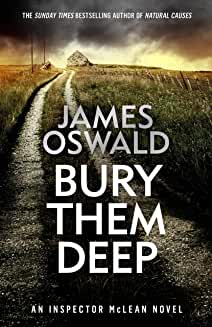
And now bestselling author James Oswald draws on the legend for his new Inspector McLean novel, ‘Bury Them Deep’, to be published next month.
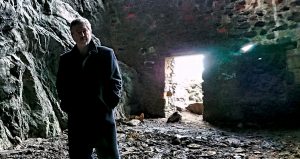
Sawney’s cave is said to be below an old car park that can still be seen jutting off from the old road. They say there is a way down to the cove below, where a cleft in the rock leads to part of it (the rest was blocked off on the orders of King James, according to the tale). They also say the cave stretches so far inland that it meets another one below the ruins of Craigneill Castle, three miles away.
I choose to believe that Sawney lived. I don’t need documents or testimony under oath or eye-witness records. It is enough for me to stand on the cliffs and hear the sound of the waves crashing on the rocks below and the cries of the sea birds around you like the screams of Beane’s victims and know that the cave exists; that Sawney and his family lived there; that a horrified King led a party of armed men with vengeance on their mind on a manhunt across this land.
Maybe they did wipe out the family in Edinburgh, maybe they didn’t.
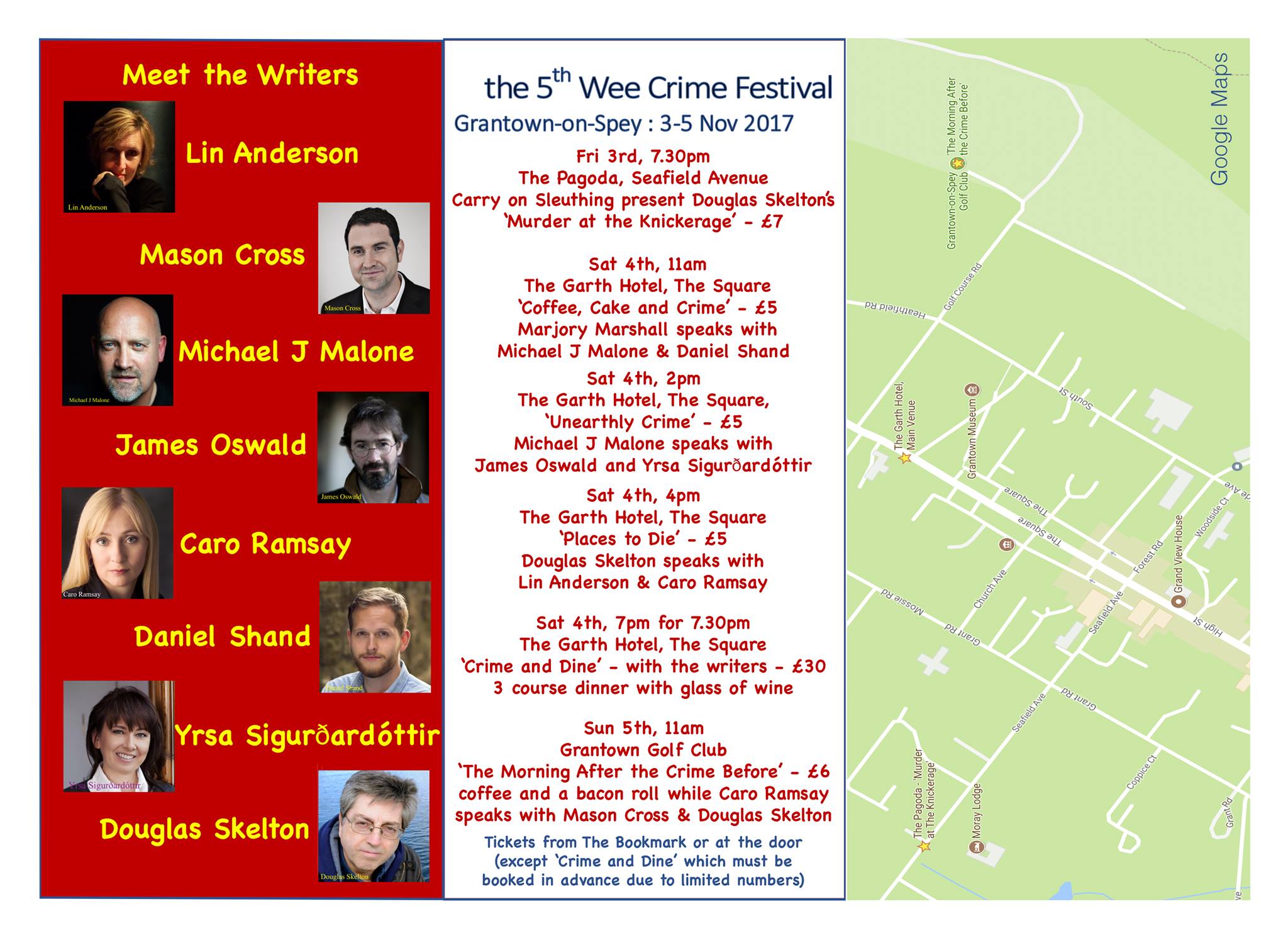
Douglas is heading back to Grantown-on-Spey in November for this year’s Wee Crime Festival.
It all kicks off on Friday November 3 with the gala premiere of the new Carry on Sleuthing extravaganza, Murder at the Knickerage, with Caro Ramsay, Michael J. Malone and some guest performers.
Douglas with Caro Ramsay in Carry on Sleuthing. A brand new mystery will make its debut in Grantown
Caro with Michael J, Malone in Carry on Sleuthing
Then on Saturday and Sunday he joins fellow authors Caro Ramsay, Lin Anderson, James Oswald, Yrsa Siguroardottir, Mason Cross, Michael J. Malone and Daniel Shand in a number of events.