
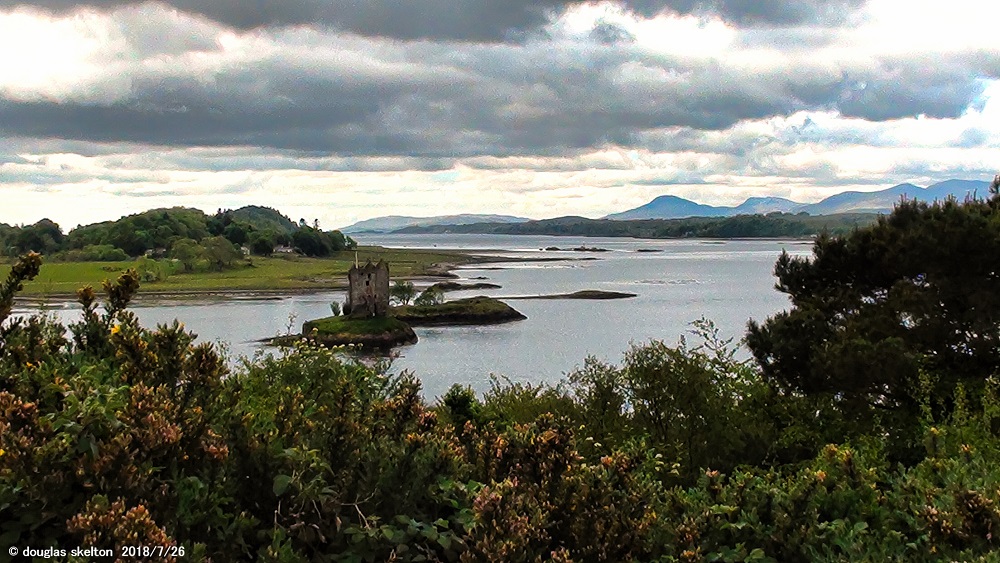
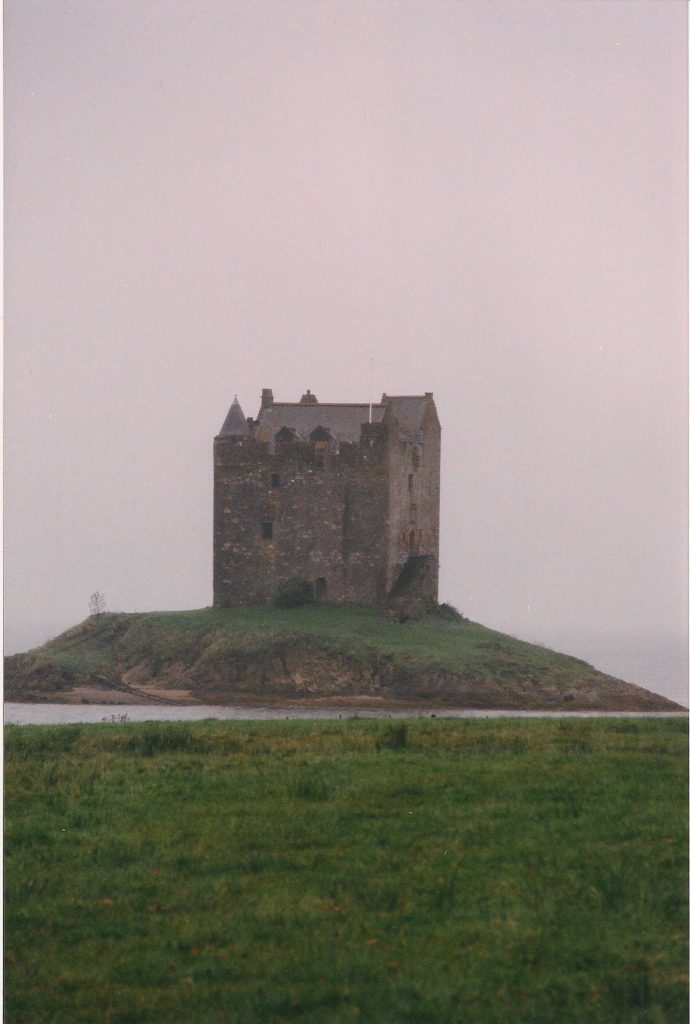
Castle Stalker is another in our series of Most Photographed Castles in Scotland. When I made my original tour for the book, the rain lashed at me like a dominatrix with a serious twitch. It seemed to fall horizontally, a curiosity which I feel may well be peculiar to Scotland. I took my pictures from the vantage point of the road above it, hiding behind a large road sign until I plucked up the courage to dart out and snap away against the downpour. (The image at the top is of more recent vintage when the weather was infinitely more clement).
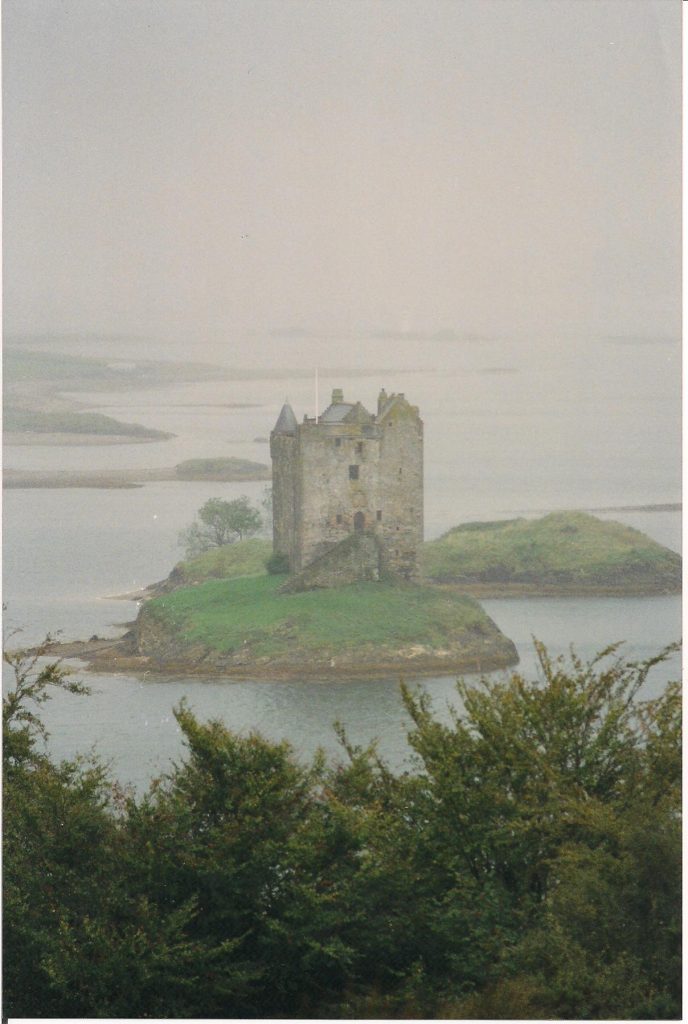
It’s situated in Appin, which lies between Oban and Ballachulish, which means Abbey Lands, which gave us the hymn There is an Abbey Land, far, far away.
The castle was built by the MacDougalls on Cormorant’s Rock on Loch Liach, given to the Stewarts, lusted after by the Campbells and finally allowed to fall into ruin until it was rebuilt under private ownership.
Cormorant Rock, for fans of JK Rowling, is a harder version of Cormorant Strike.
When the MacDougalls fell out of favour, for opposing Robert the Bruce, the castle and lands were given to the Stewarts, who had remained faithful. In 1490, Duncan Stewart of Appin offered it to James lV for use as a hunting lodge, hence its gaelic name Caisteal Stalcair – Castle of the Hunter.
I wondered if our word Stalker is derived from the Gaelic, after all, a hunter does stalk his prey. However, a swift reference to my trusty and battered Brewer’s Dictionary of Phrase and Fable tells me it comes from the Anglo Saxon staelcan.
The Campbells took possession when, during a heavy night of drinking, a Stewart agreed to hand the castle over in return for an eight oared galley. The next day, as he sipped his morning-after Irn Bru, the Stewart realised he’d been had. The Privy Council agreed with him but the Campbells refused to part with the property and there followed a lengthy siege until the Campbells gave up and the Stewarts got it back again.
Ownership was then disputed for many years and it moved back and forward like a very heavy pass the parcel until after the battle of Killiecrankie when the Stewarts, who fought on the winning side, chased the Campbells from the ramparts. No Krankies were harmed in the making of that battle, by the way.
There then followed another siege, which lasted a year, and once again the Campbells were in control. By the time the 1745 rebellion came around, the castle was reduced to garrisoning King George’s troops and after that it fell into ruin.
In the 1960s it was in private ownership and restoration work began.
Fans of Sean Connery films might recognise it as the home of the high class thief he played in ‘Entrapment.’ It co-starred Catherine Zeta Jones. There’s no reason for telling you that, I just wanted to think about Catherine Zeta Jones for a minute. I’ll be fine presently.
There was a little known battle fought near here, an unpleasantess known as the Battle of Stalc. By little known, I mean I’d never heard of it until I was researching the book.
To find the monument, I had to drive into Portnacroish, or Port of the Cross, where I parked outside a row of terraced houses and then walk back to the churchyard. I knew a battle had raged here. I knew there was a monument. A battered sign told me a battle had raged here and there was a monument in the kirkyard. But I was buggered if I could find it.
I wandered round many times and could not find it, until I chanced to look up to the right hand side and saw the grey finger of stone on a small rise, partially hidden by trees and bushes.
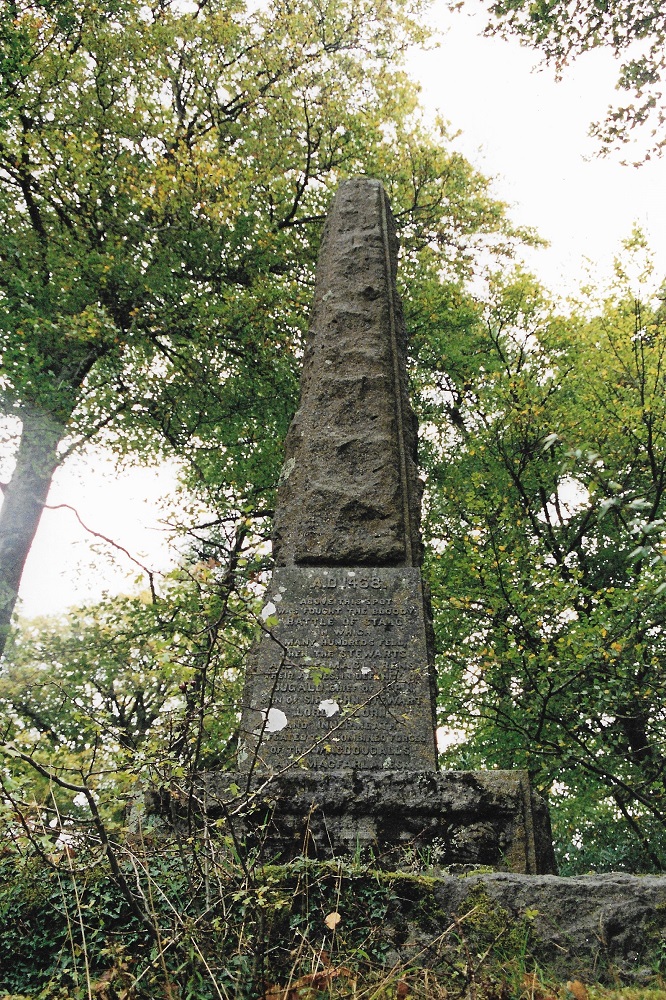
I forced my way through the overgrown bushes and climbed the rocks, for I am nothing if not determined, until I could read the inscription on the obviously not terribly well tended monument.
“Above this spot was fought the bloody battle of Stalc, in which many hundreds fell when the Stewarts and the MacLarens, their allies, in defence of Dugald, chief of Appin, son of Sir John Stewart, lord of Lorne and Innermeath, defeated the combined the forces of the MacDougalls and MacFarlanes”.
The story behind this brutal encounter was this: in 1463, at his own wedding in Dunstaffnage Castle, near Oban Sir John Stewart of Lorne – well known for his sausages – was murdered by Alan MacDougal. The heir was Dougal Stewart, which upset the MacDougalls who still insisted the castle was theirs. After much toing and froing, drawn swords and a variety of Foule Gaelic curses and imprecations, the feud came to a head on this ridge in 1468.
Like most clan battles, it was a brutal bloody affair but the Stewart team was victorious, although at great cost.
Alan MacDougall, whose murderous act in Oban had set this off, found himself on the wrong end of a claymore during the gory goings-on, said weapon perhaps wielded by Dougal himself.
Dougal himself was later killed in another clan battle, the families of Scotland never being able to live peacefully.
Not many people know that it was after this battle that apothecaries created a special powder to help smooth battle scars. They called it Stalcum Powder.
I’ll get my coat…
