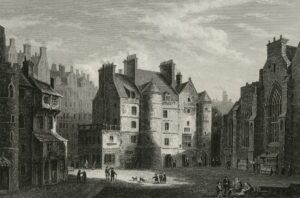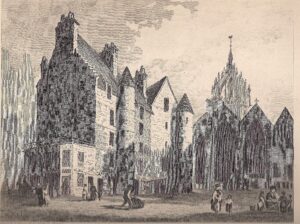
Another excerpt from ‘Dark Heart’, my non-fiction account of the life and subsequent death of the Edinburgh Tolbooth (now out of print). This historic building, of which only brass markers in the street bear testament to its history, features prominently in AN HONOURABLE THIEF, the first in my Jonas Flynt/Company of Rogues series of historical thrillers. This excerpt tells you more about the building and its place in history before it became ‘a grave for men alive.’

IT was a powerful building, even as it stood cheek-by-jowl with the magnificence that was St Giles Church. Tall and turreted, dark and imposing, it blocked Edinburgh’s High Street like a massive stone sentinel, leaving a gap of between 14 to 20 feet for the populace to go about their business. The high tenements and lands rose up around it as if, in the words of one commentator, ‘the antique fabric had been dropped whole and complete in the midst of the pent-up city.’ Its walls had been blackened by decades of smoking chimneys, its windows so grimy they were almost opaque, although now and then a white face could be glimpsed peering out. One look was enough to tell even the most casual observer what this place was – the town gaol. One of Edinburgh’s best-known landmarks, it was also one of the most hated. Even today, the spittle of good burghers covers the heart-shaped cobblestones that mark the site of its entranceway. Some will know why they are expectorating on that particular spot, others will do it merely because it’s the thing to do.

It became known as the Tolbooth, or Tolbuith, but it was not an office for the taking of roadway tolls as we understand the term today. It was, rather, originally the building to which the people came to pay their taxes, as well as acting as a headquarters for the growing civic bureaucracy. King David 1 (1124-1152) gave the monks of Holy Cross the rights to the revenues of the town, but even then the town was growing. As the monks’ influence waned, albeit slightly, the burgeoning band of burgesses grew in influence and the Throne recognised that some sort of permanent centre was needed in which the people could pay their dues. Also, according to a 19th century architectural report on the history of the Tolbooth, the town had been ‘burned and pillaged a little more thoroughly than usual’ during an incursion by the English. Some rebuilding work had proved necessary so, in 1386, Robert II, the great-nephew of Robert the Bruce and the first Stewart king, granted the town a charter, the Carta Fundi De Le Belhous, which proclaimed:

‘Know ye, that we have given, granted and by this our present charter have conferred to our beloved and faithful, the burgesses and communities of Edinburgh, and their successors in time to come, 60 feet in length and 30 in breadth of land lying in the market place of the said burgh, on the north side of the street thereof; given and granted to them, and their forsaid successors, a special license to construct and erect houses and buildings, on the forsaid land, for the ornament of the said burgh, and for their necessary use.”

There were Belhouses in other parts of Scotland and they were was exactly as the name suggested, houses with a bell. The bell was a very important part of the civic life of the town, not to mention the need for an alarm during incursions by enemies both foreign (the English) and domestic (rebellious nobles). The Aldermen of the burgh used it to call the “guild brethren together for the transaction of business.” For this, smaller bells would peal through the town, with three strikes of the Belhous bell ending the call. If the guild brethren did not drop what they were doing and come running, they could be fined twelve pennies. In addition, no-one could buy fish, cheese or any other commodity until the bell was wrung. The bells also became a handy source of income as charges were levied to ring them on birthdays, marriages or funerals.

Perhaps this Belhous is the earlier building on the site referred to by author and publisher Robert Chambers in his Traditions of Old Edinburgh. He believed this older structure, later subsumed into the fabric of the Tolbooth, was ‘a kind of peel or house of defence, required for public purposes by the citizens of Edinburgh when liable to predatory invasions.’ 

The Edinburgh Tollbooth, the town jail

The building became the ‘pretorium burgi de Edinburgi’ mentioned in early Acts of the Scottish Parliament. It appears for the first time in an official document of 1403. The great and the good massed here on a regular basis to form the Parliament. They met on the upper floor of the building, with Royalty in full dress regalia sweeping across a platform extended from a house opposite to receive the fealty of the ‘loyal’ burghers or to listen to their gripes. While affairs of state were heard in the upper chambers, commerce raged in the collection of small shops beneath them, providing rents that helped swell the city coffers. So, while the lords sat above swathed in fine cloths and velvets, the tradesmen beavered away below making and selling them. There was commerce all around the building, for the area around St Giles was the town’s market place. The famous Luckenbooths, more substantial than stalls, grew out of the Buithraw, a row of booths used by lawyers and public officers. Merchants saw the benefits of such property and so the idea grew until the Luckenbooths lined the High Street and the land around the church building itself. Their successors can be seen today in the small stores enticing tourists with their tartan trinkets and mementoes of Scotland. 

A variety of theories have been put forward as to the derivation of the name Luckenbooths. Chambers says that the word lucken signified ‘closed’, meaning that these shops were ‘closed in’ rather than being open stalls. Others say that the name came from a woollen cloth sold there, made in the Dutch town of Lacken. The root of the term may well have grown from the Celtic word for cheek, Leacan, because the booths stood at the side – or cheek – of the church.

The site of the Tolbooth, beside the market place and the principal church, was clearly integral to the business and administration of the town. The building also became very important in the affairs of the nation. Chambers believed it was likely here that the lords gathered to debate the future following the murder of James 1 in Perth in 1437. While his Queen slaked her thirst for revenge with the blood of the principal conspirators – and in so doing gave the Edinburgh people a grisly spectacle to enjoy – the Lords of Parliament pondered the state of the kingdom under a boy king. James II had been crowned at Holyrood – the first time a Scottish king was proclaimed monarch in Edinburgh, breaking the tradition of being so anointed at Scone. However, others hold that the first General Council after James’s death was held in the Great Hall of the Castle, where the Queen had lodged her six-year-old son for safety.

What is certain, however, is that in November 1438 parliament did meet in the ‘pretorio burgi de Edinburgh’ and again in 1449. By 1451, the name by which the building was to become better known appeared for the first time when ‘the parleament of ane richt hie and excellent prince, and our soverane lorde, James the Secunde, by the grace of Gode, King of Scotts, haldyn at Edinburgh the begunyn in the Tolbuth of the samyn.’ By this time, the king known as James of the Fiery Face due to a livid birthmark, was entrenched in the struggles with the Douglas Clan. Scottish history is stained with the blood of men slaughtered in the pursuit of power and, like all Stewart monarchs, young James was no stranger to treachery and death. At 16 he had been present when his boyhood friend William Douglas was lured along with his brother to a dinner in Edinburgh Castle and butchered by the Livingston/Crichton faction. The teenage James may have wept for his friend murdered at the ‘black dinner’ but a few years later he displayed his own ruthless traits by personally stabbing a Douglas Lord in the neck during a supper in Stirling. The 1451 Parliament was designed to curb the power of the Douglas family by enforcing acts ‘against the encroachments on the Royal prerogative.’ James ll ruled until he was 30, dying when a cannon exploded during an assault on Roxburgh, then in English hands.

His son, again James, was of an artistic bent but still displayed the treacherous nature that marked many a Stewart monarch. He surrounded himself with advisors whom the Scottish barons viewed with contempt. When he refused to dismiss them, the barons seized a half dozen and hung them without trial. The King was then taken prisoner and imprisoned, comfortably, in Edinburgh Castle. James had already appealed to England for aid against his rebellious nobles and a force of ten thousand men under the command of the Duke of Gloucester marched on Edinburgh in 1481, arriving just as the barons were in council within the Tolbooth. It was here the King’s brother, the slippery Duke of Albany, convinced them to make him Regent. The English returned home, but kept the prosperous town of Berwick for their trouble, while James was released from captivity and returned to the throne by his brother. An early chronicle stated that the King refused to mount a horse to take him to Holyrood until his brother climbed on behind him. Perhaps he feared an attempt on his life or perhaps he was adhering to the old adage of keeping friends close but enemies closer. Together they rode to the abbey ‘quhair they remained ane long tyme in great mirrines (merryness).’ Following the English incursion, the provost of Edinburgh, William Bertraham, told his burgesses and merchants gathered in the Tolbooth that they would pay the English King 6000 merks sterling and in return James made he and his baillies sheriffs. Importantly, the following year, he recognised the efforts made on his behalf by the city’s craftsmen. They had sided with him during the struggle with the barons and had taken to the streets when Albany came to rescue him. He conferred on them a blue banner to be used by the artisans of Edinburgh as a call to arms during times of war, which were often, and acts of civil disobedience, which were even more often. According to one unlikely history, written by an 18th century mason, the famed Blue Blanket was first created by Pope Urban ll around 1200 and was carried to the Crusades by members of the Scottish brotherhood. 

Parliaments continued to be convened in the Tolbooth, though this King favoured Stirling as a home. His barons still conspired against his rule, including his erstwhile saviour, his brother the Duke of Albany, who finally fled to England from where he staged a minor incursion that was beaten back at Lochmaben by a local force. He died one year later in France. James lll hung onto his throne until 1488, when he was killed at Sauchieburn near Stirling by a rebel army that included his own son.

Although wracked with guilt over his involvement in the murder of his father, James lV became the nation’s best-loved Stewart King. His death at Flodden, along with the flower of Scottish nobility, left Edinburgh in mourning and its Council, based in the Tolbooth, decimated. As news reached them of the disaster in the south, the remaining officials issued a proclamation that the townspeople ‘have reddy their fencible gear and wapponis (weapons)….for the keeping and defens of the toun against thame that wald invade…’. Meanwhile, the authorities exhorted the city’s women not to be seen in the street mourning the dead but instead to take to the church and offer up prayers for the salvation of the nation from the English threat. It was during these uneasy days that a standing watch was created out of a force of 24 men. This was the forerunner of the Town Guard, which from the 17th century was the closest Edinburgh had to a police force.

The proclamation was heeded, the town and buildings, including the Tolbooth, duly fortified with the considerable aid of Lothian farmers and their workhorses. An enclosing wall was built around the city, which became known as the Flodden Wall, and the citizenry held their breath in anticipation of an attack that never came. Henry Vlll, busy fighting the French, ignored the troublesome gnat that was Scotland – at least on this occasion. The people’s grief for the lost King was allowed to flow uninterrupted by military matters. In Edinburgh, a rumour began to gain currency that James was not dead, but instead had been carried to safety from the carnage of the battlefield by four of his loyal noblemen. But dead he was, his body remaining unburied by the English for some years. It was moved from place to place before the head, which had been cut off by workmen for fun, was finally buried in an anonymous grave in London during the reign of Elizabeth l.
The High Street around the Tolbooth now became the restless battleground for control of the Scottish throne as powerful men vied for the Regency. Armed men paraded from Castle to Palace and dirks were drawn at the slightest provocation. On one side was the Earl of Angus, who had positioned himself in line by marrying the Queen. On the other was the Earl of Arran, who claimed right by blood. The prize was possession of the boy King James V and dominion over all. Parliament favoured neither of their Lordships and secretly approached the Duke of Albany, the son of James lll’s treacherous brother, to take the Regency. The French-speaking Duke appeased the warring factions and urged the Queen – the sister of Henry Vlll – to behave like ‘ane guid Scottish woman’. Albany also turned on the man who had aided him to power, the powerful Border noble Lord Home, who had fought at Flodden but had refused to ride to the beleaguered king’s aid. ‘He does well that does for himself,’ he was reported as having said. ‘We have fought our vanguard already, let others do as well as we.’ This decision to look to himself eventually led to the belief that he had murdered James on the battlefield. Now Lord Chamberlain, Home and his brother William were arrested on the orders of Albany, who had heeded the poisonous words of his new advisor John Hepburn, an enemy of their blood. The Border noblemen were swiftly tried, found guilty and executed. Their heads were duly fixed on the Tolbooth tower for all in the city to see. These were not the first noble heads to adorn the building – and they would not be the last.

Albany visited France in 1517 to negotiate a new treaty with the French King but found himself the victim of Royal duplicity and political expediency. France and England had long snarled at each other across the Channel and English kings had often sallied forth to war but at this time the two super powers were uneasy friends. When Henry demanded that Albany be prevented from returning to Scotland, the French King Francis agreed. The much-vaunted Auld Alliance was always more of a guideline than a code and this was one of the occasions that the French proved it. Albany’s four-month visit became four years and during his time away the grasping Scottish nobles spilled blood on the moors, fields and streets of home. The most famous skirmish was the so-called ‘Cleanse the Causeway’ street battle in Edinburgh’s High Street in April, 1520. The reiving pack of Home family moss troopers thundered into the city and reclaimed the heads of their kinsmen from the spikes on which they had languished for nigh on five years. They were buried with all due reverence in the kirk at Blackfriars.

When the flimsy peace between Henry and Francis predictably fell apart, Albany was allowed to return with a French force to pacify the still-seething Scotland and also strike a blow at England from the north. However, memories of Flodden remained alive in the collective mind of Parliament and it refused to back any form of invasion, so Albany renounced the Regency and returned to France in disgust. James V, although only 12, was displayed to the people of Edinburgh at his investiture. Angus had now seized control and opposed a motion that the Parliament be held in the Castle, insisting that it be kept in the accustomed place – the Tolbooth – ‘and that the King be conveyed along the High Street, and in triumph shown to his own people.’ In the end, Angus won his point – although being Scotland, not without some show of force – and Parliament duly assembled in their old Tolbooth home.

James V, when he finally took control, was to become known as the Poor Man’s King and often wandered his realm in the guise of a common farmer, ‘the Goodman of Ballengeich’. He took the first steps to make Edinburgh the legal capital with the instatement in the Tolbooth of a College of Justice, later better known as the Court of Session. The idea was to make justice more readily available to the common man, with fifteen clerics and laymen acting as a supreme civil court. The King received permission from the Pope to draw the cash from the Church, which promptly raised the rents of its tenants to meet the sum agreed, thus exacerbating the growing hostility the commoners had for the established religion. Within twenty years, the corrupt and dissolute old church would be rent asunder by the reforming zeal of John Knox and his fellow reformers. Whether or not life improved much for the common people under the pursed-lip, bible-thumping Presbyterians depends on your point of view.

And so life went on in and around the hulking building, which continued to play an important role in the town’s affairs. Parliament met less and less in the upstairs rooms and eventually had their own premises in Parliament Close nearby but the Town Council still used the old building as a meeting place, while the Court of Session continued to hear cases. The town’s magistrates dealt with flashes of lawlessness, not just by the ever-warring nobles, but also by common desperadoes. In 1554, the Council Register records that following frequent assaults and robberies in the streets, lanterns were to be hung in streets and closes and to remain lit from five in the evening until nine, when all decent people were deemed to be at home and in their bed. It has been noted that this is the earliest form of public street lighting in the city.

By 1558, the country was again in the hands of a Regent – in this case Mary of Guise, the mother of Mary, Queen of Scots – and in the throes of religious upheaval. Knox and his reformers had attacked ecclesiastical buildings and fears were expressed for the safety of similar sites in Edinburgh. The capital’s populace was leaning heavily towards the new religion and the city’s magistrates pleaded with its leaders to spare the magnificent churches and houses of worship. To save St Giles’s Church, 60 men were posted and the ornately carved stalls, used during services by the high clergy and nobles and as such prime targets for the axe-wielding reformers, were removed to the security of the neighbouring Tolbooth. The mob attacked the monasteries of Black Friars and Grey Friars, leaving nothing standing but a few walls. Other churches were also targeted, including St Giles despite the armed guard, with altars trashed and religious images destroyed.

One year later, the reforming movement had pushed on even further and all-out war was on the horizon, with the Protestants backed by Queen Elizabeth of England and led by the newly-styled Lords of the Congregation. The French Mary of Guise was supported by troops from her own country. The Protestant Lords massed in the Tolbooth, where Lord Ruthven and the preachers declared their wish that Mary be deposed as an obstinate idolater. They wanted all foreign troops removed from Leith, where they were entrenched, and an order was sent to that effect. Naturally, the French forces ignored the decree and, back in the High Street headquarters, the Lords prepared to send in the grandly named Army of the Congregation of Christ. However, they did not factor in the ferocious religious ardour of the Ministers, who were outraged by the use of St Giles as a workshop for scaling ladders and, thanks to such blasphemy, prophesied the campaign’s failure. Whether by Divine will or superstitious soldiers rattled by their clergy’s fiery words, the predictions proved correct and the French forces pursued the retreating Scots force into the Canongate, slaughtering and pillaging as they advanced, much to the delight of the old Queen.

The new religion eventually overcame the old and in 1560 the Parliament decided to disestablish the Roman Catholic Church in Scotland. Protestant leaders, the stench of martyrs executed for their faith still burning in their nostrils, set about stamping out any trace of the Church of Rome. Whatever the new ways promised for the future, tolerance was not to be one of them. The arrival of the young, and devoutly Roman Catholic, Mary Queen of Scots from France did nothing for the peace of the nation. The magistrates of Edinburgh issued an order that attendance at the Sunday kirk was expected of all subjects, even priests of the old faith. Some who did so seized the opportunity to attempt to wean the populace away from the followers of Knox and were promptly ordered to leave the city within 48 hours. Mary protested this high-handed treatment of her subjects but the staunch magistrates merely thumbed their noses at her and repeated their order. Mary then wrote to the council and demanded that they convene in the Tolbooth and choose themselves a new set of magistrates. The council acquiesced to the Royal demand but did not take the trouble to find out exactly who she would have preferred enforcing the laws. Mary, being a Stewart (or rather a Stuart, for she had adopted the French spelling of her dynastic name) was none-too-pleased for she ended up with magistrates who were no more interested in her religious views than the first bunch.

Nevertheless, when she made a triumphal entry to the capital on 2 September, 1561, she found the streets gaily decorated and the public buildings the scene of pageants and allegories, some designed to subtly warn her against any opposition of her subjects’ chosen faith. It all started off well. At the head of the Lawnmarket was an arch with children singing and a suspended cloud which opened to reveal ‘ane bonnie bairn’. The child was lowered and gave the young Queen the keys to the town, a Bible and a Psalter covered in the finest purple velvet. Other scenes met her at the Tolbooth and the Cross – angels and virgins – but at the Tron there was a non-too-subtle warning of the fire awaiting idolaters.

By this time the old Tolbooth had fallen into some disrepair and was in a state quite unfitting to its noble office. Much of the business of the council had been transferred to St Giles Church – part of which was being used as a prison for adulterers. This eventually became known as Haddo’s Hole because Royalist Sir John Gordon of Haddo was imprisoned there before his execution. Mary either noticed the dilapidated state of the Tolbooth herself or it was brought to her attention – or perhaps she found the idea of municipal business being conducted on holy ground too distasteful.  At any rate, on 6 February, 1561 she sent a letter to the Town Council stating, ‘

The Queiny’s Majestie, understanding that the tolbuith of the Burgh of Edinburgh is ruinous and abill haistielie to dekay and fall doun, quhilk (which) will be warray dampnable and skaythfull to the pepill dwelland thairabout…Thairfor her Heines ordinis ane masser to pass and charge of the provest, baillies, and counsale, to caus put workmen to the taking doun of the said tolbuith, with all possible deligence.’ 

It was also ordered that alternative accommodation be found for the Lords of Session as well as members of the town’s expanding legal industry. As time progressed, the Council was warned that the entire court system would be transplanted to St Andrews unless something was done to accommodate them. The Council continued to meet in the Holy Blood aisle of St Giles Church while work was progressing. Throughout the project, the Provost and his baillies were faced with the problem of scraping up the cash to finance the building of a new Tolbooth and, as is the case even today, corners were found that could be cut in order to save them some ‘siller’. The master of works was ordered to use as much of the timber from the old building as possible, which prompted the tenants in the shops to complain that he was making off with material that they had paid for out of their own pocket. The council promised that any losses would be reimbursed but failed to mention exactly when.

Although the council wanted to preserve the old building as much as possible, the master of works continued to cannibalise it for materials in order to save money. Stones from the cast-down Chapel of the Holy Rood, which stood between what would eventually be Parliament House and the Cowgate, were also recycled for the new Tolbooth. But still money was short, despite additional taxation. The master of works threatened to walk away from the job unless further capital was forthcoming.

At length, the new Tolbooth was completed, standing side-by-side with its still crumbling predecessor and St Giles Church. The new building was to act as the meeting place for both the Parliament and the council, as well as the courts and the magistrates. In May 1563, Mary presided for the first time over Parliament, riding in procession to the new hall and graciously accepted the loyal greetings of her subject along the High Street. 

Things, of course, changed. The Belhous had become the Tolbooth which became the Session or Council House and, ultimately, power moved to Town Hall. In 1639 the seat of Government moved to the new Parliament House. The College of Justice and Privy Council went with it. Only the High Court of Justiciary, formed in 1672, remained in the new Tolbooth, or Session House, and did not move until as late as 1809. The ever-spreading mass of local government meant the Council became too big for the Session House. It sprawled first into rooms in other buildings around the church and finally transplanted into new premises on the north side of the Market place, the Royal Exchange. The New Tolbooth was pulled down in 1809. Its predecessor outlived it by eight years.

In the 17th century, though, it was still crumbling and in 1610, a cash-flush council decided to repair it. The rubble of the previous century was finally removed and that section rebuilt. When it was finally demolished two hundred years later it was noted that the later workmanship was not as fine as the old. Three krames, or small shops, were built into the west gable but were eventually replaced by a two-storey extension to the five-storey Tolbooth. This platform eventually fulfilled a dread purpose.

Since 1560, the council had a new use for what was left of the old building. In the past, the Belhous had been used as a lock-up or a ‘thieves hole’: in 1480/81 it was noted that of the booths on the ground floor, the sixth ‘is made a presoun’. The dark towers of the Tolbooth had been no stranger to the miseries of malefactors, with heads and other body parts often adorning its spikes and walls. Now it would act solely as home to the criminals, traitors and debtors of the town. Its noble past was well and truly behind it. From then on, the old Tolbooth was used as the ‘tyne gaol’.

Ahead was only darkness.

All Passion Spent

Part two of my account of the true-life incident that inspired a set-piece section of AN HONOURABLE THIEF.

Following a disastrous reaction to an execution in Edinburgh during which rioters were fired upon and killed, Captain John Porteous of the City Guard was tried and found guilty. He was sentenced to death but news reached the people that Queen Caroline was disposed towards delaying execution, perhaps even commuting it. The Edinburgh mob, a potent force, was having none of it…

They came for him on the night of 7 September, 1736.

At first there was but few of them, men and women, but as they walked from the suburb of Portsburgh towards the West Port, the grave beat of a drum in the dark alerting like-minded folk, their numbers swelled. They took control of the West Port gate, nailing it shut and barricading it. Into the Cowgate then, bodies joining them from every side, and finally onto the High Street. A band of strongly-armed and determined men seized the Nether Bow Port in order to cut off any possibility of aid from the Welsh Fusiliers then stationed in the Canongate. The headquarters of the City-Guard was stormed and taken, the officers and men disarmed and isolated. The Guard’s muskets, cutlasses and their Lochaber Axes were plundered and distributed among the multitude. 

And then they turned their attention to the Tolbooth. They surged around the ancient building, flaming torches sending tall shadows dancing against its walls, the sound of their voices reaching the soldiers in the Castle, where the General refused a verbal plea to turn out his own Guard. Whatever his reasons for not interfering – procedural or personal – he took the wisest course. The mob was not to be diverted from its course that night and military interference would only have led to further bloodshed. 

The door to the Tolbooth had been barred against them but that would not stop them. Sledgehammers were wielded against the wood and when they made little more than a dent, axes were swung to hack their way through. Finally, tar and brushwood were brought and the door set alight. When the flames weakened the thick wood, the crowd pushed it open and blazed through the portal, snatching the keys from the terrified turnkey. Into the stairway and up the stairs then, doors being thrown open and rooms searched, but their quarry was nowhere to be seen. The hapless Gudeman, the warden of the jail, was forced to divulge in which room Porteous was being held but it was, it seemed, empty. It appeared the mob’s efforts had been in vain until someone thought to peer up the chimney. The terrified Captain had crawled into the space as soon as he heard the din outside but an iron grate placed there to prevent prisoners from escaping had halted his upward progress. The desperate man screamed for mercy as he clung to the ironwork while the resolute band below hauled at his legs. But there was no mercy in that room that night. Some could recall the groans of the dead and wounded that day in April, some had perhaps suffered at Porteous’s own hands on other occasions. There was no mercy but a grim determination that their dark work would be carried through to its inescapable conclusion.

Finally, Porteous was dragged from the chimney. He would have known what fate was in store but did not know exactly where. There were men there, he knew, who would have done for him on the spot but their leaders had other notions. Perhaps hope rose in his breast then. Perhaps he thought the longer they kept from fulfilling their dread purpose, then the better were his chances of rescue by the authorities. Perhaps that slim hope sustained him through his final minutes.

The Captain was manhandled out of the Tolbooth and the procession turned towards the West Bow and the Grassmarket. The streets were clogged with people and many more watched from the tenement windows above, the whole scene lit by the fierce glow of countless torches. The flambeaux illuminated grim faces and the guttering flames glinted from the metal of blade and axe. Porteous could be heard praying as he descended the winding street. When he stumbled, he was caught and propelled onwards. At one point, a shoe came off a foot and he was halted in order for it to be retrieved and replaced. A shop was opened in the West Bow and its owner, a Mrs Jeffrey, was asked for a rope. When told it was to be used to hang Porteous, Mrs Jeffrey told them they were welcome to all she had. The men took what length they needed and left a guinea as payment.

They reached the Grassmarket but the gibbet had been taken away. Not to be discouraged from their intent, one end of the rope was thrown over a dyer’s pole on the south-east corner and the other wrapped around the neck of their proposed victim. They allowed him to pray. They permitted him to hand over what money he had on his person to a wealthy man nearby on the promise it would be delivered to his brother (some accounts say he gave his money to a debtor in the Tolbooth). Then he was hauled up by the neck. As he struggled on the rope, the executioners realised that they had not covered his face, so he was lowered again to the ground and his shirt pulled over his head to conceal the hideous grimace of death from the crowd. Then the men strained at the hemp and dragged him upwards again. Again he was let down as his freed hands feverishly fluttered at the rope biting into his neck. Some men came forward at this, tiring of the time the killing was taking, and struck at him, some trying to saw off his ears with the long Lochaber axes taken from the guardhouse. But they were pushed back and Porteous was a third time hoisted aloft, his body jerking as the life was throttled from his body. His legs flailed wildly, spasmodically, then slowed and finally stilled. His body swung slowly from the pole, the breath finally drained from it. 

The cheer that greeted the expunging of life from the hated Captain reverberated round the Grassmarket, carried up the West Bow and reached the Castle. And then, with surprising swiftness, the borrowed weapons were thrown to the ground and the mob dispersed, melting into the night like wraiths. Only the discarded axes and muskets and, more tellingly, the body still gently swaying from the makeshift Dule tree, the rope creaking softly in the now silent night, showed that they had ever been there.

The city’s populace had not only killed Porteous, they had also shown a violent disregard for the Royal prerogative. It was known that Queen Caroline had a mind to pardon the Captain and the events of the 7 September 1736 showed that the mob had scant respect for her wishes. Sir Robert Walpole’s government took steps to punish someone – anyone- for the flagrant scorn the people had shown to their authority. The question was, who could they bring to justice? It was felt that this mob had a quality that others lacked and so it was believed that many men in high office had taken part in the events, some even dressed in women’s clothes. The guinea left for payment in the corder’s store is cited as proof that men of wealth were present, for the ordinary Edinburgh mob would not have that kind of cash to leave. One such nobleman rumoured to have taken part was the Earl of Haddington, dressed like a cook-maid. Rewards were offered in a bid to track down the ringleaders and a proclamation ordered to be read from every pulpit, but many ministers refused to do so. Arrests were made but the leaders were never found, underlining the claims that the conspiracy reached high into the upper echelons of society. Other theories laid the blame at the feet of Covenanters, criminal friends of Andrew Wilson and even Jacobite sympathisers who wished to overthrow the government. 

One man arrested was William Maclauchlane, a footman to the Countess of Wemyss. He had been sent out earlier that day on an errand for his mistress. Having delivered his message, Maclauchlane then retired to John Lamb’s alehouse in Parliament Close where he enjoyed a few drinks and then, so much the worse for drink that he did not know where he was or what he was doing, joined the throng in the Grassmarket. He was implicated when witnesses identified his ‘showy livery’. His liking for drink saw him very narrowly miss being made the scapegoat for the shocking events that night.

However, according to Sir Daniel Wilson in his Memorials of Edinburgh in the Olden Time, the real mastermind behind the lynching was a baker’s apprentice named Alexander Richmond. He describes him as ‘a wild and daring lad, who took a prominent share in all the riotings of the period.’ His father was said to have deprived him of his clothes and locked him in his room on the night of the riot but the young man managed to escape, dressed in his sister’s clothes. He was in the vanguard of the attack on the Tolbooth and among the leaders as Porteous dangled on the dyer’s pole in the Grassmarket. When his name was mentioned after the hellish events, he ran off to sea and did not return for many years. While a successful merchant captain, he told a few of his closest friends his secret, one of whom passed it on to Sir Daniel many years later. Another mooted as being one of the leaders was journeyman carpenter James Maxwell.

Although no-one was directly punished for being part of the mob, the government’s ire did descend on the Lord Provost. He was arrested and jailed for three weeks before being freed on bail. Further moves against him – including preventing him from holding office anywhere in the country and imprisoning him for a year – were blocked by Scottish MPs in the Commons. They also managed to prevent the Government from demolishing the Netherbow Port and disbanding the City-Guard. Someone had to be punished, of course, and the city was ordered to pay £2000 to Mrs Porteous. In the end, the widow accepted £1500.

Two days after his death, Captain John Porteous was laid to rest in Greyfriars Kirkyard, for over two centuries marked by a small stone with the letter ‘P’ and the year 1736. In 1973, a headstone was placed there stating ‘John Porteous, a captain of the City Guard, murdered September 7, 1736. All Passion Spent.’

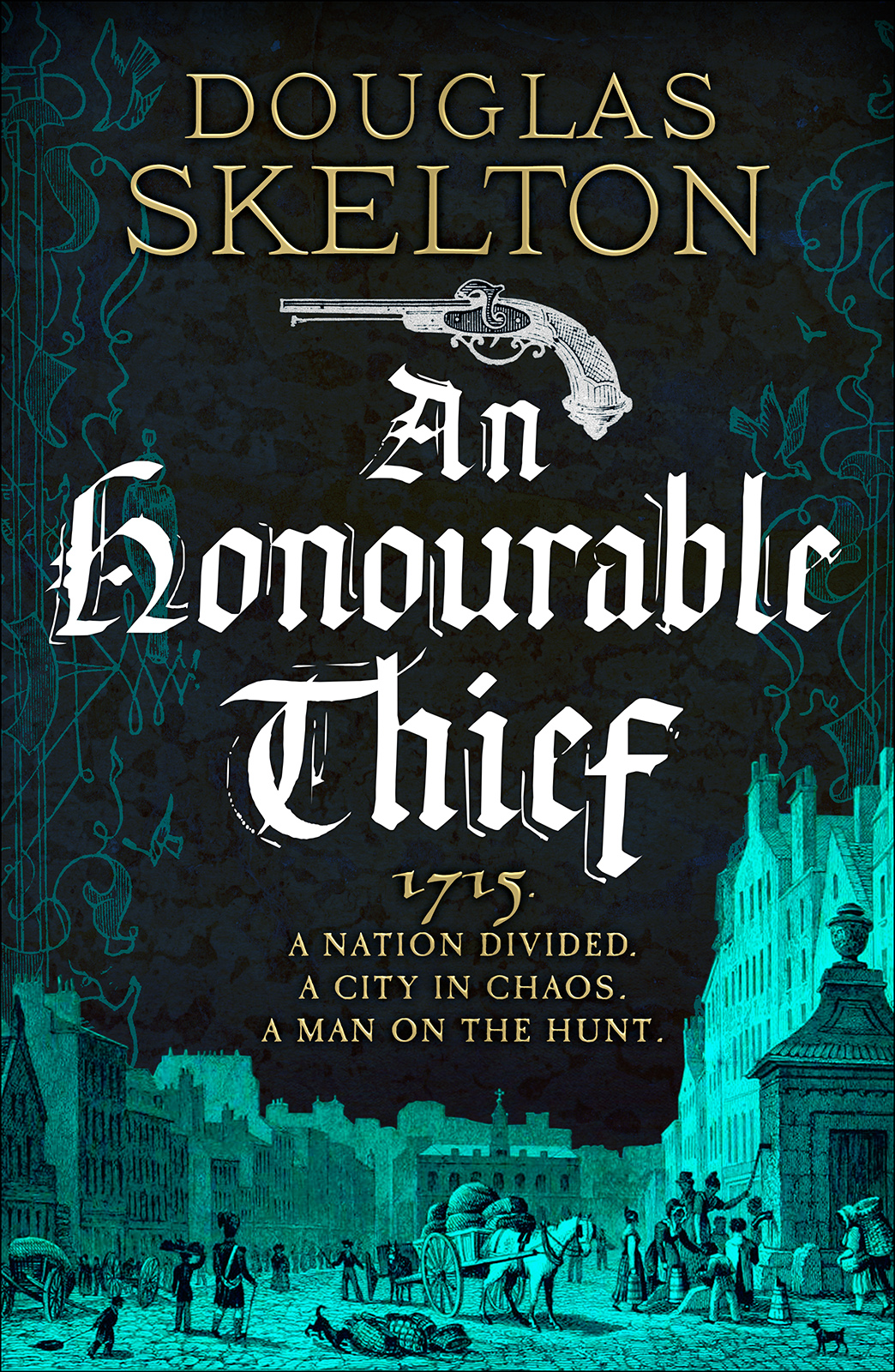
AN HONOURABLE THIEF, my first historical thriller, is published in paperback by Canelo this week and to mark the occasion I thought I’d share this account of a true life incident that inspired one of the set piece chapters.

Naturally, I fictionalised the details, characters and tweaked everything to suit my purposes, including moving the events 20 years earlier.

This account has been taken from my non-fiction work, DARK HEART (Mainstream 2008), which told the story of the Edinburgh Tolbooth, the old town jail, which Sir Walter Scott called The Heart of Midlothian. The book is now out of print but you may find second hand copies here or there. This is taken from my original manuscript version so may differ slightly from the published version.

The Treaty of Union may have changed many things but it did not appease the hot blood of the Edinburgh mob, of which English spy Daniel Defoe commented, ‘A Scots rabble is the worst of its kind …’ The benefits of the Union did not emerge for many a year and the citizenry was still prone to demonstrate its opposition. Stiff, and unfair, taxes imposed on the Nation, including an export duty on linen, another on salt and a malt tax, proved crippling and hugely unpopular. When protest was made to the English Lord Treasurer, he observed, ‘Have we not bought the Scots, and a right to tax them? However, taxation was the indirect cause of a riot and subsequent slaughter that was seen as being tantamount to rebellion. The unrest left men and women dead and wounded in the streets and led to the Bastille of Auld Reekie being stormed once again, not to free prisoners but to bring to justice a man they believed was guilty of murder. 

One source of revenues to the Crown was the duties placed on imported goods. Brandy, rum, lace and other goods from the Continent were all subject to stiff taxation but were always in demand, so bands of smugglers sprang up who were willing to supply them. Revenue officers were charged with bringing these romantic desperadoes to justice. But the clerk would have his baccy and the parson his brandy, so the smugglers carried on their moonlight trade with the sanction and often assistance of all walks of life. Scotland’s East Coast was, obviously, a focal point for the traders in contraband. Andrew Wilson was an Edinburgh baker who supplemented his income by smuggling. By 1736, the swashbuckling Wilson had grown tired of the inroads excisemen had made into his illicit business and resolved to raid the Pittenweem customs house to recover goods seized by them. Among his band were George Robertson, William Hall and John Galloway. They managed to pull off the heist but were subsequently caught and sent to Edinburgh to face trial. 

In the Warding Book of the Tolbooth for 12 January 1736, there is an entry that two of the band were subsequently liberated while John Galloway was ‘baled out of prison and examined as witness in the criminall tryall against Andrew Wilson … and did not return to prison’. With the evidence of their former co-accused against them, Wilson, Robertson and Hall were found guilty. Hall was to be transported to the penal colonies for his part in the robbery, but Wilson and Robertson were due to hang. The smuggler, though, was determined not to dance the hangman’s jig and, according to legend, he and his accomplice, with the assistance of two horse thieves, cut through the iron bars of their window, singing psalms to cover the noise. According to the tale, one of the horse thieves squeezed through and slipped off into the night. Wilson was next but they had not made a hole wide enough for his bulky frame and he ended up trapped between the bars. The gudeman of the Tolbooth was alerted to the escape bid and Wilson and Robertson were placed in more secure lodgings within the prison.

What is certain is that, on Sunday 11 April, Wilson and Robertson attended services in the Tolbooth kirk, which was part of St Giles. They were guarded by four of the City-Guard and just before the sermon began, Wilson, according to a contemporary report, grabbed the younger Robertson ‘by the head band of his breeks and threw him out of the seat.’ With a cry of ‘Run, Geordie, run’ Wilson intercepted three of the guards, reportedly seizing one in each hand and, incredibly, a third in his teeth. Robertson saw his chance and punched the fourth guard to the ground before sprinting for the door of the church. No-one got in his way and he disappeared into Parliament Close. He managed to escape through the city gates before they were sealed. Friends were waiting with tools with which to strike off his chains and a swift horse to take him to Dunbar where, it is said, he took a fast boat to Holland. For many years, it was rumoured, he kept a bar in a village near Rotterdam. The entry in the Tolbooth records states in its customary spare style that ‘the aforementioned George Robertson made his escape out of the tolbooth kirk a little before sermon and was not apprehended again.’

Wilson may have made up for ruining the earlier bid for freedom but he had sealed his own fate. Security around him was strengthened while he lay in the Tolbooth awaiting his execution. Sympathy for him among the mob also grew. As a smuggler, and known as such for thumbing his nose at the hated authorities, he was already well-liked but his selfless act in holding down the guards while his young friend got free made him into a hero. Due to hang on 14 April, word reached the magistrates that the mob might be tempted to help break him free. A detachment of Welsh Fusiliers was drafted in to beef up the guard on the appointed day.

Captain of the City-Guard at that time was John Porteous. According to The Newgate Calendar, a true crime compendium from the latter part of the 18th Century, he was a former tailor who caught the eye of a high-ranking official said to be the Lord Provost of the time. This gentleman had a wish to offload his mistress and he suggested that Porteous, well regarded by Edinburgh society but as poor as a church mouse, take her off his hands. To make the match more attractive to the lady in question, who wrinkled her nose at the thought of marrying a tradesman and a penniless one at that, a one-off payment of £500 was offered and accepted. Porteous duly married the woman and set out to rise in his profession. However, the young man was ‘much addicted to company’ and neglected his business, losing many customers in the process. His wife, fearful of being left destitute, used her influence with the Provost who offered Porteous captaincy of the City-Guard, with a salary of £80 a year. 

The fact is that Porteous was more likely to have come to City-Guard through military service, first as drill master following the 1715 Jacobite uprising. Within ten years he had been promoted to Captain. A keen golfer, he lost famously to Alexander Elphinstone in 1724 before a large crowd in a match that became the very first reported by a newspaper. Where the accounts agree is that his personality tended towards the arrogant and the truculent. He was officious, self-important and often brutal.  He soon developed a reputation for an overly-enthusiastic use of violence in quelling disturbances. The Newgate Calendar states that ‘he would exceed the bounds of his commission and treat the delinquents with the utmost cruelty by knocking them down with his musket and frequently breaking arms and legs.’

He was no less brutal when despatched to reports of tumults in ‘a house of ill fame.’ ‘Notwithstanding he was a most abandoned debauchee himself, he would take pleasure in exposing the characters of all he found there, thus destroying the peace of many families. He would treat the unhappy prostitutes with the greatest inhumanity and even drag them to a prison, though many of them had been seduced by himself.’ 

This was the man who was in charge of the City-Guard when Andrew Wilson was due to hang. His mood was already foul over Robertson’s escape and he may also have resented the fact that the Magistrates felt it necessary to bring the Fusiliers to strengthen the execution detail. (The Calendar, incidentally, says that it was Porteous himself who requested that the soldiers be present). On 14 April, Porteous led the Guard as Wilson was taken from the Tolbooth to the Grassmarket, where the ‘hanging tree’ awaited. The soldiers lined the route and the crowd watched the procession go by, but there was no suggestion of trouble, even when Porteous forced the manacles on Wilson’s wrist so tightly that the man was in obvious agony. The condemned man was led to the gibbet, where the customary Psalms were sung, prayers were said and still there was no sign of trouble. Wilson was turned off the ladder ‘with all decency and quietnes’, as one spectator wrote, and still there was no trouble. It was as the body was being cut down that it began.

It started with some boys throwing stones at hangman Jock Dalgliesh, a common enough occurrence for the post of ‘hangie’ was fraught with danger, but it was enough for Porteous to wade into the crowd himself, followed by his men. The crowd first pulled back then surged forward. One man leaped to the gibbet and cut the body of the dead smuggler down while Porteous and his guard were assailed from all sides by missiles. The magistrates, fearful for their own safety, either gave Porteous an order or he made the decision himself, but whatever the case it was the biggest mistake of his life – he told his men to fire. The first volley was aimed over the heads of the rioters but in doing so the Guard only hit those spectators who were leaning from the tenement windows. Far from cowing the mob, the gunfire merely served to push it further into a frenzy and the Captain ordered the men to shoot directly into the throng, before beating a retreat up the West Bow, a thin line of red snaking through the press of bodies. Striking out at all sides, and being hit by stones and filth from around and above, Porteous once again told his men to fire, ordering them to ‘level their pieces and be damned.’ He snatched a musket from the nearest man and fired himself, killing one man. Another volley rattled out and more people slumped to the ground, blood seeping from wounds, before the Guard were able to reach the comparative safety of their headquarters and the Fusiliers helped bring some semblance of order to the streets. 

The number of dead varies from six to nine people, depending on what account you read, and Porteous was called to account before the Council ‘where there was an abundance of witnesses to fix the guilt upon him,’ wrote a witness. ‘The uproar of the mob encreased with the loudest din that ever was heard and would have torn him, the Council and Guard all in pices, if the Magistrates had not sent him to the Tolbooth by a strong party and told them he should be tried for his life.’ 

On 5 July, Captain John Porteous faced the High Court of Justiciary. Against him was the evidence of those in the crowd who claimed that he had personally fired into the crowd and had ordered his men to do the same. His own position was that his men had fired on their own volition and that he had not pulled a trigger. He also argued that the Magistrates issuing he and his Guard with ball ammunition was more or less an order to fire if or when it became necessary. Sixteen witnesses testified that they had not seen the Captain fire into the crowd. Feelings, though, were running high and Porteous’s own reputation and the number of dead and wounded counted against him. He was found guilty and sentenced to die on the Grassmarket, where it all began, on 8 September.

News of the case reached Queen Caroline in London, then acting as Regent while her husband, George III, was on the Continent. She was disposed to pardon the Captain and issued orders that a six-week reprieve be granted. Naturally, her compassion did not sit well with the Edinburgh mob, who saw it as yet another example of am English government supporting the slaughter of innocent Scots. Captain Porteous was not to be allowed to avoid paying the ultimate penalty for his actions.

TO BE CONTINUED…

Personally speaking, (and it’s my website so I’m allowed) 2022 was a year of incredible highs and devastating lows.

But that’s life, ain’t it? Ups and downs, peaks and troughs, swing and roundabouts. All that jazz. As John Lennon said, life is what happens while you’re making other plans.

As Dickens wrote, it was the best times; it was the worst of times.

So, what was it all about, 2022?

Well, I was on the telly – three times! Four, you could say, because one was a two-parter. I think I was on screen even more than ‘The Heroes of Telemark’ this year, and that’s quite a feat.

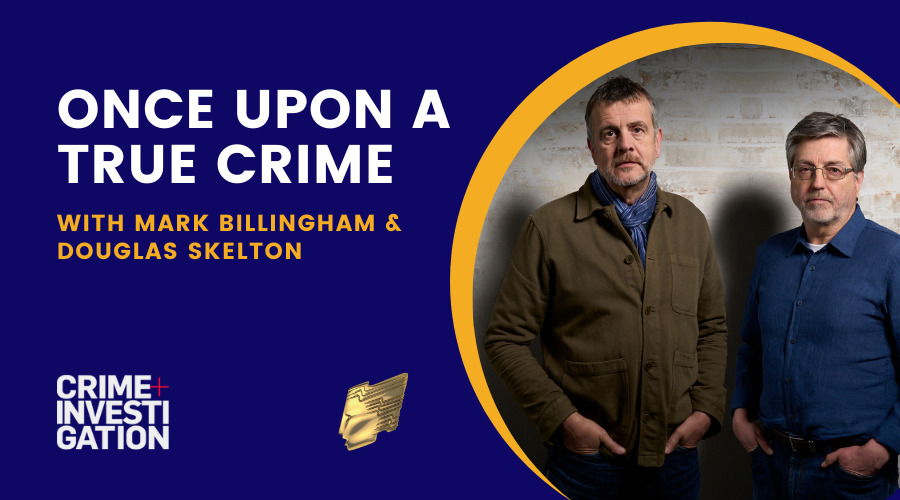
First there was a documentary I presented on the Crime + Investigation Channel. Although I’ve appeared on the box many times over the years, it was the first time I’d ever actually fronted a full show and it was an interesting experience. It was filmed in 2021 but didn’t go out until earlier this year, as part of a strand called Once Upon a True Crime, which saw some top crime writers (and me) outline a case that inspired their writing. The other authors were Denise Mina, Mark Billingham and Peter James.

Mine, of course, was about the Ice Cream Wars in 1983/84 Glasgow. I’ve never used them directly in my fiction but I did co-author the true crime account of the case and what I learned during that period has informed most of my stories.

Filming in Glasgow with a lovely car but, for me, hellish to drive.

I had to drive a Ford Capri of the period. No power steering. No ABS. After driving it round and round in order to get the take the director wanted I had shoulders like Big Arnie and I had to start hitting the brakes a half mile before I wanted to stop.

Mr Billingham and I even launched the series at a special event in The British Library in London.

Bestselling author Mark Billingham and I looking suitably sombre for the promotion of the Once Upon a True Crime series in the British Library

Later in the year I was one of the contributors to a BBC Scotland two-part investigation of the case. Reports tell me that the programme makers did a great job, but I still haven’t watched it because I really hate seeing myself.

Those two documentaries will be my last word on the tragic case.

This year I also made my second appearance on David Wilson’s Crime Files. Being interviewed by the professor is always daunting as I feel he is picking up on every bit of body language and psycho-analysing me. In fact, he probably is!

He’s a lovely guy and it was good of him to have me back.

We were talking about the Sandy Drummond case, an unsolved murder from Fife, which I find fascinating. I wrote about it in one of my true crime books many years ago, back when Caxton was still working his press.

When I walked into the studio I was greeted by the face and beard of an old friend – Stan Leech. Now a cameraman, he was part of the crew for the series. Amazingly, in a previous life, he played Sandy Drummond in a Crimewatch re-enactment. It’s a small world, right enough, but as someone once quipped, I wouldn’t like to paint it.

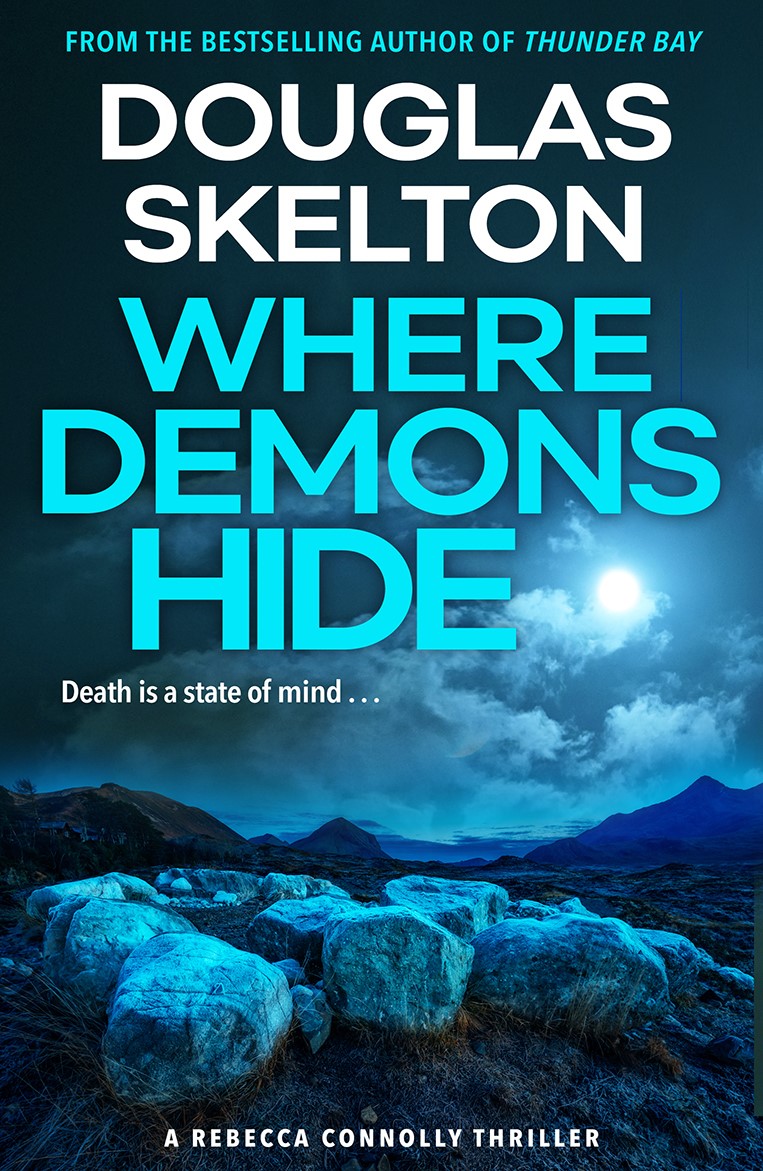
I had two books published – the fourth Rebecca Connolly thriller WHERE DEMONS HIDE (Polygon) and the first Jonas Flynt historical adventure AN HONOURABLE THIEF (Canelo).

Outing no 4 for Rebecca Connolly
The eye-catching cover for the first Jonas Flynt historical thriller

It’s a thrill to have one book published, let alone two in a year, and I am grateful to the publishers and my agent, Jo Bell, for making it happen. Also to Denzil Meyrick for more or less forcing me to begin writing the Jonas Flynt tales. But that’s a story you should all know by now. And if you don’t, I tell it in the author’s note at the end of the book.

Yes, that’s an unashamed attempt at selling!

The two-book thing will be repeated in 2023, by the way, with another Rebecca, CHILDREN OF THE MIST, and another Jonas, A THIEF’S JUSTICE.

Another high spot of the year was when the third Rebecca Connolly A RATTLE OF BONES was longlisted for the McIlvanney Award.

The longlist for this year’s McIlvanney Prize. Needless to say I wasn’t shortlisted, otherwise that’s what you’d be seeing!

That’s the third time I’ve made that prestigious list. Let’s hope it won’t be the last!

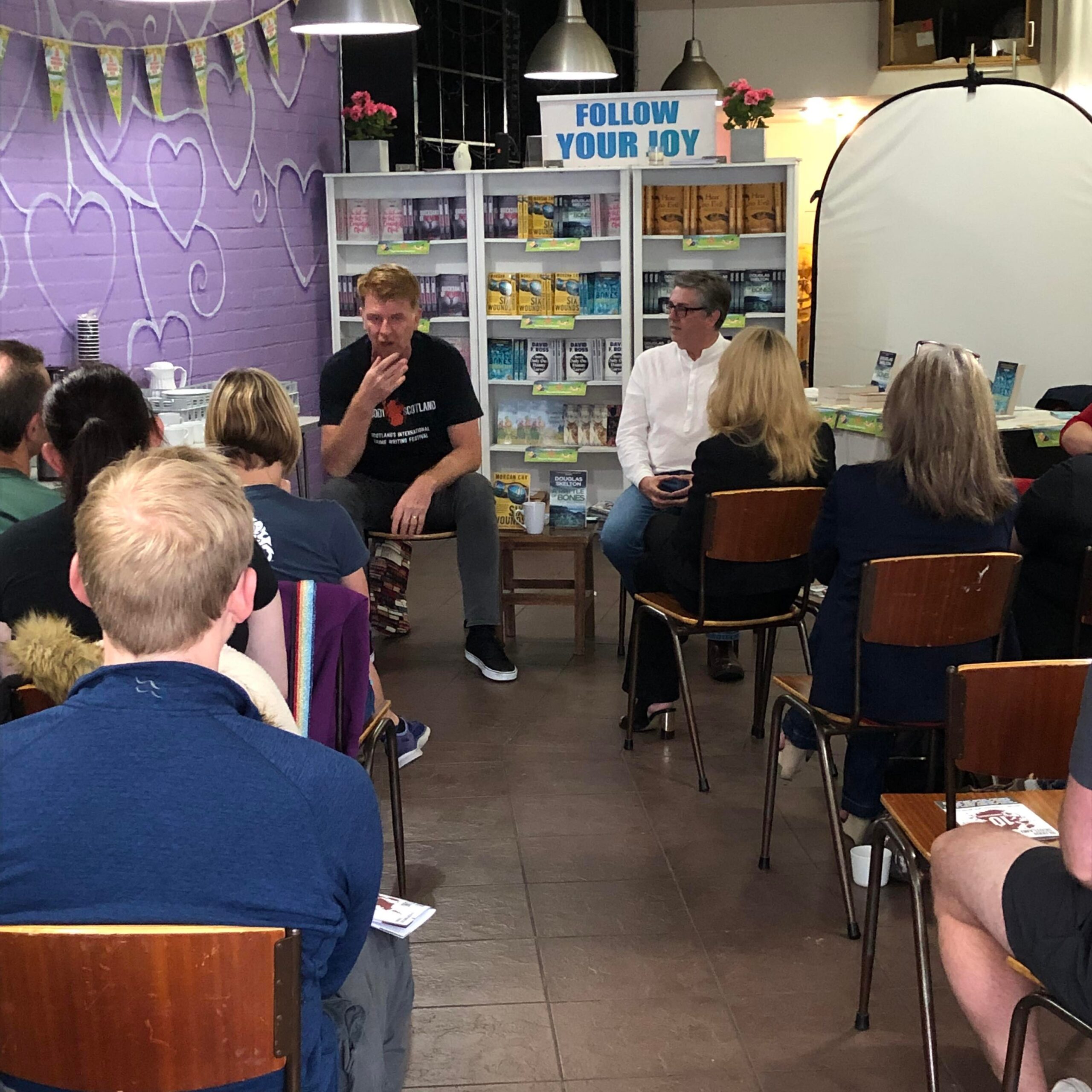
I had a busy year at festivals, appearing in Paisley, Aye Write, Bute, Stewarton, Bloody Scotland in Stirling, Grantown, even a stint hosting a table at one of the dinners in Harrogate. Not sure I’ll be as fortunate in 2023.

Author pal Gordon Brown and I teamed up for a double act to promote out new titles at a few venues, including Stewarton and Glasgow. It turned out to be a sort of Two Blokes in Search of a Plot. Or, given my advancing years, in search of a pot.

One of the best nights of my life, in the Book Nook, Stewarton, with Gordon Brown, who appears to be yawning. And I’m not even talking!

They were all fun and thank you to the bookstores and venues who hosted us.

Book Week Scotland was another busy period and I’m grateful for the libraries in Dundee, Motherwell, Musselburgh and Saltcoats for inviting me. I was crossing central Scotland like a bank robber on the lam.

That leaves the lows.

Ah, the lows.

Charles Dickens again, or maybe it was just Kermit the Frog – life is full of meetings and partings. I experienced both.

There’s a Hollywood adage for romantic comedies that breaks them down into the three-act structure of boy meets girl, boy loses girl, boy gets girl back. I’ve had the first two but the third is unlikely. Perhaps even impossible. But, as I said above, that’s life/other plans etc. I wish it wasn’t, but there we go.

Throwing myself with dramatic abandon into a slough of despond, I found myself once again grateful for my friends. They rallied round when my wife died three years ago and they did so again when this relationship died. I have some wonderful friends and if they read this – you know who you are, I won’t embarrass you – then I want them to know how much I appreciate them.

I also lost an old friend, who had been ill, on Christmas Day.

Stephen Wilkie was the most knowledgeable person regarding Scottish crime I have ever met. The consummate tabloid reporter, he was the guy I turned to whenever I needed to know something. If he didn’t know about it, it didn’t happen, simple as that. I often urged him to write a book but he never did.

I have many regrets in life. One of them is not being a better friend to him.

RIP, big guy. If there’s a news desk in the afterlife, I’ll lay odds you’re showing them how it’s done.

Stephen Wilkie, the big guy

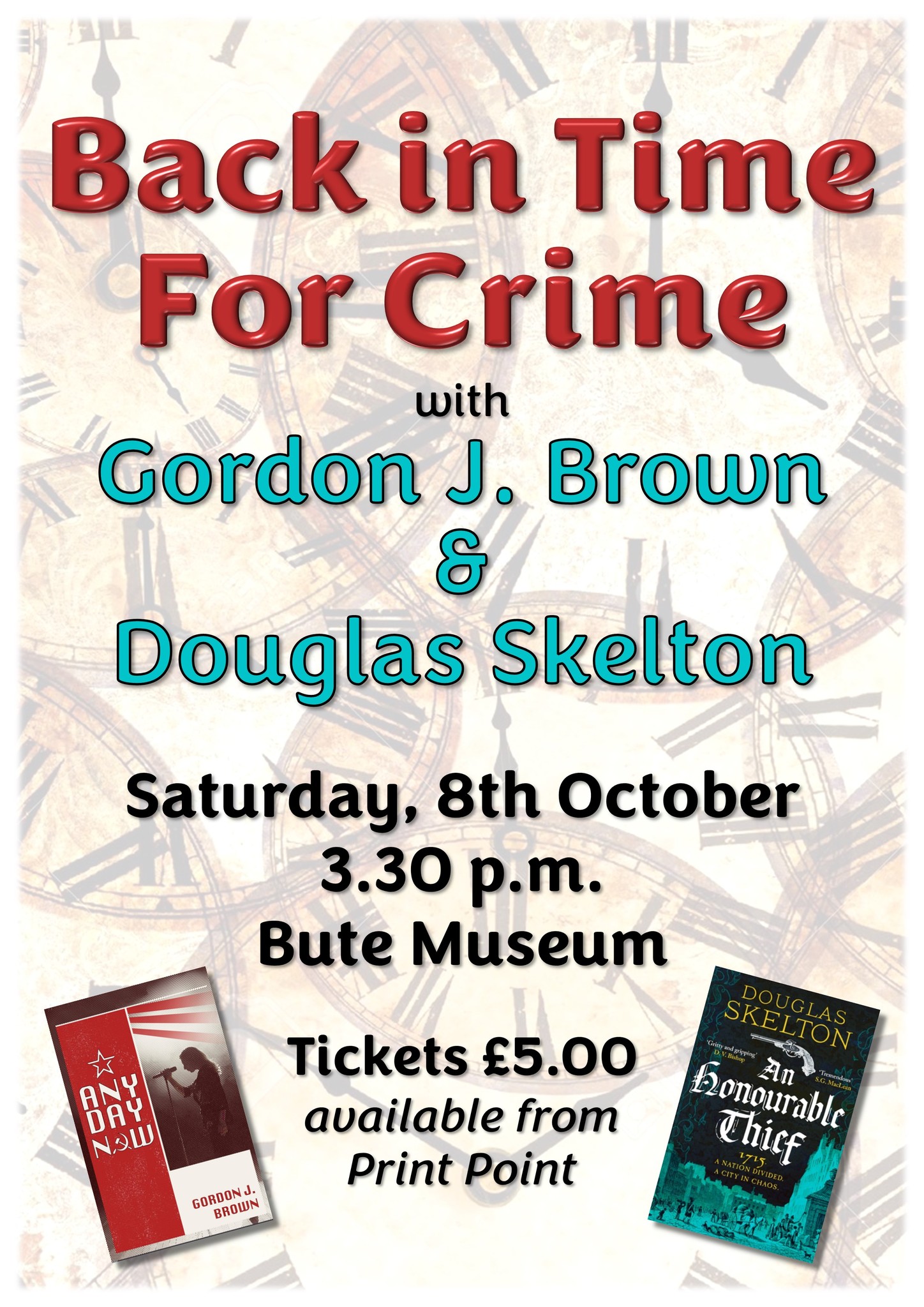
I’ll be beading back to Rothesay, on the lovely Isle of Bute, on Saturday October 8 in the company of pal and author Gordon Brown.

Ah well, you can’t have everything!

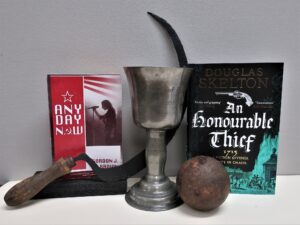
Gordon will be talking about his pacy new novel ANY DAY NOW, set in the 1980s, while I’ll be prattling about AN HONOURABLE THIEF, set in the 18th century.

If you’re on the island, or fancy a trip down the watter, then why not come see us?

Tickets cost £5 and are available from Print Point, the island’s superb bookshop, although the event will take place in the town’s museum. Which is fitting both for the subject matter of our books and because we are old.