All Passion Spent
Part two of my account of the true-life incident that inspired a set-piece section of AN HONOURABLE THIEF.
Following a disastrous reaction to an execution in Edinburgh during which rioters were fired upon and killed, Captain John Porteous of the City Guard was tried and found guilty. He was sentenced to death but news reached the people that Queen Caroline was disposed towards delaying execution, perhaps even commuting it. The Edinburgh mob, a potent force, was having none of it…
They came for him on the night of 7 September, 1736.
At first there was but few of them, men and women, but as they walked from the suburb of Portsburgh towards the West Port, the grave beat of a drum in the dark alerting like-minded folk, their numbers swelled. They took control of the West Port gate, nailing it shut and barricading it. Into the Cowgate then, bodies joining them from every side, and finally onto the High Street. A band of strongly-armed and determined men seized the Nether Bow Port in order to cut off any possibility of aid from the Welsh Fusiliers then stationed in the Canongate. The headquarters of the City-Guard was stormed and taken, the officers and men disarmed and isolated. The Guard’s muskets, cutlasses and their Lochaber Axes were plundered and distributed among the multitude.
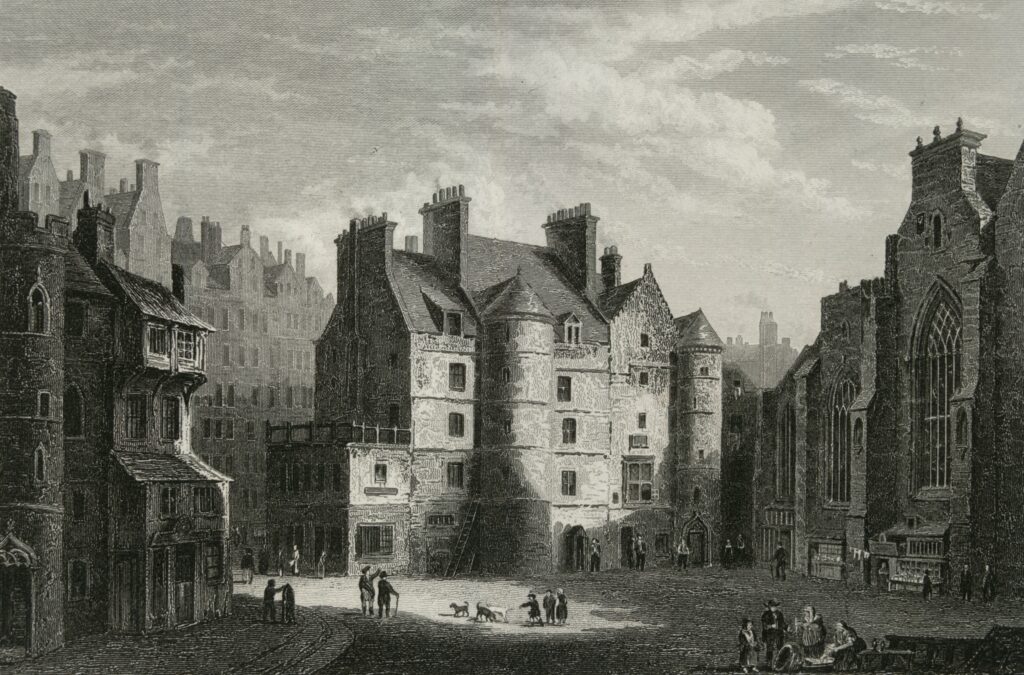
And then they turned their attention to the Tolbooth. They surged around the ancient building, flaming torches sending tall shadows dancing against its walls, the sound of their voices reaching the soldiers in the Castle, where the General refused a verbal plea to turn out his own Guard. Whatever his reasons for not interfering – procedural or personal – he took the wisest course. The mob was not to be diverted from its course that night and military interference would only have led to further bloodshed.
The door to the Tolbooth had been barred against them but that would not stop them. Sledgehammers were wielded against the wood and when they made little more than a dent, axes were swung to hack their way through. Finally, tar and brushwood were brought and the door set alight. When the flames weakened the thick wood, the crowd pushed it open and blazed through the portal, snatching the keys from the terrified turnkey. Into the stairway and up the stairs then, doors being thrown open and rooms searched, but their quarry was nowhere to be seen. The hapless Gudeman, the warden of the jail, was forced to divulge in which room Porteous was being held but it was, it seemed, empty. It appeared the mob’s efforts had been in vain until someone thought to peer up the chimney. The terrified Captain had crawled into the space as soon as he heard the din outside but an iron grate placed there to prevent prisoners from escaping had halted his upward progress. The desperate man screamed for mercy as he clung to the ironwork while the resolute band below hauled at his legs. But there was no mercy in that room that night. Some could recall the groans of the dead and wounded that day in April, some had perhaps suffered at Porteous’s own hands on other occasions. There was no mercy but a grim determination that their dark work would be carried through to its inescapable conclusion.
Finally, Porteous was dragged from the chimney. He would have known what fate was in store but did not know exactly where. There were men there, he knew, who would have done for him on the spot but their leaders had other notions. Perhaps hope rose in his breast then. Perhaps he thought the longer they kept from fulfilling their dread purpose, then the better were his chances of rescue by the authorities. Perhaps that slim hope sustained him through his final minutes.
The Captain was manhandled out of the Tolbooth and the procession turned towards the West Bow and the Grassmarket. The streets were clogged with people and many more watched from the tenement windows above, the whole scene lit by the fierce glow of countless torches. The flambeaux illuminated grim faces and the guttering flames glinted from the metal of blade and axe. Porteous could be heard praying as he descended the winding street. When he stumbled, he was caught and propelled onwards. At one point, a shoe came off a foot and he was halted in order for it to be retrieved and replaced. A shop was opened in the West Bow and its owner, a Mrs Jeffrey, was asked for a rope. When told it was to be used to hang Porteous, Mrs Jeffrey told them they were welcome to all she had. The men took what length they needed and left a guinea as payment.
They reached the Grassmarket but the gibbet had been taken away. Not to be discouraged from their intent, one end of the rope was thrown over a dyer’s pole on the south-east corner and the other wrapped around the neck of their proposed victim. They allowed him to pray. They permitted him to hand over what money he had on his person to a wealthy man nearby on the promise it would be delivered to his brother (some accounts say he gave his money to a debtor in the Tolbooth). Then he was hauled up by the neck. As he struggled on the rope, the executioners realised that they had not covered his face, so he was lowered again to the ground and his shirt pulled over his head to conceal the hideous grimace of death from the crowd. Then the men strained at the hemp and dragged him upwards again. Again he was let down as his freed hands feverishly fluttered at the rope biting into his neck. Some men came forward at this, tiring of the time the killing was taking, and struck at him, some trying to saw off his ears with the long Lochaber axes taken from the guardhouse. But they were pushed back and Porteous was a third time hoisted aloft, his body jerking as the life was throttled from his body. His legs flailed wildly, spasmodically, then slowed and finally stilled. His body swung slowly from the pole, the breath finally drained from it.
The cheer that greeted the expunging of life from the hated Captain reverberated round the Grassmarket, carried up the West Bow and reached the Castle. And then, with surprising swiftness, the borrowed weapons were thrown to the ground and the mob dispersed, melting into the night like wraiths. Only the discarded axes and muskets and, more tellingly, the body still gently swaying from the makeshift Dule tree, the rope creaking softly in the now silent night, showed that they had ever been there.
The city’s populace had not only killed Porteous, they had also shown a violent disregard for the Royal prerogative. It was known that Queen Caroline had a mind to pardon the Captain and the events of the 7 September 1736 showed that the mob had scant respect for her wishes. Sir Robert Walpole’s government took steps to punish someone – anyone- for the flagrant scorn the people had shown to their authority. The question was, who could they bring to justice? It was felt that this mob had a quality that others lacked and so it was believed that many men in high office had taken part in the events, some even dressed in women’s clothes. The guinea left for payment in the corder’s store is cited as proof that men of wealth were present, for the ordinary Edinburgh mob would not have that kind of cash to leave. One such nobleman rumoured to have taken part was the Earl of Haddington, dressed like a cook-maid. Rewards were offered in a bid to track down the ringleaders and a proclamation ordered to be read from every pulpit, but many ministers refused to do so. Arrests were made but the leaders were never found, underlining the claims that the conspiracy reached high into the upper echelons of society. Other theories laid the blame at the feet of Covenanters, criminal friends of Andrew Wilson and even Jacobite sympathisers who wished to overthrow the government.
One man arrested was William Maclauchlane, a footman to the Countess of Wemyss. He had been sent out earlier that day on an errand for his mistress. Having delivered his message, Maclauchlane then retired to John Lamb’s alehouse in Parliament Close where he enjoyed a few drinks and then, so much the worse for drink that he did not know where he was or what he was doing, joined the throng in the Grassmarket. He was implicated when witnesses identified his ‘showy livery’. His liking for drink saw him very narrowly miss being made the scapegoat for the shocking events that night.
However, according to Sir Daniel Wilson in his Memorials of Edinburgh in the Olden Time, the real mastermind behind the lynching was a baker’s apprentice named Alexander Richmond. He describes him as ‘a wild and daring lad, who took a prominent share in all the riotings of the period.’ His father was said to have deprived him of his clothes and locked him in his room on the night of the riot but the young man managed to escape, dressed in his sister’s clothes. He was in the vanguard of the attack on the Tolbooth and among the leaders as Porteous dangled on the dyer’s pole in the Grassmarket. When his name was mentioned after the hellish events, he ran off to sea and did not return for many years. While a successful merchant captain, he told a few of his closest friends his secret, one of whom passed it on to Sir Daniel many years later. Another mooted as being one of the leaders was journeyman carpenter James Maxwell.
Although no-one was directly punished for being part of the mob, the government’s ire did descend on the Lord Provost. He was arrested and jailed for three weeks before being freed on bail. Further moves against him – including preventing him from holding office anywhere in the country and imprisoning him for a year – were blocked by Scottish MPs in the Commons. They also managed to prevent the Government from demolishing the Netherbow Port and disbanding the City-Guard. Someone had to be punished, of course, and the city was ordered to pay £2000 to Mrs Porteous. In the end, the widow accepted £1500.
Two days after his death, Captain John Porteous was laid to rest in Greyfriars Kirkyard, for over two centuries marked by a small stone with the letter ‘P’ and the year 1736. In 1973, a headstone was placed there stating ‘John Porteous, a captain of the City Guard, murdered September 7, 1736. All Passion Spent.’