
I recently chaired in the Book Nook, Stewarton, author Craig Robertson whose new book ‘The Trials of Marjorie Crowe’ is a crime story that features accusations of witchcraft and a crazed witch hunt by social media. In chatting to Craig I recalled my brief account of the witch craze in Scotland, when thousands of innocent people were tortured and put to death on evidence that would be charitable to term spurious.

I’ve dug the material out from my unedited manuscript of DARK HEART (now out of print), my non-fiction account of the Edinburgh Tolbooth where many of those accused of witchcraft were held and suffered before execution.
The true tale behind this third and final part was referenced in my first Jonas Flynt novel, AN HONOURABLE THIEF, when Jonas is reflecting as he walks down the West Bow of Edinburgh.
Part 3
THEY were known as the Bowhead Saints, a group of tinsmiths who congregated in the old West Bow, an ancient thoroughfare that wound down from the Lawnmarket to the Grassmarket. It was through here that sovereigns and state visitors would enter the city and receive the loyalty of their subjects as they ascended to the High Street and on to Castle or Palace. The name remains still but the West Bow that was does not, having long since been bulldozed in the name of civic improvements. The artisans who lived there in the 16th and 17th Centuries were seen to be among the most Godly in the city, hence their nickname, although not all who took up lodgings worked the tin. One was Major Thomas Weir, a ferocious Presbyterian, who had lately been Captain of the City Guard.
Born near Carluke in Lanarkshire, Weir had fought for the Puritans in Ireland in 1641, one of 10,000 Scottish troops sent to assist Oliver’s army in the suppression of Roman Catholics. Weir then pledged his sword to the Scottish Covenanter forces when Montrose’s conscience forced him to turn against them. In 1649, he came to Edinburgh with his sister Jean, in some accounts named as Grissel, and lodged in the house of a Cowgate widow woman. It was here that he met James Mitchell, a Covenanter preacher, who would later achieve some renown for the attempted assassination of the hated Archbishop James Sharp (see chapter 10). Later, he moved into one of the tall lands on the West Bow.
In 1650, while Weir was in command of the City Guard, it fell upon him to watch over the Marquis of Montrose during his sojourn in the Tolbooth. Ordered by his Presbyterian superiors to make the prisoner’s life as uncomfortable as possible, the staunch soldier saw to it that the Marquis was tormented and verbally abused, personally calling him a ‘dog, athiest, traitor, apostate, excommunicate wretch’ as he was being led to the gallows. It was Weir who puffed vehemently on his pipe near to his charge, knowing well that the smell of tobacco turned his Lordship’s stomach.
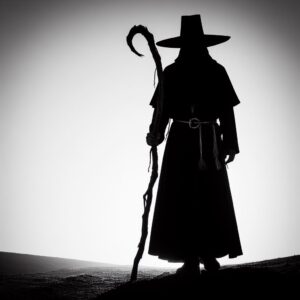
Tall in stature and dark in aspect, Weir possessed, it was noted at the time, ‘a grim countenance and a big nose’. It was also noted that he was never seen without his staff – a habit that would prove very damning in later years. It was a hefty instrument, with ‘a crooked head of thorn-wood’ and carved with the faces of Centaurs, an unusual adornment for such a sacred and sanctimonious man. He was a common sight on the streets, this towering, stern-faced soldier in a high black hat and flowing black cloak, the tap of his trusty rod echoing down the caverns of stone and wood that formed the Edinburgh streets. Weir was recognised as being a particularly devout man, even in those days when piety was commonplace. They said that he was so pious, that if four Presbyterians met together, it was certain he would be one. He had a prodigious memory for Scripture and could quote passages at will. He was no preacher but he could pray with such passion that people travelled forty or fifty miles just to join in. ‘Those who heard him pray,’ the contemporary account went on, ‘(admired) his flood in prayer, his ready extemporary expression, his heavenly gesture; so that he was thought more angel than man, and was termed by some of the holy sisters ordinarily Angelical Thomas.’ As he prayed, he always had his heavy dark staff in his hands and as he listened to others sermonise, he rested his gaunt face on it. As is so often the case, that angelic exterior hid a black heart.
In 1670, during a prayer meeting, the sainted Major stunned his ‘congregation’ with a confession of sins of which the Marquis de Sade would have been proud. What prompted this sudden outpouring of sexual adventures is not known – senility cannot be ruled out, for he was over 70 by this time – but the litany of lust was impressive. He had conducted an incestuous relationship with his sister for nigh on forty years, he told them. He had been fornicating with his servant for over twenty years. He had once been married and had abused his stepdaughter. There were other women with whom he had enjoyed sex, not to mention animals. There was more, he said, a lot more. ‘Before God, I have not told you the hundred part of what I can say more, and am guilty of.’
The Saints were appalled by the nature and extent of their most revered member’s crimes but conspired to cover the whole affair up. No doubt, a few of them had some sins of their own and undermining their piety by making public these crimes would do no-one any good. They managed to keep a lid on the matter for some months, before one of them could not contain himself any longer and felt the need to unburden his soul. He took the information to Sir Andrew Ramsey, the Provost of Edinburgh, who was equally as amazed by the revelations but was compelled to take some sort of action. At first, and no doubt accurately, he felt the cause of the good Major’s spiritual stripping down was due to some medical complaint. A variety of doctors were sent to study Weir, for the Provost believed that ‘humane nature was uncapable of such horrid crimes’ and so charged them to ‘Physick him for his distempered brain.’ The physicians, though, declared the patient as being ‘free from Hyppocondriak Distempers’ and that his ‘intellectuals’ were sound. So, with no diseases of mind or body being divined, it was decided that the Major was suffering from an ‘exulcerated conscience’ that could only be salved by facing the wrath of Scottish justice, something the man himself desired with ‘cryings and roarings.’ Charles II was at that time trying to bring the Presbyterians to heel – and revelations of the baser nature of one of their number would do nothing to hinder the King’s cause. A desire to curry favour may well have played a part in zeal with which the authorities moved against the clearly unhinged Major and his sister. However, they could not have predicted the dark turns events would take.
The scandal now the talk of the town – and with no exculpatory medical evidence to fall back on – they came under the cloak of night to arrest him. When they arrived, his sister counselled them to take possession of his black rod, for it had been given to him by the Devil – and if her brother got a hand to it, they would regret it. The good Major was not only a fornicating sinner, he was also in league with Satan.
Major Weir found himself back in the old Tolbooth, only this time on the other side of the cell door. His sister was also arrested and imprisoned. The Major’s staff was locked away but word spread through the streets that an arch-wizard was residing in the Town Gaol. Ministers visited him to divine the nature of his crimes and his contact with the Dark One. Weir did not claim to have seen the Griffin-clawed Devil of North Berwick but he did admit to having felt his presence in the night and that once he had appeared in the shape of a beautiful woman. In addition, he no longer recognised the difference between Presbyterianism and Episcopalianism. ‘Sir, you are now all alike to me,’ he told the no doubt appalled clergymen.
Details of his past sins began to emerge. Years before, in Lanarkshire, a young woman had claimed to have witnessed him having sex with an animal in a field. She was not believed and was even whipped by the hangman for slandering ‘such an eminent Holy Man.’ A report of the Major forcing his way into the bedchamber of another woman came to light, although nothing sexual took place. His sister revealed that the first time he had sexual knowledge of her was in Fife, between Kirkcaldy and Kinghorn, when she was 16. A visitor to the spot said that no grass had grown there since. The abuse continued until she was 50 years of age, when he lost interest in her ageing flesh. Thankfully, despite the 24 years of incestuous coupling, she had never fallen with child. According to the sister, this was achieved by ‘means abominate’. Interrogators wanted to know details but the ministers among them refused to allow any further questioning on that subject.
The clergy seemed more interested in the devilish side to the case. During his time in command of the City Guard it was recalled that he took fright at the mention of the name ‘Burns’ – and hesitated from crossing running water, something that held great terror to those in league with Satan. Whether Weir’s fear of ‘Burns’ was because it is the Scottish name for a stream or a presentiment of his ultimate fate is unclear. In jail, he turned from the Ministers sent to help him reject the Devil and all his works. ‘Trouble me no more with your beseeching me to repent, ‘ he told them, ‘for I know my sentence of damnation is already sealed in heaven.’ When they persisted, he cried out, ‘I find nothing within me but blackness and darkness, brimstone and burning to the bottom of hell.’. Still he refused to repent, saying that since he was to go to the Devil, he would not anger him. One minister refused to give up, saying, ‘Sir, I will pray for you in spite of your teeth and the devil your master, too.’
His sister told them that their mother was a witch and bore the Devil’s Mark on her forehead – a little horseshoe that appeared when she frowned. She also carried the mark and was eventually allowed to show it. She had found a similar mark on her brother’s back a few years before. She told her interrogators how they visited Dalkeith in a chariot of fire invisible to others – and how a stranger gave her a root that enabled her to spin huge amounts of yarn in a very short space of time. Even when she was not in the house, the yarn would be spun, although no weaver could make anything of it.

The case against the Weirs was an easy one to make, for both admitted their crimes, although they were found guilty of the more physical transgressions rather than the metaphysical. The Major was to be burned at the stake. The spot chosen for his death was on the Gallowlee, on what is now Leith Walk on the site of the parish church of Greenside. Two days after his trial, on 11 April, 1670, he was taken from the Tolbooth and placed on a sled to be transported to the execution site, he being deemed too old and infirm to walk the distance. The hangman led the horse and the people lined the streets to watch the old Devil pass by. At the Gallowlee, he was tied to the stake, a rope around his neck with which he would be ‘wirreit’. Even then the ministers were concerned for his soul, for they pleaded with him to say ‘Lord, be merciful to me.’ But still Weir refused. ‘Let me alone, I will not,’ he snapped. ‘I have lived as a beast and I must die a beast.’ The executioner either botched the strangulation or took Major Weir at his word, for the old man was burned alive. His staff, carried carefully from the Tolbooth, was thrown into the fire with him and was said to twist and writhe in the flames with its owner.
Jean was told of her brother’s death in her Tolbooth cell while she waited for her own date with the Devil. She asked of the fate of the staff and when told it had burned, she ‘in a furious rage fell on her knees, uttering words horrible to be remembered.’ She was due to die the following day on the Grassmarket, a simple hanging for her, but she vowed that she would do so ‘with all the shame that she could.’ She was as good as her word, for on the gallows she tried to strip. A witness reported, ‘On the scaffold she cast away hir mantell, hir gown tayle, and she was purposed to cast of all her cloaths before the multitude.’ Naturally, the authorities could not countenance such an unseemly display of immodesty and Baillie Oliphant stepped forward to prevent her from removing anything further, telling the hangman to ‘doe his office.’ As the executioner tried to ‘throw her ovir the leather (ladder), she smote (him) on the cheike; and her hands not being tyed when she was throwen ovir, she labored to recover herself, and put her head betwixt two of the steps of the leather, and keiped that powster for atyme, till she was put from itt.’
And so died the diabolical Weirs of the West Bow. However, Edinburgh had not heard the last of them. For generations after their deaths tales were told of the sound of Jean’s satanic wheel spinning through the midnight hour and of the Major himself galloping from his old home on a headless horse in a ‘whirlwind of flame.’ Brother and sister were also said to be seen on dark nights in a fiery coach pulled by six black horses and at the reins was the ‘muckle Deil himsel’. They were borne off in this chariot of the damned amid a clatter of hooves and the snap of Satan’s whip. And then there was the Major’s black rod, still heard tapping in the streets and taking on a life of its own in the popular imagination.
There were other tales told and they were taken so seriously that the house on the West Bow was not occupied until long after the Major and his sister were gone. However, the new tenants did not bide for any length of time, being forced out by bumps in the night and occult manifestations. It was used as a brazier’s shop and a storehouse until in 1878 it was demolished.
The tales of Major Weir were told to Sir Walter Scott, who said in 1798, ‘If I were ever to become a writer of romances, I think I would choose Major Weir, if not for my hero, at least for an agent, and a leading one, in my production.’ Scott obviously did become a writer of romances but never wrote about Weir. Robert Louis Stevenson was also fascinated by the tale. His abiding obsession with the darker resources of Man’s soul has been well-documented and he learned the legends of Major Weir from his father, who had himself heard them as ghost stories in the nursery. Stevenson described Weir as ‘the outcome and fine flower of dark and vehement religion,’ and went on to say that ‘Old Edinburgh cannot clear itself of his unholy memory.’ Eventually, the man who was Scotland’s finest writer used the story as the part of the inspiration for the double life of Dr Jekyll and Mister Hyde. There was another Edinburgh worthy who also can claim the credit for inspiring that famed tale and he also spent his final days in the Tolbooth.
But of Deacon William Brodie perhaps we shall hear later.