
IT was during the 4th Century that Regulus, or St Rule, first came to these shores. He, of course, became the patron saint of measuring things.
They say he was accompanied by eight hermits, three virgins, two deacons, a priest and a partridge in a pear tree.
He had left the Greek town of Patras a considerable time before, having had a dream that told him to travel far to the west where God would give him some sort of sign.
He took with him what might today seem like a curious cargo, basically a casket containing a bone from an arm, three fingers of a right hand, a tooth and a kneecap. These were all genuine, authenticated and bona fide relics of St Andrew, the apostle who had been martyred in Patras by being crucified to an X-shaped cross. St Rule really didn’t want to them to disappear into Byzantium so he had liberated them from the tomb in Constantinople, which is present-day Istanbul as all clever people and fans of They Might Be Giants know full well.
He and his party did not know where they were going exactly until God gave them a sign – a fierce storm that wrecked their ship and cast them onto a bay in the East Neuk of Fife.
They were met on the beach by the local Pictish King.
“We come in peace,” said St Rule, in his own language, holding up Andrew’s bones before adding, “He comes in pieces.”
The King looked at his own holy man and asked, in Pictish, “What did he say?”
“Don’t know,” said the advisor, “It’s all Greek to me. Let’s kill them.”
“Sounds like a plan,” replied the king and ordered his men to attack. But before they could heft their first spear, a white X appeared in the blue sky and stopped them. This was a sign from heaven and the king decided it was a good time to convert to Christianity.
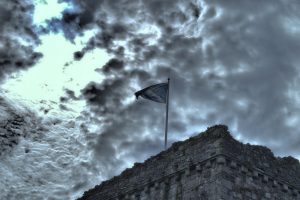
And that was how St Andrew became Scotland’s Patron Saint – and how Scotland took the white cross on the blue background as its flag.
Well, at least according to Fifers, who snort in derision at the story of the battle of Aethelstaneford in East Lothian.

The Saltire monument at Athelstaneford, East Lothian

According to legend, the Saxon monarch Aethelstane fought with a combined Pict/Scots force under Kings Hungus and Achaius. Hungus was a big lad and gave his name to a declaration of extreme manliness, as in Hungus like a horse (some sources say the name was Aengus but I can’t think of a joke for that).
Meanwhile, Achaius gave his name to what happens when you rode that horse bareback for too long.
Before the battle, as was the custom, the home side prayed to God to give them the power to slaughter their foes.
To show them he was behind them all the way, God sent a sign – very partial to signs is the Big Person (notice how PC I was there?) – a giant white X against a blue sky.
Locals insist it became the symbol of Scotland there and then – and get it roon ye, Fifers – and as such is said to be the oldest of three flags incorporated into the Union flag.
All this, by the way, supposedly took place at Athelstaneford, which was kind of convenient. I mean, what are the odds of the invading king having almost the same name as the site of the battle?