
My route through the Borders took me across a number of small bridges. Frankly, I’ve not seen so many hump-backs since the Ygor Convention of ’98, which will never been repeated. Don’t ask me, why – just a hunch.
However, the pastoral scene was such that I felt seriously guilty about travelling by car. I should have been in a horse drawn cart, which strikes me as being a far more civilised mode of travel, the only emissions being natural and good for the roses. In places the road seems almost part of the surrounding farmland and sheep had the unnerving habit of wandering across in the front of you and treating you with a look heavy with disdain. I waved a jar of mint sauce at them. That taught them.
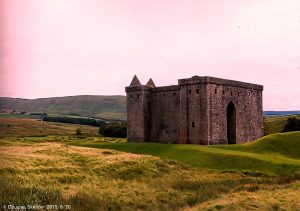
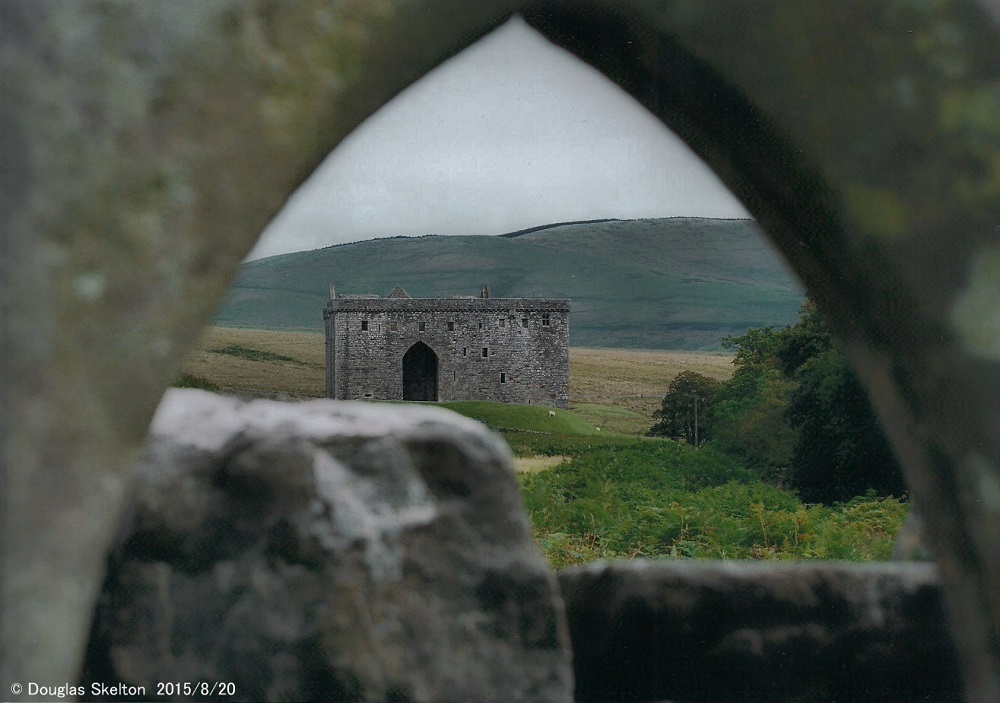
Then I had my first glimpse of Hermitage Castle, dark and gloomy against the surrounding moorland. It was a dull day but I had the feeling that even the brightest sun would fail to lighten those forbidding grey stones glaring at the land with silent aggression. The building seems to grow directly from the harsh land and it is said these walls have sunk partly into the earth, weighed down by the burden of centuries of evil.
Imagine a crack of thunder here. Maybe some demonic laughter.
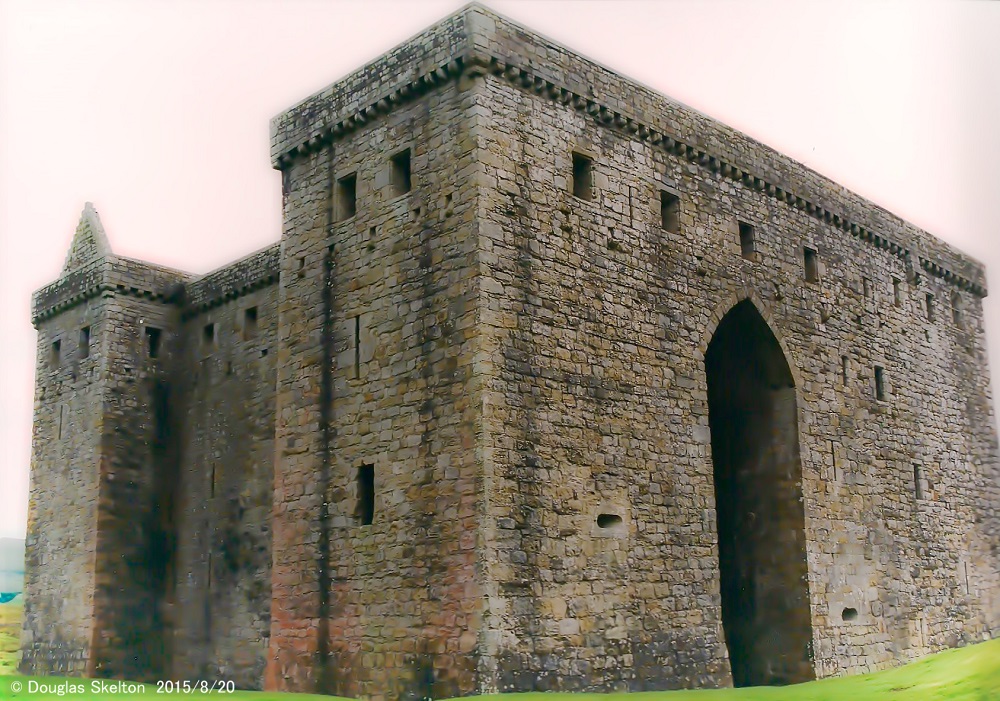
They say an old monk lived in this bleak valley, hence the Hermitage tag, but that was long before the castle that became known as “the guardhouse of the bloodiest valley in Britain”. There was an earlier wooden construction, built by the medieval firm of Motte and Bailey, but the borderlands were fiery in nature so a timber castle was unlikely to withstand an attacking force looking to bake their potatoes in a big way.
The original castle was built by Sir Nicholas de Soules, who was one of the claimants to the Scottish throne after the death of Alexander the Third. He didn’t succeed, naturally, which is just as well because King Nicholas just doesn’t sound, well, regal.
However, it’s his son, William, we begin with, for he was known as Bad Lord Soules. And bad he was, local lore tells us. Bad to the bone, as George Thorogood tells us.
It seems William was a practitioner of the Black Arts, reputedly having been initiated by Michael Scot, a name forgotten now but notorious in his day.
De Soules was a cruel and murderous master who dealt with his tenants as he did his enemies, swiftly and violently. According to local myth, he used local peasants as two-legged oxen, boring holes into their shoulders so that he could yoke them to carts and have them drag him around his lands. I won’t even begin to describe his recipe for Ox Tail Soup. Let’s just say it didn’t involve tails and the thought of it makes me cross my legs.
His best pal was Redcap, a particularly fearsome demon with a penchant for attacking travellers as they passed the castle in the night. He played with his victims like a cat before killing them, catching their blood in his hat, presumably because he liked the sensation of other people’s blood going to his head. He was described as being a somewhat grotesque individual with long, prominent teeth and sharp talons for hands. He went through mittens like nobody’s business. However, would-be victims could ward him off by invoking Christ’s name, when he would dart off like a firework but always leaving behind one of his teeth. No-one was tempted to leave it under their pillow to see what the fairies brought them.
Bad Lord Soules could not be killed by sword or gallows as long as he had Redcap as a familiar. When danger loomed, all the nobleman had to do was run to an old chest he kept in the bowels of the castle and, to paraphrase the 70s hit, knock three times on the lid. When the demon appeared, De Soules could not look at him – Redcap was far from the answer to a maiden’s prayer, after all. But that wasn’t all, for if De Soules was tempted to have a quick peek at his buddy’s visage, then his end would be nigh. Maybe De Soules had a quick squint at Redcap before he invited the Cout of Kielder to dinner.
The Cout was a giant of a man who lived across the border – there is still an area in Northumberland called Kielder – and he and De Soules were mortal enemies. De Soules invited the man to Hermitage for some nosebag.
“Come to Hermitage for some nosebag, Cout,” he said.
“What did you call me?”
“Cout.”
“Ah, okay – the line on this ye olde telephone isn’t the best. Can I bring anything?”
“Just yourself.”
“Just the job.”
The Cout’s wife begged her husband not to go for she knew De Soules was not the sort of man to invite neighbours to try out his new fondue set. But the Cout would not be there alone – he had his men with him – and anyway, he believed his magical suit of armour, which meant no sword could kill him, would be enough to protect him. Anyway, de Soules wanted to bury the hatchet. The problem was – where did he want to bury it?
De Soules did not even wait for the sticky toffee pudding to be served before he turned nasty, giving his men a sign to attack the guests. Most of them were killed at the table, but the giant Cout was too fast. Running along the tables, he slashed and hacked his way out of the room like Errol Flynn leaving Sherwood Castle. Once outside he tried to leap across Hermitage Water, which helped form part of the moat around the castle, but he fell into the deepest part. At this moment a pair of water wings would’ve been preferably to his chain mail, for he drowned. Mind you, he might’ve made it across if De Soules and his men hadn’t helpfully pushed him under the water with spears
The Cout’s body was later buried near to the chapel ground at the castle, marked by two stones, one at the head and one at the feet. I’ve seen the grave. He WAS a big lad.
The murder proved to be the last straw for the people of Liddesdale. They approached Robert the Bruce, then king, and asked him what they should do about the Lord Soules’ depredations. It was not the first time the King had heard complaints about this border baron and he had his own problems with the English so he told them, “Hang him, boil him, do anything you like with him but for heaven’s sake let me hear no more about him.”
“Right you are, your kingship,” they said.
Before he could change his mind, the villagers hit the castle like torch-wielding extras in a Frankenstein movie. They invited De Soulis to the old stone circle at Nine Stane Rig nearby. Well, when I say invited there was some rough language as well as clubs, swords and chains. Once there, master-magician Thomas the Rhymer, also known as Thomas or Ercildoune, bound Soules in ropes of sand – bear with me, this is magic – and then they pitched him into a boiling cauldron of molten lead. That was the end of Bad Lord Soules, but Redcap sloped off to bleed more people dry. He may have become a banker.
It is a nice grisly story with the villain receiving an end both painful and poetic. The fact that William De Soules actually died in a dark, dank dungeon on Dumbarton Rock after plotting to remove the crown from the Bruce’s head to place it on his own is neither here nor there. His lands were forfeited to the Crown and then came into the possession of the Douglas Clan, who perpetrated new horrors at Hermitage.
Eighteen years after the death of Bad Lord Soules, Sir William Douglas, irked that he had not been made Sheriff of the area, imprisoned Sir Alexander Ramsay – who HAD been made Sheriff of the area – and starved him to death in the castle’s prison. Sir William was later murdered in the Ettrick Forest by his godson because he had pledged his support to the English.
Eventually it fell into the possession of the Bothwell Earls. It was here that the argumentative James Hepburn, Mary Queen of Scots’ fancy bit, was brought after a fateful fight with a local rival. Bothwell had made it one of his missions in life – along with helping plot the murder of Mary’s husband Darnley and getting the Queen into bed to polish his crown jewels – to capture as many of the Elliot clan as he could. He set out to snare Little Jock Elliot, so called because his name was John and, presumably, he was vertically challenged. Slight of stature he may have been but he was big on ‘come ahead of you think you’re hard enough’ so he agreed to a bit of man-to-man combat to settle the issue. Bothwell didn’t play fair, the cad, and dropped Elliot from his saddle with a well-aimed pistol shot, then decided to move closer to finish the wee man off. But Elliot wasn’t dead yet and he stabbed Bothwell three times before finally giving up the ghost.
Bothwell was taken back to Hermitage to recuperate and Mary visited him here to give him a quick ‘there, there’, maybe a little bit more if his wounds permitted. On her way home she fell into a marsh and caught a nasty cold – and two newts.
Hermitage has a prison tower, furnished only with a small toilet and an even smaller window. When thrown in here for whatever reason – non-payment of rents, murder, theft or the playing of Kanye West songs – you would find yourself with no light to speak of, and no fresh water. On the upside you did have all the cockroaches you could kill. Meanwhile above were two floors of private rooms reserved for more noble prisoners. They had heat, they had light and they had food that didn’t wriggle about when you squirted on the ketchup.