News of the horrific discovery pulsed through the neighbourhood as swiftly as it took the police to respond. Even as detectives converged on the locus and as members of Glasgow police’s scientific bureau studied it for clues, locals began to gather at either end of the lane.
Around 1,000, grim-faced ordinary people strained and jostled to see past the police cordon, fearful for the safety of their own children and angry that such a thing could happen in their neighbourhood.
As time passed, the faces changed but the sentiments remained the same. They stood in the chilly autumn rain, watching and waiting, each fragment of news gleaned from a talkative police officer passed backwards among the throng, like a stick floating out to sea on the tide. Uniformed officers also stood guard over the huge iron gate at the end of a passageway leading from Milton Free Church in West Graham Street into the courtyard. The public gathered there, too.
A 69-year-old man who lived closest to the murder scene told reporters that he knew Betty Alexander and had heard no screams or any noises in the lane.
‘I’m often about the lane quite late at night,’ he was reported as saying. ‘It’s not very well lighted but I’ve seen or heard nothing in the last three nights. I saw Betty myself at about five p.m. on the night she went missing. She was playing with my granddaughter.’
James Alexander, the girl’s father, his face pale with anxiety, his eyes ringed by deep darkness, was called to the dispensary to identify his daughter’s body.
Later, the man, who worked in Glasgow’s meat market, offered everything he owned to anyone who could help find his daughter’s killer. But everything he owned was not enough.
The hunt begins
It was the most intensive inquiry the city had ever seen. The death of such a young child, according to police spokesmen the first of its type in Glasgow for 30 years, had horrified the city.
Police officers were drafted in from other divisions to form an initial team of 2,000 uniformed officers and 120 detectives. Members of the scientific bureau went over the locus with a fine toothcomb, searching for clues which could lead them to the killer. The wrought-iron gate was taken down from its hinges and taken away to headquarters for examination, as was the wooden gate leading to the lane.
In those days, fingerprints were not lifted at the scene of the crime but photographed at the locus, since it was believed, wrongly, that lifting them – generally by dusting them and removing them using adhesive tape – could destroy any possible evidential value. On occasion, as in this case, the source of the latent print would be taken to the laboratory.
Eventually, that wooden gate would yield the only real clue in the case.
The girl’s clothes were taken away to be thoroughly scrutinised for any traces of the killer. Fragments of the stone steps on which she lay were also removed for study.
A police Alsatian named Skipper was borrowed from the Renfrewshire force. The dog was given some of the child’s clothes not being subjected to forensic examination before being sent off to trace her scent. But Skipper’s eager nose was unable to pick up a trail and this particular line of inquiry was closed.
Detectives leading the hunt believed the killer may well have been local. They felt that only a local person would have known the yard was safe from the prying eyes of others. But they could not be sure.
At the same time, they were aware that rumours were sweeping the streets of the area with the steady rain and they knew it would only take one small incident to tip the locals over the edge.
‘There is no particular man being sought,’ said Chief Superintendent Mcllwrick, pointedly, trying to defuse the atmosphere of fear and suspicion. ‘In fact, we cannot even be certain at the moment that it was a man. No possibility is being overlooked.’
But the press was already certain that the killer was male. That assumption would later be confirmed by police when it was announced that the girl had been suffocated and ‘criminally assaulted’. Newspapers said her body had been ‘outraged’. We call it sexually assaulted.
Creating a timetable
Meanwhile, the area was flooded with officers conducting door-to-door inquiries. Vast numbers of people offered to give voluntary statements.
Slowly, the police built a timetable of the girl’s movements up to about seven pm on the Tuesday night. A dozen youngsters, accompanied by their parents, were asked to attend Northern Division headquarters in Maitland Street to help detectives build up a fairly accurate picture of the girl’s movements. But the trail ended with a sighting in Rose Street. There was a gap of around an hour from her last sighting to eight pm when Betty’s mother heard the pitiful cries of ‘Mummy, Mummy’ in the lane. Three other young girls had also heard the voice, and they were certain it was Betty’s.
Part of Garnethill was at that time the city’s bedsit land, populated by a constantly changing stream of transients, drifters, salesmen and seasonal workers, which made inquiries difficult. Even today it is home to a number of guest-houses. The police managed to speak to most of the people on the owners’ books but some of them proved elusive, thus hampering investigations. However, by Monday 13 October police officers had spoken to almost 4,000 people in connection with the murder. These statements would be checked and rechecked by detectives who were growing more desperate for something which would lead them to the murderer. Each line was carefully scrutinised in the hope that one would yield up even the tiniest clue. They even contacted mental institutions around the city to see if any patients had been released or escaped.
Meanwhile, detectives searched the caretaker’s house, the only house overlooking the courtyard. It had been empty for six weeks and the searchers found nothing of any value there. However, the fact that the caretaker and his family had left the house long before the murder was not enough for the rumour-mongers. Both he and the elderly man who lived nearby were subjected to a barrage of accusations and vicious rumour. The hate campaign became so intensive that they were eventually forced to report it to the police, who issued a stern reminder to the public that these men were not under suspicion.
A city mourns
Betty Alexander was buried in Cadder cemetery to the north of the city on Monday 13 October. The service itself, led by three clergymen, was held in her home and the cortege was due to move solemnly through the streets to the cemetery. As the little white coffin was carried from the closemouth by James Alexander and three male relatives, two senior policemen in uniform standing on the pavement came to attention and saluted.
Over 5,000 people stood silently in the streets to watch the procession go past, bringing traffic to a standstill. Many of them were from other parts of the city, for the death of the little girl had touched all of Glasgow. Some of them had gathered there four hours before the mourners were due to leave the house. They lined the route, four or five deep, waiting in the gentle rain for the procession to pass. They were mostly women, many dabbing their eyes with handkerchiefs, two fainting and having to be carried away by police officers.
And then there were the children, saying their last farewell to their friend. But there were a few men also, their hats doffed, their faces stiff as they struggled against the emotion of the moment.
A handful of family and friends clustered round the graveside as the coffin was lowered into the ground. There were more than 50 wreaths, bouquets of flowers and memorial vases from people all over Glasgow on the ground beside them. There was also a floral cross, made up of chrysanthemums and anemones, bearing the card: ‘To Bunkum – our dear wee Betty, from Daddy and Mummy’.
It was during the funeral that the crowd turned into a mob. There had already been signs of their feelings when a new rumour sprinted around the streets that a man had been arrested and was being held in Maitland Street. It was not true – when a crowd becomes a mob the truth is immaterial – and officers had to disperse them.
But then, as the funeral procession made its way to Cadder, a woman tried to abduct a young boy and the crowd’s anger grew to fever pitch.
The 15-month-old boy had been picked up and carried away from the door of a shop where his mother was shopping. An aunt of the youngster saw the woman with the boy and challenged her. She wrestled the child from the woman’s grasp and the police were called.
News of what the woman had attempted was soon communicated to the crowd who had earlier watched the small coffin go by on its way north. Luckily, the police reached the woman before they did, but this did not stop them from surrounding the police van with cries of ‘lynch her’.
Finally, the van managed to push its way through the mob and the woman was later charged with plagium, or child-stealing.
Making criminal history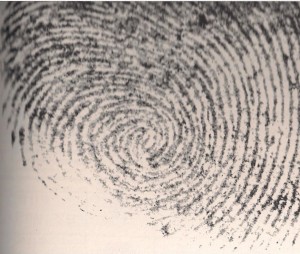

Then came news of a twist in the hunt, a twist then quite unique in Scottish law.
Experts had found a latent fingerprint on the wooden door taken from Buccleuch Lane. Although police believed that the killer had entered the courtyard via the passageway from West Graham Street, he must obviously at one point have touched the door. It was, however, only a partial print, which is difficult to match at the best of times. Police records were checked to find such a match but the owner of the prints was obviously not a known criminal. Clearly, other steps had to be taken. The print, after all, was the only real clue they had apart from vague sightings.
So, on Tuesday 14 October, the police made their dramatic announcement: every male over 17 years of age in the area was going to be asked to agree to be fingerprinted in a bid to trace the killer.
‘We are investigating the possibility of trying to connect up part of a fingerprint which had been found in the vicinity of where the body was found,’ said Chief Superintendent Gilbert Mcllwrick of Northern CID. ‘With that end in view we are asking for the co-operation of all males in the vicinity in letting their fingerprints be taken.’
This was the first time in Scotland that such a move had been taken, although the use of fingerprints in criminal identification and detection was, of course, not new.
An earlier case
It was not, however, the first exercise in mass fingerprinting to be undertaken in Britain.
Early on the morning of Saturday 15 May, 1948, young June Anne Devaney was removed from the children’s ward of Blackburn’s Queen’s Park hospital. Her empty cot was discovered by the duty nurse making her rounds and the child was found 300 yards from the hospital, sexually assaulted and battered to death.
But the killer made the mistake of moving a bottle before he lifted the child from the cot and detectives were able to lift a number of sets of fingerprints from it. The police traced and eliminated not only present staff but also anyone who may have been in the ward over the previous two years. Within one month of the murder they had made 642 fingerprint tests, eliminating all but one set of prints – without a doubt the killer’s.
To catch him, the investigating officers decided to take fingerprint samples from every male in the Blackburn area. It was a task then unprecedented in Britain and about 46,500 prints were taken. Some 200 men had been missed in the first mammoth task and so police had to cross reference their records with the release of ration books to the area.
Three months after the murder of Anne Devaney, a match was found, that of Peter Griffiths who apparently said to officers when being arrested: ‘I hope I get what I deserve.’ He was found guilty of murder and hanged. After that, all the fingerprints gathered during the inquiry were publicly destroyed.
The same assurance that all records would be destroyed was made by Glasgow’s Chief Constable Malcolm McCulloch in the Betty Alexander case. His statement, sent to men in the area and also reprinted in the press, read as follows:
To assist in the investigation of the crime, the Chief Constable appeals to you as a male of 17 years of age or over to allow your fingerprints to be taken. It is to be clearly understood that you may refuse to have your fingerprints taken, but nevertheless the Chief Constable hopes that he will have your full co-operation and gives you an undertaking that these fingerprints will only be used in connection with this inquiry and will be destroyed as soon as they have served their purpose.
By the following day, over 800 sets of fingerprints had been taken, and specially detailed officers began the laborious task of comparing them with the partial print found on the gate.
No match would be found, even though fingerprint cards continued to flood in.
Meanwhile, the case had attracted the usual amount of attention from the city’s cranks.
Early on the morning of Thursday 16 October, distinctive black police cars converged on a telephone box at the junction of Peat Road and Cowglen Road on the south side of the city. A man had phoned police confessing to the murder. The man was detained and taken to police headquarters where he was questioned personally by Chief Superintendent Mcllwrick. But, as usual, it proved to be a false alarm.
‘I do not think this man has any real connection with the murder,’ said the detective, ‘but of course we must question him in the hope that he might be able to help the investigation.’
But the man did not help the investigation, it seems. However, that night, the people of Garnethill noticed a flurry of police activity. Several persons were asked to call into Maitland Street police station to answer questions. But all the officers in charge of the case would say was that they were following a ‘definite line of inquiry’.
The activity included visits to the police office by the chief constable, two assistant chief constables, the procurator fiscal for Glasgow, Mr Robert MacDonald, and his deputy. Professor John Glaister, the pathologist who had conducted the post-mortem, was also seen to enter the police office.
The mob returns
Earlier that day, police had called at a house in Buccleuch Lane not far from where the girl had been found. Members of the scientific bureau had searched both that house and a cellar next door, leaving with a number of parcels. Uniformed officers were left on duty outside the house, prompting speculation that someone had been arrested.
Then word got out that a husband, wife and their son had been detained in their home in Garnethill and taken to the police office for questioning. They were held there for 13 hours. During that time, the angry mob returned to Maitland Street, baying for blood. At one point police officers had to jam a baton into the handles of double swing doors at the main entrance to keep them out. Meanwhile, detectives assured the crowd – and the general public – that the family had not been arrested and no charges had been preferred. All three had co-operated fully with the police in every possible way. Despite that assurance, the family had to be taken out of the police station through a side entrance to avoid the waiting crowd outside and escorted home, where another mob had gathered. They, too, were moved on by police.
The following day, checks were made on other houses in the area. The reason for the searches was never disclosed. These searches, and the intense activity of the night before, were put down to routine.
The hunt continues
Other inquiries continued. The police traced a man who had been seen running near Buccleuch Lane shortly after the girl’s body was found. He was interviewed but was able to give a satisfactory explanation of his actions. They also contacted the St Andrew’s Ambulance in an attempt to trace an ambulance seen at the Sick Children’s dispensary in West Graham Street on the night Betty Alexander went missing. It had been spotted by Mrs Alexander and a friend while they were searching for Betty. They saw a man standing beside his vehicle with a child wrapped in a blanket in his arms. At the time, Mrs Alexander said to her friend: ‘Look, there’s another wee kiddie – and us looking for Betty.’
But there was no record of an ambulance being in West Graham Street that night. The police publicly surmised that the ambulance had either come from outside the city and the driver had mistakenly gone to the dispensary instead of the Sick Children’s Hospital proper in Yorkhill, or that an ambulance driver was making an ‘unofficial’ run and was unwilling to come forward in case he found himself in trouble with his bosses. Later, Mrs Alexander conceded that it might have been a brown van she saw. Such a van was never traced.
Meanwhile, forensic officers had discovered dog hairs on Betty’s clothes. Although the hairs were black there were traces of white at the ends and detectives resumed their house-to-house search, this time to look for such a dog. However, this trail petered out when they discovered that Betty had merely patted the animal shortly before she disappeared.
But there were mysteries which were not so easily solved.
For instance, why were the girl’s shoes and socks soaking wet when they found her – yet her clothes were bone dry?
And why was a shiny chrome pin she had been wearing on her kilt changed for another one?
‘On the Tuesday, her grannie put a nice wee chrome pin in her kilt,’ said Barbara Alexander. ‘Yet when she was found dead there was a big brassy-looking pin in its place.’
None of the girl’s family had seen the pin before, so who had put it there?
Not one of the males asked for fingerprints had refused but the exercise had not turned up a match for the partial print found on the wooden door, so detectives decided to extend the catchment area to men who worked in Garnethill but did not live there.
This included the workers in a joinery shop in Buccleuch Lane and the church officer of Milton Free Church, who had been on duty that night. Detectives also fingerprinted some of the church congregation who had been painting the railings on West Graham Street.
Officers also visited the offices of the Daily Record armed with a two-inch-square cutting found on the girl’s body. The cutting was from a story in the sports section and, with the newspaper staff’s help, they managed to track down the particular edition and where it was circulated. But that was all. The cutting, like everything else, led them nowhere.
Another lead which fizzled out took two senior detectives to Inverness to interview a man who had left his lodgings in Gartnethill suddenly on 8 October, the day after Betty Alexander disappeared. But the man was able to give them a satisfactory explanation and the detectives returned home, no further forward.
A mystery unsolved
The inquiry slowly lost momentum.
The team had already been whittled down, first to 40 officers and then to only a handful. Despite the thousands of man hours, despite the fingerprints, despite the city-wide will to find the killer, no fresh evidence was uncovered. Newspaper interest switched to new subjects like the scandalous Derek Bentley case in London, the US presidential elections, the succession of knife- and razorwielding thugs in Glasgow ‘copping a Carmont’ – stiff penalties from judge Lord Carmont – and whether or not the coronation of Queen Elizabeth II would be televised in Scotland. Other crimes took up police time and the case of poor little Betty Alexander was put, figuratively speaking, into the drawer marked ‘unsolved’.
Scottish police would have somewhat better luck 25 years later, when they fingerprinted the entire adult population of an Ayrshire seaside town. On 20 December 1977, Girvan café owner Enrico Iannerelli, known to locals as ‘Papa Rico’, was found stabbed in his café, the Derby in Dalrymple Street. A substantial amount of cash was also taken, as well as a little black book, said in court to be the victim’s ‘tick book’. The suggestion was made that he was a money lender and the book contained details of his clients. However, it may just have been a record of customers to whom he had given credit.
Detectives found a series of bloody fingerprints on a storeroom inside the café. Finding no match in their records, they decided to fingerprint the entire town. Eventually, they found a match for one of the prints and a 48-year-old woman stood trial in the High Court at Ayr. The woman, who had once worked for the dead man, was jailed for life. Two others who had been arrested on the same charge were freed through lack of evidence.
However, detectives were unable to trace the owners of five other bloody prints found at the locus, or find the little black book. A mysterious scarred man who had been in possession of bloodstained banknotes some time after the murder also remained unidentified.
Back in Garnethill after the heat of the murder hunt died, life gradually returned to normal. Children once again began to play in the streets and forgot all about a little girl called Betty who lived and died there. Eventually, the dispensary building became part of the University of Glasgow’s Department of Clinical Studies and much of the courtyard disappeared under a modern extension. But, in 1994, the passageway between the old building and what was Milton Free Church was still there, blocked off now by a large green wooden door topped by rolls of barbed wire. And in the lane, the building that was once the caretaker’s house was also still there.
We do not know who killed little Betty.
We do not know whether it was a man acting alone or with an accomplice.
We do not know for sure how he got Betty’s body into the courtyard, or even why he picked that particular spot to leave her.
It could be that she was still alive hence the plaintive cries heard by her mother – and he panicked after he had assaulted her, taking her to the dispensary where he believed she would be found and treated. But she was not found until it was too late.
She should have lived a rich and full life. She should have gone on to have a family of her own. She should still be alive today.
For the public at large, little Betty Alexander is now just a memory, a face on yellowing newsprint, a name on a white marble headstone in a cemetery.
Her killer, meanwhile, has quite possibly taken his secret to his own grave.
Adapted from a chapter in ‘No Final Solution’ by Douglas Skelton (Mainstream 1994). Now out of print.