
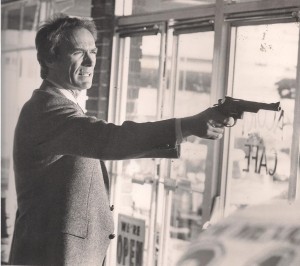
The other night, while at a loose end telly-watching wise, I stuck the DVD of ‘Dirty Harry’ on.
I don’t know how many times I’ve seen it since 1971/2 when I caught it for the first time in the ABC Sauchiehall Street. Back then it was a maligned piece of trash cinema, violent, reactionary, a contributor to the downfall of western civilisation. Naturally, I loved it. Now, of course, it’s a classic. And rightly so.
It made a superstar out of Clint Eastwood. He’d been around for a while, right enough. First as a contract player with Universal in the 50s before he achieved small screen stardom as Rowdy Yates on ‘Rawhide.’ Then Sergio Leone came knocking (when he couldn’t get Henry Fonda). His three Man With No Name westerns, even though the character did have names – or at least nicknames – were successes in Europe then, eventually, in the States. If you’re interested those names were respectively Joe, Manquo and Blondie. Even if you’re not, I’ve already typed them.
On his return to the land of the free he made ‘Hang ‘em High’ and ‘Coogan’s Bluff’ before going all big budget with ‘Where Eagles Dare’, ‘Paint Your Wagon’ and ‘Kelly’s Heroes.’
The original ‘Dirty Harry’ script, by Harry and Rita Fink, had been kicking around since the 60s and was originally designed as a vehicle for John Wayne. Naturally, the character of Harry Callahan was a bit different – certainly older. Wayne passed, although he did eventually play a brace of Harry-esque cops in ‘McQ’ and ‘Brannigan.’ Robert Mitchum declined, although his brother John made appearances in the series as DiGiorgio. Steve McQueen, hot from ‘Bullitt’, also turned it down.
Then it was all set to go with Frank Sinatra, who had scored a big hit in ‘The Detective.’ Yes, Frank Sinatra was going to play the cop who does it his way. However, a hand injury forced him to drop out and director Don Siegel found himself reunited with Clint Eastwood. Sinatra flashed the badge later in ‘The First Deadly Sin’ and ‘Contract on Cherry Street.’
I shoot the bastard, that’s my policy
Eastwood and Siegel were old friends, having already made ‘Coogan’s Bluff’, ‘Two Mules for Sister Sara’ and the unsettling ‘The Beguiled.’ Siegel also popped up in Eastwood’s directorial debut ‘Play Misty for Me’ as a bartender. Incidentally, if you look closely in ‘Dirty Harry’, you can spot a cinema hoarding advertising that film.
Eastwood made the part his own and, as we know, the character stayed with him for a further four films. None of them, however, had the quality of the first. And that is down to Siegel.
He’d been around for years as a director for hire. He helped make science fiction paranoid with ‘Invasion of the Bodysnatchers’. He helped Elvis Presley act with ‘Flaming Star’. He gave us a classic in ‘Riot in Cell Block H’. He also helped kickstart the new trend of cop movies in the late 60s with ‘Madigan’, starring Richard Widmark. And if ‘Dirty Harry’ made Clint Eastwood a force to be reckoned with, then it also made Hollywood realise that Don Siegel was more than just a jobbing director, although with the exception of ‘Charley Varrick’, he never again achieved anything as visceral, as compelling or as influential.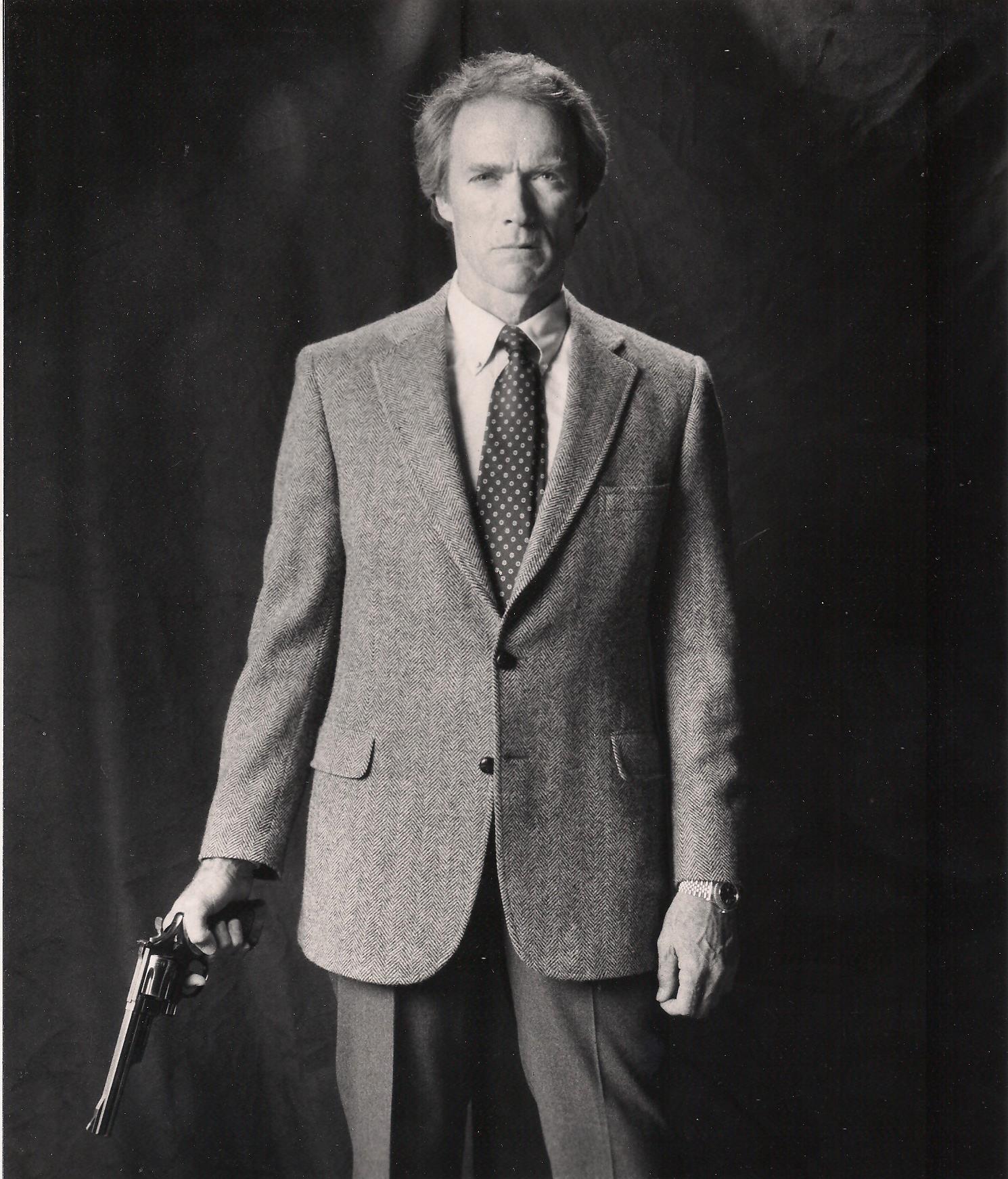
They were all aided by the script, which by the time of shooting had been worked over by Dean Riesner, a former child actor who had scripting duties on both ‘Coogan’s’ and ‘Play Misty’. He also contributed scripts to ‘Rawhide.’ His collaboration with Eastwood, although often uncredited, continued. Riesner went on to help create the first full-blown TV mini-series by adapting Irwin Shaw’s ‘Rich Man, Poor Man.’
Maverick writer/director John Milius also took a pass at the script, although his name does not appear in the credits. He did receive onscreen credit for the sequel ‘Magnum Force’ along with Eastwood protégé Michael Cimino.
I have no idea who came up with the line ‘Do you feel lucky, punk?’, although the extended speech about the lethal capacity of the Magnum.44, the most powerful handgun in the world, does have the feel of Milius. Callahan’s catchphrase became iconic, as did the later ‘Make my day,’ which I believe Milius did contribute. Other would-be memorable phrases like ‘A man should know his limitations’ and ‘You’re shit out of luck’ just didn’t have the same ring to them.
Harry, you owe it to yourself to live a little
Siegel adopted an almost documentary approach to filming. The camera is handheld much of the time while the city of San Francisco is much more than a backdrop, it’s more like a character in its own right. It begins almost immediately, during the dizzying opening credits as Eastwood hunts for clues on a rooftop. We are treated to the entire the city vista in glorious widescreen – the bay, the bridge, Alcatraz, the lot. Rooftop and aerial shots of the city are a recurring theme in the movie. The skyline becomes the canyons and deserts of Eastwood’s westerns, which mirrors Callahan’s own frontier approach to justice.
When Siegel took ill during filming, Eastwood took over and maintained the rough and ready approach. He filmed the suicide sequence, which sees Harry talking down a potential jumper, in one night.
Mention has to be made of actor Andrew Robinson, whose portrayal of the deranged killer Scorpio pushes the story forward like a punch to the gut. There is no attempt made to understand him, to give him a backstory, and the talented Robinson laps up the opportunity to go larger than life without actually taking a knife and fork to the scenery – although it’s a close-run thing. His electric performance overshadows everything he’s done since, from ‘Charley Varrick’ to ‘Deadly Pursuit’ to ‘Hellraiser’ to a recurring role on TV’s ‘Deep Space 9’.
There is similarly little attempt to explain Harry’s uncompromising stance on his city’s scumbags, killers and assorted scallywags. A couple of throwaway lines about a wife killed by a drunk driver does not explain his, shall we say, direct approach to crime fighting, although it was probably a half-hearted bid to humanise him. It’s interesting that the Mel Gibson starrer ‘Lethal Weapon’ uses a similar device and has a unique way of dealing with a would-be high rise suicide.
I’m all broken up about that man’s rights
And then there’s the violence, some of which is as gruelling today as it was then, particularly the beating the killer takes in order to discredit Callahan. Another sequence, in which Scorpio hauls a knife blade from his leg, still makes me wince. For its day, the film was pretty tough. Callahan, while not a vigilante per se, is prone to shooting first and thinking about asking questions later. He is, though, motivated by the sure knowledge that his prey is guilty, which is fine in fiction but not so much in real life. The sequence in which he first wounds then tortures the killer in order to find out where he’s buried a young girl alive is unsettling – and was edited on its first showing on TV, rendering the scene unintelligible. These days, thanks to the likes of the various ‘Saw’ movies, standing on a bleeding leg does seem pretty tame.
Finally, special mention must be made of Lalo Schifrin’s score, which catches the rhythms of the city and the period while a haunting series of female voices perfectly capture Scorpio’s madness. Schifrin was one of the busiest composers of the 60s and 70s, who already had attention grabbing scores for ‘Bullitt’ and ‘Cool Hand Luke’ to his credit. He’d previously worked with Siegel and Eastwood on ‘Coogan’s Bluff’ and on Eastwood’s ‘Kelly’s Heroes’ and would go on to score ‘MagnumForce’, ‘Sudden Impact’ and ‘Joe Kidd.’ He is perhaps most famous for his theme to ‘Mission:Impossible’, easily one of the ten best TV themes ever written.
‘Dirty Harry’ is a film which has been much-maligned and often copied, even by its own star, but it has never been bettered.