
I watched the film ‘Puppet on a Chain’ for the first time in easily twenty years recently. Overall it was a limp affair, not at all the way I remembered it from my first viewing in the East Kilbride Cinema in 1970. It had the groovy music so prevalent in those days, a lacklustre plot, a female agent (Barbara Perkins) who couldn’t defend herself and a hero in Sven-Bertil Taube – whatever happened to him? – who was so deadpan he was practically comatose.
It did, however, have a superb speedboat chase through the Amsterdam canals, directed by Don Sharp, which was quite something in those pre-CGI days.
However, it did get me thinking again about Alistair MacLean, who wrote the script and then produced a book based on it, which was his modus operandi by the time. It was later, as the movies dried up thanks to disasters like ‘The Golden Rendezvous’ and ‘Bear Island’, that he returned to books not based on scripts. Or maybe they were and just never filmed.
Although he’s not thought about much nowadays, Glasgow-born MacLean used to be a big deal, probably the biggest Scotland had produced in the thriller/adventure market.
His first, HMS Ulysses, wasn’t a thriller, though.
From page to screen
Published in 1955, it was a stark, compelling account of the hell that was the Arctic Convoys. MacLean had served in the navy during the war, as had his brother, who provided some of the detail.
He never wrote anything like it again, which is a puzzler.
Not that he was a slacker.
From 1955 until 1986 he wrote 28 thrillers, as well as two or three non-fiction works. He also originated a number of stories that were turned into TV movies and novels after his death in 1987.
The first of his books to be filmed was the Hungary-set The Last Frontier, which was filmed in 1961 as The Secret Ways with Richard Widmark. I recall reading the book when I was around 19 or 20. I still have it. The film is seldom seen – I’ve never seen it – but I’ve read there were tensions between Widmark and the director Phil Karlson.
Some of his books are perhaps more famous as films – The Guns of Navarone, Where Eagles Dare, Ice Station Zebra. A new Alistair MacLean movie was an event for me – When Eight Bells Toll (the only one of his books to be set in his native Scotland), the western Breakheart Pass, Force 10 from Navarone (his only sequel, with material from an uncredited George McDonald Fraser) – being some of the titles. They were of varying quality but eagerly awaited by fans.
Cold days
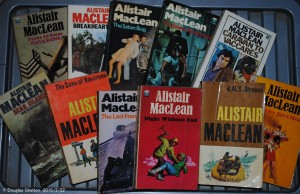
My own favourite was never filmed. Night Without End was a tense tale of skulduggery in the Arctic. It was written in 1959 but I’m looking at my paperback from 1972. There is no synopsis on the back cover – by then you didn’t need to tell his loyal fans what the book was about, you knew you were in for a fast-moving read where all would not be as it seemed. All the back cover had was a slice of text from the book itself.
‘I could half hear, half feel, a hissing tremor as the aircraft gouged through the ice. Then came another convulsion and above the gale the sudden sharp sound of the crash, the grinding tearing scream of the crushed metal. Then, abruptly, a deep and ominous silence when the sound of the wind in the darkness was no sound at all.’
Bloody hell, it makes me want to read it again.
In 1961 he wanted to prove that people bought his books on the quality of the writing and plot and not just his name. Sounds kinda familiar. Can anyone say JK Rowling?
He released two books under the pseudonym Ian Stuart – The Dark Crusader and The Satan Bug – but he fooled nobody. Later, they were reissued under his own name. The Satan Bug was even filmed, directed by John Sturges, who would have two bites at the MacLean cherry, going on to make Ice Station Zebra.
He was a gruff old sort, at least that’s my memory from the one TV interview I ever saw. I recall he said that there wasn’t as much money in books as people think. I know from experience that is true but perhaps not in his case. After all, he was living in Switzerland at the time, a whisky bottle throw from Richard Burton.
The books became less interesting as time went on, although one The Golden Gate, did act as a precursor to more modern thrillers like Die Hard and Olympus Has Fallen, even TV’s 24, in that it deals with the US President being held to ransom in the middle of the bridge in San Francisco, which is rigged to explode.
It’s a shame he is not better known these days but perhaps the reissues from Harper Collins will redress that balance.