AN HONOURABLE THIEF, my first historical thriller, is published in paperback by Canelo this week and to mark the occasion I thought I’d share this account of a true life incident that inspired one of the set piece chapters.
Naturally, I fictionalised the details, characters and tweaked everything to suit my purposes, including moving the events 20 years earlier.
This account has been taken from my non-fiction work, DARK HEART (Mainstream 2008), which told the story of the Edinburgh Tolbooth, the old town jail, which Sir Walter Scott called The Heart of Midlothian. The book is now out of print but you may find second hand copies here or there. This is taken from my original manuscript version so may differ slightly from the published version.

The Treaty of Union may have changed many things but it did not appease the hot blood of the Edinburgh mob, of which English spy Daniel Defoe commented, ‘A Scots rabble is the worst of its kind …’ The benefits of the Union did not emerge for many a year and the citizenry was still prone to demonstrate its opposition. Stiff, and unfair, taxes imposed on the Nation, including an export duty on linen, another on salt and a malt tax, proved crippling and hugely unpopular. When protest was made to the English Lord Treasurer, he observed, ‘Have we not bought the Scots, and a right to tax them? However, taxation was the indirect cause of a riot and subsequent slaughter that was seen as being tantamount to rebellion. The unrest left men and women dead and wounded in the streets and led to the Bastille of Auld Reekie being stormed once again, not to free prisoners but to bring to justice a man they believed was guilty of murder.
One source of revenues to the Crown was the duties placed on imported goods. Brandy, rum, lace and other goods from the Continent were all subject to stiff taxation but were always in demand, so bands of smugglers sprang up who were willing to supply them. Revenue officers were charged with bringing these romantic desperadoes to justice. But the clerk would have his baccy and the parson his brandy, so the smugglers carried on their moonlight trade with the sanction and often assistance of all walks of life. Scotland’s East Coast was, obviously, a focal point for the traders in contraband. Andrew Wilson was an Edinburgh baker who supplemented his income by smuggling. By 1736, the swashbuckling Wilson had grown tired of the inroads excisemen had made into his illicit business and resolved to raid the Pittenweem customs house to recover goods seized by them. Among his band were George Robertson, William Hall and John Galloway. They managed to pull off the heist but were subsequently caught and sent to Edinburgh to face trial.
In the Warding Book of the Tolbooth for 12 January 1736, there is an entry that two of the band were subsequently liberated while John Galloway was ‘baled out of prison and examined as witness in the criminall tryall against Andrew Wilson … and did not return to prison’. With the evidence of their former co-accused against them, Wilson, Robertson and Hall were found guilty. Hall was to be transported to the penal colonies for his part in the robbery, but Wilson and Robertson were due to hang. The smuggler, though, was determined not to dance the hangman’s jig and, according to legend, he and his accomplice, with the assistance of two horse thieves, cut through the iron bars of their window, singing psalms to cover the noise. According to the tale, one of the horse thieves squeezed through and slipped off into the night. Wilson was next but they had not made a hole wide enough for his bulky frame and he ended up trapped between the bars. The gudeman of the Tolbooth was alerted to the escape bid and Wilson and Robertson were placed in more secure lodgings within the prison.
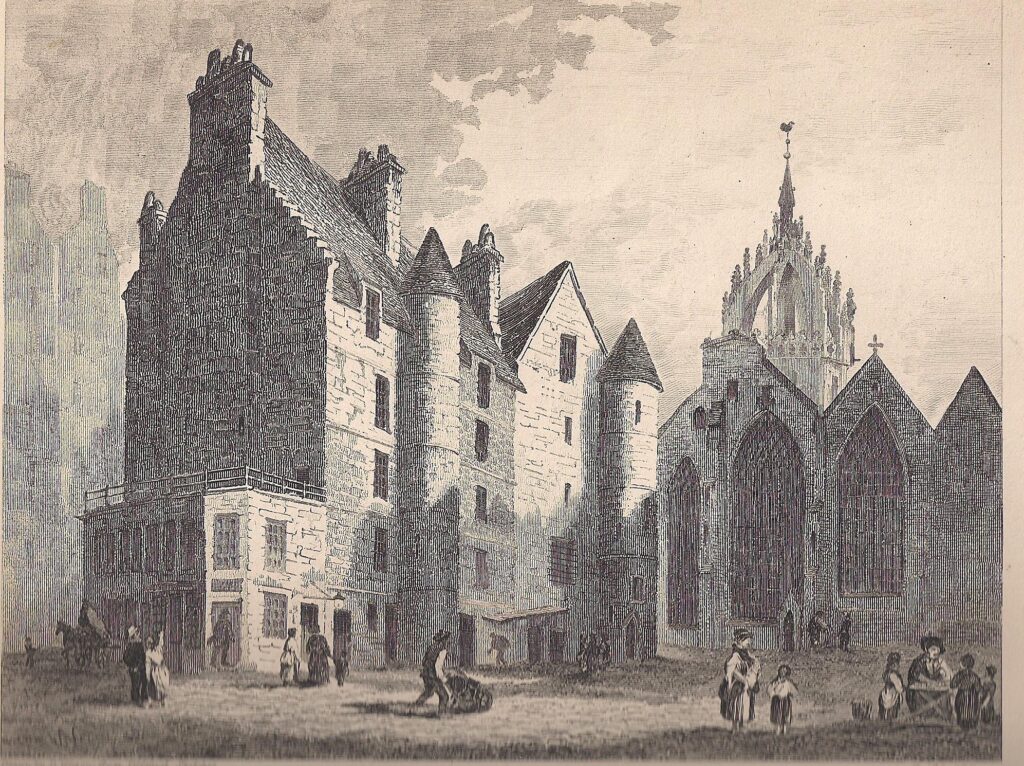
What is certain is that, on Sunday 11 April, Wilson and Robertson attended services in the Tolbooth kirk, which was part of St Giles. They were guarded by four of the City-Guard and just before the sermon began, Wilson, according to a contemporary report, grabbed the younger Robertson ‘by the head band of his breeks and threw him out of the seat.’ With a cry of ‘Run, Geordie, run’ Wilson intercepted three of the guards, reportedly seizing one in each hand and, incredibly, a third in his teeth. Robertson saw his chance and punched the fourth guard to the ground before sprinting for the door of the church. No-one got in his way and he disappeared into Parliament Close. He managed to escape through the city gates before they were sealed. Friends were waiting with tools with which to strike off his chains and a swift horse to take him to Dunbar where, it is said, he took a fast boat to Holland. For many years, it was rumoured, he kept a bar in a village near Rotterdam. The entry in the Tolbooth records states in its customary spare style that ‘the aforementioned George Robertson made his escape out of the tolbooth kirk a little before sermon and was not apprehended again.’
Wilson may have made up for ruining the earlier bid for freedom but he had sealed his own fate. Security around him was strengthened while he lay in the Tolbooth awaiting his execution. Sympathy for him among the mob also grew. As a smuggler, and known as such for thumbing his nose at the hated authorities, he was already well-liked but his selfless act in holding down the guards while his young friend got free made him into a hero. Due to hang on 14 April, word reached the magistrates that the mob might be tempted to help break him free. A detachment of Welsh Fusiliers was drafted in to beef up the guard on the appointed day.
Captain of the City-Guard at that time was John Porteous. According to The Newgate Calendar, a true crime compendium from the latter part of the 18th Century, he was a former tailor who caught the eye of a high-ranking official said to be the Lord Provost of the time. This gentleman had a wish to offload his mistress and he suggested that Porteous, well regarded by Edinburgh society but as poor as a church mouse, take her off his hands. To make the match more attractive to the lady in question, who wrinkled her nose at the thought of marrying a tradesman and a penniless one at that, a one-off payment of £500 was offered and accepted. Porteous duly married the woman and set out to rise in his profession. However, the young man was ‘much addicted to company’ and neglected his business, losing many customers in the process. His wife, fearful of being left destitute, used her influence with the Provost who offered Porteous captaincy of the City-Guard, with a salary of £80 a year.
The fact is that Porteous was more likely to have come to City-Guard through military service, first as drill master following the 1715 Jacobite uprising. Within ten years he had been promoted to Captain. A keen golfer, he lost famously to Alexander Elphinstone in 1724 before a large crowd in a match that became the very first reported by a newspaper. Where the accounts agree is that his personality tended towards the arrogant and the truculent. He was officious, self-important and often brutal. He soon developed a reputation for an overly-enthusiastic use of violence in quelling disturbances. The Newgate Calendar states that ‘he would exceed the bounds of his commission and treat the delinquents with the utmost cruelty by knocking them down with his musket and frequently breaking arms and legs.’
He was no less brutal when despatched to reports of tumults in ‘a house of ill fame.’ ‘Notwithstanding he was a most abandoned debauchee himself, he would take pleasure in exposing the characters of all he found there, thus destroying the peace of many families. He would treat the unhappy prostitutes with the greatest inhumanity and even drag them to a prison, though many of them had been seduced by himself.’
This was the man who was in charge of the City-Guard when Andrew Wilson was due to hang. His mood was already foul over Robertson’s escape and he may also have resented the fact that the Magistrates felt it necessary to bring the Fusiliers to strengthen the execution detail. (The Calendar, incidentally, says that it was Porteous himself who requested that the soldiers be present). On 14 April, Porteous led the Guard as Wilson was taken from the Tolbooth to the Grassmarket, where the ‘hanging tree’ awaited. The soldiers lined the route and the crowd watched the procession go by, but there was no suggestion of trouble, even when Porteous forced the manacles on Wilson’s wrist so tightly that the man was in obvious agony. The condemned man was led to the gibbet, where the customary Psalms were sung, prayers were said and still there was no sign of trouble. Wilson was turned off the ladder ‘with all decency and quietnes’, as one spectator wrote, and still there was no trouble. It was as the body was being cut down that it began.
It started with some boys throwing stones at hangman Jock Dalgliesh, a common enough occurrence for the post of ‘hangie’ was fraught with danger, but it was enough for Porteous to wade into the crowd himself, followed by his men. The crowd first pulled back then surged forward. One man leaped to the gibbet and cut the body of the dead smuggler down while Porteous and his guard were assailed from all sides by missiles. The magistrates, fearful for their own safety, either gave Porteous an order or he made the decision himself, but whatever the case it was the biggest mistake of his life – he told his men to fire. The first volley was aimed over the heads of the rioters but in doing so the Guard only hit those spectators who were leaning from the tenement windows. Far from cowing the mob, the gunfire merely served to push it further into a frenzy and the Captain ordered the men to shoot directly into the throng, before beating a retreat up the West Bow, a thin line of red snaking through the press of bodies. Striking out at all sides, and being hit by stones and filth from around and above, Porteous once again told his men to fire, ordering them to ‘level their pieces and be damned.’ He snatched a musket from the nearest man and fired himself, killing one man. Another volley rattled out and more people slumped to the ground, blood seeping from wounds, before the Guard were able to reach the comparative safety of their headquarters and the Fusiliers helped bring some semblance of order to the streets.
The number of dead varies from six to nine people, depending on what account you read, and Porteous was called to account before the Council ‘where there was an abundance of witnesses to fix the guilt upon him,’ wrote a witness. ‘The uproar of the mob encreased with the loudest din that ever was heard and would have torn him, the Council and Guard all in pices, if the Magistrates had not sent him to the Tolbooth by a strong party and told them he should be tried for his life.’
On 5 July, Captain John Porteous faced the High Court of Justiciary. Against him was the evidence of those in the crowd who claimed that he had personally fired into the crowd and had ordered his men to do the same. His own position was that his men had fired on their own volition and that he had not pulled a trigger. He also argued that the Magistrates issuing he and his Guard with ball ammunition was more or less an order to fire if or when it became necessary. Sixteen witnesses testified that they had not seen the Captain fire into the crowd. Feelings, though, were running high and Porteous’s own reputation and the number of dead and wounded counted against him. He was found guilty and sentenced to die on the Grassmarket, where it all began, on 8 September.
News of the case reached Queen Caroline in London, then acting as Regent while her husband, George III, was on the Continent. She was disposed to pardon the Captain and issued orders that a six-week reprieve be granted. Naturally, her compassion did not sit well with the Edinburgh mob, who saw it as yet another example of am English government supporting the slaughter of innocent Scots. Captain Porteous was not to be allowed to avoid paying the ultimate penalty for his actions.
TO BE CONTINUED…