
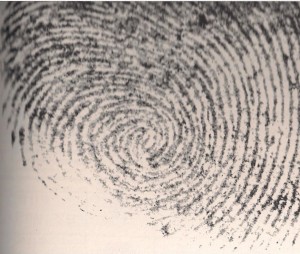
 THROUGHOUT the life of crime, authorities the world over have faced the problem of how to identify criminals.
In the Bible it was easy: when Cain rose up to slay his brother Abel, God merely had to smite him to leave a mark on his cheek. Wherever he went after that, he would be recognised as a fratricidal killer. Perhaps using that as an example, successive cultures have developed their own marks of Cain. In order to both punish criminals and let others know exactly what sort of wrongdoers they were, eyes have been gouged, tongues slit, ears, hands and feet lopped off, flesh branded and backs flayed. Such practices were still in use in some parts of Britain until the early nineteenth century and in Russia until around 1860.
But as the human race became increasingly sophisticated and developed a more liberal conscience – some of it at least – other forms of identification had to be developed. Francois Eugene Vidocq, the thief-turned-detective who formed the French Sureté during the early nineteenth century, insisted that his detectives regularly visit jails to view the prisoners, so that if one of the villains should cross their path again, they would know him. Over a century later, American detectives in some cities were required to attend daily line-ups at headquarters – perp walks – where all the felons arrested during the previous day and night were paraded to allow the officers to become familiar with them should they ever stray into their precinct.
Vidocq also initiated the first system of criminal records, with descriptions of the subjects carefully updated and kept. This spawned the pseudo-science of anthropometry which reasoned that no two individuals bore the exact same body measurements. This latter system, developed by another Frenchman, Alphonse Bertillon, in 1879, entailed the recording and storing of various personal details, such as arm and leg lengths, facial shapings, and length of fingers and feet.
Yet another early system saw felons holding their hands up just below their faces when having their police photographs taken so that the scars and abnormalities common among the so-called lower classes could be easily seen and used in future identification.
Although both these systems seemed to work, they proved too cumbersome for workable records to be kept and were gradually replaced by the new science of fingerprinting.
Clues at their fingertips
The theory itself – that no two persons have the same marks on the tips of their fingers was not new. For centuries the Chinese had used thumbprints as a means of signing and sealing documents, while in the seventeenth century the Italian anatomist Marcello Malpighi first described the patterns on the fingertips. Further researches followed, with scientists continuing to study and describe the many whorls, ellipses and triangles to be found on the fingers and palms of our hands.
In the mid-nineteenth century, William Herschel, a clerk in the British Indian colony, discovered that native workers were making their mark for receipt of pay and then joining the end of the queue again to draw more but using another mark. Herschel decided to circumvent this systematic fraud by insisting that each worker add his fingerprints to a register. They would then ‘sign’ for their pay by leaving their fingerprint, which could be more easily checked. Herschel also discovered that an individual’s fingerprint does not change over time. Later researchers would find they are formed in the womb during the sixth month of pregnancy.
The first crime recorded to have been solved by using fingerprints took place in Tokyo in 1879. A thief had made his getaway over a fence, leaving behind a dirty handprint. This was inspected by Scottish doctor Henry Faulds, who had been making a study of the use of handprints as a means of signature. Faulds was able to clear one suspect and subsequently prove the guilt of another man by taking his palm print and comparing it with the one left on the fence. Dr Faulds wrote of his findings in a British scientific journal, Nature. On reading of Fauld’s work, Herschel, believing that his own theories were being stolen, launched a bitter campaign for recognition through the pages of the same publication.
Eventually, though, it was left to another scientist, Sir Francis Galton, to pull together the various strands of research and package them into an identifiable branch of science. In 1892 he wrote a book which laid down a system of classification, a technique later perfected by Sir Edward Henry, a former inspector in the Bengal Police, who in 1901 became head of Scotland Yard’s new fingerprint bureau.
A breakthrough in Argentina
However, the first murder case to be solved using the new techniques was committed not in Europe, but in Argentina. In the latter half of the nineteenth century, a Croatian-born detective named Juan Vucetich, based in the town of La Plata, read articles penned by Galton and others and created his own system of fingerprint identification, or dactyloscopy as it was known. He managed to interest fellow officers in his process and in 1892 one of these men used the Vucetich fingerprinting system to prove that a mother had beaten her two children to death. She had accused a male neighbour but the detective found bloody prints on the door to the shanty in which the children were living; prints which matched those of the mother. Confronted with this evidence, she broke down and confessed. This and another murder case solved by fingerprint evidence convinced the Argentinian authorities that the theory was workable, and in 1894 the country became the first in the world to officially adopt fingerprinting as a means of criminal identification.
In 1916 the Argentinians went even further. They announced they were to set up the world’s first universal register: a directory of every citizen’s fingerprints. This was not only Vucetich’s dream but also every other police officer’s the world over, then and now. But the populace was violently opposed to the idea and after a series of riots, during which the building which was to house the central records was damaged, the scheme was abandoned. A bitter Juan Vucetich retired from public life and died in 1925, suffering from both tuberculosis and stomach cancer.
It was a full ten years after the Argentinian murder that the first European homicide, a case of homosexual jealousy in Paris, was solved using fingerprints. In that case, the killer gave himself up when he realised he had been unmasked literally by his own hands, his confession – like that of the Argentinian mother – saving the authorities the trouble of proving in court that fingerprints were indeed a useful tool in tracing murderers. However, the police and prosecutors in Britain’s first fingerprint murder were not to be so lucky.
In 1905 the police arrested two petty thieves, brothers Albert and Alfred Stratton, for the brutal murders of 71-year-old shopkeeper Thomas Farrow and his wife. Officers had found a clear thumbprint, eventually found to match Alfred Stratton’s on a cash box. The accused man refused to crack and confess so the Crown found itself in the unenviable position of having to prove to the jury and a somewhat sceptical judge that the ‘new-fangled’ system was admissible as evidence in a murder trial. The intricacies of fingerprinting were explained to the jury with the use of enlarged photographs. One jury member was also fingerprinted to help prove the theory and ultimately the brothers were found guilty and hanged.
In 1911 the US Supreme Court ruled that properly prepared fingerprint evidence was relevant and competent following a murder case in Chicago. And so, throughout the world, the techniques were established and accepted that would revolutionise crime investigation and detection.
Toe and fro
However, fingerprinting, like any other process, is only as efficient as the men and women applying it. Criminals and civil-rights groups realise that liberties can be taken – it is easy to transpose fingerprints from one place to another if you know how – and mistakes – in preparation of specimens and identification – can be made. For instance, police have been guilty of failing to fingerprint items which would normally be expected to be tested, occasionally even the murder weapon.
But it is not only our hands and fingers which can help in identification. Blood, hair and even teeth can assist, although they cannot prove identity in themselves, while more recently, genetic fingerprinting, or DNA profiling, has come to the fore, albeit controversially. And like our fingers and palms, our feet and toes also bear unique ridges and patterns. Some American hospitals have been using footprints to identify babies since 1915, while on 4 November 1952 in Glasgow, a man was convicted for the first time in Britain on the basis of a toeprint – in his case his big toe. The man was found guilty of breaking into premises and trying to blow a safe, somehow managing to leave behind a clear imprint of his big toe.
In this country, citizens are not fingerprinted unless they have been arrested,leaving the vast majority of its citizens unclassified. Attempts to create national registers similar to the one mooted in Argentina in 1916 have also failed. The police and some politicians love the notion, claiming that innocent people have nothing to fear; the public remain unconvinced while civil-liberties groups view these moves with the mistrust of a sparrow for a cat. However, there are plans to create a national DNA register in the very near future.
In the absence of such a fingerprint register, the police find themselves stumped when a full or partial print is found at the scene of a crime and no match can be found in their records. Although it can be used later for corroborative purposes if the culprit is found, in terms of leading detectives to their quarry the print can be as much use as an ash-tray on a motorcycle.
So if the fingerprint is the only, or best, evidence available, then police may wish to take steps which will at least eliminate vast sections of the local population, if not lead them directly to the killer. And for that, they rely on the goodwill of the public. That was exactly what happened in 1952, following the brutal murder of a four-year-old child in an area of Glasgow known as Garnethill.
TO BE CONTINUED…
This article first appeared in ‘No Final Solution’ by Douglas Skelton (Mainstream, 1992)