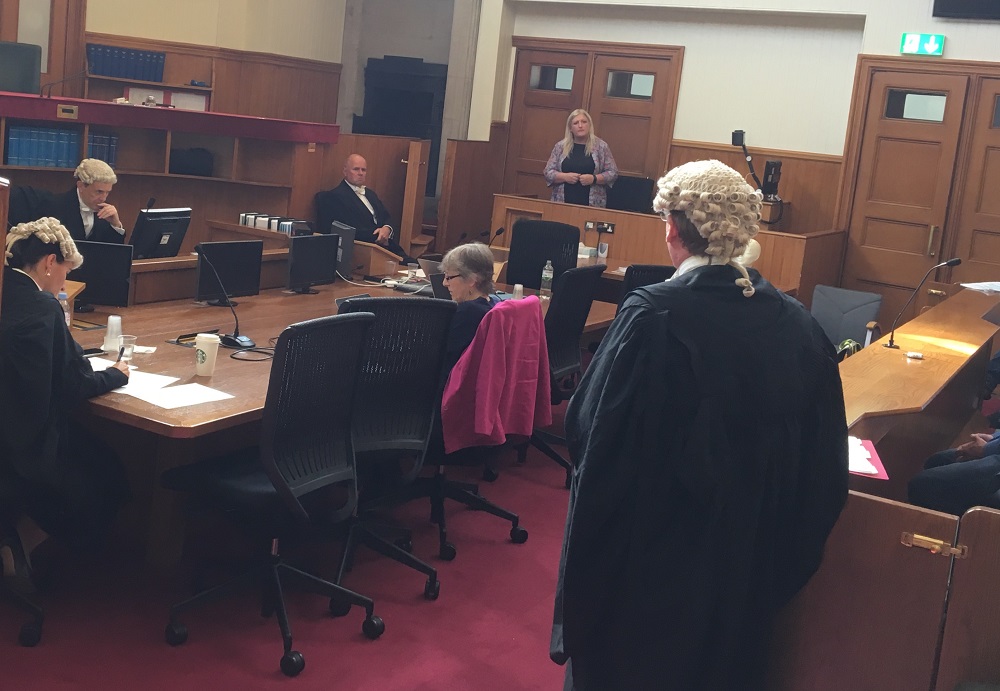
The recent You the Jury courtroom drama at Bloody Scotland was based on a real case from 1926.
Though we changed the names and location, updated evidence to include DNA and amended testimony to suit our telescoped running time, the basis of the case was very much as it was all those years ago.
Here is a brief account for anyone who wished to know more. As usual, any errors of fact are mine.
John Donald Merrett was born in New Zealand in 1908, his father was a maritime engineer, his mother from a wealthy family. His father either died or deserted, there are conflicting accounts.
At the age of 18, he and his mother, Bertha, came to Edinburgh. Merrett was meant to study, and though he was described as a competent scholar with an affinity for languages, he seemed to do precious little academic work. He was, to put it bluntly, a bit of a wastrel.
In Edinburgh, he formed a relationship with a dancing instructress. He had an allowance of ten shillings week, a tidy sum then but not enough for him.
To subsidise his allowance, and also to maintain his extra-curricular activities, he began to steal from his mother. He bought two motorbikes, one with a sidecar.
But he couldn’t steal enough to support his lifestyle. Perhaps something more drastic, more permanent, was called for.
On March 17, 1926, he and his mother had breakfast together at their home in Leith. Later, she sat at her desk opening her mail, while he was nearby in a chair supposedly reading.
Housekeeper Mrs Henrietta Sutherland was in the kitchen when she heard a loud bang, a scream and something heavy falling to the floor. Merrett burst in and declared that this mother had shot herself.
Mrs Merrett was on the floor, blood streaming from her ear. She was alive but unconscious.
She was rushed to Edinburgh’s Royal Infirmary where she was placed in a locked room as an attempted suicide.
She lingered for many days, but subsequently died on April 1, according to accounts of the time of meningitis brought on by the gunshot.
(For brevity, in our version, the victim died at the scene, but only after making a statement to our housekeeper.)
Before she passed away, Merrett visited her and kissed her fondly on the cheek – then dashed off to take his girlfriend out for the afternoon.
She was able to tell doctors that she had been aware of her son standing by her side. She told him to go away and not to annoy her but then there was a loud explosion and she didn’t remember anything else until she woke up in hospital.
An authority on mental diseases said that though she might appear normal, the wound would have caused a state of altered consciousness which would affect her memory and it would be unsafe to draw inferences from anything she said or did.
Doctors admitted she was barely lucid when she made the statement, but all the same, police questioned Merrett.
He told a similar story, but said that when he turned away, he heard the gun go off and when he looked back his mother had slumped to the floor.
He admitted the gun was his, that he had bought it to shoot rabbits, but his mother had confiscated it. He claimed he hadn’t seen it again until the day she shot herself. On the other hand, he also stated that he didn’t know that she knew he’d bought it.
Police found that Mrs Merrett was overdrawn at the bank, which seemed to support the suicide claim.
The housekeeper’s confused statements didn’t help. First she said the pistol was on the desk when she rushed in, then she said she saw it falling from Mrs Merrett’s hand.
The police who attended the scene were also unsure where the gun was found.
Police appeared to put the death down to suicide, but in November Merrett was arrested for uttering cheques to the sum of £457. That led to them looking at the case again and he was also charged with her murder.
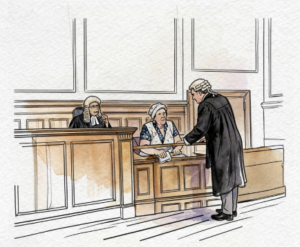
The trial began in February 1927 and experts for the defence and prosecution disagreed over the gunshot.
The prosecution contended the nature of the wounds pointed to murder, supported by the testimony of experts Prof John Glaister and Prof Harvey Littlejohn. The defence, in the persons of Sir Bernard Spilbury and firearms expert Robert Churchill, argued the opposite.
The weapon was a .25 calibre automatic of Spanish manufacture and the bullet had travelled upward, carving a furrow in the neck beneath and just in front of the woman’s right ear.
One of the issues were powder burns, or tattooing. In short there were none. If the death had been self-inflicted it was believed that there would be burns present as the gun would have been held close to the skin. No such marks would suggest that the weapon had been further away.
Spilsbury argued that the powder burns could have been washed away by the blood and stated that suicide was a possibility. Churchill tested the weapon with ammunition bought from the same shop as Merrett and found it to contain two grains of flake smokeless powder, which he said would not tattoo the skin, even at close range. They wouldn’t penetrate, merely cling to the surface and could be washed off with a damp cloth.
Mrs Merrett’s wound had been cleaned by doctors who reported no powder burns.
(There is no reference to any tests for gunshot residue on the hands of the victim or the accused, using an undependable process called the Lunge Test. However, as for many months it was treated as suicide, perhaps no test was made.
In our version, we added DNA trace evidence).
The prosecution attacked the police, saying their failure to obtain a dying declaration while the victim lingered was a criminal neglect ‘of a mostly obvious and imperative duty.’ Police evidence was also a little contradictory and vague as to where the pistol was found.
The expert witnesses, the confused housekeeper, the defence calling into question Mrs Merrett’s state of mind, the possible police failings, all created sufficient doubt in the jury’s mind to return a Not Proven verdict.
He was found guilty of the uttering charge and sentenced to a year. (We abandoned the fraud charge during the course of our fictional recreation of the trial.)
That then was the end of that case.
But it wasn’t the end of John Donald Merrett’s story.
After his release, Merrett moved to Hastings where he seduced the 17-year-old daughter of an old friend of his mother’s.
Together, they returned to Scotland where they married in 1928.
He changed his name to Ronald Chesney and continued his career as a fraudster. What cash he inherited from his mother didn’t last long so he and his wife travelled the country passing rubber cheques.
He was caught in Newcastle and sent to Durham Jail for six months. On his release he inherited £50k from his grandfather’s estate, which he subsequently squandered.
He became something of a swashbuckling figure, a blackmailer and a smuggler, running guns, cigarettes and alcohol. After the Second World War, having served with the Royal Navy Volunteer Reserve, found himself immersed in the black market economy of post-war Germany.
He was jailed once again, this time for smuggling women’s stockings into Britain, and on release found himself, predictably, out of cash. He and his wife, Vera, had established a trust fund worth over £8k, payable to whoever survived.
Given his history, that was perhaps unwise on her part.
Vera had set up in Ealing with her mother, who was calling herself Lady Menzies having married a Scot who styled himself a Baron, and was running an old folks home.
Merrett returned to England using a false passport, and managed to enter the Ealing house undetected. He got his wife drunk, then drowned her in the bath to make her death look like an accident.
But her mother surprised him and he killed her by beating her unconscious then strangling her.
He fled to Germany but police were searching for him. He had the sense to know that he would not escape execution this time.
On February 16, 1954 he shot himself in a wood near Cologne.
Before he died, he wrote a letter to his new girlfriend saying that he died with her face before his eyes.
A subsequent inquest ruled that he was responsible for the death of the two women in Ealing.

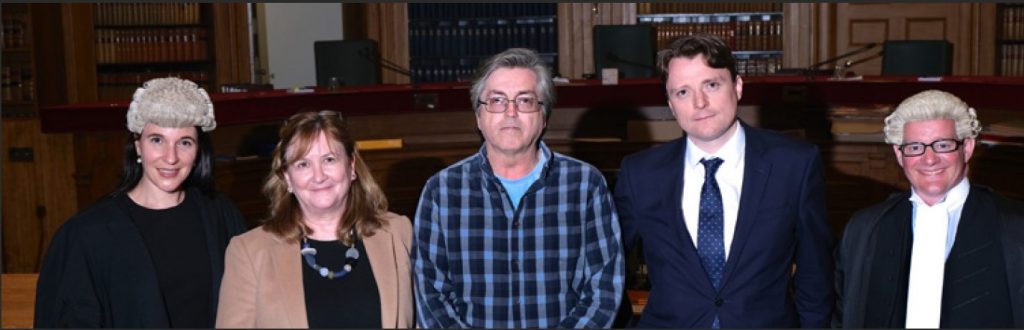
(I’m grateful to the team who took the raw materials I provided and turned it into the drama the three audiences witnessed in Stirling. The productions would not have been possible without their hard work. Similarly, the support of the Faculty of Advocates, The James Hutton Institute and the Open University was vital to their success. Huge thanks are also due to Scottish Courts and Tribunals Service for allowing us to use Stirling Sheriff Court and to Bloody Scotland for including the show in the programme).