
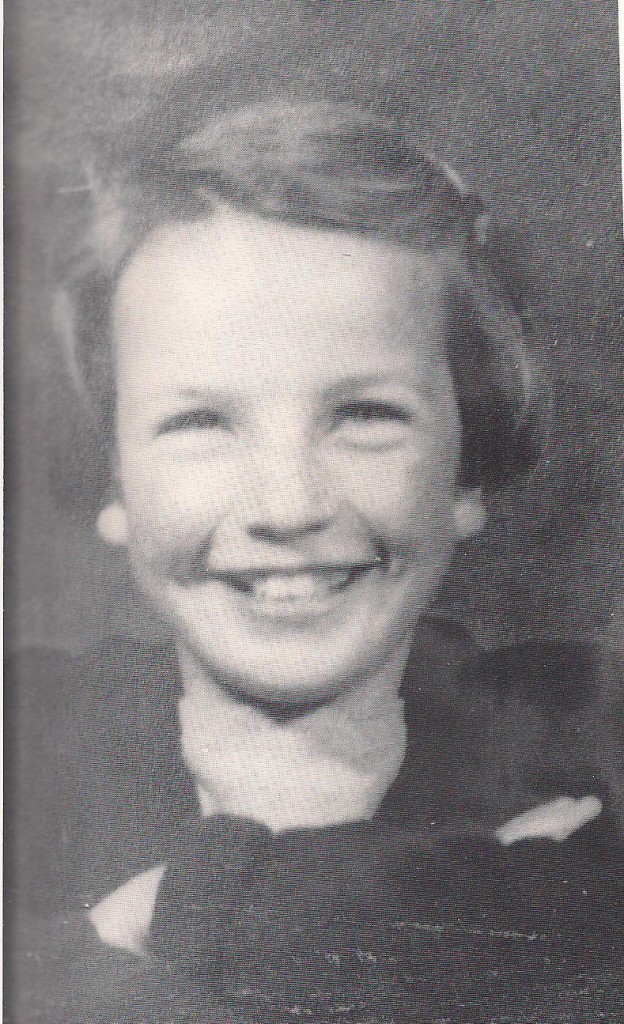
Pretty, twelve-year-old Moira Anderson was highly excited all that day, Saturday, 23 February 1957. That was the day she was being allowed to go to the pictures on her own for the first time. Well, not on her own exactly. She was going to see Guys and Dolls at the Regal with two cousins, one of whom was 15 years of age. But she was going without her parents for the first time and that was near enough on her own. She often went to the Saturday morning children’s club at the Odeon, but this was different, this was the proper pictures. The idea of this trip made her feel so grown up and she was looking forward to it enormously.
But before her big day, her parents had a number of errands for her. First, she went with her father, who had one leg, to the Limb Centre in Motherwell. When she got back to her home at 71 Eglinton Street, Coatbridge, just after 11 a.m., there were other messages for her to run. She didn’t mind for it just brought her trip to the cinema all that closer.
Then she was told that her outing would have to be postponed to the early evening performance because her older cousin had to visit their sick grandfather in Glasgow’s Royal Infirmary. Her grandmother was also ill but she was still at home, in nearby 209 Muiryhall Street. Her grandmother wasn’t alone – Moira’s uncle was staying there – but the girl was still sent round to see if there was anything she needed.
The youngster left her own home at 3.50 p.m., walking through a fierce snowstorm, arriving at her granny’s a few minutes later. As soon as she arrived, her uncle, who was in the kitchen frying some fish for tea, asked her to nip out to the Co-operative grocers on Laird Street for some butter. She was a helpful child and she said she would. Normally, she would have taken her grandmother’s collie, Glen, with her. But the weather outside was too ferocious, so he was left, warm and comfortable, lying in front of the fire. Anyway, she would only be gone for a few minutes.
But a lot can happen in a few minutes. Decisions can be made, actions can be taken. Had she taken the dog, she might still be alive today.
The young girl shouted something to her granny in the bedroom and then stepped out again into the blizzard. She had three shillings and sixpence in her pocket and her granny’s Cooperative order book in her hand. Her fawncoloured kilted burberry coat was firmly buttoned around her to keep out the snow which was being driven almost horizontally by the howling wind. Underneath her coat a blue scarf kept the winter chill from her young chest and throat and beneath that she wore a blue jumper and lemon-coloured cardigan. She was also wearing a thick tweed skirt, fawn socks and brown shoes. Her short fair hair was encased in a navyblue woollen pixie hat with red bands. Her mother had ensured that she was properly dressed for the winter weather. She had protected her daughter in every way she could. But the successive layers of clothing could not protect the youngster from everything.
Moira Anderson was swallowed up by the snow and never seen again.
A massive search
Wherever Moira Anderson went that day, it was not to the Co-op in Laird Street, little more than 500 yards from her granny’s house. An assistant in the store questioned later knew the girl and was adamant he had not seen her. When Moira did not return to her grandmother’s it was at first assumed that she had gone straight on to the pictures. But her cousins had not seen her and when she had not returned home by 11 that night, the police were called.
And so began the search for a little girl whose disappearance has become part of a town’s folklore. Today, 58 years later, that search still goes on.
The police and hundreds of local volunteers, striking dustmen as well as Scouts and Rover cubs, saturated the area. Cinema managers were contacted early on Sunday morning to see if she had been locked in by accident. Every park in Coatbridge and nearby Airdrie was searched thoroughly, especially Dunbeth Park which she would have passed to get to the Co-op. Schools and libraries were opened to see if she had managed to get inside. The public were asked to unlock their garages and lock-ups. Search parties scrambled over snow-covered slag heaps and stumbled down muddy mineshafts. But there was no sign of the young girl.
Eventually, news of the inevitable sightings came in. She was seen on a bus with a man going to Glasgow. She was seen in Greenock and Port Glasgow, one woman there describing her so exactly that it was felt she could not have been mistaken and police rushed down to the Clydeside town fully expecting to find her. They were disappointed. They were always disappointed.
A family reported seeing a girl answering her description at a funfair in Queen’s Park recreation grounds on the south side of Glasgow. But detectives questioning the showpeople got no further. Another sighting in nearby St Andrew’s Drive also proved inconclusive, as did reports of Moira being seen in Kinning Park, Glasgow. A lorry driver even saw a girl answering her description standing beside two parked lorries outside Doncaster in the north of England. The man, from Dagenham in Essex, was shown a picture of the missing girl and he said: ‘It’s an awfully good likeness of the girl I saw.’ But the girl he saw, whoever she was, was not traced. A railwayman found a blue gaberdine belt hooked on a fence which skirted a local marsh known as The Moss. He handed it to police but Andrew Anderson, Moira’s father, said it was not his daughter’s. Nevertheless, the marsh was fully searched. Someone called the police, telling them they had seen a young girl being dragged into a van at Baillieston, only four miles away from Coatbridge. The van was chased on the Carlisle Road and stopped at Gretna where it was found that the ‘girl’ was a young woman who had been hitching a lift.
Moira’s parents were convinced their little girl had not run away. The Sunday after she disappeared was her mother’s birthday and Moira had talked her her to bake empire biscuits. The girl would not run away the day before her birthday, of that she was certain.
‘I know my girl,’ said Margery Anderson. ‘If she was free she would come back home.’
They believed someone had abducted their daughter and begged whoever had her to release her unharmed.
‘Moira’s mother and I are pleading with you to let our little girl go free,’ said Andrew Anderson through the pages of the Daily Record. ‘For five agonising days since Moira’s disappearance, we have lived with fear in our hearts. But with faith in God’s mercy, we believe Moira will still return alive and well. Have pity on us. We all need her so much.’
But if someone had Moira locked away, they ignored the parents’ pitiful pleas.
The police did, however, manage to piece together some of the girl’s movements after she left her grandmother’s house. She had actually been spotted by three people going in the opposite direction from Laird Street and getting on a bus in Alexander Street. She was first seen as she walked through the snow from Muiryhall Street by a woman looking out of her window. As she walked across a piece of waste ground she slipped and fell, picked herself up and continued on her way. Then she was seen by a man who was standing in a tenement doorway opposite the bus stop, sheltering from the snow. This man ran out when his bus came Baxter’s Cliftonville bus going to Old Monkland – but could not say if the girl got on behind him. However, another woman who was already on the bus – and who knew Moira – said the girl did climb on and nodded and smiled at her. However, this witness did not see where the girl got off.
So where was Moira going? And where did she get off? She was also seen by a fourth witness standing at a bus stop in Whifflet, kicking the ground and looking generally as if she was waiting for someone. But who? And did this person pick her up? And if he did, where did he take her?
Many years later, that bus trip figured prominently in the case.
Mother retained hope
Her older sister Janet, aged 13, told reporters a story Moira had passed on the night before she disappeared. The story involved a walk down a dark street and a man with a knife. Moira had told Janet about her experience while the two girls walked down Park Street, Coatbridge.
‘She pointed to a dark spot and told me that a man had stopped her on Tuesday night as she was taking newspapers to my grandmother,’ Janet said, explaining that the man wanted Moira to come with him. ‘Moira told me that she started edging away and told the man – who was about 20 – that she didn’t want to go. Then she told me the man stepped forward and said “If you don’t I’ll run a knife into you.” Moira told me that by that time she had managed to get a little bit away and she turned and ran.’
The police never did trace that young man, while years later, Janet did not even remember telling the story.
Mrs Anderson never gave up hope that her daughter was alive. She refused to believe any harm had come to her, taking refuge in her strong religious beliefs.
‘I am not giving up hope yet,’ she said. ‘I feel God is guiding me to Moira.’
Sunday 31 March was Mother’s Day. It was also Moira’s 13th birthday. Her parents had bought her a Monopoly set: she had told them she wanted it the day before she went missing. Mrs Anderson said she would keep it for her until she came home.
The investigation ran its course and Moira was never found. Many of the officers based in the burgh police station in Muiryhall Street, not far from Moira’s grandmother’s house, worked day and night on the case, scouring the area time and time again for the girl.
But the investigation was not without its critics. At the time, the most crucial period in any police inquiry was the first 24 hours. Many officers believed that if they did not get a clear break in that period then they faced a long, hard slog before the end was reached, if ever. In this case, according to some, certain steps were not taken. For instance, it would appear that there were no door-todoor inquiries made. (Although later newspaper reports would say that there were.) Official word at the time was that the case had been well publicised and anyone with any information would have come forward. That, however, is a dangerous assumption to make in an investigation such as this. Officers cannot be sure everyone will come forward. Also, the Monklands canal was not dragged. According to the authorities, this could not be done because it was overgrown with weeds. The parents had wanted the burgh police to call in Glasgow CID, who were more experienced in cases of missing children. But this was not done. Police were also urged to have Moira’s picture broadcast on BBC television. However, they said the BBC did not transmit the pictures of missing children, and doing so would serve no useful purpose. The BBC said they had not been asked. Following pressure from the local MP, the girl’s picture did finally appear on TV at teatime on Saturday 18 May, and although the incident room in Coatbridge received another flood of sightings, all of which proved without foundation, the investigation died.
And the legend began.
Peter Manuel suspected
Someone had heard a car braking to a screeching halt near where the girl had been seen last, so some said she had been knocked down and killed. The driver had then panicked, thrown the body into the boot of his vehicle and taken it away for disposal. But where would they have disposed of the body so efficiently that it has not been found for almost 40 years? Like everywhere else, the Coatbridge area has changed considerably over the years. Old buildings have been demolished while housing schemes have sprouted from what were once open field sites. There were a few such schemes under construction when Moira Anderson disappeared. Her body could have been thrown deep into the foundations of a building, like a block of flats. Or perhaps the killer was not working alone. Her body could have been buried in a garden or under floorboards and someone – a mother, a wife, a father, a brother – covered it up. Perhaps…
Part of the legend concerns mass murderer Peter Manuel. Manuel was tried and hanged in 1958 for the murders of the Watt family, the Smart family and Isabel Cooke. He was almost certainly responsible for other murders – including Anne Kneilands in East Kilbride – and there are those who say he also killed Moira. But Manuel was in prison at the time, doing eighteen months for breaking into Hamilton Colliery. He was not released until November 1957. However, this did not prevent detectives from trying to pin the supposed death of Moira Anderson on him. The missing girl was even mentioned during Manuel’s trial, when he told the court that detectives had accused him of murdering the girl. But he did not.
In 1963, it was even suggested that Moira Anderson was, in fact, Mandy Rice-Davies. This totally groundless rumour allegedly began when Moira’s mother saw the woman’s face on television during the publicity surrounding the Profumo scandal.
The case reappeared in magazines and newspapers many times over the years, usually on or near the anniversary of Moira’s disappearance. Mrs Anderson died without ever giving up hope that her daughter was alive somewhere. Mr Anderson died, aged 85, on 18 July 1992. A death notice in the local newspaper said that he was the much-loved father of ‘Janet, Moira and Marjory’.
A new probe
Then, a few months after his death, Coatbridge police announced they were re-opening the case. Information had been received, they said. They would not say what and they would not say from whom. But whatever it was, it was convincing enough to warrant a fresh appeal for witnesses, particularly men who were in the town to attend a football match between Airdrieonians and Ayr United – a match cancelled at the last minute because of the severe weather. They also tried to track down the people who saw Moira near the bus stop and on the Old Monkland bus. By 1993, three of them were dead, but the remaining witness remembered the incident well.
Moira’s sisters were both married by this time and had moved away from Coatbridge. However, a friend saw the appeals in the newspapers and contacted Marjory, now 43, at her new home in England. She in turn got in touch with 50-old Janet, who had emigrated to Australia. Detective Inspector James McEwan, one of the officers in charge of the renewed hunt, was himself holidaying in Australia and his office contacted him with the woman’s address. By lucky chance, she was only about 80 miles away from where he was staying and he went down to see her.
Meanwhile the appeal had brought results. Witnesses came forward, including some who had not spoken to the police before. But detectives still had to get out on the streets and track down a number of the original witnesses – including a few of the police officers who had worked the case in 1957. And, more tellingly, on three occasions detectives visited a man in the north of England in connection with the case.
‘A lot of people came out of the woodwork and gave us a lot of good information regarding the case,’ said the then DI McEwan in 1994. ‘This was particularly heartening given the passage of time and certainly, some of them don’t remember things quite as clearly. But the thing about this case is that it is part of local folklore and everyone who was around at the time remembers where they were when Moira Anderson disappeared. It’s a bit like people remembering where you were when Kennedy was shot.’
For DI McEwan, his memory was of sliding down a coal bing near Hamilton on a sheet of metal at the age of ten.
But not everyone proved helpful. The police encountered a great deal of resistance from some people who would rather that the matter was allowed to rest.
‘It was a surprising wall of silence, I suppose you could call it,’ continued DI McEwan.
‘Some people just didn’t want to know. They didn’t want us to rake up the past. Some of them were pretty hostile to us.’
When he was transferred from Airdrie CID to Strathclyde Serious Crime Squad, the police officer pledged that the inquiry would continue until every possible avenue had been explored. He remained somewhat tight-lipped about the cause and impetus of the new investigation but made it clear that there was a positive line of inquiry. They were close to a solution, it seems, but not yet close enough. ‘But we’ll keep going until the circle is complete,’ said DI McEwan. ‘It’s an old cliché really but the Moira Anderson case does prove that cases like this are never really closed.’
Prime suspect named
The circle began to come together in 2014 when prosecutors announced that bus driver Alexander Gartshore was the likely murderer. Gartshore was the driver of the bus Moira boarded, he’d admitted he was the last person to see her alive, he had also told his family he was sexually attracted to young girls, especially Moira. He had exposed himself to her and another young girl the previous year. He was later convicted of molesting a young girl.
Gartshore had died in 2006 but his name was already in the public domain as a suspect thanks to his daughter, Sandra Brown, who was convinced he had killed the poor girl. She bravely took up the battle to win justice for a little girl who could not fight for herself. She wrote a book on the matter, gave interviews, set up a foundation in Moira’s name to assist victims of childhood sexual abuse.
A fresh cold case review uncovered new witnesses, including the woman who, as a young girl, Gartshore had sexally harrassed along with Moira.
Another witness said a man, identified as Gartshore, had been seen dragging a young girl by the arms near a bus terminal.
Sandra Brown had known it all along, now the prosecuting authorities were satisfied. However, the case will never reach a court and so evidence has not been tested. But for the family it must be closure.
But Moira’s body has never been found.
Perhaps geoforensic expert Professor Lorna Dawson, brought in this week to lead a new search, will finally complete the circle.
Adapted and updated from ‘No Final Solution’ by Douglas Skelton (Mainstream, 1994). No longer in print
