The second part of my look at the life, and the crimes that surrounded it, of Mary Stuart, Queen of Scots.
(Image above: Murder of Rizzio By Jean Lulves – cyfrowe.mnw.art.pl, Public Domain, https://commons.wikimedia.org/w/index.php?curid=52163810)
WHILE Darnley was courting Mary he became friendly with a hunchbacked little Italian musician who had managed, through his ingratiating manner and enjoyable company, to worm his way into Mary’s confidence.
Much has been suggested about David Rizzio, or Riccio. It is claimed he was a Papal spy, which was probably not true, but he was a foreigner and a Catholic and as such far too close to Mary for the comfort of many Scots barons. His rise through the ranks of the Queen’s staff was swift and eventually he became her personal secretary. Soon he was insisting that any business with the Queen should be cleared with him first. And a little bribery was always welcome.
Moray had already fallen out of favour with his half-sister, thanks to his opposition to the royal marriage. Had his criticisms remained verbal then he could perhaps have ridden out the storm but he had the audacity to raise a standard against her along with other Lords of the Congregation and Mary personally led a small army to pursue them across the country. There were no real hostilities during this rebellion, merely a catch-me-if-you-can gallop across moss and heather that became known as the Chaseabout Raid.
Moray and his Presbyterian Lords eventually found sanctuary in England and Mary returned to Edinburgh, her legend further strengthened by the fact that she had donned armour and pistol to protect her throne. What was not so well known, though, was that she had secretly arranged assistance from Catholic Spain if she needed it and that she had vowed to protect the Roman Church in Scotland as part of the price for permission to marry from the Pope.
When she fell pregnant Mary left many matters of state to her grasping little secretary. This irritated not only the remaining nobles but also Darnley, who saw the power for which he had lusted resting in Rizzio’s hands. He had married Mary but had not been declared King and that prompted a momentous sulk. So when wagging tongues suggested that his wife was cuckolding him with the upstart Italian musician he was more than ready to believe it. In his jealousy and bitterness, he even began to suspect that the child Mary was carrying was not his.
A movement, backed by Moray in exile in Newcastle, towards granting him the Crown Matrimonial, and so making him King of Scotland, gathered impetus. A number of their lordships still in Scotland put their name to a document backing the plan. Only James Hepburn, Earl of Bothwell, and John Gordon, Earl of Huntly, remained loyal to the Queen.
All that was needed to seal the document was blood.
And Darnley’s old friend David Rizzio was selected to provide it.
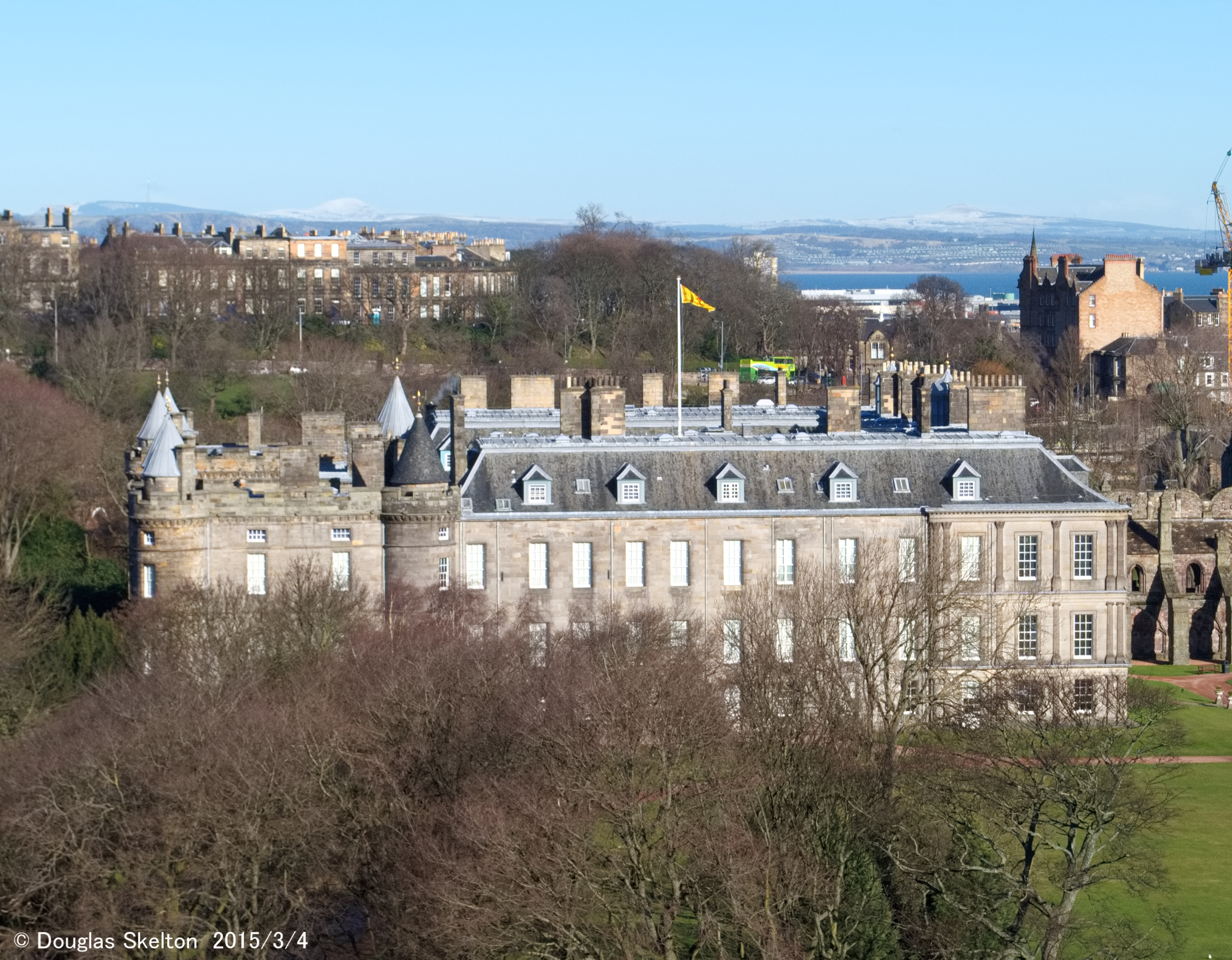
ON a dark and wet evening in March 1566, the six-month pregnant Mary was enjoying a private supper in an anteroom off her chambers on the second floor of Holyrood Palace. Bothwell and Huntly had been decoyed elsewhere; Moray was at that time en route from Newcastle with a company of soldiers.
It was – and is – a tiny space and must have been particularly cramped that night, for dining with Mary were her half-sister the Countess of Argyll, another half brother, Lord Robert Stewart, commendator of Holyrood, and a few other friends, including David Rizzio. The first sign of impending trouble came in the shape of Darnley who appeared through the tapestry that hid a private staircase leading to his own rooms directly below the Queen’s. He was filled with good humour and copious amounts of wine. His high spirits alone, considering his recent petulance, was enough to create suspicion.
Then the others began to arrive. First came Lord Ruthven, his body armoured, his face sallow and drawn through illness. But he was well enough to point to the Queen’s secretary at the far end of the table and say, ‘May it please your Majesty to let yon man Davie come forth of your presence, for he has been ower long here.’
It did not please Her Majesty to let Davie go anywhere and certainly not with an armed and armoured man. She asked what offence Rizzio had given and the red-eyed Ruthven replied, ‘Great offence.’
Mary ordered Ruthven to leave but he refused. She stood up and was grabbed by Darnley. Rizzio, smelling death in the air, drew his dagger and stepped behind his friend and Queen. Ruthven made a grab for him but when blocked by Mary’s companions he turned and spat angrily, ‘Lay no haunds on me, for I’ll no be handlit.’
And then the others arrived, including Lord George Douglas, Darnley’s uncle. If space was limited before their arrival it was now a veritable crowd scene. There was a struggle as Rizzio tried to evade the assassins during which every candle but one was knocked over. Lady Argyll grabbed the last and the grisly scene that followed was played out in the flickering of the solo flame. Shadows danced across the walls as the various voices merged in a cantata of death; Rizzio screaming, the gruff nobles rasping oaths, the Queen calling for order.
Mary tried to save her friend but one of the men pointed a pistol at her belly making her fear she was also a target. Rizzio tried once again to shield himself behind her but his fingers were prised away from her skirts and he was dragged away, struggling and screaming for help.
But no-one helped. No-one could.
Mary ordered the men to stop but they were on a mission – and had the permission of her husband, who stood behind his wife, his face flushed red from the wine and the excitement. As Rizzio was carried from the small room, Ruthven told Darnley to comfort his wife and assure her they meant her no harm. They must have known that such trauma could well have brought on a miscarriage, which would have played into Darnley’s hands, considering he had chosen to believe the child was not his. And should Mary die then he would, naturally, finally, become King.
David Rizzio suffered an horrific death. He dragged himself across the hallway, still trying to avoid the fate these men had decided for him. He screamed for help in French, appealing to Mary, ‘Save my life, madame, save my life!’
But that life was not for the saving.
The grim-faced men stalked him as he pulled himself along by his fingertips, lashing out with their daggers again and again, Rizzio’s lifeblood dripping to the wooden floor. They stabbed him 56 times that night, the final stroke coming from a dagger belonging to Darnley which was left buried to the hilt in the already lifeless body. Then he was tossed down the stairs and stripped before finally being tipped into a pauper’s grave in Holyrood Cemetery.
Lord Ruthven returned first to the Queen and collapsed into a chair, his hands wet with Rizzio’s blood. He asked for wine and the Queen, having already been told that her secretary was dead, turned her now cold gaze on him and apparently said, ‘I trust that God, who beholdeth all things from the high heaven, will avenge my wrongs and move that which shall be born of me to root out you and your treacherous posterity.’
Years later, her son James the Sixth did in fact root out the Ruthven line and wipe it from existence. But he had reasons of his own for doing so, including revenge for being abducted by the family as a youth and then, later, claiming they had tried to assassinate him.
Meanwhile, the assassins sought out Bothwell and Huntly, for they were seen as dangers to their plans, but they had already made their escape.
News of the murder and the threat to the Queen reached the city of Edinburgh and the Provost gathered a small army of townsfolk to march down the High Street to save her. However, the conspirators had foreseen this and the palace gates were closed against them. The mob demanded news of the Queen but only Darnley appeared at a window to reassure them. Meanwhile, a dagger was held at Mary and she was warned she would be ‘cut into collops’ if she made any sound. However, her husband did not convince the people and he angrily said to them, ‘Do you not know I am King? I command you to pass home to your house.’
Finally the people’s army dispersed.
Mary recognised her husband as the weakest link in the murder chain. Within hours of Rizzio’s death she was playing up to him, flattering him, telling him she believed dangerous men had used him, men who even now were probably plotting against him. Darnley, perhaps shocked at the ferocity of the attack on his former friend, fell for it.
The following day Mary received Moray, apparently unaware that he was a prime mover in the conspiracy. She smiled with him and drank with him and discussed the situation with him. She told the assassins there would be no action taken against them. But all the while she was plotting her escape – and along with Darnley stole out of Holyrood Palace in dead of night and galloped for Seton House near Tranent. After resting there, they headed for Dunbar where Bothwell and Huntly waited with a strong body of supporters.
Mary had played the game and played it well. By managing to bring Darnley over to her side she had put the fear of death into the principal conspirators. His support was vital to their plan and his being back at his wife’s side could only mean their lives were forfeit. Then, as news reached them of an 8000 strong army heading their way, discretion was deemed the better part of valour and they fled south. Even John Knox wisely took himself off to Ayr, where he continued to rant against the woman he saw as the royal whore. Moray, though, stayed where he was, secure in the knowledge that the Queen did not suspect his part in the plot.
With her husband back in the fold, at least for the moment, Mary declared that Rizzio’s murderers must be brought to justice. Two of the murderous band, Tom Scott, under-sheriff of Perth, and Henry Yair were caught, tried and beheaded.
The question remains over what Mary thought of Darnley. She knew he was a fickle, weak young man who could change sides as soon as things were not going his way. He was also a womanizer and stories of his infidelities were legion. And there was her unborn child to consider. Darnley had proved willing to risk a miscarriage, both during the Rizzio murder and the subsequent wild ride to Dunbar. He had parried her objections over the effect on the child in her womb with the statement that if she miscarried they could have more. He had been badly frightened then and desperate to get away from the men who had so recently been his co-conspirators. What were his plans for that child now?
These are questions she would have pondered as she went into confinement in Edinburgh Castle. She may have reached a somewhat desperate solution.
On June 19 1566, the Stuart claim to the throne of England was stronger by one baby boy, the sixth in the Stuart line to be named James. On hearing the news, Elizabeth made the famous statement, ‘The Queen of Scots is lighter of a fair son and I am of but barren stock.’
The not so proud father had, once again, taken the huff. He still believed the boy was not his but Rizzio’s and even the Queen’s assurance that the boy had been ‘begotten by none but you’ failed to reassure him. However, although Mary needed his acceptance to assure the succession she may have already formulated other plans for her husband, who was feeling increasingly isolated. The surviving nobles involved in the Rizzio plot felt betrayed by him while Mary’s supporters, principally the Lords Huntly and Bothwell, trusted him somewhat less than they could throw him, and they would have thrown him extremely far if they could.
Bothwell, in particular, was a danger. He was growing closer to the Queen than even Rizzio. But the Border lord was not as easy a target as the Italian. He was no courtier but a man of action; rough in his manner, quick in his temper, and skilful with his sword. When he was wounded during hand-to-hand combat with Border reiver Jock Elliot, Mary rushed from Jedburgh where she was overseeing a court of justice to his fortress at Hermitage to consult him on matters of state. The 80-mile round trip was completed in a single day, which shows how important he had become to her.
On the return journey she fell into a marsh, became seriously ill and almost died. Years later, with her life and ambitions in ruins, she looked back on the days she hovered on the edge of life in Jedburgh and wished she had succumbed to the fever.
Bothwell, steeped in the art of feud, was not a man to let Darnley’s actions go unpunished. Mary’s Stuart blood would not allow her to forgive her husband’s treachery, or let a continuing threat to the safety of her royal line go unchecked. Divorce was not an option thanks to her religion while an annulment may have cast doubt on the legitimacy of her son’s birth. Some other means had to be found to counter the threat posed by the Queen’s preening puppy of a husband.
Whether Darnley knew it or not, he was not long for this earth.
APOLOGISTS for Mary say she had no knowledge of the plot supposedly hatched by Bothwell, Huntly and others. Although it is likely they might have kept certain details from her to provide plausible deniability, it is probable she knew something was afoot.
Darnley was still smarting over being cold-shouldered in favour of Bothwell. This did not stop him fornicating his merry way through the bawds and harlots of Edinburgh and Stirling. Finally, in 1567, he came down with a pox. The disease ravaged his face and the vain Darnley took himself off to Glasgow’s Lennox Castle, which stood on the site now taken up by the city’s Royal Infirmary.
Mary arrived in the city to visit her ailing husband, possibly staying in Provand’s Lordship, the oldest building in the city. She was there to convince Darnley to return to Edinburgh. She told him there were plots against him and he could be better protected there. Darnley, never the sharpest arrow in the quiver, believed her but with the brutal slaying of Rizzio still fresh in his mind did not wish to return to Holyrood. For her part, Mary did not want her infant son open to whatever infection was rampaging through his father’s body. Instead, Darnley agreed to take up residence at Kirk O’ Field, a house near the city limits and dwarfed by the jagged edge of Salisbury Crags.
It was here that the royal couple was reconciled. Or so it seemed. As Darnley lay in his sick bed, his face covered by a cloth to hide the hideous eruptions, Mary sat by his side, ministering to him, reading to him, relaying court gossip. Finally, on Sunday February 9, she attended a wedding at Holyrood but did take the time to visit her husband accompanied by Bothwell, Huntly and other nobles. Decked in their finery, the men threw some dice and made pleasant conversation. But the stakes that night were higher than those on the gaming table. Finally, it came time for them to return to the revelries and Darnley, his face still swathed in the cotton mask, complained bitterly over being deserted. Mary assured him she would be back the following day and gave him a ring as a parting gift.
At two the following morning a huge explosion near the city walls awakened the city. The house at Kirk O’ Field was demolished after someone set off a store of gunpowder in the basement. Darnley and his valet were dead, their bodies being found a short distance away under a pear tree. Reports suggested they had both been throttled. Perhaps they had been alerted before the fuse was ignited. Perhaps they had tried to get away and been caught in the garden by the assassins. Or perhaps by some freak the explosion had killed them but left their bodies unmarked and thrown clear of the rubble, the strangulation charge concocted later.
Bothwell’s name was soon in the frame for the murder but there is no firm evidence linking him with the crime, even though a friend’s brother owned the house. Neither is there any firm evidence linking Mary to her husband’s death. Darnley had enemies on all sides and it is possible that one, or more, conspired to rid the country of him and his Queen. Perhaps the gunpowder stored in the cellar was supposed to go off when the Queen and her supporters were together on the night of the wedding.
However, only Mary and Bothwell seemed to benefit from Darnley’s death. Mary had removed one potential danger to herself and her son; Bothwell was rid of the man married to the woman he desired for himself. That Bothwell had some notions regarding the Queen there can be no doubt, although whether they were of a romantic or a self-serving nature is not known. Rumours that the two had been lovers were rife and although Darnley’s death did remove one obstacle to their union, it also threw up another one – but one that Mary, in her customary arrogance, ignored.
After a two-day period of mourning, she and Bothwell left the city and traveled to Seton House, where they played golf and organised archery contests. The people, though, were unhappy with the way matters were progressing. Whereas they had formerly taken their young queen to their heart – with some reservations regarding her religion, certainly – they now turned against her. Knox’s accusations over her sexual abandon were being openly repeated in the streets and, in a bid to soothe the unfuriated morals of the masses, pressure was brought to bear on Mary to instigate some sort of inquiry into Bothwell’s alleged complicity in Darnley’s murder. Reluctantly, she agreed but when the time came Bothwell filled Edinburgh with his own men, no witnesses were called and the swashbuckling Borderer challenged anyone who thought him guilty to trial by combat. He was, unsurprisingly, acquitted.
Bothwell wanted to marry Mary but he had one problem – he already had a wife. However, she was quite happy to be rid of him, filing for divorce on the grounds of a convenient infidelity with a serving lass. The way now lay open for Mary Stuart and James Hepburn to be together, despite the ever-growing tide of public opposition. But still Mary hesitated.
Finally Bothwell, man of action that he was, took matters into his own hands by apparently abducting her at Bridge of Almond near Edinburgh and carrying her off to the stronghold at Dunbar, the castle to which she and Darnley fled following Rizzio’s murder. How willing Mary was in this turn of events is unknown, but she did prevent her own protectors from taking any action.
At Dunbar the relationship reached a physical level, although whether it was rape or consensual depends on your view of the couple in question. In May 1567 Bothwell obtained his divorce and Mary made him Duke of Orkney. She told her council she wished no action taken against him for the abduction. In fact, she was going to marry him.
The news shattered what support she had. To begin with, the ceremony was a Protestant one and that angered her own church. Her allies in France and Spain were also against the match. Bothwell’s enemies wanted to separate the couple while the common people still believed they had conspired to murder Darnley. Finally, while the now married couple was at Borthwick Castle, a force of 1000 men arrived to arrest Bothwell. The canny Borderer managed to escape and left Mary to deal with the posse before she slipped past them disguised as a boy. Reuniting with her new husband, they took refuge in the all-but-impregnable Dunbar Castle, with which Mary was by now becoming very familiar.
With her lords forming a confederation and now in open rebellion, Mary and Bothwell raised an army to defend her crown and their marriage. The two forces met at Carberry Hill, near Musselburgh, and very close to the site of the battle of Pinkie Cleugh which had led to the child Mary being spirited from the country all those years before. However, there was to be no blood shed on this occasion. The confederate lords demanded that Mary give Bothwell up to them. Bothwell, as was his habit, challenged anyone who thought they were hard enough to single combat but the first challenger to come ahead was dismissed for not being of a lofty enough position to trade blows with the new Duke of Orkney. As the wrangling continued, Mary’s army grew bored and began to desert.
Finally, Bothwell realised no good was going to come of this continual dickering so he suggested they return to Dunbar. But Mary, who perhaps now saw there was no future with the maverick noble, opted to stay with the confederate lords. Again, it could be argued that the spirit of self-preservation had risen in her breast and she was happy to throw her new lover to the wolves. Or perhaps she felt it advisable that he get away to raise another army. Whatever the case, the lovers were parted on that field and never saw one another again. He went into exile and ended up forgotten but not gone in a Norwegian prison, where he eventually succumbed to a gangrenous wound.
(That end and its aftermath is something I may return to in another post)
IF Mary thought she would fare well with the Confederate Lords she was sadly mistaken. By giving herself into their hands she had effectively destroyed everything for which she had worked – and possibly killed – to keep. She was imprisoned and forced to abdicate in favour of her son, the infant James. Her half-brother Moray, proving to be something of a survivor in Scottish politics, was once again named Regent. However, his luck ran out in 1570 when he was shot in the stomach as he rode through Linlithgow.
But Mary did not submit willingly to her fall from grace. Despite miscarrying twins, her charms proved useful in luring a young man to aid her in a dramatic escape from imprisonment at Loch Leven Castle. She then led her army of loyal Highland supporters against Moray’s force at Langside in Glasgow. The resulting defeat forced a despondent Mary to seek refuge with her cousin Elizabeth in England. However, suspicion was strong that not only was she involved in Darnley’s murder, she was also at the centre of various plots to take the place of the English queen. Letters had been found, allegedly written by Mary while she stayed in Glasgow, which proved she was involved in the murder plot. The originals were never actually seen, what was produced were transcripts or copies, but the so-called Casket Letters, named after the silver box in which they were found, were generally accepted at the time as proof of her guilt. She had also never renounced her claim to the English throne and more letters were supposedly uncovered during her nineteen years of captivity that alleged she was at the centre of rebellious plots. Her attitude at her trial, that she could be judged only by God and not by any court of Man, failed to go down well in a court filled with men who thought they were somewhere just above God in the pecking order.
Elizabeth was not keen to order the death of her cousin, perhaps because she knew some of the evidence was fabricated. Finally, though, she saw to it that the execution warrant was hidden among other innocent papers so it could be signed as if by mistake. The farcical pretence played out, Mary Stuart was beheaded at Fotheringay on February 8, 1587.
The story of Mary, Queen of Scots, is filled with mysteries. There was so much intrigue but so few records that it is impossible to say with any certainty who was responsible for what. Mary herself cuts a highly romantic figure and even today it is easy to dismiss much of what happened as a conspiracy by a male-dominated society. Mary, though, must shoulder much of the blame for the blood spilled during her few years in Scotland. She was arrogant and ambitious. She saw the Scottish crown as third rate compared to that of France and England. She used men just easily as they were prepared to use her. Despite the change of spelling she was a Stewart and throughout their history, from their beginnings in Ayrshire to their final days on the throne, they put themselves first and everything else second. Nothing must get in the way of their right to rule – not the people, not the nobles, not religion. Mary often acted solely to protect her own powerbase and that of her son, who inherited much of his mother’s steely determination.
Or did he?
For according to legend, Mary’s son died soon after birth and was substituted with another, the newly-born second son of the Countess of Mar, to whose care the infant had been admitted while Mary went off to plan her husband’s downfall. It is said the adult James the Sixth bore little likeness to earlier Stewarts, or even his father but did bear a strong resemblance to John, the Second Earl of Mar, with whom he shared a particular connection. Was this a family resemblance and a brotherly bond?
It is of course, only legend. But in 1830, they say, following a fire in the rooms used by Mary in Edinburgh Castle, a small coffin was found behind a wall. There were bones inside the tiny casket, the bones of a child only one or two months old. And those bones were wrapped in rich silk. And that rich silk was embroidered with a letter, either the letter J or I (I is used in Latin for J).
Was this the final resting-place of Mary’s boy child, dead in infancy?
And did a changeling take his place on the throne of Scotland and later England?